Comparing CFRP Composites: Tensile vs Compressive Modulus
SEP 17, 20259 MIN READ
Generate Your Research Report Instantly with AI Agent
Patsnap Eureka helps you evaluate technical feasibility & market potential.
CFRP Composites Background and Research Objectives
Carbon Fiber Reinforced Polymer (CFRP) composites have emerged as revolutionary materials in various high-performance industries over the past five decades. Initially developed for aerospace applications in the 1960s, these advanced composites have progressively expanded into automotive, marine, sporting goods, and civil infrastructure sectors due to their exceptional strength-to-weight ratio and design flexibility.
The fundamental structure of CFRP composites consists of high-strength carbon fibers embedded within a polymer matrix, typically epoxy, creating a synergistic material system that leverages the directional strength of fibers while overcoming their individual limitations. This combination results in materials that exhibit superior mechanical properties compared to traditional engineering materials such as steel and aluminum, particularly in terms of specific strength and stiffness.
A critical aspect of CFRP performance that warrants deeper investigation is the discrepancy between tensile and compressive moduli. While these materials demonstrate exceptional performance under tension, their behavior under compression often differs significantly, creating challenges for engineers and designers who must account for these differences in structural applications. This phenomenon stems from the anisotropic nature of composites and the complex micromechanical interactions between fibers and matrix under different loading conditions.
Recent technological advancements in manufacturing processes, including automated fiber placement, out-of-autoclave curing, and thermoplastic composites, have further expanded the potential applications of CFRP materials. However, the fundamental understanding of mechanical property differences remains crucial for optimizing design and performance.
The global CFRP market has been experiencing steady growth, projected to reach approximately $38.7 billion by 2026, with a CAGR of 10.6% from 2021. This growth is driven by increasing demands for lightweight solutions in transportation sectors focused on fuel efficiency and emissions reduction, as well as expanding applications in renewable energy infrastructure such as wind turbine blades.
This research aims to comprehensively analyze the differences between tensile and compressive moduli in CFRP composites, investigating the underlying mechanisms responsible for these variations. The primary objectives include: quantifying the typical disparities across various fiber types and architectures; identifying the micromechanical factors influencing compressive behavior; evaluating existing predictive models for accuracy in representing both tensile and compressive properties; and developing improved design guidelines that account for these differences in structural applications.
By addressing these objectives, this research seeks to enhance the fundamental understanding of CFRP mechanical behavior and provide practical insights for engineers to optimize composite structures for applications where both tensile and compressive loading conditions are significant factors.
The fundamental structure of CFRP composites consists of high-strength carbon fibers embedded within a polymer matrix, typically epoxy, creating a synergistic material system that leverages the directional strength of fibers while overcoming their individual limitations. This combination results in materials that exhibit superior mechanical properties compared to traditional engineering materials such as steel and aluminum, particularly in terms of specific strength and stiffness.
A critical aspect of CFRP performance that warrants deeper investigation is the discrepancy between tensile and compressive moduli. While these materials demonstrate exceptional performance under tension, their behavior under compression often differs significantly, creating challenges for engineers and designers who must account for these differences in structural applications. This phenomenon stems from the anisotropic nature of composites and the complex micromechanical interactions between fibers and matrix under different loading conditions.
Recent technological advancements in manufacturing processes, including automated fiber placement, out-of-autoclave curing, and thermoplastic composites, have further expanded the potential applications of CFRP materials. However, the fundamental understanding of mechanical property differences remains crucial for optimizing design and performance.
The global CFRP market has been experiencing steady growth, projected to reach approximately $38.7 billion by 2026, with a CAGR of 10.6% from 2021. This growth is driven by increasing demands for lightweight solutions in transportation sectors focused on fuel efficiency and emissions reduction, as well as expanding applications in renewable energy infrastructure such as wind turbine blades.
This research aims to comprehensively analyze the differences between tensile and compressive moduli in CFRP composites, investigating the underlying mechanisms responsible for these variations. The primary objectives include: quantifying the typical disparities across various fiber types and architectures; identifying the micromechanical factors influencing compressive behavior; evaluating existing predictive models for accuracy in representing both tensile and compressive properties; and developing improved design guidelines that account for these differences in structural applications.
By addressing these objectives, this research seeks to enhance the fundamental understanding of CFRP mechanical behavior and provide practical insights for engineers to optimize composite structures for applications where both tensile and compressive loading conditions are significant factors.
Market Applications and Demand Analysis for CFRP Materials
The global Carbon Fiber Reinforced Polymer (CFRP) market continues to experience robust growth, driven primarily by increasing demand across aerospace, automotive, wind energy, and sporting goods sectors. Current market valuations exceed $25 billion, with projections indicating a compound annual growth rate between 7-10% through 2028, reflecting the material's expanding applications across industries.
Aerospace remains the dominant application sector for CFRP materials, accounting for approximately 30% of total market consumption. The critical difference between tensile and compressive modulus properties directly impacts aircraft component design and safety factors. Commercial aircraft manufacturers have increased CFRP content significantly, with modern aircraft like the Boeing 787 and Airbus A350 incorporating over 50% composite materials by weight, primarily due to superior tensile properties.
The automotive industry represents the fastest-growing market segment for CFRP applications, with luxury and performance vehicles leading adoption. This sector particularly values the tensile-compressive modulus relationship for structural components subject to complex loading conditions. BMW's i-Series vehicles pioneered mass-produced CFRP passenger cells, while Formula 1 racing teams extensively utilize these materials for their exceptional strength-to-weight ratio despite the challenges in managing compressive loads.
Wind energy generation has emerged as another significant market driver, with turbine blade manufacturers requiring materials that can withstand both tensile forces on the downwind side and compressive forces on the upwind side during operation. The differential between tensile and compressive modulus directly influences blade design parameters and service life predictions.
Regional market analysis reveals North America and Europe as established markets with sophisticated applications requiring precise understanding of both tensile and compressive properties. Meanwhile, the Asia-Pacific region, particularly China and Japan, shows the highest growth rates as manufacturing capabilities mature and domestic demand increases across multiple sectors.
Market research indicates a growing premium for CFRP materials with balanced tensile-compressive modulus ratios, with manufacturers willing to pay 15-20% more for composites demonstrating less than 10% difference between these properties. This trend is particularly evident in high-performance sporting goods and medical device applications where predictable mechanical behavior under varied loading conditions is essential.
Industry surveys reveal that over 70% of design engineers consider the tensile-compressive modulus relationship a critical selection criterion when specifying CFRP materials, highlighting the market's increasing sophistication and technical requirements beyond simple weight reduction metrics.
Aerospace remains the dominant application sector for CFRP materials, accounting for approximately 30% of total market consumption. The critical difference between tensile and compressive modulus properties directly impacts aircraft component design and safety factors. Commercial aircraft manufacturers have increased CFRP content significantly, with modern aircraft like the Boeing 787 and Airbus A350 incorporating over 50% composite materials by weight, primarily due to superior tensile properties.
The automotive industry represents the fastest-growing market segment for CFRP applications, with luxury and performance vehicles leading adoption. This sector particularly values the tensile-compressive modulus relationship for structural components subject to complex loading conditions. BMW's i-Series vehicles pioneered mass-produced CFRP passenger cells, while Formula 1 racing teams extensively utilize these materials for their exceptional strength-to-weight ratio despite the challenges in managing compressive loads.
Wind energy generation has emerged as another significant market driver, with turbine blade manufacturers requiring materials that can withstand both tensile forces on the downwind side and compressive forces on the upwind side during operation. The differential between tensile and compressive modulus directly influences blade design parameters and service life predictions.
Regional market analysis reveals North America and Europe as established markets with sophisticated applications requiring precise understanding of both tensile and compressive properties. Meanwhile, the Asia-Pacific region, particularly China and Japan, shows the highest growth rates as manufacturing capabilities mature and domestic demand increases across multiple sectors.
Market research indicates a growing premium for CFRP materials with balanced tensile-compressive modulus ratios, with manufacturers willing to pay 15-20% more for composites demonstrating less than 10% difference between these properties. This trend is particularly evident in high-performance sporting goods and medical device applications where predictable mechanical behavior under varied loading conditions is essential.
Industry surveys reveal that over 70% of design engineers consider the tensile-compressive modulus relationship a critical selection criterion when specifying CFRP materials, highlighting the market's increasing sophistication and technical requirements beyond simple weight reduction metrics.
Current Challenges in Tensile-Compressive Property Disparities
The disparity between tensile and compressive moduli in Carbon Fiber Reinforced Polymer (CFRP) composites presents significant challenges for engineers and materials scientists. This property mismatch, often ranging from 10% to 30% depending on fiber type and manufacturing processes, creates fundamental design limitations that impact structural integrity and performance prediction. The compressive modulus typically measures lower than the tensile modulus due to microbuckling phenomena at the fiber level, creating a complex mechanical behavior profile that traditional isotropic material models fail to adequately capture.
Manufacturing inconsistencies further exacerbate these challenges. Fiber misalignment, which may seem minor during production, disproportionately affects compressive properties compared to tensile ones. Even slight waviness in fiber orientation can reduce compressive strength by up to 50%, while having minimal impact on tensile properties. This sensitivity creates significant quality control challenges in industrial-scale production environments where perfect alignment is practically unattainable.
Testing methodologies for accurately measuring these disparities remain problematic. While standardized protocols exist for tensile property characterization (such as ASTM D3039), compressive testing suffers from fixture-induced effects and premature failure modes that can skew results. The absence of universally accepted testing standards specifically addressing the tensile-compressive disparity hampers cross-industry comparisons and reliable data collection.
Computational modeling faces equally daunting challenges. Current finite element models struggle to simultaneously account for both tensile and compressive behaviors within the same simulation framework. Most commercial software packages require separate material cards or complex user-defined subroutines to address this duality, increasing computational complexity and reducing solution efficiency. The multi-scale nature of the problem—spanning from fiber-matrix interactions to macroscopic structural behavior—further complicates accurate numerical representation.
Design engineers must contend with these disparities through conservative safety factors, often leading to overdesigned structures that negate the weight advantages of composite materials. The aerospace industry, where weight efficiency is paramount, has developed proprietary knockdown factors based on extensive testing, but these remain closely guarded intellectual property and are not readily available to broader engineering communities.
Environmental factors introduce additional complexity, as temperature and moisture exposure can affect tensile and compressive properties differently. Hygrothermal aging typically degrades compressive properties more severely than tensile ones, creating time-dependent property disparities that must be accounted for throughout the service life of composite structures.
Manufacturing inconsistencies further exacerbate these challenges. Fiber misalignment, which may seem minor during production, disproportionately affects compressive properties compared to tensile ones. Even slight waviness in fiber orientation can reduce compressive strength by up to 50%, while having minimal impact on tensile properties. This sensitivity creates significant quality control challenges in industrial-scale production environments where perfect alignment is practically unattainable.
Testing methodologies for accurately measuring these disparities remain problematic. While standardized protocols exist for tensile property characterization (such as ASTM D3039), compressive testing suffers from fixture-induced effects and premature failure modes that can skew results. The absence of universally accepted testing standards specifically addressing the tensile-compressive disparity hampers cross-industry comparisons and reliable data collection.
Computational modeling faces equally daunting challenges. Current finite element models struggle to simultaneously account for both tensile and compressive behaviors within the same simulation framework. Most commercial software packages require separate material cards or complex user-defined subroutines to address this duality, increasing computational complexity and reducing solution efficiency. The multi-scale nature of the problem—spanning from fiber-matrix interactions to macroscopic structural behavior—further complicates accurate numerical representation.
Design engineers must contend with these disparities through conservative safety factors, often leading to overdesigned structures that negate the weight advantages of composite materials. The aerospace industry, where weight efficiency is paramount, has developed proprietary knockdown factors based on extensive testing, but these remain closely guarded intellectual property and are not readily available to broader engineering communities.
Environmental factors introduce additional complexity, as temperature and moisture exposure can affect tensile and compressive properties differently. Hygrothermal aging typically degrades compressive properties more severely than tensile ones, creating time-dependent property disparities that must be accounted for throughout the service life of composite structures.
Existing Methodologies for Modulus Measurement and Comparison
01 Manufacturing methods to improve tensile and compressive modulus of CFRP
Various manufacturing techniques can enhance the mechanical properties of Carbon Fiber Reinforced Polymer (CFRP) composites. These include specialized layup methods, curing processes, and fiber orientation control that significantly impact the tensile and compressive modulus. Advanced manufacturing approaches like automated fiber placement and controlled resin infusion can create more uniform composites with improved load-bearing capabilities in both tension and compression.- Manufacturing methods to improve tensile and compressive modulus of CFRP: Various manufacturing techniques can be employed to enhance the tensile and compressive modulus of Carbon Fiber Reinforced Polymer (CFRP) composites. These include specialized layup methods, curing processes, and fiber orientation control. By optimizing these manufacturing parameters, the mechanical properties of CFRP composites can be significantly improved, resulting in higher strength-to-weight ratios and better performance under load conditions.
- Matrix modification for enhanced mechanical properties: The polymer matrix in CFRP composites can be modified to improve tensile and compressive modulus. This includes incorporating nanomaterials, using specialized resins, or adding reinforcing agents to the matrix. These modifications can enhance the load transfer between fibers and matrix, increase the overall stiffness, and improve resistance to microcracking under compression, resulting in superior mechanical performance of the composite material.
- Fiber architecture and orientation effects on modulus: The arrangement and orientation of carbon fibers within CFRP composites significantly impact their tensile and compressive modulus. Unidirectional fibers provide maximum stiffness in the fiber direction, while multi-directional layouts offer more balanced properties. Techniques such as fiber weaving patterns, ply stacking sequences, and hybrid fiber systems can be optimized to achieve desired mechanical properties for specific loading conditions.
- Testing and characterization methods for CFRP modulus: Various testing methodologies are employed to accurately measure and characterize the tensile and compressive modulus of CFRP composites. These include standardized test procedures, non-destructive evaluation techniques, and advanced instrumentation for strain measurement. Proper characterization is essential for quality control, material development, and ensuring that composites meet design specifications for structural applications.
- Environmental and loading condition effects on CFRP modulus: The tensile and compressive modulus of CFRP composites can be significantly affected by environmental conditions and loading scenarios. Factors such as temperature, humidity, UV exposure, and cyclic loading can alter the mechanical properties over time. Understanding these effects is crucial for designing CFRP structures with appropriate safety factors and predicting long-term performance in various service environments.
02 Fiber architecture and orientation effects on mechanical properties
The arrangement and orientation of carbon fibers within the composite matrix critically determine the tensile and compressive modulus of CFRP. Unidirectional fibers provide maximum stiffness in the fiber direction, while multi-directional or woven architectures offer more balanced properties. Fiber volume fraction, alignment precision, and interlaminar interactions all contribute to the overall mechanical performance of the composite structure.Expand Specific Solutions03 Matrix modification for enhanced mechanical performance
The polymer matrix in CFRP composites can be modified to improve both tensile and compressive modulus. Incorporating nanomaterials, toughening agents, or specialized additives can enhance the load transfer between fibers and matrix. Cross-linking density optimization and the use of hybrid resin systems can significantly improve the compression resistance while maintaining excellent tensile properties.Expand Specific Solutions04 Testing and characterization methods for CFRP mechanical properties
Accurate measurement of tensile and compressive modulus in CFRP composites requires specialized testing methodologies. Standardized procedures for specimen preparation, loading conditions, and data analysis ensure reliable property determination. Advanced characterization techniques including digital image correlation, acoustic emission monitoring, and in-situ microscopy provide deeper insights into deformation mechanisms and failure modes under different loading conditions.Expand Specific Solutions05 Environmental factors affecting CFRP modulus stability
The tensile and compressive modulus of CFRP composites can be significantly affected by environmental conditions. Moisture absorption, temperature fluctuations, UV exposure, and chemical contact can all degrade mechanical properties over time. Protective coatings, specialized matrix formulations, and environmental barrier systems can be employed to maintain the structural integrity and mechanical performance of CFRP components under challenging service conditions.Expand Specific Solutions
Leading Manufacturers and Research Institutions in CFRP Industry
The carbon fiber reinforced polymer (CFRP) composites market is currently in a growth phase, with increasing adoption across aerospace, automotive, and wind energy sectors. The global CFRP market is projected to reach approximately $38 billion by 2027, growing at a CAGR of around 10%. Technologically, the understanding of tensile vs. compressive modulus properties remains critical for advanced applications. Leading players include Toray Industries and Hexcel Corporation, who have established strong R&D capabilities in high-performance aerospace-grade composites. DuPont and Mitsubishi Heavy Industries are advancing automotive applications, while Boeing and Airbus drive innovation through demanding aerospace requirements. Academic institutions like Xi'an Jiaotong University and Southeast University are contributing significant research on improving compressive properties, which traditionally lag behind tensile performance in CFRP materials.
Toray Industries, Inc.
Technical Solution: Toray has developed advanced T800 and T1100 carbon fiber series specifically engineered to address the tensile-compressive modulus gap in CFRP composites. Their proprietary technology involves precise fiber alignment control and specialized sizing agents that enhance the interfacial bonding between carbon fibers and matrix materials. Toray's research has demonstrated that their high-performance CFRP materials can achieve tensile modulus values exceeding 230 GPa while maintaining compressive modulus at approximately 70-80% of the tensile value. Their latest innovation includes nano-modified resin systems that improve the compressive performance by enhancing the matrix's ability to prevent fiber microbuckling under compressive loads. Toray has also pioneered hybrid fabric architectures that strategically combine fibers with different properties to optimize both tensile and compressive performance in critical structural applications.
Strengths: Industry-leading fiber technology with exceptional tensile properties and relatively good compressive-to-tensile modulus ratio. Extensive manufacturing capacity and quality control systems ensure consistent performance. Weaknesses: Higher cost compared to standard CFRP solutions, and the compressive modulus still remains significantly lower than tensile modulus despite improvements.
DuPont de Nemours, Inc.
Technical Solution: DuPont has developed innovative approaches to address the tensile-compressive modulus gap in CFRP composites through their advanced materials science expertise. Their technology focuses on hybrid composite systems that strategically combine carbon fibers with other reinforcement materials like aramid (Kevlar®) to balance mechanical properties. DuPont's research has shown that these hybrid systems can reduce the typical 30-40% difference between tensile and compressive modulus to approximately 20-25% while maintaining overall performance. Their proprietary sizing and surface treatment technologies enhance the fiber-matrix interface, which is critical for compressive load transfer. DuPont has also pioneered specialized thermoplastic matrix systems that provide improved damage tolerance and compressive performance compared to traditional thermoset systems. Their latest innovation includes nano-modified resin systems that create hierarchical reinforcement structures within the composite, effectively constraining fiber microbuckling under compressive loads while maintaining excellent tensile properties.
Strengths: Extensive materials science expertise across multiple polymer and fiber technologies enables unique hybrid solutions. Strong fundamental understanding of structure-property relationships in composite materials. Weaknesses: Hybrid approaches may sacrifice some absolute tensile performance to achieve better balance. Solutions often require specialized processing techniques that may limit manufacturing scalability.
Key Research Findings on Tensile-Compressive Behavior Differences
Bond Inspection System and Method
PatentActiveUS20160320350A1
Innovation
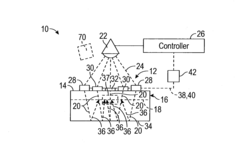
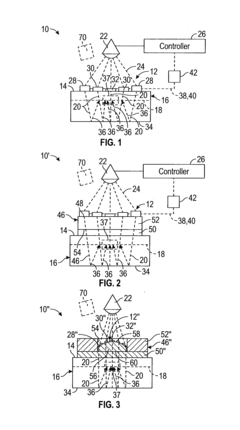
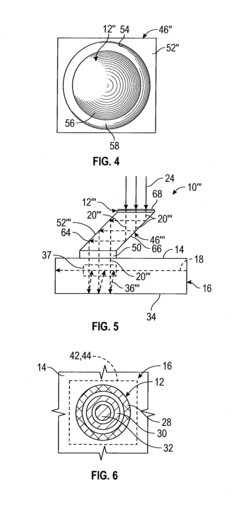
- A compact bond inspection system using a reactive material that creates compression waves when activated by a lower-energy source, such as a 10 joule laser, positioned in a predetermined pattern to generate tension waves that reflect and combine simultaneously at the bondline, reducing the need for high-power equipment and enabling on-site inspections.
Carbon fiber and reinforcing fabric
PatentInactiveJP2009256833A
Innovation
- The development of a carbon fiber bundle with specific crystallite size, strand tensile strength, and Weibull shape factor, integrated into a reinforcing fabric with controlled microvoids and surface roughness, to enhance mechanical properties and reduce crimp-induced stress concentration.


Standards and Testing Protocols for CFRP Mechanical Properties
The standardization of testing methods for Carbon Fiber Reinforced Polymer (CFRP) composites is essential for ensuring reliable and comparable mechanical property data across different laboratories and manufacturers. Several international organizations have developed comprehensive standards specifically for testing CFRP materials, with ASTM International and ISO being the most prominent contributors.
ASTM D3039 serves as the primary standard for determining tensile properties of polymer matrix composite materials, including CFRP. This protocol specifies specimen dimensions, preparation procedures, testing speeds, and data analysis methods. For tensile modulus measurements, the standard recommends using strain gauges or extensometers to accurately capture the material's response under tension.
Complementing this, ASTM D6641 addresses the compressive properties of composite materials using a combined loading compression test method. This standard is particularly relevant when comparing tensile and compressive moduli, as it provides guidelines for specimen preparation that minimize buckling effects—a critical consideration in compression testing of anisotropic materials like CFRP.
ISO 527 series, particularly ISO 527-4 and ISO 527-5, offers parallel standards for tensile property determination of fiber-reinforced plastic composites. These standards provide specific guidance for unidirectional and multidirectional fiber arrangements, which is crucial when evaluating the directional differences between tensile and compressive moduli.
For compressive testing, ISO 14126 outlines methods for determining compressive properties in the in-plane direction. This standard addresses the challenges specific to compression testing, including end crushing and global buckling, which can significantly affect the measured compressive modulus values.
Beyond these fundamental standards, specialized protocols exist for specific applications. SACMA SRM 1R-94 provides industry-specific guidelines for tensile properties of composite materials used in aerospace applications, while SACMA SRM 1-88 addresses compressive properties for the same sector.
Testing equipment calibration standards, such as ASTM E4 for force verification and ASTM E83 for extensometer verification, ensure measurement accuracy across different testing facilities. These supporting standards are essential when comparing tensile and compressive moduli, as they help minimize systematic errors in the measurement chain.
Recent developments in digital image correlation (DIC) techniques have led to emerging standards like ASTM E2208, which provides guidelines for strain measurement using optical methods. These advanced techniques offer advantages when comparing tensile and compressive behavior, as they allow for full-field strain mapping without mechanical interference with the specimen.
ASTM D3039 serves as the primary standard for determining tensile properties of polymer matrix composite materials, including CFRP. This protocol specifies specimen dimensions, preparation procedures, testing speeds, and data analysis methods. For tensile modulus measurements, the standard recommends using strain gauges or extensometers to accurately capture the material's response under tension.
Complementing this, ASTM D6641 addresses the compressive properties of composite materials using a combined loading compression test method. This standard is particularly relevant when comparing tensile and compressive moduli, as it provides guidelines for specimen preparation that minimize buckling effects—a critical consideration in compression testing of anisotropic materials like CFRP.
ISO 527 series, particularly ISO 527-4 and ISO 527-5, offers parallel standards for tensile property determination of fiber-reinforced plastic composites. These standards provide specific guidance for unidirectional and multidirectional fiber arrangements, which is crucial when evaluating the directional differences between tensile and compressive moduli.
For compressive testing, ISO 14126 outlines methods for determining compressive properties in the in-plane direction. This standard addresses the challenges specific to compression testing, including end crushing and global buckling, which can significantly affect the measured compressive modulus values.
Beyond these fundamental standards, specialized protocols exist for specific applications. SACMA SRM 1R-94 provides industry-specific guidelines for tensile properties of composite materials used in aerospace applications, while SACMA SRM 1-88 addresses compressive properties for the same sector.
Testing equipment calibration standards, such as ASTM E4 for force verification and ASTM E83 for extensometer verification, ensure measurement accuracy across different testing facilities. These supporting standards are essential when comparing tensile and compressive moduli, as they help minimize systematic errors in the measurement chain.
Recent developments in digital image correlation (DIC) techniques have led to emerging standards like ASTM E2208, which provides guidelines for strain measurement using optical methods. These advanced techniques offer advantages when comparing tensile and compressive behavior, as they allow for full-field strain mapping without mechanical interference with the specimen.
Microstructural Factors Affecting Modulus Anisotropy
The microstructural architecture of Carbon Fiber Reinforced Polymer (CFRP) composites plays a critical role in determining the anisotropic behavior observed between tensile and compressive moduli. At the fundamental level, carbon fibers exhibit inherent anisotropy due to their graphitic crystal structure, where carbon atoms are arranged in planar hexagonal networks with strong covalent bonds within planes but weaker van der Waals forces between planes.
Fiber orientation distribution represents perhaps the most significant microstructural factor affecting modulus anisotropy. In unidirectional composites, fibers aligned parallel to the loading direction provide maximum stiffness in tension, while misalignment angles as small as 1-2° can dramatically reduce compressive modulus due to microbuckling mechanisms. This sensitivity to fiber misalignment explains why compressive modulus values typically measure 10-20% lower than tensile moduli in the same material system.
Interfacial properties between fiber and matrix significantly influence the load transfer efficiency across different loading modes. Strong interfacial bonding enhances tensile modulus by enabling effective stress transfer, while in compression, the interface must resist fiber microbuckling and kinking. Research indicates that surface treatments modifying fiber-matrix adhesion can affect tensile and compressive moduli differently, with some treatments improving tensile properties while potentially reducing compressive performance.
Matrix properties contribute substantially to modulus anisotropy, particularly in compression where the matrix provides critical lateral support to fibers. Higher matrix modulus and yield strength correlate with improved compressive modulus retention. Studies have demonstrated that increasing matrix crosslink density can narrow the gap between tensile and compressive moduli by enhancing resistance to localized deformation under compressive loading.
Void content and distribution represent another crucial factor. Voids act as stress concentrators that disproportionately affect compressive properties compared to tensile ones. Microscopic analysis reveals that voids located at fiber-matrix interfaces or between plies can reduce compressive modulus by up to 30% while causing only minimal reduction in tensile modulus at equivalent void fractions.
Fiber waviness, characterized by in-plane or out-of-plane undulations, significantly impacts modulus anisotropy. Quantitative models show that waviness parameters, including amplitude and wavelength, correlate directly with reductions in compressive modulus while having less pronounced effects on tensile properties. Manufacturing processes inducing higher degrees of fiber waviness typically produce composites with greater disparities between tensile and compressive performance.
Fiber orientation distribution represents perhaps the most significant microstructural factor affecting modulus anisotropy. In unidirectional composites, fibers aligned parallel to the loading direction provide maximum stiffness in tension, while misalignment angles as small as 1-2° can dramatically reduce compressive modulus due to microbuckling mechanisms. This sensitivity to fiber misalignment explains why compressive modulus values typically measure 10-20% lower than tensile moduli in the same material system.
Interfacial properties between fiber and matrix significantly influence the load transfer efficiency across different loading modes. Strong interfacial bonding enhances tensile modulus by enabling effective stress transfer, while in compression, the interface must resist fiber microbuckling and kinking. Research indicates that surface treatments modifying fiber-matrix adhesion can affect tensile and compressive moduli differently, with some treatments improving tensile properties while potentially reducing compressive performance.
Matrix properties contribute substantially to modulus anisotropy, particularly in compression where the matrix provides critical lateral support to fibers. Higher matrix modulus and yield strength correlate with improved compressive modulus retention. Studies have demonstrated that increasing matrix crosslink density can narrow the gap between tensile and compressive moduli by enhancing resistance to localized deformation under compressive loading.
Void content and distribution represent another crucial factor. Voids act as stress concentrators that disproportionately affect compressive properties compared to tensile ones. Microscopic analysis reveals that voids located at fiber-matrix interfaces or between plies can reduce compressive modulus by up to 30% while causing only minimal reduction in tensile modulus at equivalent void fractions.
Fiber waviness, characterized by in-plane or out-of-plane undulations, significantly impacts modulus anisotropy. Quantitative models show that waviness parameters, including amplitude and wavelength, correlate directly with reductions in compressive modulus while having less pronounced effects on tensile properties. Manufacturing processes inducing higher degrees of fiber waviness typically produce composites with greater disparities between tensile and compressive performance.
Unlock deeper insights with Patsnap Eureka Quick Research — get a full tech report to explore trends and direct your research. Try now!
Generate Your Research Report Instantly with AI Agent
Supercharge your innovation with Patsnap Eureka AI Agent Platform!