

Evaluating CFRP Recycling Methods: Efficiency and Cost
SEP 17, 20259 MIN READ
Generate Your Research Report Instantly with AI Agent
PatSnap Eureka helps you evaluate technical feasibility & market potential.
CFRP Recycling Technology Background and Objectives
Carbon Fiber Reinforced Polymer (CFRP) composites have emerged as revolutionary materials in various high-performance industries since their commercial introduction in the 1960s. Initially developed for aerospace and defense applications, these lightweight yet exceptionally strong materials have transformed engineering capabilities across automotive, wind energy, sporting goods, and construction sectors. The evolution of CFRP technology has been characterized by continuous improvements in manufacturing processes, fiber quality, and matrix systems, leading to enhanced performance characteristics and expanded applications.
The global CFRP market has experienced substantial growth, with annual production exceeding 150,000 tons and market value surpassing $30 billion. However, this growth has created a significant environmental challenge: the accumulation of end-of-life CFRP waste. With carbon fiber production consuming approximately 165-360 MJ/kg of energy—ten times more energy-intensive than steel manufacturing—the environmental imperative for recycling is clear.
Current recycling rates for CFRP remain alarmingly low at less than 15% globally, with the majority of waste directed to landfills or incineration. This represents not only an environmental concern but also a substantial economic loss, as virgin carbon fiber typically costs $20-40 per kilogram. The technical challenge lies in the inherent complexity of CFRP materials, which consist of carbon fibers embedded in thermoset polymer matrices designed specifically for durability and resistance to degradation.
The primary objective of CFRP recycling technology development is to establish economically viable and environmentally sustainable methods to recover and repurpose carbon fibers while minimizing quality degradation. This involves developing processes that can efficiently separate carbon fibers from polymer matrices without compromising fiber integrity, strength, and length—critical factors that determine the value and application potential of recycled fibers.
Secondary objectives include reducing the energy consumption of recycling processes, minimizing hazardous byproducts, and developing standardized quality assessment methods for recycled carbon fibers. The ultimate goal is to establish a circular economy model for CFRP materials, where end-of-life components become valuable resources rather than waste.
The technological evolution in this field is progressing along three main pathways: mechanical recycling (grinding and size reduction), thermal processes (pyrolysis, fluidized bed, and microwave-assisted pyrolysis), and chemical methods (solvolysis using various solvents under different conditions). Each approach presents distinct advantages and limitations regarding fiber quality retention, processing costs, scalability, and environmental impact.
As regulatory pressures increase globally, with the European Union's End-of-Life Vehicle Directive and similar legislation mandating higher recycling rates, the development of efficient CFRP recycling technologies has become both an environmental necessity and a strategic business opportunity for materials manufacturers and recycling enterprises.
The global CFRP market has experienced substantial growth, with annual production exceeding 150,000 tons and market value surpassing $30 billion. However, this growth has created a significant environmental challenge: the accumulation of end-of-life CFRP waste. With carbon fiber production consuming approximately 165-360 MJ/kg of energy—ten times more energy-intensive than steel manufacturing—the environmental imperative for recycling is clear.
Current recycling rates for CFRP remain alarmingly low at less than 15% globally, with the majority of waste directed to landfills or incineration. This represents not only an environmental concern but also a substantial economic loss, as virgin carbon fiber typically costs $20-40 per kilogram. The technical challenge lies in the inherent complexity of CFRP materials, which consist of carbon fibers embedded in thermoset polymer matrices designed specifically for durability and resistance to degradation.
The primary objective of CFRP recycling technology development is to establish economically viable and environmentally sustainable methods to recover and repurpose carbon fibers while minimizing quality degradation. This involves developing processes that can efficiently separate carbon fibers from polymer matrices without compromising fiber integrity, strength, and length—critical factors that determine the value and application potential of recycled fibers.
Secondary objectives include reducing the energy consumption of recycling processes, minimizing hazardous byproducts, and developing standardized quality assessment methods for recycled carbon fibers. The ultimate goal is to establish a circular economy model for CFRP materials, where end-of-life components become valuable resources rather than waste.
The technological evolution in this field is progressing along three main pathways: mechanical recycling (grinding and size reduction), thermal processes (pyrolysis, fluidized bed, and microwave-assisted pyrolysis), and chemical methods (solvolysis using various solvents under different conditions). Each approach presents distinct advantages and limitations regarding fiber quality retention, processing costs, scalability, and environmental impact.
As regulatory pressures increase globally, with the European Union's End-of-Life Vehicle Directive and similar legislation mandating higher recycling rates, the development of efficient CFRP recycling technologies has become both an environmental necessity and a strategic business opportunity for materials manufacturers and recycling enterprises.
Market Analysis for Recycled Carbon Fiber Products
The global market for recycled carbon fiber products has been experiencing significant growth, driven by increasing environmental regulations, sustainability initiatives, and cost considerations across various industries. The recycled carbon fiber market was valued at approximately 125 million USD in 2022 and is projected to reach 300 million USD by 2030, growing at a CAGR of around 11.5% during the forecast period. This growth trajectory reflects the expanding applications and improving economics of recycled carbon fiber materials.
Automotive and aerospace sectors currently represent the largest market segments for recycled carbon fiber products, collectively accounting for over 60% of market demand. The automotive industry, in particular, has shown increasing adoption rates as manufacturers seek lightweight materials to improve fuel efficiency and reduce emissions while managing costs. Major automotive manufacturers including BMW, Ford, and Toyota have initiated programs to incorporate recycled carbon fiber components in their vehicle designs.
The aerospace sector presents a more complex market landscape, with stringent certification requirements often limiting the use of recycled materials in primary structures. However, secondary structures and interior components offer substantial opportunities, with companies like Boeing and Airbus exploring recycled carbon fiber applications to meet sustainability targets while maintaining performance standards.
Wind energy represents the fastest-growing application segment, with an estimated annual growth rate of 15.2%. The increasing size of wind turbine blades and the need for cost-effective, sustainable materials have created significant demand potential. Several wind energy companies have begun incorporating recycled carbon fiber in non-critical components, with research ongoing for broader applications.
Regional analysis indicates that Europe currently leads the market with approximately 40% share, driven by stringent waste management regulations and well-established recycling infrastructure. North America follows with 30% market share, while the Asia-Pacific region is experiencing the fastest growth rate, particularly in China, Japan, and South Korea where industrial policies increasingly favor circular economy initiatives.
Consumer perception of recycled carbon fiber products has improved significantly, with 78% of surveyed industrial buyers now considering these materials comparable to virgin materials for specific applications. This represents a marked improvement from just 45% five years ago, indicating growing market acceptance and confidence in recycled carbon fiber performance characteristics.
Price dynamics remain a critical market factor, with recycled carbon fiber typically offering 30-40% cost savings compared to virgin materials, though this varies significantly based on quality grades and processing methods. Market analysts predict that as recycling technologies mature and economies of scale improve, this price advantage will increase, potentially expanding market penetration across additional industrial applications.
Automotive and aerospace sectors currently represent the largest market segments for recycled carbon fiber products, collectively accounting for over 60% of market demand. The automotive industry, in particular, has shown increasing adoption rates as manufacturers seek lightweight materials to improve fuel efficiency and reduce emissions while managing costs. Major automotive manufacturers including BMW, Ford, and Toyota have initiated programs to incorporate recycled carbon fiber components in their vehicle designs.
The aerospace sector presents a more complex market landscape, with stringent certification requirements often limiting the use of recycled materials in primary structures. However, secondary structures and interior components offer substantial opportunities, with companies like Boeing and Airbus exploring recycled carbon fiber applications to meet sustainability targets while maintaining performance standards.
Wind energy represents the fastest-growing application segment, with an estimated annual growth rate of 15.2%. The increasing size of wind turbine blades and the need for cost-effective, sustainable materials have created significant demand potential. Several wind energy companies have begun incorporating recycled carbon fiber in non-critical components, with research ongoing for broader applications.
Regional analysis indicates that Europe currently leads the market with approximately 40% share, driven by stringent waste management regulations and well-established recycling infrastructure. North America follows with 30% market share, while the Asia-Pacific region is experiencing the fastest growth rate, particularly in China, Japan, and South Korea where industrial policies increasingly favor circular economy initiatives.
Consumer perception of recycled carbon fiber products has improved significantly, with 78% of surveyed industrial buyers now considering these materials comparable to virgin materials for specific applications. This represents a marked improvement from just 45% five years ago, indicating growing market acceptance and confidence in recycled carbon fiber performance characteristics.
Price dynamics remain a critical market factor, with recycled carbon fiber typically offering 30-40% cost savings compared to virgin materials, though this varies significantly based on quality grades and processing methods. Market analysts predict that as recycling technologies mature and economies of scale improve, this price advantage will increase, potentially expanding market penetration across additional industrial applications.
Current CFRP Recycling Challenges and Limitations
Carbon Fiber Reinforced Polymer (CFRP) recycling faces significant technical and economic challenges that currently limit widespread implementation. The primary technical challenge stems from the thermoset nature of most CFRP matrices, which are designed to be permanent and non-reversible once cured. This inherent property makes separation of carbon fibers from the polymer matrix extremely difficult without causing substantial fiber damage.
Mechanical recycling methods, while relatively simple, result in significant degradation of fiber length and mechanical properties, with recycled fibers typically retaining only 30-40% of their original tensile strength. This severe property reduction limits their application potential to non-structural components, creating a value gap in the recycling chain.
Pyrolysis processes, though more effective at preserving fiber integrity, require substantial energy input with temperatures ranging from 400-600°C, resulting in high operational costs and considerable carbon footprint. The energy consumption for pyrolysis can reach 30 MJ/kg of processed CFRP, making the environmental benefits questionable when compared to virgin fiber production.
Chemical recycling using solvolysis shows promise for fiber recovery but introduces environmental concerns related to hazardous solvent usage and disposal. Current solvolysis processes typically require specialized pressure vessels and extended processing times (4-12 hours), limiting industrial scalability and throughput capacity.
The economic viability of CFRP recycling is further compromised by collection and sorting challenges. Unlike metals or conventional plastics, CFRP waste streams are heterogeneous, containing various fiber types, resins, and contaminants. The absence of standardized identification and sorting technologies results in cross-contamination, further reducing the quality and value of recycled materials.
Market acceptance presents another significant barrier. Aerospace and automotive industries, the primary CFRP consumers, maintain stringent quality requirements that recycled fibers currently struggle to meet. The lack of consistent quality standards and certification protocols for recycled carbon fibers creates uncertainty among potential end-users.
Infrastructure limitations also impede progress, with few dedicated CFRP recycling facilities globally. The geographical dispersion of CFRP waste generation versus processing capacity creates logistical inefficiencies, with transportation costs sometimes exceeding the material value of the waste itself.
Regulatory frameworks remain underdeveloped in many regions, with limited producer responsibility requirements for composite materials. Without policy drivers mandating recycling targets or incentivizing closed-loop systems, investment in advanced recycling technologies remains risky and economically unattractive.
Mechanical recycling methods, while relatively simple, result in significant degradation of fiber length and mechanical properties, with recycled fibers typically retaining only 30-40% of their original tensile strength. This severe property reduction limits their application potential to non-structural components, creating a value gap in the recycling chain.
Pyrolysis processes, though more effective at preserving fiber integrity, require substantial energy input with temperatures ranging from 400-600°C, resulting in high operational costs and considerable carbon footprint. The energy consumption for pyrolysis can reach 30 MJ/kg of processed CFRP, making the environmental benefits questionable when compared to virgin fiber production.
Chemical recycling using solvolysis shows promise for fiber recovery but introduces environmental concerns related to hazardous solvent usage and disposal. Current solvolysis processes typically require specialized pressure vessels and extended processing times (4-12 hours), limiting industrial scalability and throughput capacity.
The economic viability of CFRP recycling is further compromised by collection and sorting challenges. Unlike metals or conventional plastics, CFRP waste streams are heterogeneous, containing various fiber types, resins, and contaminants. The absence of standardized identification and sorting technologies results in cross-contamination, further reducing the quality and value of recycled materials.
Market acceptance presents another significant barrier. Aerospace and automotive industries, the primary CFRP consumers, maintain stringent quality requirements that recycled fibers currently struggle to meet. The lack of consistent quality standards and certification protocols for recycled carbon fibers creates uncertainty among potential end-users.
Infrastructure limitations also impede progress, with few dedicated CFRP recycling facilities globally. The geographical dispersion of CFRP waste generation versus processing capacity creates logistical inefficiencies, with transportation costs sometimes exceeding the material value of the waste itself.
Regulatory frameworks remain underdeveloped in many regions, with limited producer responsibility requirements for composite materials. Without policy drivers mandating recycling targets or incentivizing closed-loop systems, investment in advanced recycling technologies remains risky and economically unattractive.
Comparative Analysis of Current Recycling Methods
01 Thermal recycling methods for CFRP
Thermal recycling methods involve the use of heat to decompose the polymer matrix in carbon fiber reinforced polymers (CFRP), allowing for the recovery of carbon fibers. These methods include pyrolysis, where the material is heated in an oxygen-free environment, and fluidized bed processes, which use high-temperature air to oxidize the resin. Thermal methods are relatively efficient for recovering clean fibers but can be energy-intensive and may cause some degradation in fiber properties. The cost-effectiveness depends on energy prices and the scale of operation.- Thermal recycling methods for CFRP: Thermal recycling methods involve the use of heat to break down carbon fiber reinforced polymers (CFRP) and recover valuable components. These methods include pyrolysis, which decomposes the polymer matrix at high temperatures in an oxygen-free environment, and fluidized bed processes that use heated air to separate fibers from the matrix. Thermal methods are generally efficient for recovering clean carbon fibers but may result in some degradation of fiber properties. The cost-effectiveness depends on energy consumption and the quality of recovered materials.
- Chemical recycling processes for CFRP: Chemical recycling uses solvents or chemical reactions to dissolve or break down the polymer matrix while preserving the carbon fibers. Methods include solvolysis, where organic or supercritical solvents separate the matrix from fibers, and acid digestion techniques. These processes generally produce higher quality recovered fibers compared to thermal methods but may involve higher operational costs due to chemical consumption and waste treatment. The efficiency depends on the specific chemicals used and processing conditions.
- Mechanical recycling techniques for CFRP: Mechanical recycling involves physical processes such as grinding, shredding, or milling to reduce CFRP waste into smaller particles or powder. These methods are relatively simple and low-cost compared to thermal or chemical approaches but typically result in shorter fiber lengths and reduced mechanical properties. The recovered materials are often used in lower-value applications such as fillers or reinforcements in new composite materials. The efficiency of mechanical recycling depends on the processing equipment and the desired size of the recycled material.
- Hybrid and innovative CFRP recycling methods: Hybrid recycling methods combine multiple approaches to optimize efficiency and cost-effectiveness. These include thermo-chemical processes that use both heat and chemicals, microwave-assisted pyrolysis that reduces energy consumption, and electrochemical techniques that can selectively separate components. Innovative methods also include biotechnological approaches using enzymes or microorganisms to break down polymer matrices. These hybrid and innovative methods aim to address the limitations of traditional recycling approaches by improving fiber quality retention while reducing processing costs.
- Economic and efficiency assessment of CFRP recycling: Economic assessment of CFRP recycling involves analyzing the cost-benefit ratio of different recycling methods, considering factors such as energy consumption, equipment investment, labor costs, and the market value of recovered materials. Efficiency is evaluated based on fiber recovery rates, retention of mechanical properties, and environmental impact. Life cycle assessment (LCA) approaches are used to compare the sustainability of various recycling methods. The commercial viability of recycling operations depends on the scale of processing, waste collection infrastructure, and the development of markets for recycled carbon fiber products.
02 Chemical recycling processes for CFRP
Chemical recycling uses solvents or catalytic solutions to dissolve or depolymerize the resin matrix, separating it from the carbon fibers. Methods include solvolysis, supercritical fluid extraction, and acid digestion. These processes can recover high-quality fibers with minimal mechanical property degradation. Chemical recycling typically operates at lower temperatures than thermal methods, potentially reducing energy costs, but requires chemical handling infrastructure and may generate waste streams that need treatment. The efficiency and cost balance depends on solvent recovery rates and processing time.Expand Specific Solutions03 Mechanical recycling techniques for CFRP
Mechanical recycling involves grinding, shredding, or milling CFRP waste into smaller particles or powder that can be used as fillers or reinforcements in new composite materials. This approach is relatively simple and has lower energy requirements compared to thermal or chemical methods. However, it significantly reduces the fiber length and mechanical properties of the recovered materials. Mechanical recycling is generally more cost-effective for lower-value applications but less efficient at maintaining the high-value properties of carbon fibers.Expand Specific Solutions04 Hybrid and innovative CFRP recycling approaches
Hybrid recycling approaches combine multiple methods (thermal, chemical, and mechanical) to optimize efficiency and cost. Innovative techniques include microwave-assisted pyrolysis, electrochemical recycling, and biotechnological processes using enzymes to degrade the polymer matrix. These emerging technologies aim to reduce energy consumption, processing time, and environmental impact while maintaining fiber quality. Some approaches focus on selective recovery of both fibers and valuable resin components. While potentially more efficient, many of these methods are still in development stages and may have higher initial implementation costs.Expand Specific Solutions05 Economic and lifecycle assessment of CFRP recycling
Economic analyses and lifecycle assessments of CFRP recycling methods evaluate the overall efficiency, cost-effectiveness, and environmental impact of different processes. Factors considered include energy consumption, processing time, equipment costs, labor requirements, and the market value of recovered materials. Studies show that the economic viability of recycling depends on the scale of operation, waste volume, recycled fiber quality, and market demand. Closed-loop recycling systems that reintegrate recovered materials into high-value applications generally show better economic and environmental performance than downcycling approaches.Expand Specific Solutions
Leading Companies in CFRP Recycling Industry
The CFRP recycling market is currently in a growth phase, with increasing demand driven by sustainability concerns and regulatory pressures. Market size is expanding rapidly as automotive and aerospace industries (BMW, Toyota, Nissan, Boeing) seek cost-effective recycling solutions for carbon fiber composites. Technologically, the field shows varying maturity levels across different methods. Leading companies like ELG Carbon Fibre and Vartega have developed commercial-scale mechanical recycling processes, while academic institutions (Tokyo Institute of Technology, Karlsruhe Institute) and chemical companies (SGL Carbon, Toray) are advancing thermal and chemical recycling techniques. The integration of these technologies into mainstream manufacturing remains challenging but represents significant opportunity for cross-industry collaboration.
ELG Carbon Fibre International GmbH
Technical Solution: ELG Carbon Fibre has developed a proprietary pyrolysis-based recycling process for carbon fiber reinforced polymers (CFRP). Their Carbiso™ technology uses controlled thermal decomposition at temperatures between 400-600°C in an oxygen-deficient environment to remove polymer matrices while preserving carbon fiber integrity. The process recovers clean fibers with up to 95% of virgin mechanical properties[1]. ELG's industrial-scale operation can process over 2,000 tonnes of CFRP waste annually, making it one of the largest commercial CFRP recycling operations globally[2]. Their recycled carbon fiber products include milled fibers, chopped fibers, and nonwoven mats that serve automotive, aerospace, and consumer goods industries. The company has established closed-loop recycling partnerships with major manufacturers like Boeing and Airbus to recycle production scraps and end-of-life components[3].
Strengths: Industry-leading commercial scale operation with established supply chains; high retention of mechanical properties in recycled fibers; diverse product portfolio addressing multiple markets. Weaknesses: Pyrolysis process requires significant energy input; recycled fibers typically have shorter lengths than virgin material, limiting some high-performance applications; surface treatments may be required for optimal composite performance.
Vartega, Inc.
Technical Solution: Vartega has pioneered a solvolysis-based recycling technology for CFRP that operates at lower temperatures than conventional pyrolysis. Their patented process uses specialized solvent systems to selectively dissolve thermoset and thermoplastic matrices at temperatures below 200°C, preserving fiber length and mechanical properties[1]. The technology employs a closed-loop solvent recovery system that recaptures and purifies solvents for reuse, minimizing waste and environmental impact. Vartega's process achieves over 90% recovery of both carbon fiber and polymer components in some applications, particularly with thermoplastic composites[2]. The company has developed proprietary surface treatment technologies to restore fiber sizing and optimize interfacial bonding in second-life applications. Their modular recycling units can be scaled from R&D to commercial production volumes, with current capacity reaching several hundred tonnes annually. Vartega focuses on high-value applications including sporting goods, automotive components, and 3D printing filaments containing recycled carbon fiber[3].
Strengths: Lower energy consumption compared to pyrolysis; better preservation of fiber length and surface characteristics; potential for matrix material recovery; modular and scalable technology. Weaknesses: Process chemistry must be tailored to specific resin systems; higher operational complexity than thermal methods; solvent handling and recovery adds process steps; technology still scaling to full industrial implementation.
Key Technical Innovations in CFRP Recovery
Methods for recovering carbon fiber from carbon-fiber-reinforced polymer (CFRP) composites
PatentInactiveUS9790346B2
Innovation
- A method involving the use of organic solvents and acid solutions to treat carbon fiber reinforced composites, forming carbon fiber bundles and acid-treated fibers, which are then processed under solvothermal conditions to isolate clean and undamaged carbon fibers.


Recyclable enhanced performance carbon fiber reinforced polymers
PatentActiveUS12115701B2
Innovation
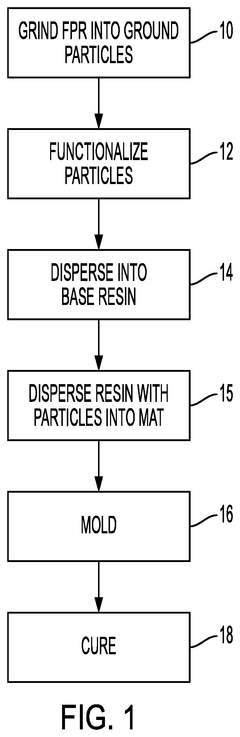
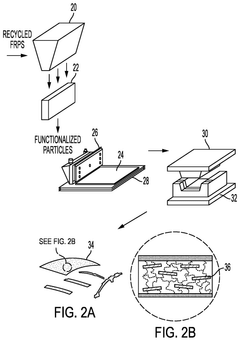
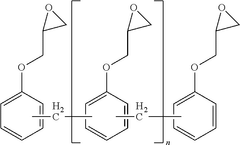
- A method involving grinding used CFRPs to produce ground particles, functionalizing them, and dispersing these particles into a base resin with high glass transition temperature epoxy, which are then molded and cured to create recyclable CFRP parts with enhanced mechanical properties and dimensional stability, enabling cost-effective and efficient recycling.
Environmental Impact Assessment of Recycling Processes
The environmental impact of Carbon Fiber Reinforced Polymer (CFRP) recycling processes represents a critical dimension in evaluating their overall sustainability. Current recycling methods demonstrate varying ecological footprints that must be comprehensively assessed to determine their true value proposition beyond mere economic considerations.
Mechanical recycling processes, while energy-efficient compared to alternative methods, generate significant particulate matter during grinding operations. These microparticles pose potential respiratory hazards and may contribute to environmental contamination if not properly contained. Additionally, the reduced fiber length resulting from mechanical processing limits the recyclate's applications, potentially leading to downcycling rather than true recycling.
Pyrolysis techniques present a complex environmental profile. While effective at fiber recovery, these thermal processes consume substantial energy and produce greenhouse gas emissions. Modern pyrolysis facilities have implemented improved emission control systems, reducing their carbon footprint by approximately 30-40% compared to earlier generations. However, the production of potentially hazardous byproducts, including volatile organic compounds and polyaromatic hydrocarbons, remains a significant concern requiring specialized treatment.
Chemical recycling methods utilizing solvolysis demonstrate promising environmental advantages through lower energy requirements and operating temperatures. Recent life cycle assessments indicate that supercritical water-based processes can reduce overall environmental impact by up to 60% compared to virgin CFRP production. Nevertheless, these processes employ potentially hazardous solvents that require careful handling and disposal protocols to prevent water and soil contamination.
Fluidized bed processes offer moderate environmental performance with controlled atmospheric conditions that minimize harmful emissions. Their intermediate energy requirements position them between mechanical and pyrolysis methods in terms of carbon footprint. However, the process efficiency remains dependent on feedstock purity, with contaminated inputs potentially generating additional environmental burdens.
Comparative life cycle analyses reveal that recycled carbon fiber can reduce energy consumption by 90-95% compared to virgin fiber production when optimal recycling methods are employed. This translates to significant reductions in greenhouse gas emissions, with estimates suggesting potential savings of 30-40 kg CO₂ equivalent per kilogram of recovered fiber.
Water usage patterns vary dramatically across recycling technologies, with chemical methods typically requiring 5-10 times more water than thermal approaches. This factor becomes particularly significant in water-stressed regions where resource competition may intensify with increased recycling operations.
Future environmental improvements will likely emerge from hybrid recycling systems that combine multiple technologies to optimize both resource recovery and ecological performance. Emerging technologies incorporating renewable energy sources and closed-loop solvent recovery systems show particular promise for further reducing the environmental footprint of CFRP recycling operations.
Mechanical recycling processes, while energy-efficient compared to alternative methods, generate significant particulate matter during grinding operations. These microparticles pose potential respiratory hazards and may contribute to environmental contamination if not properly contained. Additionally, the reduced fiber length resulting from mechanical processing limits the recyclate's applications, potentially leading to downcycling rather than true recycling.
Pyrolysis techniques present a complex environmental profile. While effective at fiber recovery, these thermal processes consume substantial energy and produce greenhouse gas emissions. Modern pyrolysis facilities have implemented improved emission control systems, reducing their carbon footprint by approximately 30-40% compared to earlier generations. However, the production of potentially hazardous byproducts, including volatile organic compounds and polyaromatic hydrocarbons, remains a significant concern requiring specialized treatment.
Chemical recycling methods utilizing solvolysis demonstrate promising environmental advantages through lower energy requirements and operating temperatures. Recent life cycle assessments indicate that supercritical water-based processes can reduce overall environmental impact by up to 60% compared to virgin CFRP production. Nevertheless, these processes employ potentially hazardous solvents that require careful handling and disposal protocols to prevent water and soil contamination.
Fluidized bed processes offer moderate environmental performance with controlled atmospheric conditions that minimize harmful emissions. Their intermediate energy requirements position them between mechanical and pyrolysis methods in terms of carbon footprint. However, the process efficiency remains dependent on feedstock purity, with contaminated inputs potentially generating additional environmental burdens.
Comparative life cycle analyses reveal that recycled carbon fiber can reduce energy consumption by 90-95% compared to virgin fiber production when optimal recycling methods are employed. This translates to significant reductions in greenhouse gas emissions, with estimates suggesting potential savings of 30-40 kg CO₂ equivalent per kilogram of recovered fiber.
Water usage patterns vary dramatically across recycling technologies, with chemical methods typically requiring 5-10 times more water than thermal approaches. This factor becomes particularly significant in water-stressed regions where resource competition may intensify with increased recycling operations.
Future environmental improvements will likely emerge from hybrid recycling systems that combine multiple technologies to optimize both resource recovery and ecological performance. Emerging technologies incorporating renewable energy sources and closed-loop solvent recovery systems show particular promise for further reducing the environmental footprint of CFRP recycling operations.
Economic Viability and ROI Analysis
The economic viability of Carbon Fiber Reinforced Polymer (CFRP) recycling methods represents a critical factor in determining their industrial adoption and sustainability impact. Current market analysis indicates that virgin carbon fiber production costs range from $20-35 per kilogram, while recycled carbon fiber can potentially be produced at $10-15 per kilogram, creating a compelling economic incentive for recycling operations.
Return on Investment (ROI) calculations for CFRP recycling facilities demonstrate varying payback periods depending on the selected technology. Pyrolysis systems typically require capital investments of $5-10 million with payback periods of 4-7 years, while solvolysis facilities may demand $7-12 million with slightly longer recovery timeframes of 5-8 years. Mechanical recycling presents the lowest initial investment at $2-5 million with faster returns of 3-5 years, though resulting in lower-value recyclate.
Cost-benefit analysis reveals that energy consumption significantly impacts operational economics. Pyrolysis consumes 10-30 MJ/kg of CFRP processed, while chemical methods require 15-40 MJ/kg. These energy requirements must be balanced against recovery rates, with pyrolysis achieving 90-95% fiber recovery versus 80-90% for solvolysis and 60-70% for mechanical methods.
Market value assessment of recycled carbon fiber products indicates tiered pricing structures based on fiber quality and length preservation. High-quality recycled fibers with minimal degradation can command 60-70% of virgin fiber prices, while chopped or more degraded fibers typically achieve 30-50% of virgin material value.
Sensitivity analysis demonstrates that economic viability is heavily dependent on waste acquisition costs, energy prices, and end-market development. A 20% increase in energy costs can reduce profit margins by 15-25%, while secured waste supply chains through manufacturer partnerships can improve margins by 10-15%.
Scaling considerations reveal significant economies of scale, with facilities processing over 1,000 tons annually showing 25-30% lower per-unit processing costs compared to smaller operations. This suggests that centralized recycling facilities serving multiple waste generators offer superior economic performance, though transportation costs become a limiting factor beyond certain geographical ranges.
Return on Investment (ROI) calculations for CFRP recycling facilities demonstrate varying payback periods depending on the selected technology. Pyrolysis systems typically require capital investments of $5-10 million with payback periods of 4-7 years, while solvolysis facilities may demand $7-12 million with slightly longer recovery timeframes of 5-8 years. Mechanical recycling presents the lowest initial investment at $2-5 million with faster returns of 3-5 years, though resulting in lower-value recyclate.
Cost-benefit analysis reveals that energy consumption significantly impacts operational economics. Pyrolysis consumes 10-30 MJ/kg of CFRP processed, while chemical methods require 15-40 MJ/kg. These energy requirements must be balanced against recovery rates, with pyrolysis achieving 90-95% fiber recovery versus 80-90% for solvolysis and 60-70% for mechanical methods.
Market value assessment of recycled carbon fiber products indicates tiered pricing structures based on fiber quality and length preservation. High-quality recycled fibers with minimal degradation can command 60-70% of virgin fiber prices, while chopped or more degraded fibers typically achieve 30-50% of virgin material value.
Sensitivity analysis demonstrates that economic viability is heavily dependent on waste acquisition costs, energy prices, and end-market development. A 20% increase in energy costs can reduce profit margins by 15-25%, while secured waste supply chains through manufacturer partnerships can improve margins by 10-15%.
Scaling considerations reveal significant economies of scale, with facilities processing over 1,000 tons annually showing 25-30% lower per-unit processing costs compared to smaller operations. This suggests that centralized recycling facilities serving multiple waste generators offer superior economic performance, though transportation costs become a limiting factor beyond certain geographical ranges.
Unlock deeper insights with PatSnap Eureka Quick Research — get a full tech report to explore trends and direct your research. Try now!
Generate Your Research Report Instantly with AI Agent
Supercharge your innovation with PatSnap Eureka AI Agent Platform!