FTIR vs EDX: Material Composition Analysis Efficiency
SEP 22, 20259 MIN READ
Generate Your Research Report Instantly with AI Agent
Patsnap Eureka helps you evaluate technical feasibility & market potential.
FTIR and EDX Technology Background and Objectives
Fourier Transform Infrared Spectroscopy (FTIR) and Energy Dispersive X-ray Spectroscopy (EDX) represent two fundamental analytical techniques that have revolutionized material composition analysis across multiple industries. The evolution of these technologies spans several decades, with FTIR's roots tracing back to the mid-20th century when interferometric spectroscopy began gaining prominence. EDX emerged later as an offshoot of electron microscopy techniques, becoming commercially viable in the 1970s.
FTIR technology has progressed from simple dispersive instruments to sophisticated Fourier transform systems that offer significantly improved signal-to-noise ratios and resolution. This advancement has enabled the analysis of increasingly complex organic compounds and polymers with greater precision. The technology operates by measuring how infrared radiation is absorbed or transmitted through a sample, providing detailed information about molecular structures and chemical bonds.
EDX, conversely, has evolved from basic energy detection systems to highly sensitive spectrometers capable of detecting elements as light as beryllium. Modern EDX systems integrated with scanning electron microscopes (SEM-EDX) can now perform elemental mapping with spatial resolution approaching nanometer scales. The technique functions by analyzing the characteristic X-rays emitted when a sample is bombarded with high-energy electrons.
The technological trajectory for both methods has been marked by continuous improvements in detection limits, resolution, and analysis speed. Recent developments include portable FTIR devices and automated EDX systems that have expanded the application scope beyond traditional laboratory settings into field operations and production environments.
The primary objective of comparing these technologies is to establish optimal analytical protocols for different material types and research questions. FTIR excels in identifying organic compounds and functional groups, while EDX provides superior elemental composition data, particularly for inorganic materials. Understanding their relative efficiencies is crucial for industries ranging from pharmaceuticals to semiconductor manufacturing.
Current research aims to overcome the inherent limitations of each technique. For FTIR, this includes improving quantitative analysis capabilities and reducing interference from water and atmospheric gases. For EDX, efforts focus on enhancing light element detection and reducing beam damage to sensitive samples. The ultimate goal is to develop complementary analytical approaches that maximize information yield while minimizing analysis time and sample preparation requirements.
As materials science advances toward increasingly complex composites and nanomaterials, the integration of these analytical methods becomes essential for comprehensive characterization. The technological evolution continues toward more automated, user-friendly systems with enhanced data processing capabilities and artificial intelligence-assisted interpretation.
FTIR technology has progressed from simple dispersive instruments to sophisticated Fourier transform systems that offer significantly improved signal-to-noise ratios and resolution. This advancement has enabled the analysis of increasingly complex organic compounds and polymers with greater precision. The technology operates by measuring how infrared radiation is absorbed or transmitted through a sample, providing detailed information about molecular structures and chemical bonds.
EDX, conversely, has evolved from basic energy detection systems to highly sensitive spectrometers capable of detecting elements as light as beryllium. Modern EDX systems integrated with scanning electron microscopes (SEM-EDX) can now perform elemental mapping with spatial resolution approaching nanometer scales. The technique functions by analyzing the characteristic X-rays emitted when a sample is bombarded with high-energy electrons.
The technological trajectory for both methods has been marked by continuous improvements in detection limits, resolution, and analysis speed. Recent developments include portable FTIR devices and automated EDX systems that have expanded the application scope beyond traditional laboratory settings into field operations and production environments.
The primary objective of comparing these technologies is to establish optimal analytical protocols for different material types and research questions. FTIR excels in identifying organic compounds and functional groups, while EDX provides superior elemental composition data, particularly for inorganic materials. Understanding their relative efficiencies is crucial for industries ranging from pharmaceuticals to semiconductor manufacturing.
Current research aims to overcome the inherent limitations of each technique. For FTIR, this includes improving quantitative analysis capabilities and reducing interference from water and atmospheric gases. For EDX, efforts focus on enhancing light element detection and reducing beam damage to sensitive samples. The ultimate goal is to develop complementary analytical approaches that maximize information yield while minimizing analysis time and sample preparation requirements.
As materials science advances toward increasingly complex composites and nanomaterials, the integration of these analytical methods becomes essential for comprehensive characterization. The technological evolution continues toward more automated, user-friendly systems with enhanced data processing capabilities and artificial intelligence-assisted interpretation.
Market Demand Analysis for Material Composition Analysis
The global market for material composition analysis technologies has witnessed substantial growth, driven by increasing demands across multiple industries for precise material characterization. The combined market for analytical instruments used in material composition analysis was valued at approximately $5.2 billion in 2022, with projections indicating a compound annual growth rate (CAGR) of 6.8% through 2028.
Industries such as semiconductor manufacturing, pharmaceuticals, and advanced materials development represent the primary demand drivers for sophisticated analytical techniques like FTIR (Fourier Transform Infrared Spectroscopy) and EDX (Energy Dispersive X-ray Spectroscopy). The semiconductor industry alone accounts for nearly 24% of the total market demand, requiring increasingly sensitive analysis methods to detect contaminants at sub-nanometer scales.
Research institutions and academic laboratories constitute another significant market segment, representing approximately 18% of the total demand. These entities typically require versatile analytical capabilities that can be applied across diverse research projects, making multi-functional instruments particularly valuable in this sector.
Geographically, North America and Europe currently dominate the market with a combined share of 58%, though the Asia-Pacific region is experiencing the fastest growth at 8.3% annually. This regional shift reflects the expanding manufacturing capabilities and research infrastructure in countries like China, South Korea, and India.
A notable market trend is the increasing demand for portable and field-deployable analysis systems, which has grown by 12.4% annually since 2020. This trend is particularly relevant for environmental monitoring, quality control in manufacturing, and on-site materials verification applications where rapid results are essential.
The healthcare and pharmaceutical sectors have emerged as rapidly expanding markets for material composition analysis, growing at 7.9% annually. This growth is driven by stringent regulatory requirements for material purity and the development of advanced biomaterials requiring precise compositional control.
Customer surveys indicate that key purchasing factors include analysis speed (cited by 78% of respondents), accuracy (92%), ease of sample preparation (65%), and total cost of ownership (71%). These factors directly relate to the efficiency comparison between FTIR and EDX technologies, with users increasingly seeking solutions that optimize these parameters while minimizing operational complexity.
The market is also witnessing increased demand for integrated analysis platforms that combine multiple techniques, with 43% of new installations featuring some form of complementary analytical capability. This suggests a growing recognition that comprehensive material characterization often requires multiple analytical approaches working in concert.
Industries such as semiconductor manufacturing, pharmaceuticals, and advanced materials development represent the primary demand drivers for sophisticated analytical techniques like FTIR (Fourier Transform Infrared Spectroscopy) and EDX (Energy Dispersive X-ray Spectroscopy). The semiconductor industry alone accounts for nearly 24% of the total market demand, requiring increasingly sensitive analysis methods to detect contaminants at sub-nanometer scales.
Research institutions and academic laboratories constitute another significant market segment, representing approximately 18% of the total demand. These entities typically require versatile analytical capabilities that can be applied across diverse research projects, making multi-functional instruments particularly valuable in this sector.
Geographically, North America and Europe currently dominate the market with a combined share of 58%, though the Asia-Pacific region is experiencing the fastest growth at 8.3% annually. This regional shift reflects the expanding manufacturing capabilities and research infrastructure in countries like China, South Korea, and India.
A notable market trend is the increasing demand for portable and field-deployable analysis systems, which has grown by 12.4% annually since 2020. This trend is particularly relevant for environmental monitoring, quality control in manufacturing, and on-site materials verification applications where rapid results are essential.
The healthcare and pharmaceutical sectors have emerged as rapidly expanding markets for material composition analysis, growing at 7.9% annually. This growth is driven by stringent regulatory requirements for material purity and the development of advanced biomaterials requiring precise compositional control.
Customer surveys indicate that key purchasing factors include analysis speed (cited by 78% of respondents), accuracy (92%), ease of sample preparation (65%), and total cost of ownership (71%). These factors directly relate to the efficiency comparison between FTIR and EDX technologies, with users increasingly seeking solutions that optimize these parameters while minimizing operational complexity.
The market is also witnessing increased demand for integrated analysis platforms that combine multiple techniques, with 43% of new installations featuring some form of complementary analytical capability. This suggests a growing recognition that comprehensive material characterization often requires multiple analytical approaches working in concert.
Current Status and Challenges in Spectroscopic Techniques
Spectroscopic techniques for material composition analysis have evolved significantly over the past decades, with Fourier Transform Infrared Spectroscopy (FTIR) and Energy Dispersive X-ray Spectroscopy (EDX) emerging as dominant methodologies. Currently, these technologies represent complementary approaches with distinct capabilities and limitations in analytical efficiency.
FTIR spectroscopy has reached a mature stage with high-resolution capabilities down to 0.1 cm^-1 and expanded spectral ranges from far-IR (400 cm^-1) to near-IR (4000 cm^-1). Modern FTIR systems incorporate advanced computational algorithms that enable real-time analysis and automated peak identification, significantly reducing analysis time from hours to minutes. However, FTIR faces challenges in analyzing inorganic materials and metals, as these substances often lack the characteristic vibrational modes that FTIR detects.
EDX technology has similarly progressed with improved detector sensitivity, allowing for detection limits approaching 0.1% for most elements. Contemporary EDX systems feature silicon drift detectors (SDDs) that provide superior energy resolution (approximately 130 eV) compared to earlier generations. Integration with scanning electron microscopy (SEM-EDX) has enhanced spatial resolution to nanometer scales, enabling precise elemental mapping of heterogeneous samples.
A significant challenge for both techniques lies in quantitative analysis accuracy. FTIR struggles with precise quantification due to matrix effects and overlapping spectral bands, while EDX faces limitations in detecting light elements (Z<11) and suffers from peak overlaps in complex samples. Sample preparation remains a critical bottleneck for efficiency in both methods, with FTIR requiring careful preparation of KBr pellets or ATR accessories, and EDX often necessitating conductive coating for non-conductive samples.
Data interpretation presents another substantial challenge. Despite advances in reference libraries and pattern recognition algorithms, both techniques require significant expertise for accurate interpretation, especially for complex or novel materials. False positives and ambiguous results remain problematic in automated analysis systems.
Globally, these technologies show uneven distribution, with advanced research facilities concentrated in North America, Europe, and East Asia. This geographical disparity creates challenges in standardization and method validation across different laboratories and regions. Additionally, the high cost of acquisition and maintenance of these instruments (ranging from $50,000 to $500,000) limits accessibility for smaller institutions and developing regions.
Recent developments focus on miniaturization and portability, with handheld FTIR and portable EDX devices entering the market. However, these compact versions typically sacrifice some analytical performance for mobility, presenting a trade-off between accessibility and analytical power that remains to be optimally resolved.
FTIR spectroscopy has reached a mature stage with high-resolution capabilities down to 0.1 cm^-1 and expanded spectral ranges from far-IR (400 cm^-1) to near-IR (4000 cm^-1). Modern FTIR systems incorporate advanced computational algorithms that enable real-time analysis and automated peak identification, significantly reducing analysis time from hours to minutes. However, FTIR faces challenges in analyzing inorganic materials and metals, as these substances often lack the characteristic vibrational modes that FTIR detects.
EDX technology has similarly progressed with improved detector sensitivity, allowing for detection limits approaching 0.1% for most elements. Contemporary EDX systems feature silicon drift detectors (SDDs) that provide superior energy resolution (approximately 130 eV) compared to earlier generations. Integration with scanning electron microscopy (SEM-EDX) has enhanced spatial resolution to nanometer scales, enabling precise elemental mapping of heterogeneous samples.
A significant challenge for both techniques lies in quantitative analysis accuracy. FTIR struggles with precise quantification due to matrix effects and overlapping spectral bands, while EDX faces limitations in detecting light elements (Z<11) and suffers from peak overlaps in complex samples. Sample preparation remains a critical bottleneck for efficiency in both methods, with FTIR requiring careful preparation of KBr pellets or ATR accessories, and EDX often necessitating conductive coating for non-conductive samples.
Data interpretation presents another substantial challenge. Despite advances in reference libraries and pattern recognition algorithms, both techniques require significant expertise for accurate interpretation, especially for complex or novel materials. False positives and ambiguous results remain problematic in automated analysis systems.
Globally, these technologies show uneven distribution, with advanced research facilities concentrated in North America, Europe, and East Asia. This geographical disparity creates challenges in standardization and method validation across different laboratories and regions. Additionally, the high cost of acquisition and maintenance of these instruments (ranging from $50,000 to $500,000) limits accessibility for smaller institutions and developing regions.
Recent developments focus on miniaturization and portability, with handheld FTIR and portable EDX devices entering the market. However, these compact versions typically sacrifice some analytical performance for mobility, presenting a trade-off between accessibility and analytical power that remains to be optimally resolved.
Comparative Analysis of FTIR and EDX Methodologies
01 Combined FTIR and EDX analysis systems
Integrated systems that combine Fourier Transform Infrared Spectroscopy (FTIR) and Energy Dispersive X-ray (EDX) techniques for comprehensive material analysis. These systems allow for simultaneous or sequential analysis of both molecular structure and elemental composition, increasing efficiency by reducing the need for separate testing procedures. The combined approach provides complementary data that enhances analytical accuracy and reduces overall analysis time.- Combined FTIR and EDX analysis systems: Integrated systems that combine Fourier Transform Infrared Spectroscopy (FTIR) and Energy Dispersive X-ray (EDX) techniques for comprehensive material analysis. These systems allow for simultaneous or sequential analysis of both molecular structure and elemental composition, increasing efficiency by reducing sample preparation time and providing complementary data from a single sample. The integration enhances analytical capabilities for complex materials characterization in research and quality control applications.
- Automated sample preparation and analysis workflows: Automated systems for sample preparation and analysis using FTIR and EDX techniques that improve efficiency through reduced human intervention. These systems incorporate robotic sample handling, automated calibration, and sequential or parallel analysis protocols. The automation reduces analysis time, minimizes human error, and increases throughput for routine analyses in industrial and research settings, allowing for more consistent and reliable results across multiple samples.
- Data processing and interpretation algorithms: Advanced algorithms and software solutions for processing and interpreting data from FTIR and EDX analyses. These computational methods include spectral deconvolution, peak identification, quantitative analysis, and machine learning approaches for pattern recognition. The algorithms enhance the efficiency of data interpretation by automating complex analytical tasks, reducing analysis time, and improving the accuracy of results, particularly for complex sample matrices or when analyzing trace components.
- Portable and field-deployable FTIR-EDX systems: Compact, portable systems that combine FTIR and EDX capabilities for on-site or field analysis. These systems feature miniaturized components, battery operation, and ruggedized designs suitable for use outside laboratory environments. The portability increases analytical efficiency by eliminating sample transport to centralized laboratories, enabling real-time decision making, and allowing for immediate analysis of materials in their native environments or during manufacturing processes.
- Specialized sample holders and preparation techniques: Innovative sample holders and preparation methods designed specifically for efficient sequential or simultaneous FTIR and EDX analysis. These include multi-position sample stages, specialized substrates compatible with both techniques, and preparation protocols that minimize sample alteration between analyses. The specialized equipment and methods reduce analysis time, improve reproducibility, and enable more efficient characterization of challenging samples such as thin films, powders, or heterogeneous materials.
02 Automated sample preparation and analysis workflows
Automated systems for sample preparation and analysis using FTIR and EDX techniques. These systems incorporate robotics, automated sample handling, and computerized analysis protocols to streamline the analytical process. By reducing manual intervention, these innovations minimize human error, increase throughput, and standardize testing procedures, resulting in more consistent and reliable analytical results.Expand Specific Solutions03 Enhanced data processing algorithms
Advanced algorithms and software solutions for processing and interpreting data from FTIR and EDX analyses. These computational methods include machine learning approaches, multivariate analysis, and automated peak identification to extract meaningful information from complex spectral data. The enhanced data processing capabilities improve the speed and accuracy of analysis, enabling more efficient identification of materials and detection of subtle compositional differences.Expand Specific Solutions04 Portable and field-deployable FTIR-EDX instruments
Compact, portable instruments that combine FTIR and EDX capabilities for on-site analysis. These devices are designed for field deployment, allowing for real-time material characterization without the need to transport samples to a laboratory. The portability increases analytical efficiency by eliminating transportation delays and enabling immediate decision-making based on analytical results, particularly valuable in environmental monitoring, forensic investigations, and quality control applications.Expand Specific Solutions05 Specialized sample holders and preparation techniques
Innovative sample holders and preparation methods specifically designed to optimize the efficiency of FTIR and EDX analyses. These include multi-sample holders, specialized substrates, and novel sample preparation techniques that minimize contamination and maximize signal quality. The improved sample handling approaches reduce preparation time, allow for higher throughput, and enhance the quality of analytical data by ensuring optimal presentation of samples to the analytical instruments.Expand Specific Solutions
Key Industry Players in Analytical Instrumentation
The FTIR vs EDX material composition analysis market is currently in a growth phase, with increasing demand for precise analytical tools across industries. The global market size for these technologies is estimated to exceed $5 billion, driven by applications in semiconductor manufacturing, materials science, and industrial quality control. FTIR technology offers superior molecular structure identification, while EDX provides excellent elemental analysis capabilities. Key players shaping this competitive landscape include Hitachi High-Tech America and Horiba Ltd., who lead with comprehensive analytical solutions; Shimazu KK and QuantaRed Technologies focusing on specialized applications; and academic institutions like USC and EPFL contributing to technological advancements through research partnerships with industry leaders.
Hitachi High-Tech America, Inc.
Technical Solution: Hitachi High-Tech America has developed advanced integrated FTIR-EDX systems that combine the molecular identification capabilities of FTIR with the elemental analysis strengths of EDX. Their proprietary SEM-EDX systems feature silicon drift detectors with resolution down to 129 eV, enabling detection of elements from beryllium to uranium. Their FTIR solutions incorporate diamond ATR accessories with spectral ranges of 7,800-400 cm⁻¹ and resolution capabilities of 0.7 cm⁻¹. The company's analytical software platform allows for simultaneous data acquisition and interpretation from both techniques, providing comprehensive material characterization within a single workflow. Hitachi's systems are designed for high-throughput industrial applications with automated sample handling capabilities processing up to 120 samples per hour.
Strengths: Seamless integration of complementary techniques provides comprehensive material analysis without sample transfer between instruments. Superior detector technology offers exceptional sensitivity for trace element detection. Weaknesses: Higher initial investment compared to standalone systems. Requires specialized training to fully utilize the combined capabilities of both techniques.
National Technology & Engineering Solutions of Sandia LLC
Technical Solution: Sandia has developed advanced material analysis platforms that integrate FTIR and EDX capabilities for comprehensive characterization of complex materials. Their systems feature hyperspectral FTIR imaging with spatial resolution down to 0.8 μm coupled with high-precision EDX mapping capabilities achieving elemental detection limits below 100 ppm. Sandia's proprietary "MatID" software platform employs machine learning algorithms trained on over 75,000 reference materials to correlate molecular and elemental signatures for accurate identification of unknown compounds. Their technology incorporates cryogenic sample handling systems that maintain samples at temperatures as low as 4K during analysis, enabling characterization of temperature-sensitive materials. Sandia has pioneered non-destructive depth profiling techniques combining ATR-FTIR with variable-energy EDX to characterize material composition as a function of depth with resolution down to 10 nm. The systems feature automated calibration routines that ensure measurement accuracy within ±0.5% across both techniques.
Strengths: Cutting-edge research capabilities provide exceptional analytical performance for complex materials. Advanced software integration enables sophisticated data interpretation beyond conventional analysis. Weaknesses: Systems are primarily designed for research applications rather than routine industrial analysis. High complexity requires specialized expertise for operation and maintenance.
Technical Innovations in Spectroscopic Analysis
Infrared spectrometer with automated tablet sampling
PatentInactiveUS7053373B1
Innovation
- An automated infrared spectrometer system with a tablet holding wheel that includes grippers and a cam ring, allowing for the adaptation to various tablet sizes and shapes, enabling the system to automatically advance and position tablets for analysis without the need for frequent holder adjustments.


Elemental identification based on phase analysis
PatentPendingUS20250231127A1
Innovation
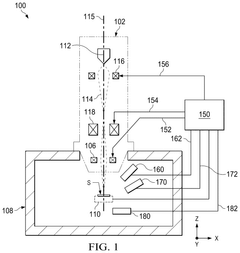
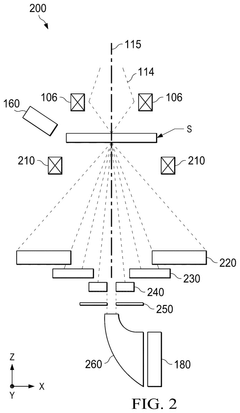
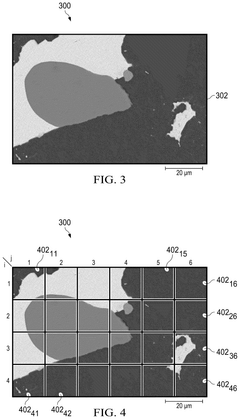
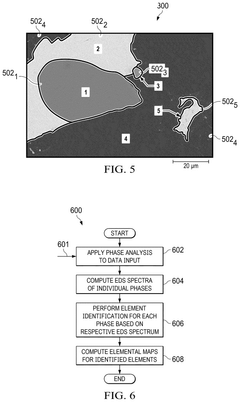
- Implementing phase analysis and multivariate statistical analysis to compute phase maps and elemental maps by binning pixelwise energy-dispersive X-ray spectroscopy spectra, allowing for live updates during data acquisition.
Cost-Benefit Analysis of Analytical Techniques
When evaluating analytical techniques like FTIR (Fourier Transform Infrared Spectroscopy) and EDX (Energy Dispersive X-ray Spectroscopy), cost-benefit analysis becomes crucial for organizations making investment decisions. The initial acquisition costs present significant differences: EDX systems typically range from $150,000 to $500,000, while FTIR instruments are considerably more affordable at $30,000 to $100,000. This substantial price gap often makes FTIR more accessible for smaller laboratories or companies with limited capital expenditure budgets.
Operational expenses also differ markedly between these technologies. EDX systems require specialized facilities with radiation shielding, stable power supplies, and often cooling systems, adding significant infrastructure costs. Additionally, EDX maintenance contracts can cost 8-12% of the instrument price annually. FTIR systems, conversely, have more modest operational requirements, with maintenance contracts typically ranging from 5-8% of the purchase price and less demanding facility specifications.
Sample preparation efficiency represents another important economic consideration. FTIR often requires minimal sample preparation, allowing for rapid analysis cycles with throughput of 20-30 samples per hour. EDX frequently demands more extensive preparation, including coating for non-conductive samples, reducing throughput to 10-15 samples hourly. This difference directly impacts labor costs and overall analytical efficiency.
The versatility of application must be factored into the return on investment calculation. While EDX excels at elemental analysis with detection limits in the 0.1-1% range, FTIR provides molecular structure information and can detect organic compounds at parts-per-million levels. Organizations analyzing diverse sample types may find greater value in FTIR's broader application range, though those requiring precise elemental composition might justify EDX's higher costs.
Training requirements present another cost dimension. EDX typically requires specialized operators with radiation safety training and advanced analytical skills, representing a significant human resource investment. FTIR systems generally have more intuitive interfaces and shorter learning curves, reducing training costs and allowing for broader staff utilization.
Long-term value assessment reveals that while EDX systems typically have 10-15 year operational lifespans, FTIR instruments often remain viable for 8-12 years. When calculating cost per analysis over the equipment lifetime, organizations must consider sample volumes, staff efficiency, and the specific analytical requirements that each technique satisfies within their research or production contexts.
Operational expenses also differ markedly between these technologies. EDX systems require specialized facilities with radiation shielding, stable power supplies, and often cooling systems, adding significant infrastructure costs. Additionally, EDX maintenance contracts can cost 8-12% of the instrument price annually. FTIR systems, conversely, have more modest operational requirements, with maintenance contracts typically ranging from 5-8% of the purchase price and less demanding facility specifications.
Sample preparation efficiency represents another important economic consideration. FTIR often requires minimal sample preparation, allowing for rapid analysis cycles with throughput of 20-30 samples per hour. EDX frequently demands more extensive preparation, including coating for non-conductive samples, reducing throughput to 10-15 samples hourly. This difference directly impacts labor costs and overall analytical efficiency.
The versatility of application must be factored into the return on investment calculation. While EDX excels at elemental analysis with detection limits in the 0.1-1% range, FTIR provides molecular structure information and can detect organic compounds at parts-per-million levels. Organizations analyzing diverse sample types may find greater value in FTIR's broader application range, though those requiring precise elemental composition might justify EDX's higher costs.
Training requirements present another cost dimension. EDX typically requires specialized operators with radiation safety training and advanced analytical skills, representing a significant human resource investment. FTIR systems generally have more intuitive interfaces and shorter learning curves, reducing training costs and allowing for broader staff utilization.
Long-term value assessment reveals that while EDX systems typically have 10-15 year operational lifespans, FTIR instruments often remain viable for 8-12 years. When calculating cost per analysis over the equipment lifetime, organizations must consider sample volumes, staff efficiency, and the specific analytical requirements that each technique satisfies within their research or production contexts.
Sample Preparation Requirements and Limitations
Sample preparation represents a critical factor in determining the efficiency and accuracy of both FTIR (Fourier Transform Infrared Spectroscopy) and EDX (Energy Dispersive X-ray Spectroscopy) analytical techniques. These methodologies impose distinct requirements that significantly impact their practical application in material composition analysis.
FTIR sample preparation typically requires minimal processing for many sample types. Solid samples can be analyzed through various techniques including KBr pellet preparation, attenuated total reflection (ATR), or diffuse reflectance. Liquid samples may be examined directly using specialized cells with infrared-transparent windows. However, FTIR faces limitations with highly absorbing or scattering materials, which can diminish spectral quality and complicate interpretation. Water-containing samples present particular challenges due to strong infrared absorption bands that may obscure other spectral features.
EDX sample preparation demands more rigorous protocols to ensure accurate elemental analysis. Samples generally require a flat, polished surface to minimize topographical effects that can distort X-ray emission. Conductive coating (typically carbon or gold) is often necessary for non-conductive materials to prevent charging effects during electron beam interaction. This additional preparation step introduces complexity and potential contamination risks. EDX also requires samples to withstand vacuum conditions, limiting analysis of volatile or outgassing materials.
Sample size and homogeneity considerations differ significantly between techniques. FTIR can accommodate samples ranging from microscopic particles to bulk materials, with minimal size requirements when using microscope attachments. EDX typically requires samples that fit within the SEM chamber, with analysis areas ranging from nanometers to millimeters depending on beam settings and detector configuration.
Depth of analysis represents another critical distinction. FTIR primarily provides surface and near-surface information (typically 0.5-5 μm depth), while EDX penetration depth varies with accelerating voltage and sample composition, potentially reaching several micrometers. This difference impacts sample preparation strategies when targeting specific sample regions or layers.
Time efficiency considerations favor FTIR for routine analysis, as sample preparation is generally faster and less technically demanding. EDX preparation protocols often require multiple steps including cutting, mounting, polishing, and coating, potentially extending preparation time to hours compared to minutes for many FTIR applications.
FTIR sample preparation typically requires minimal processing for many sample types. Solid samples can be analyzed through various techniques including KBr pellet preparation, attenuated total reflection (ATR), or diffuse reflectance. Liquid samples may be examined directly using specialized cells with infrared-transparent windows. However, FTIR faces limitations with highly absorbing or scattering materials, which can diminish spectral quality and complicate interpretation. Water-containing samples present particular challenges due to strong infrared absorption bands that may obscure other spectral features.
EDX sample preparation demands more rigorous protocols to ensure accurate elemental analysis. Samples generally require a flat, polished surface to minimize topographical effects that can distort X-ray emission. Conductive coating (typically carbon or gold) is often necessary for non-conductive materials to prevent charging effects during electron beam interaction. This additional preparation step introduces complexity and potential contamination risks. EDX also requires samples to withstand vacuum conditions, limiting analysis of volatile or outgassing materials.
Sample size and homogeneity considerations differ significantly between techniques. FTIR can accommodate samples ranging from microscopic particles to bulk materials, with minimal size requirements when using microscope attachments. EDX typically requires samples that fit within the SEM chamber, with analysis areas ranging from nanometers to millimeters depending on beam settings and detector configuration.
Depth of analysis represents another critical distinction. FTIR primarily provides surface and near-surface information (typically 0.5-5 μm depth), while EDX penetration depth varies with accelerating voltage and sample composition, potentially reaching several micrometers. This difference impacts sample preparation strategies when targeting specific sample regions or layers.
Time efficiency considerations favor FTIR for routine analysis, as sample preparation is generally faster and less technically demanding. EDX preparation protocols often require multiple steps including cutting, mounting, polishing, and coating, potentially extending preparation time to hours compared to minutes for many FTIR applications.
Unlock deeper insights with Patsnap Eureka Quick Research — get a full tech report to explore trends and direct your research. Try now!
Generate Your Research Report Instantly with AI Agent
Supercharge your innovation with Patsnap Eureka AI Agent Platform!