FTIR vs Modular Spectroscopy: Adapting to Challenges
SEP 22, 20259 MIN READ
Generate Your Research Report Instantly with AI Agent
Patsnap Eureka helps you evaluate technical feasibility & market potential.
FTIR and Modular Spectroscopy Evolution and Objectives
Fourier Transform Infrared (FTIR) spectroscopy has evolved significantly since its inception in the mid-20th century. Initially developed as an advancement over dispersive spectroscopy, FTIR technology revolutionized molecular analysis by enabling simultaneous measurement of all infrared frequencies. The evolution began with large, laboratory-confined instruments and has progressed to more compact, field-deployable systems that maintain high resolution and sensitivity.
The technological trajectory of FTIR has been marked by continuous improvements in interferometer design, detector sensitivity, and data processing capabilities. Early systems required significant expertise to operate and interpret results, while modern FTIR spectrometers incorporate advanced software algorithms that facilitate automated analysis and interpretation, making the technology more accessible to non-specialists.
Parallel to FTIR development, modular spectroscopy has emerged as an alternative approach. Unlike the integrated design of traditional FTIR systems, modular spectroscopy employs discrete components that can be assembled in various configurations to address specific analytical challenges. This approach gained momentum in the early 2000s with advances in miniaturized optical components, low-cost detectors, and embedded computing systems.
The evolution of modular spectroscopy has been characterized by increasing integration with digital technologies, including wireless connectivity, cloud computing, and artificial intelligence for spectral analysis. These developments have transformed spectroscopic tools from standalone analytical instruments to networked devices capable of real-time data sharing and collaborative analysis.
The primary objective of both technologies is to provide accurate molecular identification and quantification across diverse applications. However, they differ in their approach to meeting this goal. FTIR systems aim to deliver comprehensive spectral information with high resolution across the entire infrared range, prioritizing analytical depth and precision. Conversely, modular spectroscopy focuses on application-specific performance, emphasizing adaptability, cost-effectiveness, and ease of integration into existing workflows.
Current technological objectives include enhancing portability without sacrificing analytical performance, improving resistance to environmental interferences, and developing more intuitive user interfaces. For FTIR, specific goals include reducing size and power requirements while maintaining optical stability. For modular systems, objectives center on standardizing interfaces between components, improving spectral resolution of miniaturized elements, and developing more sophisticated calibration methods to ensure reliability across different configurations.
The convergence of these technologies with data science represents another significant trend, with objectives focused on developing more powerful algorithms for spectral interpretation, automated pattern recognition, and integration with other analytical techniques to provide more comprehensive material characterization capabilities.
The technological trajectory of FTIR has been marked by continuous improvements in interferometer design, detector sensitivity, and data processing capabilities. Early systems required significant expertise to operate and interpret results, while modern FTIR spectrometers incorporate advanced software algorithms that facilitate automated analysis and interpretation, making the technology more accessible to non-specialists.
Parallel to FTIR development, modular spectroscopy has emerged as an alternative approach. Unlike the integrated design of traditional FTIR systems, modular spectroscopy employs discrete components that can be assembled in various configurations to address specific analytical challenges. This approach gained momentum in the early 2000s with advances in miniaturized optical components, low-cost detectors, and embedded computing systems.
The evolution of modular spectroscopy has been characterized by increasing integration with digital technologies, including wireless connectivity, cloud computing, and artificial intelligence for spectral analysis. These developments have transformed spectroscopic tools from standalone analytical instruments to networked devices capable of real-time data sharing and collaborative analysis.
The primary objective of both technologies is to provide accurate molecular identification and quantification across diverse applications. However, they differ in their approach to meeting this goal. FTIR systems aim to deliver comprehensive spectral information with high resolution across the entire infrared range, prioritizing analytical depth and precision. Conversely, modular spectroscopy focuses on application-specific performance, emphasizing adaptability, cost-effectiveness, and ease of integration into existing workflows.
Current technological objectives include enhancing portability without sacrificing analytical performance, improving resistance to environmental interferences, and developing more intuitive user interfaces. For FTIR, specific goals include reducing size and power requirements while maintaining optical stability. For modular systems, objectives center on standardizing interfaces between components, improving spectral resolution of miniaturized elements, and developing more sophisticated calibration methods to ensure reliability across different configurations.
The convergence of these technologies with data science represents another significant trend, with objectives focused on developing more powerful algorithms for spectral interpretation, automated pattern recognition, and integration with other analytical techniques to provide more comprehensive material characterization capabilities.
Market Applications and Industry Demand Analysis
The spectroscopy market has witnessed substantial growth in recent years, driven by increasing applications across multiple industries. The global spectroscopy market was valued at approximately $14.2 billion in 2021 and is projected to reach $20.8 billion by 2027, growing at a CAGR of 6.7%. Within this broader market, both FTIR (Fourier Transform Infrared) and modular spectroscopy technologies serve critical roles across diverse sectors.
In the pharmaceutical industry, spectroscopy represents a cornerstone technology for drug development and quality control. The pharmaceutical analytical testing market, where spectroscopy plays a vital role, is expanding at nearly 8% annually. Companies increasingly demand portable and adaptable spectroscopic solutions that can be integrated into production lines for real-time analysis, creating significant opportunities for modular spectroscopy systems.
The food and beverage sector demonstrates growing demand for spectroscopic technologies to ensure product safety and quality. With food safety testing market growth exceeding 7% annually, manufacturers require solutions that can rapidly detect contaminants and verify ingredient authenticity. Modular spectroscopy systems offer advantages in this space due to their customizability for specific detection needs.
Environmental monitoring represents another significant market driver, with regulatory agencies worldwide implementing stricter emissions and pollution control standards. The environmental testing market is expanding at approximately 6.5% annually, with spectroscopy being essential for detecting and measuring pollutants in air, water, and soil samples. Modular systems that can be deployed in field conditions hold particular value in this sector.
The semiconductor and electronics manufacturing industry increasingly relies on spectroscopic techniques for quality control and materials analysis. With the semiconductor market experiencing unprecedented growth, demand for specialized spectroscopic solutions has intensified. Both FTIR and modular approaches serve different needs within this sector, with FTIR excelling in laboratory settings and modular systems offering flexibility for production environments.
Healthcare applications, particularly in clinical diagnostics and biomedical research, represent an emerging frontier for spectroscopic technologies. The medical spectroscopy market segment is growing at nearly 7.5% annually, with applications ranging from disease diagnosis to treatment monitoring. Modular spectroscopy's adaptability makes it particularly valuable for point-of-care applications and specialized research settings.
Industrial manufacturing broadly shows increasing adoption of spectroscopic technologies for process control and quality assurance. The industrial quality control market utilizing spectroscopy is expanding steadily at 5-6% annually, with manufacturers seeking solutions that can be integrated directly into production lines, favoring the adaptability of modular spectroscopic approaches.
In the pharmaceutical industry, spectroscopy represents a cornerstone technology for drug development and quality control. The pharmaceutical analytical testing market, where spectroscopy plays a vital role, is expanding at nearly 8% annually. Companies increasingly demand portable and adaptable spectroscopic solutions that can be integrated into production lines for real-time analysis, creating significant opportunities for modular spectroscopy systems.
The food and beverage sector demonstrates growing demand for spectroscopic technologies to ensure product safety and quality. With food safety testing market growth exceeding 7% annually, manufacturers require solutions that can rapidly detect contaminants and verify ingredient authenticity. Modular spectroscopy systems offer advantages in this space due to their customizability for specific detection needs.
Environmental monitoring represents another significant market driver, with regulatory agencies worldwide implementing stricter emissions and pollution control standards. The environmental testing market is expanding at approximately 6.5% annually, with spectroscopy being essential for detecting and measuring pollutants in air, water, and soil samples. Modular systems that can be deployed in field conditions hold particular value in this sector.
The semiconductor and electronics manufacturing industry increasingly relies on spectroscopic techniques for quality control and materials analysis. With the semiconductor market experiencing unprecedented growth, demand for specialized spectroscopic solutions has intensified. Both FTIR and modular approaches serve different needs within this sector, with FTIR excelling in laboratory settings and modular systems offering flexibility for production environments.
Healthcare applications, particularly in clinical diagnostics and biomedical research, represent an emerging frontier for spectroscopic technologies. The medical spectroscopy market segment is growing at nearly 7.5% annually, with applications ranging from disease diagnosis to treatment monitoring. Modular spectroscopy's adaptability makes it particularly valuable for point-of-care applications and specialized research settings.
Industrial manufacturing broadly shows increasing adoption of spectroscopic technologies for process control and quality assurance. The industrial quality control market utilizing spectroscopy is expanding steadily at 5-6% annually, with manufacturers seeking solutions that can be integrated directly into production lines, favoring the adaptability of modular spectroscopic approaches.
Current Technical Limitations and Development Challenges
Despite significant advancements in both FTIR and modular spectroscopy technologies, several technical limitations and development challenges persist that hinder their optimal application across various industries. FTIR systems, while offering high spectral resolution and accuracy, continue to face challenges related to their size, cost, and operational complexity. Traditional FTIR instruments remain bulky, requiring controlled laboratory environments and skilled operators, which limits their deployment in field applications or continuous monitoring scenarios.
The optical components in FTIR systems, particularly the interferometer mechanisms, are susceptible to mechanical vibrations and temperature fluctuations, affecting measurement stability and reliability in non-laboratory settings. Additionally, the moving parts in these systems require regular maintenance and calibration, increasing the total cost of ownership and reducing operational efficiency.
Modular spectroscopy approaches, while addressing some of these limitations through miniaturization and simplified designs, face their own set of challenges. The reduced optical path lengths in miniaturized systems often result in decreased sensitivity and signal-to-noise ratios compared to their full-sized counterparts. This trade-off between size and performance remains a significant hurdle for applications requiring both portability and high analytical precision.
Spectral resolution in compact modular systems is typically lower than in traditional FTIR instruments, limiting their applicability in scenarios requiring fine spectral discrimination. The integration of multiple components in modular systems also introduces challenges in maintaining optical alignment and calibration stability over time, particularly in harsh or variable environmental conditions.
Data processing and interpretation present additional challenges for both technologies. The complex spectral data generated requires sophisticated algorithms for analysis, pattern recognition, and interference correction. As applications expand into new domains like real-time process monitoring or medical diagnostics, the need for faster, more efficient data processing becomes increasingly critical.
Power consumption remains a constraint for portable and field-deployable spectroscopic systems. Battery-operated devices must balance performance requirements with energy efficiency, often resulting in compromised functionality or limited operational duration. This challenge is particularly acute for IoT applications or remote sensing scenarios where continuous operation is necessary.
Material limitations also affect both technologies. The development of more efficient detectors, sources, and optical components that can operate across broader spectral ranges while maintaining sensitivity and stability continues to be an active area of research. Similarly, the integration of these technologies with other analytical methods or sensing platforms presents both opportunities and challenges for system designers and manufacturers.
The optical components in FTIR systems, particularly the interferometer mechanisms, are susceptible to mechanical vibrations and temperature fluctuations, affecting measurement stability and reliability in non-laboratory settings. Additionally, the moving parts in these systems require regular maintenance and calibration, increasing the total cost of ownership and reducing operational efficiency.
Modular spectroscopy approaches, while addressing some of these limitations through miniaturization and simplified designs, face their own set of challenges. The reduced optical path lengths in miniaturized systems often result in decreased sensitivity and signal-to-noise ratios compared to their full-sized counterparts. This trade-off between size and performance remains a significant hurdle for applications requiring both portability and high analytical precision.
Spectral resolution in compact modular systems is typically lower than in traditional FTIR instruments, limiting their applicability in scenarios requiring fine spectral discrimination. The integration of multiple components in modular systems also introduces challenges in maintaining optical alignment and calibration stability over time, particularly in harsh or variable environmental conditions.
Data processing and interpretation present additional challenges for both technologies. The complex spectral data generated requires sophisticated algorithms for analysis, pattern recognition, and interference correction. As applications expand into new domains like real-time process monitoring or medical diagnostics, the need for faster, more efficient data processing becomes increasingly critical.
Power consumption remains a constraint for portable and field-deployable spectroscopic systems. Battery-operated devices must balance performance requirements with energy efficiency, often resulting in compromised functionality or limited operational duration. This challenge is particularly acute for IoT applications or remote sensing scenarios where continuous operation is necessary.
Material limitations also affect both technologies. The development of more efficient detectors, sources, and optical components that can operate across broader spectral ranges while maintaining sensitivity and stability continues to be an active area of research. Similarly, the integration of these technologies with other analytical methods or sensing platforms presents both opportunities and challenges for system designers and manufacturers.
Comparative Analysis of Current FTIR and Modular Solutions
01 FTIR spectroscopy for environmental monitoring and analysis
FTIR spectroscopy systems have been adapted to address environmental monitoring challenges by enabling real-time analysis of air, water, and soil contaminants. These systems incorporate specialized sampling interfaces and data processing algorithms to detect trace pollutants even in complex matrices. The technology allows for field-deployable solutions that can withstand harsh environmental conditions while maintaining analytical precision, making it valuable for both regulatory compliance and research applications.- Adaptability of FTIR spectroscopy for environmental monitoring: FTIR spectroscopy systems have been adapted to address environmental monitoring challenges by incorporating specialized sampling interfaces and data processing algorithms. These adaptations enable real-time analysis of air, water, and soil contaminants under varying field conditions. The technology allows for detection of trace pollutants and can be integrated with automated sampling systems for continuous monitoring in challenging environments.
- Modular spectroscopy systems for industrial process control: Modular spectroscopy platforms have been developed to meet the challenges of industrial process monitoring by allowing customizable configurations. These systems feature interchangeable components that can be adapted to different manufacturing environments, enabling real-time quality control and process optimization. The modular design allows for quick reconfiguration to address changing production parameters and integration with existing industrial control systems.
- Miniaturization and portability innovations in spectroscopic devices: Advances in miniaturization have addressed the challenge of field deployment for spectroscopic analysis. Compact FTIR and modular spectroscopy systems have been developed that maintain analytical performance while being suitable for on-site use. These innovations include reduced optical path designs, integrated microprocessors for data analysis, and battery operation capabilities, enabling spectroscopic analysis in remote locations and challenging environments.
- Enhanced data processing algorithms for complex sample analysis: Sophisticated data processing algorithms have been developed to overcome challenges in analyzing complex samples using spectroscopic techniques. These computational approaches include machine learning methods for pattern recognition, multivariate analysis for component separation, and automated baseline correction. Such algorithms enable accurate interpretation of spectral data from heterogeneous samples and improve detection limits in the presence of interfering substances.
- Integration of multiple spectroscopic techniques for comprehensive analysis: Hybrid systems combining FTIR with other spectroscopic methods have been developed to provide more comprehensive analytical capabilities. These integrated platforms may combine infrared spectroscopy with Raman, UV-Vis, or mass spectrometry to overcome the limitations of individual techniques. Such multi-modal approaches enable simultaneous analysis of different molecular properties and improve identification of complex compounds in challenging matrices.
02 Modular spectroscopy systems for industrial process control
Modular spectroscopy platforms have been developed to address industrial process monitoring challenges by allowing customizable configurations for specific manufacturing environments. These systems feature interchangeable components that can be optimized for different sample types, concentration ranges, and process conditions. The modular design enables rapid adaptation to changing production requirements while maintaining measurement consistency, facilitating quality control and process optimization in industries ranging from pharmaceuticals to petrochemicals.Expand Specific Solutions03 Advanced data processing algorithms for spectroscopic analysis
Sophisticated data processing algorithms have been integrated with spectroscopy systems to overcome challenges in analyzing complex samples with overlapping spectral features. These computational approaches include machine learning techniques, multivariate analysis, and chemometric methods that can extract meaningful information from noisy or convoluted spectral data. The algorithms enable automated identification of compounds, quantification of components in mixtures, and detection of subtle spectral changes that indicate material properties or quality attributes.Expand Specific Solutions04 Miniaturized and portable spectroscopy solutions
Miniaturized FTIR and modular spectroscopy systems have been developed to address challenges related to field analysis and point-of-use testing. These compact designs incorporate innovations in optical components, detector technology, and power management to deliver laboratory-quality results in portable formats. The miniaturized systems enable on-site analysis in applications such as food safety inspection, forensic investigation, pharmaceutical verification, and geological surveys, eliminating the need for sample transport to centralized laboratories.Expand Specific Solutions05 Integration of spectroscopy with complementary analytical techniques
Hybrid analytical systems that combine FTIR or modular spectroscopy with complementary techniques have been developed to address complex analytical challenges. These integrated platforms may combine spectroscopic methods with chromatography, mass spectrometry, or microscopy to provide multi-dimensional characterization of samples. The synergistic approach overcomes limitations of individual techniques, enabling more comprehensive analysis of heterogeneous materials, trace components, or dynamic processes that require multiple analytical perspectives.Expand Specific Solutions
Leading Manufacturers and Research Institutions Landscape
The FTIR vs Modular Spectroscopy market is currently in a growth phase, with increasing adoption across research and industrial applications. The global spectroscopy market is projected to reach significant scale, driven by demand in pharmaceutical, environmental monitoring, and medical diagnostics sectors. Leading players include established instrumentation companies like Agilent Technologies, Shimadzu, Bruker Optik, and Hamamatsu Photonics, who offer comprehensive FTIR solutions. Emerging competitors such as Spectra Analysis Instruments and Daylight Solutions are advancing modular spectroscopy technologies to address traditional FTIR limitations. Academic institutions including Monash University, TUM, and Max Planck Society are contributing breakthrough research, while companies like PulmonIR are developing specialized applications for medical diagnostics, demonstrating the technology's expanding versatility across multiple sectors.
Hamamatsu Photonics KK
Technical Solution: Hamamatsu has developed innovative modular spectroscopy solutions that address key limitations of traditional FTIR systems. Their approach centers on advanced detector technology, particularly their InGaAs and InAsSb detector arrays that offer superior sensitivity in the near and mid-infrared regions. Hamamatsu's modular systems feature miniaturized optical components that maintain high optical throughput while significantly reducing instrument size. Their MEMS-based micro-spectrometers achieve remarkable compactness without sacrificing performance, making them ideal for portable applications where traditional FTIR systems would be impractical. Hamamatsu has also pioneered the integration of their spectroscopic modules with wireless connectivity and cloud-based data processing, enabling real-time analysis in field applications. Their systems incorporate proprietary signal enhancement algorithms that improve detection limits in challenging samples with complex matrices or low analyte concentrations.
Strengths: Exceptional miniaturization capabilities, industry-leading detector sensitivity, and seamless integration with digital platforms for remote monitoring applications. Weaknesses: More limited spectral range compared to full-featured FTIR systems and potentially higher cost for specialized detector technologies.
Agilent Technologies, Inc.
Technical Solution: Agilent has developed advanced modular spectroscopy solutions that address the limitations of traditional FTIR systems. Their modular approach incorporates quantum cascade laser (QCL) technology with tunable diode laser absorption spectroscopy (TDLAS) to achieve higher sensitivity and selectivity in targeted applications. Agilent's systems feature interchangeable modules that can be optimized for specific wavelength ranges and applications, allowing users to customize their spectroscopic capabilities without investing in multiple standalone instruments. Their portable modular systems incorporate microelectromechanical systems (MEMS) technology to reduce size while maintaining performance comparable to benchtop FTIR systems. Agilent has also developed advanced algorithms for real-time data processing that compensate for environmental interferences, particularly important in field applications where conditions cannot be controlled.
Strengths: Superior sensitivity for trace analysis, reduced maintenance requirements compared to FTIR, and flexibility to upgrade specific modules rather than entire systems. Weaknesses: Higher initial investment cost compared to single-purpose FTIR systems and potential complexity in operation requiring specialized training for optimal use.
Key Patents and Breakthrough Technologies in Spectroscopy
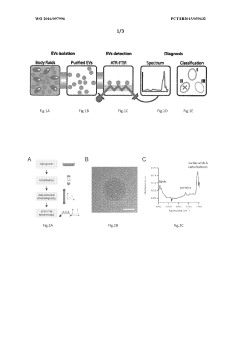
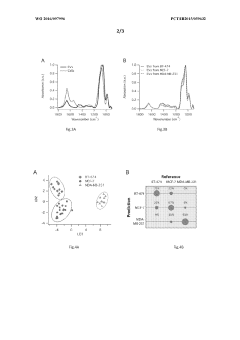
Use of fourier transform infrared spectroscopy analysis of extracellular vesicles isolated from body fluids for diagnosing, prognosing and monitoring pathophysiological states and method therfor
PatentWO2016097996A1
Innovation
- The use of Fourier Transform Infrared Spectroscopy (FTIR) to analyze extracellular vesicles (EVs) isolated from body fluids, combined with multivariate analysis, provides a non-invasive and label-free method for classifying EVs based on their molecular composition, enabling early diagnosis, prognosis, and monitoring of cancer and other proliferative diseases.
Fourier transform infrared spectrophotometer
PatentInactiveUS7535004B2
Innovation
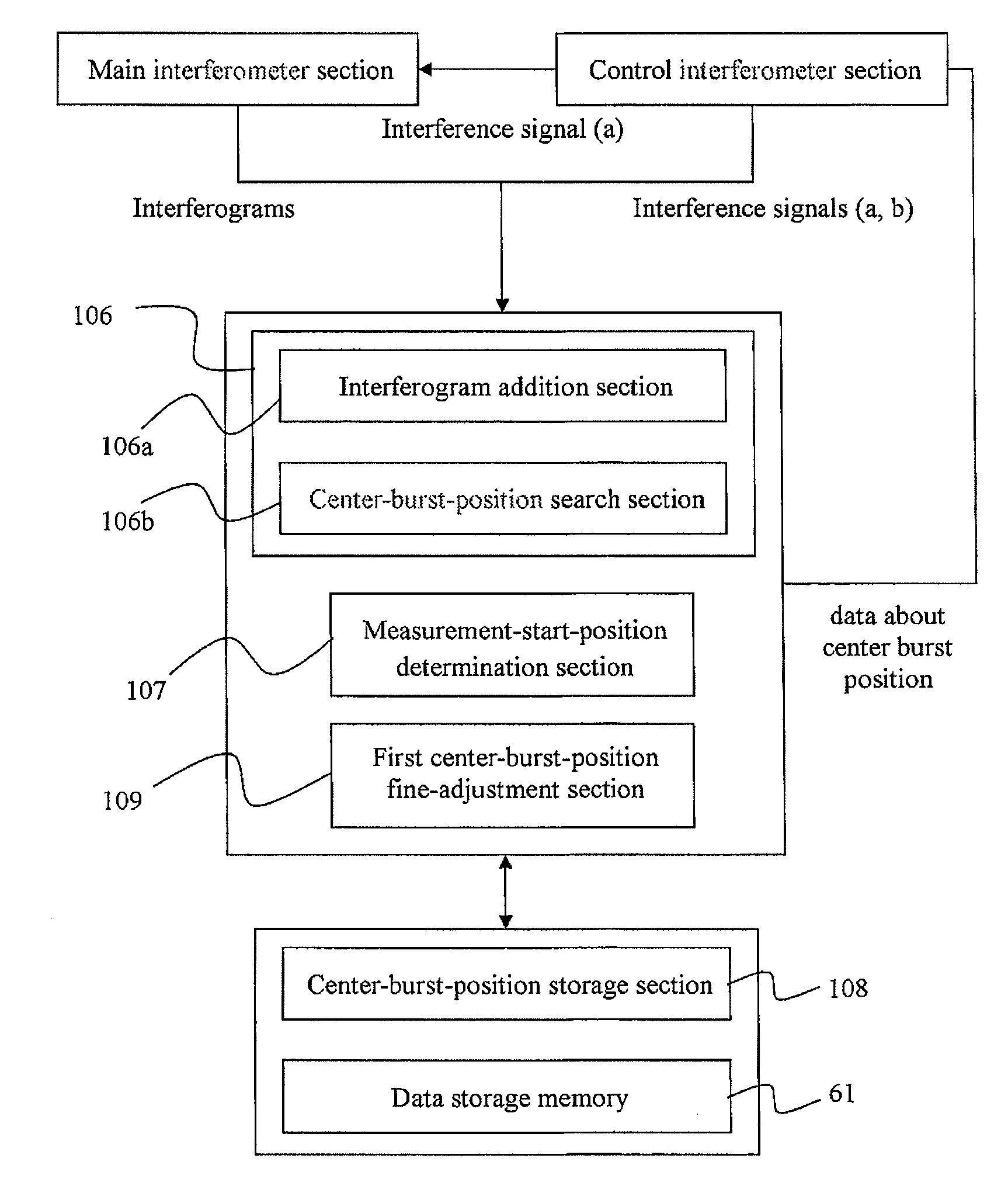
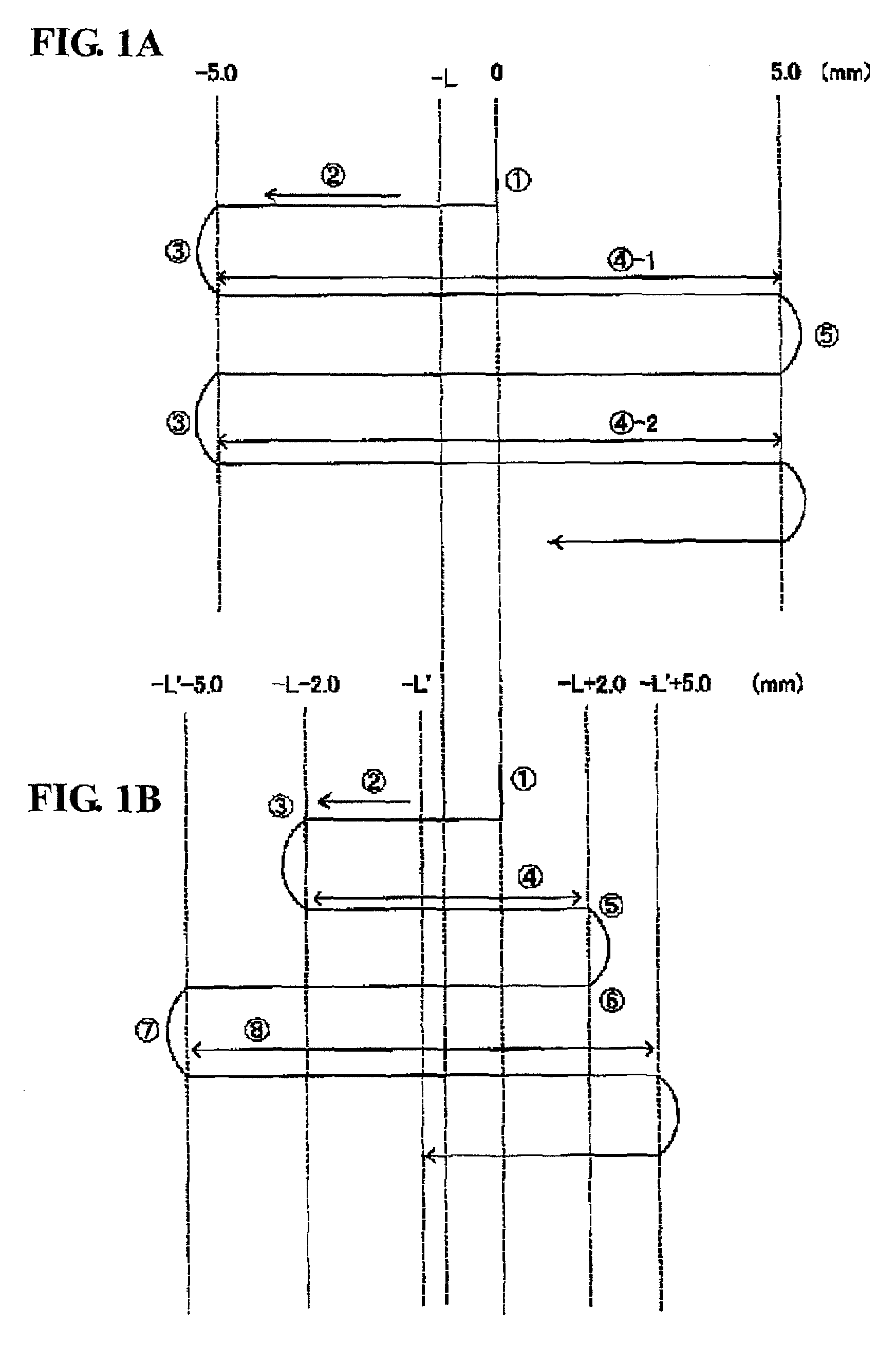
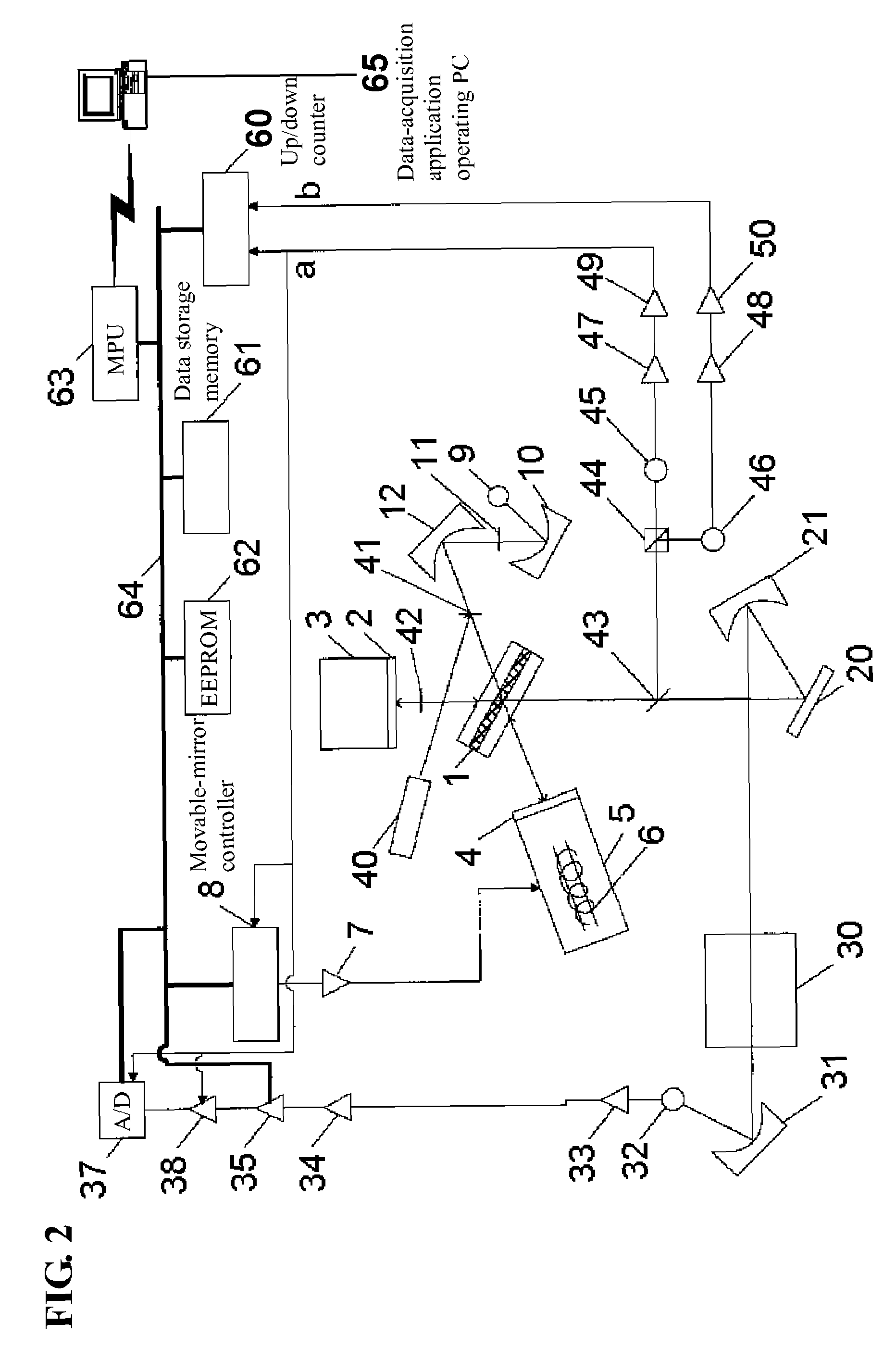
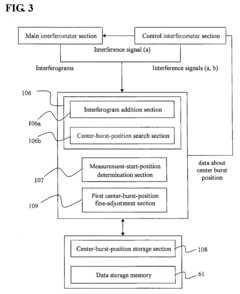
- The implementation of a center-burst-position detection section that performs addition processing on interferogram intensities to produce a cumulative interferogram, correcting positional deviations and enhancing the detection of the center burst position by increasing the intensity of true peaks while canceling out noise peaks, thereby ensuring accurate detection even under low light conditions.
Cost-Benefit Analysis of Implementation Approaches
When evaluating the implementation approaches for FTIR versus modular spectroscopy technologies, a comprehensive cost-benefit analysis reveals significant differences in initial investment, operational expenses, and long-term value proposition.
The initial capital expenditure for traditional FTIR systems typically ranges from $20,000 to $100,000 for laboratory-grade instruments, representing a substantial upfront investment. Conversely, modular spectroscopy solutions generally require lower initial outlays, with entry-level systems starting around $5,000 to $15,000, making them more accessible for smaller organizations or pilot projects.
Operational costs present another critical dimension for comparison. FTIR systems often demand specialized maintenance contracts costing $2,000-$5,000 annually, plus expenses for replacement parts and consumables. These systems also require controlled environmental conditions, potentially necessitating additional infrastructure investments. Modular spectroscopy solutions typically incur lower maintenance costs, with annual expenses averaging 30-50% less than traditional FTIR systems.
Energy consumption metrics further differentiate these technologies. Traditional FTIR instruments consume approximately 200-400 watts during operation, while modular systems generally operate at 50-150 watts, translating to meaningful energy savings over the equipment lifecycle.
Personnel requirements constitute another significant cost factor. FTIR systems traditionally require operators with specialized training, whereas modular spectroscopy's simplified interfaces and automated calibration features reduce training requirements by an estimated 40-60%, lowering both direct training costs and opportunity costs associated with staff development.
Return on investment calculations reveal that while FTIR systems may take 3-5 years to reach ROI breakeven points, modular spectroscopy solutions typically achieve this milestone in 1-3 years, depending on application intensity and utilization rates.
Scalability considerations further favor modular approaches, as they allow for incremental investment aligned with organizational growth. This contrasts with FTIR systems that often require complete replacement when capacity needs increase, resulting in redundant capital expenditures.
Risk assessment metrics indicate that modular systems present lower financial exposure due to their distributed architecture—failure of a single component rarely necessitates complete system replacement. Conversely, critical failures in integrated FTIR systems can result in total downtime and substantial repair costs, representing a higher financial risk profile.
The initial capital expenditure for traditional FTIR systems typically ranges from $20,000 to $100,000 for laboratory-grade instruments, representing a substantial upfront investment. Conversely, modular spectroscopy solutions generally require lower initial outlays, with entry-level systems starting around $5,000 to $15,000, making them more accessible for smaller organizations or pilot projects.
Operational costs present another critical dimension for comparison. FTIR systems often demand specialized maintenance contracts costing $2,000-$5,000 annually, plus expenses for replacement parts and consumables. These systems also require controlled environmental conditions, potentially necessitating additional infrastructure investments. Modular spectroscopy solutions typically incur lower maintenance costs, with annual expenses averaging 30-50% less than traditional FTIR systems.
Energy consumption metrics further differentiate these technologies. Traditional FTIR instruments consume approximately 200-400 watts during operation, while modular systems generally operate at 50-150 watts, translating to meaningful energy savings over the equipment lifecycle.
Personnel requirements constitute another significant cost factor. FTIR systems traditionally require operators with specialized training, whereas modular spectroscopy's simplified interfaces and automated calibration features reduce training requirements by an estimated 40-60%, lowering both direct training costs and opportunity costs associated with staff development.
Return on investment calculations reveal that while FTIR systems may take 3-5 years to reach ROI breakeven points, modular spectroscopy solutions typically achieve this milestone in 1-3 years, depending on application intensity and utilization rates.
Scalability considerations further favor modular approaches, as they allow for incremental investment aligned with organizational growth. This contrasts with FTIR systems that often require complete replacement when capacity needs increase, resulting in redundant capital expenditures.
Risk assessment metrics indicate that modular systems present lower financial exposure due to their distributed architecture—failure of a single component rarely necessitates complete system replacement. Conversely, critical failures in integrated FTIR systems can result in total downtime and substantial repair costs, representing a higher financial risk profile.
Environmental Impact and Sustainability Considerations
The environmental footprint of spectroscopic technologies has become increasingly important as organizations worldwide commit to sustainability goals. FTIR (Fourier Transform Infrared) spectroscopy systems traditionally consume significant energy due to their complex optical components and continuous operation requirements. These systems often utilize specialized materials in their construction, including rare earth elements and precision optics that present challenges for end-of-life recycling and disposal.
In contrast, modular spectroscopy approaches offer several environmental advantages. Their reduced size and power requirements translate to lower energy consumption, with some modern modular systems operating on less than 5 watts compared to traditional FTIR systems requiring 50-100 watts. This energy efficiency becomes particularly significant when considering the cumulative impact of instruments deployed across multiple locations or in continuous monitoring applications.
The manufacturing processes for modular spectroscopic components typically require fewer specialized materials and can be designed with sustainability principles from inception. Many newer modular systems incorporate recyclable components and avoid hazardous substances in compliance with regulations such as RoHS (Restriction of Hazardous Substances) and REACH (Registration, Evaluation, Authorization and Restriction of Chemicals).
Field deployment considerations further highlight sustainability differences. FTIR systems often require climate-controlled environments and regular maintenance involving specialized parts and chemicals. Modular systems, designed for field operation, can function in ambient conditions without extensive environmental controls, reducing the overall carbon footprint of their operation. Their simplified maintenance requirements also reduce the need for service visits and replacement parts over their operational lifetime.
Life cycle assessment (LCA) studies indicate that modular spectroscopic technologies can reduce the overall environmental impact by 30-40% compared to traditional FTIR systems when considering manufacturing, operation, and disposal phases. This advantage becomes particularly pronounced in remote monitoring applications where energy efficiency and durability are paramount.
The adaptability of modular systems also supports circular economy principles. Their component-based architecture facilitates upgrades rather than complete system replacement, extending useful life and reducing electronic waste. Several manufacturers have implemented take-back programs specifically for modular spectroscopic components, ensuring proper recycling of electronic and optical elements.
As environmental regulations become more stringent globally, the sustainability advantages of modular spectroscopy may become decisive factors in technology selection, particularly for applications in environmentally sensitive areas or organizations with strong sustainability commitments.
In contrast, modular spectroscopy approaches offer several environmental advantages. Their reduced size and power requirements translate to lower energy consumption, with some modern modular systems operating on less than 5 watts compared to traditional FTIR systems requiring 50-100 watts. This energy efficiency becomes particularly significant when considering the cumulative impact of instruments deployed across multiple locations or in continuous monitoring applications.
The manufacturing processes for modular spectroscopic components typically require fewer specialized materials and can be designed with sustainability principles from inception. Many newer modular systems incorporate recyclable components and avoid hazardous substances in compliance with regulations such as RoHS (Restriction of Hazardous Substances) and REACH (Registration, Evaluation, Authorization and Restriction of Chemicals).
Field deployment considerations further highlight sustainability differences. FTIR systems often require climate-controlled environments and regular maintenance involving specialized parts and chemicals. Modular systems, designed for field operation, can function in ambient conditions without extensive environmental controls, reducing the overall carbon footprint of their operation. Their simplified maintenance requirements also reduce the need for service visits and replacement parts over their operational lifetime.
Life cycle assessment (LCA) studies indicate that modular spectroscopic technologies can reduce the overall environmental impact by 30-40% compared to traditional FTIR systems when considering manufacturing, operation, and disposal phases. This advantage becomes particularly pronounced in remote monitoring applications where energy efficiency and durability are paramount.
The adaptability of modular systems also supports circular economy principles. Their component-based architecture facilitates upgrades rather than complete system replacement, extending useful life and reducing electronic waste. Several manufacturers have implemented take-back programs specifically for modular spectroscopic components, ensuring proper recycling of electronic and optical elements.
As environmental regulations become more stringent globally, the sustainability advantages of modular spectroscopy may become decisive factors in technology selection, particularly for applications in environmentally sensitive areas or organizations with strong sustainability commitments.
Unlock deeper insights with Patsnap Eureka Quick Research — get a full tech report to explore trends and direct your research. Try now!
Generate Your Research Report Instantly with AI Agent
Supercharge your innovation with Patsnap Eureka AI Agent Platform!