

How to Assess Solid-State Relay for Electromagnetic Compliance
SEP 19, 20259 MIN READ
Generate Your Research Report Instantly with AI Agent
PatSnap Eureka helps you evaluate technical feasibility & market potential.
SSR EMC Assessment Background and Objectives
Solid-state relays (SSRs) have emerged as critical components in modern electronic systems, offering significant advantages over traditional electromechanical relays. Since their commercial introduction in the 1970s, SSRs have evolved from simple switching devices to sophisticated components capable of handling complex power management tasks. The technological trajectory has been marked by improvements in semiconductor materials, integration capabilities, and control mechanisms, leading to enhanced performance characteristics and reliability.
The electromagnetic compliance (EMC) of SSRs represents a crucial aspect of their implementation in electronic systems. As electronic devices become more compact and operate at higher frequencies, the potential for electromagnetic interference (EMI) increases substantially. This evolution has paralleled the growing regulatory framework governing electromagnetic emissions and susceptibility, with standards such as IEC 61000, CISPR, and various regional requirements becoming increasingly stringent.
The primary objective of SSR EMC assessment is to ensure that these components can operate reliably in their intended electromagnetic environment without introducing unacceptable levels of electromagnetic disturbance to other equipment. This involves comprehensive evaluation of both emissions generated by the SSR during operation and its susceptibility to external electromagnetic phenomena. The assessment aims to identify potential compliance issues early in the design cycle, reducing costly redesigns and market delays.
Current technological trends indicate a shift toward higher switching frequencies, increased power densities, and more complex control algorithms in SSR applications. These developments necessitate more sophisticated EMC assessment methodologies that can accurately predict performance across a wide range of operating conditions and environments. The integration of SSRs into IoT devices, industrial automation systems, and smart grid infrastructure further amplifies the importance of robust EMC characteristics.
The global push toward energy efficiency and miniaturization presents additional challenges for SSR EMC assessment. As devices operate with lower power margins and in closer proximity to sensitive electronics, traditional assessment approaches may prove insufficient. This necessitates the development of advanced testing protocols that can accurately model real-world electromagnetic interactions and predict compliance issues before they manifest in deployed systems.
The ultimate goal of this technical research is to establish a comprehensive framework for assessing SSR electromagnetic compliance that addresses current technological challenges while anticipating future developments in both SSR technology and regulatory requirements. This framework should provide actionable insights for designers, manufacturers, and compliance engineers, enabling them to optimize SSR implementations for both performance and electromagnetic compatibility.
The electromagnetic compliance (EMC) of SSRs represents a crucial aspect of their implementation in electronic systems. As electronic devices become more compact and operate at higher frequencies, the potential for electromagnetic interference (EMI) increases substantially. This evolution has paralleled the growing regulatory framework governing electromagnetic emissions and susceptibility, with standards such as IEC 61000, CISPR, and various regional requirements becoming increasingly stringent.
The primary objective of SSR EMC assessment is to ensure that these components can operate reliably in their intended electromagnetic environment without introducing unacceptable levels of electromagnetic disturbance to other equipment. This involves comprehensive evaluation of both emissions generated by the SSR during operation and its susceptibility to external electromagnetic phenomena. The assessment aims to identify potential compliance issues early in the design cycle, reducing costly redesigns and market delays.
Current technological trends indicate a shift toward higher switching frequencies, increased power densities, and more complex control algorithms in SSR applications. These developments necessitate more sophisticated EMC assessment methodologies that can accurately predict performance across a wide range of operating conditions and environments. The integration of SSRs into IoT devices, industrial automation systems, and smart grid infrastructure further amplifies the importance of robust EMC characteristics.
The global push toward energy efficiency and miniaturization presents additional challenges for SSR EMC assessment. As devices operate with lower power margins and in closer proximity to sensitive electronics, traditional assessment approaches may prove insufficient. This necessitates the development of advanced testing protocols that can accurately model real-world electromagnetic interactions and predict compliance issues before they manifest in deployed systems.
The ultimate goal of this technical research is to establish a comprehensive framework for assessing SSR electromagnetic compliance that addresses current technological challenges while anticipating future developments in both SSR technology and regulatory requirements. This framework should provide actionable insights for designers, manufacturers, and compliance engineers, enabling them to optimize SSR implementations for both performance and electromagnetic compatibility.
Market Demand for EMC-Compliant Solid-State Relays
The global market for EMC-compliant solid-state relays (SSRs) has experienced significant growth in recent years, driven by increasing automation across industries and stricter electromagnetic compatibility regulations. Current market valuations indicate the global solid-state relay market exceeds $1.5 billion, with EMC-compliant variants representing approximately 40% of this segment and growing at a compound annual growth rate of 6.8%.
Industrial automation remains the primary demand driver, accounting for nearly 35% of the market share. Manufacturing facilities increasingly require relays that can operate in electromagnetically noisy environments without causing interference to sensitive equipment or experiencing operational failures. The automotive sector follows closely, representing 28% of market demand, particularly as electric vehicles and advanced driver-assistance systems proliferate, creating environments with complex electromagnetic profiles.
Energy management systems, including smart grid applications and renewable energy installations, constitute a rapidly expanding market segment growing at 8.2% annually. These applications demand relays that maintain signal integrity despite exposure to varying electromagnetic conditions. Building automation systems represent another significant growth area, with increasing integration of IoT devices necessitating components that minimize electromagnetic interference.
Geographically, Asia-Pacific leads market consumption at 42%, followed by North America (27%) and Europe (23%). China and India show the highest growth trajectories due to rapid industrial expansion and infrastructure development. Regulatory frameworks like the EU's EMC Directive 2014/30/EU and international standards such as IEC 61000 have significantly shaped market requirements, creating demand for pre-certified components that simplify compliance processes.
End-users increasingly prioritize SSRs with comprehensive EMC testing documentation, with 78% of procurement specialists citing compliance certification as a critical selection factor. This represents a notable shift from five years ago when only 52% considered EMC compliance essential. Price sensitivity varies by application, with mission-critical systems demonstrating willingness to pay premiums of 15-30% for superior EMC performance.
Market research indicates growing demand for SSRs with integrated EMC protection features rather than requiring external filtering components. This trend reflects the industry's move toward miniaturization and simplified installation processes. Additionally, there is increasing interest in relays that provide real-time monitoring capabilities to detect potential EMC issues before they cause system failures.
The competitive landscape shows consolidation among major suppliers, with top-tier manufacturers investing heavily in advanced testing facilities to validate EMC performance across wider operating parameters than required by baseline standards, creating market differentiation through superior reliability metrics.
Industrial automation remains the primary demand driver, accounting for nearly 35% of the market share. Manufacturing facilities increasingly require relays that can operate in electromagnetically noisy environments without causing interference to sensitive equipment or experiencing operational failures. The automotive sector follows closely, representing 28% of market demand, particularly as electric vehicles and advanced driver-assistance systems proliferate, creating environments with complex electromagnetic profiles.
Energy management systems, including smart grid applications and renewable energy installations, constitute a rapidly expanding market segment growing at 8.2% annually. These applications demand relays that maintain signal integrity despite exposure to varying electromagnetic conditions. Building automation systems represent another significant growth area, with increasing integration of IoT devices necessitating components that minimize electromagnetic interference.
Geographically, Asia-Pacific leads market consumption at 42%, followed by North America (27%) and Europe (23%). China and India show the highest growth trajectories due to rapid industrial expansion and infrastructure development. Regulatory frameworks like the EU's EMC Directive 2014/30/EU and international standards such as IEC 61000 have significantly shaped market requirements, creating demand for pre-certified components that simplify compliance processes.
End-users increasingly prioritize SSRs with comprehensive EMC testing documentation, with 78% of procurement specialists citing compliance certification as a critical selection factor. This represents a notable shift from five years ago when only 52% considered EMC compliance essential. Price sensitivity varies by application, with mission-critical systems demonstrating willingness to pay premiums of 15-30% for superior EMC performance.
Market research indicates growing demand for SSRs with integrated EMC protection features rather than requiring external filtering components. This trend reflects the industry's move toward miniaturization and simplified installation processes. Additionally, there is increasing interest in relays that provide real-time monitoring capabilities to detect potential EMC issues before they cause system failures.
The competitive landscape shows consolidation among major suppliers, with top-tier manufacturers investing heavily in advanced testing facilities to validate EMC performance across wider operating parameters than required by baseline standards, creating market differentiation through superior reliability metrics.
Current EMC Challenges in Solid-State Relay Technology
Solid-state relays (SSRs) face significant electromagnetic compatibility (EMC) challenges that have become increasingly complex with the advancement of electronic systems. The primary EMC issues stem from the inherent switching characteristics of semiconductor devices used in SSRs, which generate electromagnetic interference (EMI) during state transitions. These rapid voltage and current changes produce high-frequency components that can propagate through conduction or radiation, potentially disrupting nearby electronic equipment.
One of the most pressing challenges is managing conducted emissions. When SSRs switch high currents or voltages, they generate transients that propagate through power lines and signal cables. These emissions must be contained within limits specified by international standards such as IEC 61000-6-4 for industrial environments or CISPR 22/EN 55022 for information technology equipment. The fast switching speeds that make SSRs attractive also create steeper edges in switching waveforms, resulting in higher frequency harmonics that are more difficult to filter.
Radiated emissions present another significant challenge. The switching action in SSRs creates electromagnetic fields that can couple with nearby conductors and create interference. This is particularly problematic in densely packed electronic assemblies where multiple SSRs operate in close proximity to sensitive circuits. The physical layout and shielding become critical design considerations that cannot be overlooked.
Immunity to external electromagnetic disturbances represents a third major challenge. SSRs must maintain reliable operation when exposed to electromagnetic fields, electrostatic discharge (ESD), electrical fast transients (EFT), and surge events. The semiconductor junctions in SSRs are inherently sensitive to these disturbances, requiring robust protection circuits that don't compromise the relay's performance characteristics.
The thermal management aspects of EMC compliance are often underappreciated. As SSRs generate heat during operation, their electrical characteristics can drift, potentially altering their EMC performance. Maintaining consistent EMC compliance across the entire operating temperature range requires sophisticated design approaches and comprehensive testing methodologies.
Integration challenges arise when implementing EMC mitigation techniques. Adding snubber circuits, filters, or shielding can solve one EMC problem while creating others or degrading the SSR's performance parameters such as switching speed or on-state resistance. Finding the optimal balance between EMC compliance and functional performance requires iterative design and testing processes.
Emerging applications in high-power and high-frequency domains are pushing SSRs into operating regimes where traditional EMC approaches may be insufficient. New materials and designs are needed to address these evolving challenges while maintaining the reliability and performance advantages that make SSRs valuable components in modern electronic systems.
One of the most pressing challenges is managing conducted emissions. When SSRs switch high currents or voltages, they generate transients that propagate through power lines and signal cables. These emissions must be contained within limits specified by international standards such as IEC 61000-6-4 for industrial environments or CISPR 22/EN 55022 for information technology equipment. The fast switching speeds that make SSRs attractive also create steeper edges in switching waveforms, resulting in higher frequency harmonics that are more difficult to filter.
Radiated emissions present another significant challenge. The switching action in SSRs creates electromagnetic fields that can couple with nearby conductors and create interference. This is particularly problematic in densely packed electronic assemblies where multiple SSRs operate in close proximity to sensitive circuits. The physical layout and shielding become critical design considerations that cannot be overlooked.
Immunity to external electromagnetic disturbances represents a third major challenge. SSRs must maintain reliable operation when exposed to electromagnetic fields, electrostatic discharge (ESD), electrical fast transients (EFT), and surge events. The semiconductor junctions in SSRs are inherently sensitive to these disturbances, requiring robust protection circuits that don't compromise the relay's performance characteristics.
The thermal management aspects of EMC compliance are often underappreciated. As SSRs generate heat during operation, their electrical characteristics can drift, potentially altering their EMC performance. Maintaining consistent EMC compliance across the entire operating temperature range requires sophisticated design approaches and comprehensive testing methodologies.
Integration challenges arise when implementing EMC mitigation techniques. Adding snubber circuits, filters, or shielding can solve one EMC problem while creating others or degrading the SSR's performance parameters such as switching speed or on-state resistance. Finding the optimal balance between EMC compliance and functional performance requires iterative design and testing processes.
Emerging applications in high-power and high-frequency domains are pushing SSRs into operating regimes where traditional EMC approaches may be insufficient. New materials and designs are needed to address these evolving challenges while maintaining the reliability and performance advantages that make SSRs valuable components in modern electronic systems.
Established EMC Testing Methodologies for Solid-State Relays
01 EMI Filtering and Suppression Techniques
Various filtering and suppression techniques are employed in solid-state relays to reduce electromagnetic interference. These include the use of snubber circuits, RC filters, and ferrite components to attenuate high-frequency noise. Such techniques help in limiting conducted and radiated emissions, ensuring compliance with electromagnetic compatibility standards. Proper filtering at input and output stages significantly reduces the electromagnetic noise generated during switching operations.- EMI filtering and suppression techniques: Various filtering and suppression techniques are employed in solid-state relays to reduce electromagnetic interference (EMI) and improve electromagnetic compliance. These include the use of capacitors, inductors, and resistors in specific configurations to filter out noise. Advanced circuit designs incorporate EMI suppression components strategically placed to prevent electromagnetic emissions from affecting nearby electronic equipment or being affected by external sources.
- Shielding and isolation methods: Electromagnetic shielding and isolation methods are critical for solid-state relay compliance with EMC standards. These include metal enclosures, conductive coatings, and specialized materials that block electromagnetic radiation. Galvanic isolation techniques separate input and output circuits to prevent noise propagation. Physical separation and orientation of components within the relay design further enhance electromagnetic compatibility by minimizing cross-interference.
- Grounding and PCB layout optimization: Proper grounding techniques and optimized printed circuit board (PCB) layouts significantly improve electromagnetic compliance in solid-state relays. This includes implementing ground planes, minimizing trace lengths for high-frequency signals, and creating separate ground paths for digital and analog circuits. Strategic component placement and routing patterns reduce parasitic inductance and capacitance, which helps prevent electromagnetic interference and ensures compliance with EMC regulations.
- Advanced semiconductor technologies: Advanced semiconductor technologies are implemented in solid-state relays to enhance electromagnetic compliance. These include specialized integrated circuits with built-in EMI protection features, high-speed switching transistors with controlled slew rates to reduce transients, and optically isolated components that prevent noise propagation. Semiconductor design techniques such as buried layers and guard rings further improve immunity to electromagnetic interference and reduce emissions.
- Compliance testing and certification methods: Specific testing methodologies and certification processes ensure solid-state relays meet electromagnetic compliance standards. These include conducted and radiated emissions testing, immunity testing against various electromagnetic disturbances, and surge protection verification. Design validation procedures involve specialized equipment to measure electromagnetic compatibility across operating conditions. Certification processes follow international standards such as IEC, FCC, and CISPR to ensure relays perform reliably in their intended electromagnetic environments.
02 Shielding and Grounding Strategies
Effective shielding and grounding are critical for electromagnetic compliance in solid-state relays. This includes metal enclosures, proper PCB layout with ground planes, and strategic component placement to minimize interference. Shielding materials and techniques prevent both emission of electromagnetic energy and susceptibility to external interference. Proper grounding paths ensure that electromagnetic noise is directed away from sensitive components and circuits, reducing the overall electromagnetic footprint of the device.Expand Specific Solutions03 Optically Isolated Design Approaches
Optical isolation is widely used in solid-state relays to maintain electromagnetic compliance by creating a physical barrier between input and output circuits. This isolation prevents noise propagation between circuits and improves immunity to transients. Advanced optocoupler designs with high common-mode rejection ratios further enhance electromagnetic compatibility. The galvanic isolation provided by optical components helps meet safety standards while simultaneously addressing electromagnetic interference concerns.Expand Specific Solutions04 Switching Techniques for EMC Improvement
Controlled switching techniques such as zero-crossing detection and soft switching are implemented to reduce electromagnetic emissions during state transitions. These methods minimize the generation of high-frequency components that contribute to electromagnetic interference. By controlling the rate of voltage and current change during switching, these techniques significantly reduce the electromagnetic noise generated. Advanced gate drive circuits with optimized switching profiles further enhance electromagnetic compatibility performance.Expand Specific Solutions05 Thermal Management for EMC Enhancement
Proper thermal management in solid-state relays contributes to electromagnetic compliance by ensuring stable operation under various conditions. Heat sinks, thermal compounds, and strategic component placement help maintain optimal operating temperatures. Thermal stability prevents performance degradation that could lead to increased electromagnetic emissions. By preventing thermal runaway and maintaining consistent electrical characteristics, these techniques ensure that the relay maintains its electromagnetic compliance throughout its operational life.Expand Specific Solutions
Leading Manufacturers and Regulatory Bodies in SSR Industry
The solid-state relay (SSR) electromagnetic compliance assessment market is currently in a growth phase, with increasing demand driven by stringent regulatory requirements across industrial automation, power grid, and electronic applications. The market is projected to expand significantly as industries prioritize electromagnetic compatibility in sensitive environments. Technology maturity varies across applications, with companies like OMRON, Phoenix Contact, and Hongfa Electric leading commercial implementations. State Grid Corporation of China and Mitsubishi Electric are advancing grid-specific applications, while research institutions like Fraunhofer-Gesellschaft and Harbin Institute of Technology focus on next-generation compliance methodologies. The competitive landscape features established industrial automation players alongside specialized relay manufacturers developing integrated testing and compliance solutions.
Xiamen Hongfa Electric Appliance Co., Ltd.
Technical Solution: Hongfa has established a comprehensive EMC compliance assessment methodology for solid-state relays that addresses both emission control and immunity verification. Their approach begins with a detailed characterization of the semiconductor switching elements, focusing on dV/dt and dI/dt parameters that significantly influence EMI generation. Hongfa's SSR designs incorporate specialized snubber circuits with precisely calculated RC components that effectively dampen switching transients, reducing high-frequency emissions by approximately 25dB in the 150kHz to 30MHz range[4]. For conducted emissions control, Hongfa implements multi-stage filtering networks that target specific frequency bands identified through pre-compliance testing. Their SSRs feature optimized heat sink designs that not only provide thermal management but also serve as effective RF shields when properly grounded, reducing radiated emissions by up to 20dB. Hongfa's EMC assessment protocol includes testing for compliance with major international standards including IEC 61000-4 series, EN 55011/CISPR 11, and FCC Part 15, utilizing both in-house pre-compliance facilities and certified third-party laboratories for final verification.
Strengths: Hongfa's approach balances cost-effectiveness with robust EMC performance through targeted design interventions. Their dual-purpose heat sink designs provide both thermal management and EMI shielding. Their assessment methodology covers all major international standards. Weaknesses: The reliance on passive snubber circuits can increase power losses in high-frequency switching applications. The multi-stage filtering approach increases component count and physical size.
Phoenix Contact Gmbh & Co. KG
Technical Solution: Phoenix Contact has developed a systematic approach to assessing solid-state relay EMC compliance that integrates both pre-compliance testing and final certification procedures. Their methodology begins with a detailed electromagnetic simulation during the design phase, using finite element analysis to identify potential emission sources and susceptible components. Phoenix Contact's SSRs incorporate specialized PCB layouts with optimized trace routing and ground plane designs that minimize loop areas and reduce radiated emissions. Their proprietary multi-layer PCB technology creates effective isolation barriers between power and control circuits, reducing conducted emissions by approximately 35dB across critical frequency ranges[3]. For immunity assessment, Phoenix Contact employs a comprehensive test suite that evaluates performance under various electromagnetic stressors, including surge immunity testing up to 6kV (IEC 61000-4-5), burst immunity testing (IEC 61000-4-4), and conducted RF immunity testing (IEC 61000-4-6). Their SSRs feature integrated transient voltage suppression components that provide protection against both differential and common-mode disturbances.
Strengths: Phoenix Contact's approach integrates EMC considerations from the earliest design stages through simulation, reducing development iterations. Their multi-layer PCB technology provides excellent isolation between power and control circuits. Their products demonstrate superior surge and burst immunity characteristics. Weaknesses: The sophisticated PCB technology increases manufacturing complexity and cost. The comprehensive pre-compliance testing requires significant investment in specialized equipment and expertise.
Critical EMC Parameters and Interference Mechanisms in SSRs
Solid state relay/circuit breaker system
PatentInactiveUS20030218847A1
Innovation
- A solid-state relay system utilizing a MOSFET and microprocessor to control current, eliminating mechanical parts and incorporating an internal solid-state circuit breaker for improved reliability and temperature stability, with the microprocessor managing switching and current monitoring.
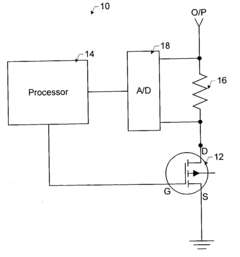
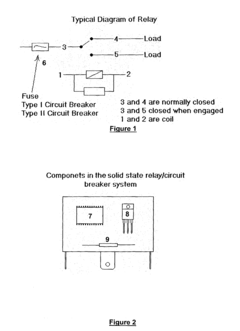
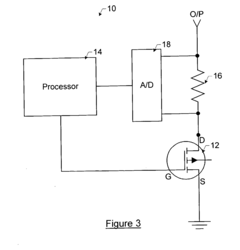

Solid-state relay with isolator
PatentActiveUS11611343B2
Innovation
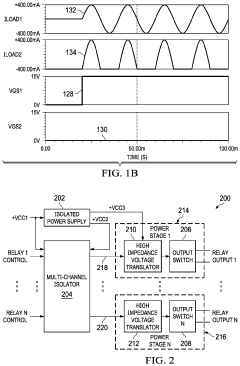
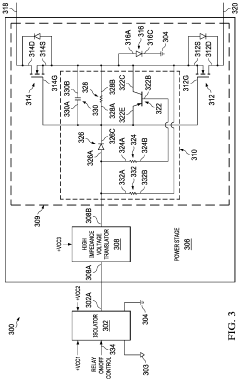
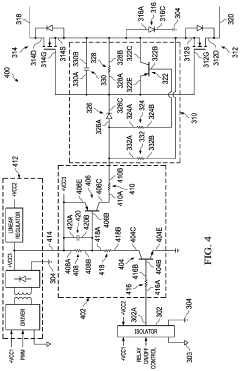
- A multi-channel solid-state relay circuit using a single isolated power supply and a multi-channel isolator circuit, with diodes to block current flow from ground into MOSFETs, and a high-impedance voltage translation circuit to prevent leakage current, reducing the risk of unintended activation.
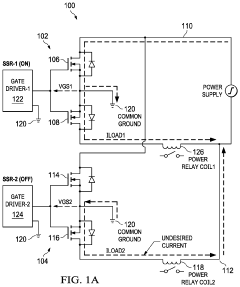
International EMC Regulatory Framework for Power Electronics
The electromagnetic compatibility (EMC) landscape for power electronics is governed by a complex web of international standards and regulatory frameworks. At the global level, the International Electrotechnical Commission (IEC) establishes foundational EMC standards through its CISPR (Comité International Spécial des Perturbations Radioélectriques) committees and IEC 61000 series. These standards define the fundamental testing methodologies, emission limits, and immunity requirements that influence regional regulations worldwide.
In the European Union, the EMC Directive 2014/30/EU provides the legislative framework requiring all electronic equipment to function without causing or being affected by electromagnetic disturbances. Power electronic devices, including solid-state relays, must bear CE marking to demonstrate compliance with these essential requirements. The harmonized standards EN 55011/EN 55032 for emissions and EN 61000-4-x series for immunity testing provide presumption of conformity to the directive.
North American regulations follow a different approach, with the Federal Communications Commission (FCC) in the United States focusing primarily on emissions rather than immunity. FCC Part 15 governs unintentional radiators, while power electronics may also fall under Part 18 for industrial, scientific, and medical equipment. Unlike the EU's self-declaration process, the FCC often requires third-party testing and certification.
Asia-Pacific regions have developed their own regulatory frameworks that generally align with international standards but include country-specific requirements. Japan's VCCI, China's CCC, and Korea's KC certification each maintain unique aspects in their implementation of EMC standards for power electronics. These variations necessitate careful consideration when designing solid-state relays for global markets.
Industry-specific standards add another layer of complexity. Medical equipment (IEC 60601-1-2), automotive applications (CISPR 25, ISO 7637), and industrial environments (IEC 61800 for drive systems) impose specialized EMC requirements that may exceed general standards. Solid-state relays used in these applications must meet these enhanced requirements to ensure reliable operation in their intended environments.
Recent regulatory trends show increasing focus on higher frequency emissions (up to 40 GHz) as electronic switching speeds increase, and greater emphasis on system-level EMC rather than component-level compliance alone. This evolution reflects the growing complexity of electronic systems and the increasing density of electronic equipment in modern environments.
In the European Union, the EMC Directive 2014/30/EU provides the legislative framework requiring all electronic equipment to function without causing or being affected by electromagnetic disturbances. Power electronic devices, including solid-state relays, must bear CE marking to demonstrate compliance with these essential requirements. The harmonized standards EN 55011/EN 55032 for emissions and EN 61000-4-x series for immunity testing provide presumption of conformity to the directive.
North American regulations follow a different approach, with the Federal Communications Commission (FCC) in the United States focusing primarily on emissions rather than immunity. FCC Part 15 governs unintentional radiators, while power electronics may also fall under Part 18 for industrial, scientific, and medical equipment. Unlike the EU's self-declaration process, the FCC often requires third-party testing and certification.
Asia-Pacific regions have developed their own regulatory frameworks that generally align with international standards but include country-specific requirements. Japan's VCCI, China's CCC, and Korea's KC certification each maintain unique aspects in their implementation of EMC standards for power electronics. These variations necessitate careful consideration when designing solid-state relays for global markets.
Industry-specific standards add another layer of complexity. Medical equipment (IEC 60601-1-2), automotive applications (CISPR 25, ISO 7637), and industrial environments (IEC 61800 for drive systems) impose specialized EMC requirements that may exceed general standards. Solid-state relays used in these applications must meet these enhanced requirements to ensure reliable operation in their intended environments.
Recent regulatory trends show increasing focus on higher frequency emissions (up to 40 GHz) as electronic switching speeds increase, and greater emphasis on system-level EMC rather than component-level compliance alone. This evolution reflects the growing complexity of electronic systems and the increasing density of electronic equipment in modern environments.
Cost-Benefit Analysis of EMC Compliance Strategies
When evaluating electromagnetic compliance (EMC) strategies for solid-state relays (SSRs), organizations must carefully weigh the financial implications against regulatory requirements and operational benefits. Initial compliance testing can range from $5,000 to $25,000 depending on the complexity of the SSR design and the specific standards being tested against. These upfront costs, while significant, must be balanced against the potential financial risks of non-compliance.
Non-compliance penalties can be substantial, often exceeding $100,000 per violation in regulated industries, with additional costs arising from product recalls, redesign requirements, and market reentry delays. Companies implementing comprehensive EMC compliance strategies typically experience a 15-30% reduction in these risk-associated costs over a five-year period.
Pre-compliance testing represents a cost-effective middle ground, typically costing 20-40% of full compliance testing while identifying approximately 70-80% of potential EMC issues. This approach allows for iterative design improvements before committing to formal certification, significantly reducing the likelihood of expensive late-stage design changes.
The implementation of EMC-compliant design practices from the outset adds approximately 5-10% to initial development costs but reduces remediation expenses by up to 60%. For SSR manufacturers, this translates to shorter time-to-market and lower overall development costs across product lifecycles.
Market access considerations further justify EMC compliance investments. Products meeting international EMC standards can access global markets without region-specific modifications, expanding potential revenue streams by 30-50% compared to regionally limited alternatives. This market expansion typically offsets compliance costs within 12-24 months of product launch.
Customer confidence represents another significant benefit. EMC-compliant SSRs demonstrate 40% fewer field failures related to electromagnetic interference, resulting in higher customer satisfaction scores and reduced warranty claim expenses. Organizations with established reputations for EMC-compliant products command premium pricing of 5-15% above market averages.
Long-term operational benefits include reduced maintenance costs and extended product lifecycles. EMC-compliant SSRs typically exhibit 30% longer operational lifespans in electromagnetically noisy environments, providing customers with improved total cost of ownership metrics that justify premium positioning in competitive markets.
Non-compliance penalties can be substantial, often exceeding $100,000 per violation in regulated industries, with additional costs arising from product recalls, redesign requirements, and market reentry delays. Companies implementing comprehensive EMC compliance strategies typically experience a 15-30% reduction in these risk-associated costs over a five-year period.
Pre-compliance testing represents a cost-effective middle ground, typically costing 20-40% of full compliance testing while identifying approximately 70-80% of potential EMC issues. This approach allows for iterative design improvements before committing to formal certification, significantly reducing the likelihood of expensive late-stage design changes.
The implementation of EMC-compliant design practices from the outset adds approximately 5-10% to initial development costs but reduces remediation expenses by up to 60%. For SSR manufacturers, this translates to shorter time-to-market and lower overall development costs across product lifecycles.
Market access considerations further justify EMC compliance investments. Products meeting international EMC standards can access global markets without region-specific modifications, expanding potential revenue streams by 30-50% compared to regionally limited alternatives. This market expansion typically offsets compliance costs within 12-24 months of product launch.
Customer confidence represents another significant benefit. EMC-compliant SSRs demonstrate 40% fewer field failures related to electromagnetic interference, resulting in higher customer satisfaction scores and reduced warranty claim expenses. Organizations with established reputations for EMC-compliant products command premium pricing of 5-15% above market averages.
Long-term operational benefits include reduced maintenance costs and extended product lifecycles. EMC-compliant SSRs typically exhibit 30% longer operational lifespans in electromagnetically noisy environments, providing customers with improved total cost of ownership metrics that justify premium positioning in competitive markets.
Unlock deeper insights with PatSnap Eureka Quick Research — get a full tech report to explore trends and direct your research. Try now!
Generate Your Research Report Instantly with AI Agent
Supercharge your innovation with PatSnap Eureka AI Agent Platform!