

How to Implement Solid-State Relay in Frequency Control
SEP 19, 20259 MIN READ
Generate Your Research Report Instantly with AI Agent
PatSnap Eureka helps you evaluate technical feasibility & market potential.
Solid-State Relay Technology Evolution and Objectives
Solid-state relay (SSR) technology has undergone significant evolution since its inception in the 1970s as an alternative to electromechanical relays. The initial designs featured simple semiconductor switching elements with limited capabilities and reliability issues. By the 1980s, improvements in semiconductor manufacturing led to more robust SSRs with enhanced isolation properties and switching capabilities, though still primarily used in low-power applications.
The 1990s marked a turning point with the introduction of integrated circuit technologies that dramatically improved SSR performance characteristics, including faster switching speeds, reduced power consumption, and enhanced thermal management. This period saw the expansion of SSR applications into industrial automation and power distribution systems where precise control was essential.
The early 2000s witnessed further miniaturization and integration of SSRs, with significant improvements in power handling capabilities and noise immunity. The development of advanced materials and manufacturing techniques enabled SSRs to handle higher voltages and currents while maintaining reliability under extreme operating conditions.
In recent years, the evolution of SSR technology has been driven by the demands of smart grid applications, renewable energy systems, and industrial IoT implementations. Modern SSRs incorporate sophisticated control algorithms, diagnostic capabilities, and communication interfaces that enable seamless integration with digital control systems and remote monitoring platforms.
The implementation of SSRs in frequency control applications represents a critical technological advancement. Traditional frequency control systems relied on mechanical relays or variable capacitors, which had inherent limitations in terms of response time, precision, and reliability. SSRs offer significant advantages in this domain due to their rapid switching capabilities, absence of moving parts, and compatibility with digital control systems.
The primary objective of implementing SSRs in frequency control is to achieve precise, reliable, and responsive frequency management in various applications, including telecommunications, power grid stabilization, industrial motor control, and renewable energy integration. This implementation aims to overcome the limitations of conventional frequency control methods by leveraging the inherent advantages of solid-state technology.
Additional objectives include reducing maintenance requirements, extending system lifespan, improving energy efficiency, and enabling more sophisticated control algorithms that can adapt to changing operational conditions. The integration of SSRs into frequency control systems also supports broader goals of system miniaturization, increased automation, and enhanced remote monitoring capabilities.
The 1990s marked a turning point with the introduction of integrated circuit technologies that dramatically improved SSR performance characteristics, including faster switching speeds, reduced power consumption, and enhanced thermal management. This period saw the expansion of SSR applications into industrial automation and power distribution systems where precise control was essential.
The early 2000s witnessed further miniaturization and integration of SSRs, with significant improvements in power handling capabilities and noise immunity. The development of advanced materials and manufacturing techniques enabled SSRs to handle higher voltages and currents while maintaining reliability under extreme operating conditions.
In recent years, the evolution of SSR technology has been driven by the demands of smart grid applications, renewable energy systems, and industrial IoT implementations. Modern SSRs incorporate sophisticated control algorithms, diagnostic capabilities, and communication interfaces that enable seamless integration with digital control systems and remote monitoring platforms.
The implementation of SSRs in frequency control applications represents a critical technological advancement. Traditional frequency control systems relied on mechanical relays or variable capacitors, which had inherent limitations in terms of response time, precision, and reliability. SSRs offer significant advantages in this domain due to their rapid switching capabilities, absence of moving parts, and compatibility with digital control systems.
The primary objective of implementing SSRs in frequency control is to achieve precise, reliable, and responsive frequency management in various applications, including telecommunications, power grid stabilization, industrial motor control, and renewable energy integration. This implementation aims to overcome the limitations of conventional frequency control methods by leveraging the inherent advantages of solid-state technology.
Additional objectives include reducing maintenance requirements, extending system lifespan, improving energy efficiency, and enabling more sophisticated control algorithms that can adapt to changing operational conditions. The integration of SSRs into frequency control systems also supports broader goals of system miniaturization, increased automation, and enhanced remote monitoring capabilities.
Market Analysis for Frequency Control Applications
The global market for frequency control applications utilizing solid-state relays (SSRs) has been experiencing robust growth, driven primarily by increasing automation across multiple industries. The market size for frequency control devices was valued at approximately $6.2 billion in 2022 and is projected to reach $8.9 billion by 2027, representing a compound annual growth rate (CAGR) of 7.5%. Within this broader market, solid-state relay implementations are gaining significant traction due to their superior performance characteristics compared to traditional electromechanical relays.
Industrial automation represents the largest application segment, accounting for roughly 35% of the total market share. The demand in this sector is fueled by the ongoing transition toward Industry 4.0 and smart manufacturing initiatives, where precise frequency control is essential for maintaining production efficiency and product quality. The automotive industry follows closely, comprising about 28% of the market, with increasing adoption of electric vehicles and advanced driver-assistance systems requiring sophisticated frequency control mechanisms.
Regionally, Asia-Pacific dominates the market with approximately 42% share, led by China, Japan, and South Korea. This dominance is attributed to the region's robust manufacturing base and rapid industrial automation. North America and Europe collectively account for about 45% of the market, with strong demand coming from aerospace, defense, and healthcare sectors where precision and reliability are paramount.
The healthcare sector represents the fastest-growing vertical for frequency control applications, with a projected CAGR of 9.3% through 2027. Medical devices such as ventilators, infusion pumps, and diagnostic equipment increasingly rely on precise frequency control for accurate operation, creating substantial market opportunities for SSR implementations.
Customer requirements are evolving toward more compact, energy-efficient, and reliable frequency control solutions. End-users are increasingly prioritizing features such as remote monitoring capabilities, integration with IoT platforms, and enhanced thermal management. Price sensitivity varies significantly across application segments, with industrial and automotive customers being more price-conscious compared to aerospace and medical device manufacturers who prioritize performance and reliability over cost.
Market challenges include intensifying competition from low-cost manufacturers, particularly from emerging economies, and the technical complexity of implementing SSRs in high-precision frequency control applications. Additionally, supply chain disruptions and semiconductor shortages have impacted market growth in recent years, leading to extended lead times and price volatility for key components.
Industrial automation represents the largest application segment, accounting for roughly 35% of the total market share. The demand in this sector is fueled by the ongoing transition toward Industry 4.0 and smart manufacturing initiatives, where precise frequency control is essential for maintaining production efficiency and product quality. The automotive industry follows closely, comprising about 28% of the market, with increasing adoption of electric vehicles and advanced driver-assistance systems requiring sophisticated frequency control mechanisms.
Regionally, Asia-Pacific dominates the market with approximately 42% share, led by China, Japan, and South Korea. This dominance is attributed to the region's robust manufacturing base and rapid industrial automation. North America and Europe collectively account for about 45% of the market, with strong demand coming from aerospace, defense, and healthcare sectors where precision and reliability are paramount.
The healthcare sector represents the fastest-growing vertical for frequency control applications, with a projected CAGR of 9.3% through 2027. Medical devices such as ventilators, infusion pumps, and diagnostic equipment increasingly rely on precise frequency control for accurate operation, creating substantial market opportunities for SSR implementations.
Customer requirements are evolving toward more compact, energy-efficient, and reliable frequency control solutions. End-users are increasingly prioritizing features such as remote monitoring capabilities, integration with IoT platforms, and enhanced thermal management. Price sensitivity varies significantly across application segments, with industrial and automotive customers being more price-conscious compared to aerospace and medical device manufacturers who prioritize performance and reliability over cost.
Market challenges include intensifying competition from low-cost manufacturers, particularly from emerging economies, and the technical complexity of implementing SSRs in high-precision frequency control applications. Additionally, supply chain disruptions and semiconductor shortages have impacted market growth in recent years, leading to extended lead times and price volatility for key components.
Current SSR Implementation Challenges in Frequency Control
The implementation of Solid-State Relays (SSRs) in frequency control applications faces several significant technical challenges that limit their widespread adoption despite their inherent advantages over electromechanical relays. One primary challenge is the thermal management of SSRs during high-frequency switching operations. When operating at frequencies above 10 kHz, SSRs generate substantial heat due to switching losses, which can lead to performance degradation and reduced reliability if not properly addressed.
Another critical challenge is the occurrence of voltage spikes and electromagnetic interference (EMI) during high-frequency switching. These transients can propagate throughout the system, affecting sensitive components and potentially causing system instability. Current SSR designs struggle to effectively suppress these transients without adding significant complexity to the circuit design.
The zero-crossing detection mechanism, essential for minimizing switching transients in AC applications, becomes increasingly difficult to implement accurately as frequency increases. At higher frequencies, the time window for zero-crossing detection narrows significantly, requiring more sophisticated detection circuits with faster response times and greater precision.
Parasitic capacitance in SSR structures presents another substantial challenge, particularly in high-frequency applications. This unwanted capacitance can create current leakage paths and contribute to false triggering, especially problematic in precision frequency control systems where signal integrity is paramount.
The trade-off between switching speed and power handling capability remains a significant design constraint. SSRs capable of handling higher power loads typically exhibit slower switching speeds due to larger semiconductor junctions, limiting their applicability in high-frequency control applications that require both high power handling and rapid switching.
Current SSR technologies also face challenges related to temperature coefficient variations, which can affect the consistency of frequency control across different operating temperatures. This temperature dependency can lead to frequency drift and reduced precision in applications requiring tight frequency tolerances.
Additionally, the cost-effectiveness of implementing SSRs in frequency control applications remains a concern. The specialized semiconductor materials and complex driver circuits required for high-frequency operation significantly increase the overall system cost compared to conventional relay solutions, creating barriers to adoption in cost-sensitive applications.
Finally, there is a notable lack of standardization in SSR specifications for frequency control applications, making it difficult for engineers to select appropriate components and predict system behavior accurately. This fragmentation in the market contributes to implementation challenges and slows the evolution of optimized solutions for specific frequency control requirements.
Another critical challenge is the occurrence of voltage spikes and electromagnetic interference (EMI) during high-frequency switching. These transients can propagate throughout the system, affecting sensitive components and potentially causing system instability. Current SSR designs struggle to effectively suppress these transients without adding significant complexity to the circuit design.
The zero-crossing detection mechanism, essential for minimizing switching transients in AC applications, becomes increasingly difficult to implement accurately as frequency increases. At higher frequencies, the time window for zero-crossing detection narrows significantly, requiring more sophisticated detection circuits with faster response times and greater precision.
Parasitic capacitance in SSR structures presents another substantial challenge, particularly in high-frequency applications. This unwanted capacitance can create current leakage paths and contribute to false triggering, especially problematic in precision frequency control systems where signal integrity is paramount.
The trade-off between switching speed and power handling capability remains a significant design constraint. SSRs capable of handling higher power loads typically exhibit slower switching speeds due to larger semiconductor junctions, limiting their applicability in high-frequency control applications that require both high power handling and rapid switching.
Current SSR technologies also face challenges related to temperature coefficient variations, which can affect the consistency of frequency control across different operating temperatures. This temperature dependency can lead to frequency drift and reduced precision in applications requiring tight frequency tolerances.
Additionally, the cost-effectiveness of implementing SSRs in frequency control applications remains a concern. The specialized semiconductor materials and complex driver circuits required for high-frequency operation significantly increase the overall system cost compared to conventional relay solutions, creating barriers to adoption in cost-sensitive applications.
Finally, there is a notable lack of standardization in SSR specifications for frequency control applications, making it difficult for engineers to select appropriate components and predict system behavior accurately. This fragmentation in the market contributes to implementation challenges and slows the evolution of optimized solutions for specific frequency control requirements.
Contemporary SSR Frequency Control Solutions
01 Frequency control circuits for solid-state relays
Specialized circuits are designed to control the switching frequency of solid-state relays, allowing precise regulation of power delivery to loads. These circuits typically include oscillators, timing components, and feedback mechanisms to maintain stable frequency operation. By controlling the switching frequency, these systems can optimize power efficiency, reduce electromagnetic interference, and extend the operational life of the relay.- Frequency control circuits for solid-state relays: Specialized circuits can be designed to control the switching frequency of solid-state relays. These circuits typically include oscillators, timers, or frequency generators that provide precise control over the relay's operation. By adjusting the frequency control parameters, the relay's performance can be optimized for specific applications, reducing switching losses and improving efficiency. These control circuits often incorporate feedback mechanisms to maintain stable frequency operation under varying load conditions.
- Zero-crossing detection for frequency-controlled SSRs: Zero-crossing detection techniques are implemented in solid-state relays to synchronize switching operations with the zero-crossing points of AC waveforms. This approach minimizes electromagnetic interference and reduces stress on components by avoiding switching at high voltage points. Advanced zero-crossing detection circuits can be designed to work across a range of frequencies, allowing the relay to adapt to different power systems or variable frequency drives. These systems often incorporate timing circuits to precisely control the switching moment relative to the detected zero-crossing.
- Thermal management in frequency-controlled solid-state relays: Thermal management is critical in solid-state relays operating at various frequencies. As switching frequency increases, heat generation typically rises due to switching losses. Advanced cooling techniques, including heat sinks, thermal interface materials, and active cooling systems, can be implemented to maintain optimal operating temperatures. Circuit designs that minimize power dissipation during switching transitions help reduce thermal stress. Temperature monitoring and protective shutdown features prevent damage from overheating when operating at high frequencies.
- Semiconductor materials for high-frequency SSR applications: The choice of semiconductor materials significantly impacts the frequency response capabilities of solid-state relays. Materials such as silicon carbide (SiC) and gallium nitride (GaN) offer superior high-frequency performance compared to traditional silicon-based devices. These wide-bandgap semiconductors provide faster switching speeds, lower switching losses, and better thermal conductivity, making them ideal for high-frequency applications. The semiconductor structure design, including gate geometry and doping profiles, can be optimized to enhance frequency response while maintaining isolation properties.
- Control interfaces for frequency-adjustable solid-state relays: Modern solid-state relays incorporate sophisticated control interfaces that allow for dynamic frequency adjustment. These interfaces may include digital communication protocols, analog control inputs, or microcontroller-based systems that enable precise frequency setting and modulation. Programmable frequency control allows for adaptive operation based on load conditions or system requirements. Some advanced designs feature remote monitoring and control capabilities, allowing frequency parameters to be adjusted through network connections or wireless interfaces for integration into automated systems.
02 Zero-crossing detection for frequency-controlled SSRs
Zero-crossing detection techniques are implemented in solid-state relays to synchronize switching operations with the AC waveform's zero-crossing points. This approach minimizes switching losses, reduces electromagnetic interference, and prevents voltage spikes. Advanced zero-crossing detection circuits can adapt to varying frequencies and maintain precise timing control even under fluctuating load conditions.Expand Specific Solutions03 Semiconductor materials and structures for high-frequency SSRs
Advanced semiconductor materials and specialized device structures are employed to enhance the high-frequency performance of solid-state relays. These include wide-bandgap semiconductors, optimized gate structures, and improved thermal management designs. Such innovations allow solid-state relays to operate efficiently at higher frequencies while maintaining reliability and reducing switching losses.Expand Specific Solutions04 Feedback control systems for frequency regulation
Feedback control mechanisms are integrated into solid-state relay systems to maintain precise frequency regulation under varying load and environmental conditions. These systems continuously monitor output parameters and adjust the control signals accordingly. Advanced implementations may include microcontroller-based adaptive algorithms that optimize performance based on operational history and current conditions.Expand Specific Solutions05 Thermal management for frequency-controlled SSRs
Specialized thermal management solutions are developed for solid-state relays operating under frequency control, as switching losses can generate significant heat at higher frequencies. These include advanced heat sink designs, phase-change materials, and active cooling systems. Effective thermal management ensures reliable operation and extends the service life of solid-state relays in high-frequency applications.Expand Specific Solutions
Leading Manufacturers and Competitive Landscape
The solid-state relay (SSR) market for frequency control applications is in a growth phase, with increasing adoption driven by smart grid initiatives and industrial automation. The market is expected to reach significant scale as power infrastructure modernization continues globally. Technologically, companies like State Grid Corp. of China, NARI Technology, and Texas Instruments lead in implementation research, while Infineon, Panasonic Electric Works, and Novosense Microelectronics demonstrate advanced manufacturing capabilities. Academic institutions such as University of Electronic Science & Technology of China and Tianjin University contribute fundamental research. The technology shows varying maturity levels across applications, with power grid implementations more advanced than emerging IoT and renewable energy integration use cases, creating a competitive landscape where established players and innovative newcomers compete for market share.
State Grid Corp. of China
Technical Solution: State Grid Corporation of China has developed proprietary solid-state relay technology for frequency control in their ultra-high voltage transmission networks. Their implementation integrates custom-designed power semiconductor modules with advanced microprocessor control systems to achieve precise frequency regulation across vast power distribution networks. State Grid's solid-state relay solution incorporates wide-area measurement systems (WAMS) that synchronize switching operations across multiple grid nodes, enabling coordinated frequency control across provincial boundaries. Their technology features adaptive response algorithms that automatically adjust switching parameters based on real-time grid conditions, optimizing performance during both normal operation and contingency scenarios. State Grid has also implemented comprehensive fault detection and isolation mechanisms in their solid-state relay systems, with self-healing capabilities that maintain grid stability during frequency disturbances.
Strengths: Unparalleled experience with large-scale power grid implementations; comprehensive integration with existing grid infrastructure; robust performance under extreme environmental conditions. Weaknesses: Highly customized solutions that may not transfer easily to other markets; significant capital investment requirements; complex maintenance procedures requiring specialized training.
Nanjing Nari Jibao Electric Co. Ltd.
Technical Solution: Nanjing Nari Jibao Electric has developed specialized solid-state relay technology tailored for power grid frequency control applications. Their implementation integrates high-voltage thyristor modules with microprocessor-based control systems to achieve precise frequency regulation in power distribution networks. The company's solid-state relay solutions feature proprietary thermal management designs that enable continuous operation under high-load conditions typical in grid applications. Their technology incorporates advanced synchronization algorithms that ensure accurate phase-locked switching, critical for maintaining grid stability during frequency adjustment operations. Nari Jibao's solid-state relays also feature redundant protection mechanisms including overvoltage, overcurrent, and overtemperature safeguards, with self-diagnostic capabilities that continuously monitor operational parameters to prevent system failures.
Strengths: Specialized design optimized for power grid applications; robust performance under harsh environmental conditions; extensive field validation in Chinese power infrastructure. Weaknesses: Limited international market presence; higher initial implementation costs; requires specialized technical support for maintenance and troubleshooting.
Key Patents and Technical Innovations in SSR Technology
High-frequency solid-state relay
PatentInactiveUS5298817A
Innovation
- A solid-state relay design featuring a control circuit driving pass transistors and a shunt transistor, utilizing MOSFETs and JFETs with opposite bias conductivities, to minimize feed-through and maintain high isolation during signal switching, with an optical control signal converting electrical signals to control transistor conductivity.
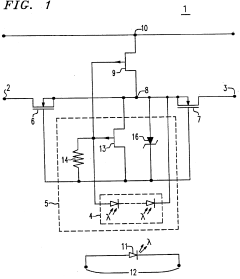
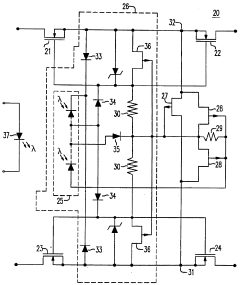
RF AC/DC coupling circuit using general purpose solid-state relay
PatentActiveUS8129867B2
Innovation
- An RF AC/DC coupling circuit employing a general purpose solid-state relay and carefully chosen inductors to compensate for parasitic elements, developing an inductive input path as frequency increases and partially cancelling parasitic capacitive admittances, thus improving input return loss without requiring expensive or complex methods.


Thermal Management Strategies for SSR Applications
Thermal management represents a critical aspect of solid-state relay (SSR) implementation in frequency control applications. As SSRs operate, they generate significant heat due to semiconductor junction losses and contact resistance, particularly when handling high current loads or during frequent switching operations. Without proper thermal management, these devices can experience performance degradation, reduced reliability, and premature failure.
The primary thermal management approach involves the use of appropriately sized heat sinks. These components facilitate heat dissipation through increased surface area and are typically made from aluminum or copper due to their excellent thermal conductivity properties. The selection of heat sink dimensions and fin design must be calculated based on the specific power dissipation requirements of the SSR in frequency control applications.
Active cooling methods provide enhanced thermal management capabilities for high-power applications. Forced-air cooling using fans or blowers can significantly improve heat dissipation rates by increasing air circulation across heat sink surfaces. In more demanding environments, liquid cooling systems may be employed, offering superior thermal transfer efficiency through the circulation of coolant through channels integrated with or attached to the SSR assembly.
Thermal interface materials (TIMs) play a crucial role in maximizing heat transfer between the SSR and heat sink. These materials—including thermal greases, phase-change materials, and thermal pads—fill microscopic air gaps at the interface, substantially improving thermal conductivity. The selection of appropriate TIMs depends on factors such as operating temperature range, thermal conductivity requirements, and installation constraints.
Temperature monitoring and protection circuits represent another essential aspect of thermal management strategies. Implementing temperature sensors near critical components allows for real-time monitoring of operating conditions. These sensors can be integrated with control systems to enable automatic load reduction or shutdown when temperature thresholds are exceeded, preventing thermal damage to the SSR components.
Strategic placement and orientation of SSRs within the frequency control system can significantly impact thermal performance. Positioning devices to maximize natural convection airflow and maintaining adequate spacing between heat-generating components helps prevent localized hot spots. In rack-mounted systems, vertical orientation of heat sinks often provides optimal natural convection cooling paths.
For frequency control applications with variable duty cycles, adaptive thermal management strategies can be implemented. These approaches adjust cooling resources based on actual thermal load, optimizing energy efficiency while maintaining safe operating temperatures across varying operational demands.
The primary thermal management approach involves the use of appropriately sized heat sinks. These components facilitate heat dissipation through increased surface area and are typically made from aluminum or copper due to their excellent thermal conductivity properties. The selection of heat sink dimensions and fin design must be calculated based on the specific power dissipation requirements of the SSR in frequency control applications.
Active cooling methods provide enhanced thermal management capabilities for high-power applications. Forced-air cooling using fans or blowers can significantly improve heat dissipation rates by increasing air circulation across heat sink surfaces. In more demanding environments, liquid cooling systems may be employed, offering superior thermal transfer efficiency through the circulation of coolant through channels integrated with or attached to the SSR assembly.
Thermal interface materials (TIMs) play a crucial role in maximizing heat transfer between the SSR and heat sink. These materials—including thermal greases, phase-change materials, and thermal pads—fill microscopic air gaps at the interface, substantially improving thermal conductivity. The selection of appropriate TIMs depends on factors such as operating temperature range, thermal conductivity requirements, and installation constraints.
Temperature monitoring and protection circuits represent another essential aspect of thermal management strategies. Implementing temperature sensors near critical components allows for real-time monitoring of operating conditions. These sensors can be integrated with control systems to enable automatic load reduction or shutdown when temperature thresholds are exceeded, preventing thermal damage to the SSR components.
Strategic placement and orientation of SSRs within the frequency control system can significantly impact thermal performance. Positioning devices to maximize natural convection airflow and maintaining adequate spacing between heat-generating components helps prevent localized hot spots. In rack-mounted systems, vertical orientation of heat sinks often provides optimal natural convection cooling paths.
For frequency control applications with variable duty cycles, adaptive thermal management strategies can be implemented. These approaches adjust cooling resources based on actual thermal load, optimizing energy efficiency while maintaining safe operating temperatures across varying operational demands.
EMI/EMC Considerations in SSR Frequency Control Systems
Electromagnetic Interference (EMI) and Electromagnetic Compatibility (EMC) represent critical considerations in the implementation of Solid-State Relay (SSR) frequency control systems. These systems, while offering numerous advantages over mechanical relays, inherently generate electromagnetic emissions during switching operations that can potentially disrupt nearby electronic equipment.
The primary EMI sources in SSR frequency control systems stem from the rapid voltage and current transitions during switching events. When SSRs switch at high frequencies, they produce electromagnetic radiation across a spectrum of frequencies. This radiation can propagate through conductive, radiative, or capacitive coupling mechanisms, potentially affecting sensitive circuits within the same system or adjacent equipment.
Regulatory standards such as IEC 61000, CISPR 22/32, and FCC Part 15 establish strict limits on electromagnetic emissions from electronic equipment. SSR frequency control systems must comply with these standards to ensure market acceptance and legal operation. These regulations typically define limits for both conducted emissions (traveling through power lines) and radiated emissions (propagating through air).
Design strategies for EMI/EMC mitigation in SSR frequency control systems include several key approaches. Proper PCB layout techniques represent the first line of defense, with considerations for trace routing, ground plane implementation, and component placement being paramount. Signal traces should be kept short, with controlled impedance and adequate separation from sensitive circuits.
Filtering components such as ferrite beads, common-mode chokes, and capacitive filters play crucial roles in suppressing EMI. Strategic placement of these components at both input and output stages of the SSR can significantly reduce both conducted and radiated emissions. Shielding techniques, including metal enclosures and EMI gaskets, provide additional protection by containing electromagnetic radiation within the system boundaries.
Grounding strategies deserve particular attention in SSR frequency control applications. Proper implementation of single-point grounding, star grounding configurations, or ground planes helps minimize ground loops that can exacerbate EMI issues. The physical separation of power and signal grounds, while maintaining appropriate interconnections, contributes significantly to EMC performance.
Testing methodologies for EMI/EMC compliance include pre-compliance testing during development phases and formal compliance testing prior to product release. Common test procedures involve measuring conducted emissions with Line Impedance Stabilization Networks (LISN) and radiated emissions in anechoic chambers or open area test sites. These measurements help identify potential issues early in the development cycle, allowing for timely remediation.
Advanced SSR designs increasingly incorporate integrated EMI suppression features, such as built-in snubber circuits, controlled switching transitions, and optimized internal layouts. These features, when properly implemented, can substantially reduce the need for external mitigation components, resulting in more compact and cost-effective solutions.
The primary EMI sources in SSR frequency control systems stem from the rapid voltage and current transitions during switching events. When SSRs switch at high frequencies, they produce electromagnetic radiation across a spectrum of frequencies. This radiation can propagate through conductive, radiative, or capacitive coupling mechanisms, potentially affecting sensitive circuits within the same system or adjacent equipment.
Regulatory standards such as IEC 61000, CISPR 22/32, and FCC Part 15 establish strict limits on electromagnetic emissions from electronic equipment. SSR frequency control systems must comply with these standards to ensure market acceptance and legal operation. These regulations typically define limits for both conducted emissions (traveling through power lines) and radiated emissions (propagating through air).
Design strategies for EMI/EMC mitigation in SSR frequency control systems include several key approaches. Proper PCB layout techniques represent the first line of defense, with considerations for trace routing, ground plane implementation, and component placement being paramount. Signal traces should be kept short, with controlled impedance and adequate separation from sensitive circuits.
Filtering components such as ferrite beads, common-mode chokes, and capacitive filters play crucial roles in suppressing EMI. Strategic placement of these components at both input and output stages of the SSR can significantly reduce both conducted and radiated emissions. Shielding techniques, including metal enclosures and EMI gaskets, provide additional protection by containing electromagnetic radiation within the system boundaries.
Grounding strategies deserve particular attention in SSR frequency control applications. Proper implementation of single-point grounding, star grounding configurations, or ground planes helps minimize ground loops that can exacerbate EMI issues. The physical separation of power and signal grounds, while maintaining appropriate interconnections, contributes significantly to EMC performance.
Testing methodologies for EMI/EMC compliance include pre-compliance testing during development phases and formal compliance testing prior to product release. Common test procedures involve measuring conducted emissions with Line Impedance Stabilization Networks (LISN) and radiated emissions in anechoic chambers or open area test sites. These measurements help identify potential issues early in the development cycle, allowing for timely remediation.
Advanced SSR designs increasingly incorporate integrated EMI suppression features, such as built-in snubber circuits, controlled switching transitions, and optimized internal layouts. These features, when properly implemented, can substantially reduce the need for external mitigation components, resulting in more compact and cost-effective solutions.
Unlock deeper insights with PatSnap Eureka Quick Research — get a full tech report to explore trends and direct your research. Try now!
Generate Your Research Report Instantly with AI Agent
Supercharge your innovation with PatSnap Eureka AI Agent Platform!