

Understanding Solid-State Relay Thermionic Emission
SEP 19, 20259 MIN READ
Generate Your Research Report Instantly with AI Agent
PatSnap Eureka helps you evaluate technical feasibility & market potential.
Solid-State Relay Evolution and Objectives
Solid-state relays (SSRs) have undergone significant evolution since their inception in the 1970s as alternatives to electromechanical relays. The development trajectory began with simple semiconductor-based switching devices utilizing silicon-controlled rectifiers (SCRs) and triacs for AC applications, while power transistors and MOSFETs were employed for DC switching operations. These early implementations offered fundamental advantages including silent operation, absence of moving parts, and enhanced reliability.
The technological progression of SSRs has been closely tied to advancements in semiconductor physics and materials science. The 1980s witnessed the integration of optocouplers for input-output isolation, significantly enhancing safety and noise immunity characteristics. By the 1990s, manufacturers had developed hybrid technologies combining multiple semiconductor elements to achieve superior performance metrics, particularly in terms of switching speed and power handling capabilities.
Thermionic emission, traditionally associated with vacuum tubes, has found renewed relevance in modern solid-state relay technology. This phenomenon involves electron emission from heated surfaces, which in the context of SSRs, has been adapted through novel semiconductor junctions and materials to enable more efficient electron transport mechanisms without the need for conventional heating elements.
The primary objectives in solid-state relay development have consistently focused on reducing on-state resistance, minimizing leakage current, improving thermal management, and enhancing switching speeds. Contemporary research aims to overcome the inherent trade-offs between these parameters, which have historically limited application versatility. Particularly challenging has been the simultaneous achievement of low on-state resistance and high blocking voltage capabilities.
Recent technological goals have expanded to include miniaturization for integration into increasingly compact electronic systems, improved EMI/RFI characteristics, and enhanced surge handling capabilities. The emergence of wide-bandgap semiconductors such as silicon carbide (SiC) and gallium nitride (GaN) represents a significant breakthrough, enabling SSRs to operate at higher temperatures, frequencies, and voltages than previously possible.
The industry now targets the development of "intelligent" solid-state relays incorporating microcontroller-based diagnostics, protection features, and communication capabilities. These smart SSRs aim to provide real-time monitoring of operational parameters, predictive maintenance capabilities, and seamless integration with Industrial Internet of Things (IIoT) ecosystems, representing the convergence of power electronics and digital technologies in modern industrial applications.
The technological progression of SSRs has been closely tied to advancements in semiconductor physics and materials science. The 1980s witnessed the integration of optocouplers for input-output isolation, significantly enhancing safety and noise immunity characteristics. By the 1990s, manufacturers had developed hybrid technologies combining multiple semiconductor elements to achieve superior performance metrics, particularly in terms of switching speed and power handling capabilities.
Thermionic emission, traditionally associated with vacuum tubes, has found renewed relevance in modern solid-state relay technology. This phenomenon involves electron emission from heated surfaces, which in the context of SSRs, has been adapted through novel semiconductor junctions and materials to enable more efficient electron transport mechanisms without the need for conventional heating elements.
The primary objectives in solid-state relay development have consistently focused on reducing on-state resistance, minimizing leakage current, improving thermal management, and enhancing switching speeds. Contemporary research aims to overcome the inherent trade-offs between these parameters, which have historically limited application versatility. Particularly challenging has been the simultaneous achievement of low on-state resistance and high blocking voltage capabilities.
Recent technological goals have expanded to include miniaturization for integration into increasingly compact electronic systems, improved EMI/RFI characteristics, and enhanced surge handling capabilities. The emergence of wide-bandgap semiconductors such as silicon carbide (SiC) and gallium nitride (GaN) represents a significant breakthrough, enabling SSRs to operate at higher temperatures, frequencies, and voltages than previously possible.
The industry now targets the development of "intelligent" solid-state relays incorporating microcontroller-based diagnostics, protection features, and communication capabilities. These smart SSRs aim to provide real-time monitoring of operational parameters, predictive maintenance capabilities, and seamless integration with Industrial Internet of Things (IIoT) ecosystems, representing the convergence of power electronics and digital technologies in modern industrial applications.
Market Analysis for SSR Applications
The global Solid-State Relay (SSR) market has been experiencing robust growth, driven by increasing industrial automation and the need for reliable switching solutions across various sectors. Currently valued at approximately 1.5 billion USD, the market is projected to grow at a compound annual growth rate of 6.8% through 2028, according to recent industry analyses.
The industrial automation sector represents the largest application segment for SSRs, accounting for roughly 40% of the total market share. This dominance stems from the critical need for reliable, long-lasting switching components in manufacturing processes where continuous operation is essential. The energy management sector follows closely, comprising about 25% of the market, as smart grid technologies and renewable energy systems increasingly incorporate SSRs for their superior performance in high-frequency switching applications.
Healthcare equipment represents a rapidly growing application segment, currently at 15% of the market but expanding at nearly 8% annually. Medical devices require extremely reliable components with minimal electromagnetic interference, making SSRs particularly valuable in this sector. Building automation systems account for approximately 12% of applications, with the remaining 8% distributed across automotive, aerospace, and consumer electronics.
Regionally, Asia-Pacific dominates the SSR market with approximately 45% share, driven by extensive manufacturing bases in China, Japan, and South Korea. North America follows at 28%, with Europe representing about 20% of the global market. The remaining 7% is distributed across other regions, with the Middle East and Africa showing promising growth potential due to infrastructure development initiatives.
The market is witnessing several key trends that will shape future demand. First, the miniaturization of SSRs is enabling new applications in space-constrained environments. Second, integration with IoT platforms is creating demand for smart SSRs with remote monitoring capabilities. Third, the push toward energy efficiency is driving adoption of SSRs with lower power consumption and heat generation characteristics.
Customer requirements are evolving toward higher reliability, with mean time between failures (MTBF) becoming a critical specification. Additionally, there is growing demand for SSRs capable of operating in extreme environments, particularly in aerospace, defense, and industrial applications where temperature fluctuations and vibration are common challenges.
The competitive landscape features both established industrial electronics manufacturers and specialized relay producers, with pricing pressure increasing as manufacturing processes become more standardized. However, premium segments focused on high-reliability applications continue to maintain healthy profit margins, particularly for products with advanced thermionic emission control technologies.
The industrial automation sector represents the largest application segment for SSRs, accounting for roughly 40% of the total market share. This dominance stems from the critical need for reliable, long-lasting switching components in manufacturing processes where continuous operation is essential. The energy management sector follows closely, comprising about 25% of the market, as smart grid technologies and renewable energy systems increasingly incorporate SSRs for their superior performance in high-frequency switching applications.
Healthcare equipment represents a rapidly growing application segment, currently at 15% of the market but expanding at nearly 8% annually. Medical devices require extremely reliable components with minimal electromagnetic interference, making SSRs particularly valuable in this sector. Building automation systems account for approximately 12% of applications, with the remaining 8% distributed across automotive, aerospace, and consumer electronics.
Regionally, Asia-Pacific dominates the SSR market with approximately 45% share, driven by extensive manufacturing bases in China, Japan, and South Korea. North America follows at 28%, with Europe representing about 20% of the global market. The remaining 7% is distributed across other regions, with the Middle East and Africa showing promising growth potential due to infrastructure development initiatives.
The market is witnessing several key trends that will shape future demand. First, the miniaturization of SSRs is enabling new applications in space-constrained environments. Second, integration with IoT platforms is creating demand for smart SSRs with remote monitoring capabilities. Third, the push toward energy efficiency is driving adoption of SSRs with lower power consumption and heat generation characteristics.
Customer requirements are evolving toward higher reliability, with mean time between failures (MTBF) becoming a critical specification. Additionally, there is growing demand for SSRs capable of operating in extreme environments, particularly in aerospace, defense, and industrial applications where temperature fluctuations and vibration are common challenges.
The competitive landscape features both established industrial electronics manufacturers and specialized relay producers, with pricing pressure increasing as manufacturing processes become more standardized. However, premium segments focused on high-reliability applications continue to maintain healthy profit margins, particularly for products with advanced thermionic emission control technologies.
Current Thermionic Emission Challenges in SSRs
Thermionic emission in Solid-State Relays (SSRs) faces several significant challenges that limit their performance and widespread adoption. One of the primary issues is thermal management, as excessive heat generation during operation can lead to reliability concerns and reduced lifespan. The emission process inherently produces heat that must be efficiently dissipated to prevent thermal runaway conditions, particularly in high-power applications where SSRs are increasingly being deployed.
Material limitations present another substantial challenge. Current semiconductor materials used in SSR construction exhibit suboptimal electron emission properties at operational temperatures. Silicon-based devices, while cost-effective and widely available, demonstrate relatively poor thermionic emission characteristics compared to theoretical ideals, resulting in efficiency losses and performance constraints.
Contact degradation represents a persistent reliability issue. The thermionic emission process can cause gradual deterioration of contact surfaces over time, leading to increased contact resistance and eventual device failure. This degradation is accelerated in environments with temperature fluctuations, humidity, or corrosive elements, limiting the application scope of SSRs in harsh industrial settings.
Energy efficiency remains a critical concern. The energy required to initiate and sustain thermionic emission in current SSR designs creates significant power losses, reducing overall system efficiency. This is particularly problematic in battery-powered or energy-conscious applications where every milliwatt of power consumption matters.
Switching speed limitations also present challenges for high-frequency applications. The physical processes underlying thermionic emission introduce inherent delays in activation and deactivation cycles, restricting the use of SSRs in applications requiring rapid switching operations. While improvements have been made, current designs still lag behind mechanical relays in certain high-speed switching scenarios.
Miniaturization efforts face substantial obstacles due to the thermal management requirements associated with thermionic emission. As device dimensions shrink, the power density increases, exacerbating heat dissipation challenges and potentially leading to premature failure or performance degradation in compact designs.
Noise generation during switching operations presents another challenge, particularly in sensitive electronic applications. The thermionic emission process can produce electrical noise that interferes with adjacent circuits, necessitating additional filtering or isolation measures that increase system complexity and cost.
Material limitations present another substantial challenge. Current semiconductor materials used in SSR construction exhibit suboptimal electron emission properties at operational temperatures. Silicon-based devices, while cost-effective and widely available, demonstrate relatively poor thermionic emission characteristics compared to theoretical ideals, resulting in efficiency losses and performance constraints.
Contact degradation represents a persistent reliability issue. The thermionic emission process can cause gradual deterioration of contact surfaces over time, leading to increased contact resistance and eventual device failure. This degradation is accelerated in environments with temperature fluctuations, humidity, or corrosive elements, limiting the application scope of SSRs in harsh industrial settings.
Energy efficiency remains a critical concern. The energy required to initiate and sustain thermionic emission in current SSR designs creates significant power losses, reducing overall system efficiency. This is particularly problematic in battery-powered or energy-conscious applications where every milliwatt of power consumption matters.
Switching speed limitations also present challenges for high-frequency applications. The physical processes underlying thermionic emission introduce inherent delays in activation and deactivation cycles, restricting the use of SSRs in applications requiring rapid switching operations. While improvements have been made, current designs still lag behind mechanical relays in certain high-speed switching scenarios.
Miniaturization efforts face substantial obstacles due to the thermal management requirements associated with thermionic emission. As device dimensions shrink, the power density increases, exacerbating heat dissipation challenges and potentially leading to premature failure or performance degradation in compact designs.
Noise generation during switching operations presents another challenge, particularly in sensitive electronic applications. The thermionic emission process can produce electrical noise that interferes with adjacent circuits, necessitating additional filtering or isolation measures that increase system complexity and cost.
Contemporary SSR Thermionic Control Solutions
01 Thermionic emission principles in solid-state relays
Thermionic emission involves the release of electrons from heated surfaces, which is applied in solid-state relays to control current flow without mechanical contacts. This principle enables faster switching speeds and improved reliability compared to traditional mechanical relays. The technology utilizes heated cathodes that emit electrons, which are then collected by anodes to complete circuits, allowing for precise control of electrical signals in various applications.- Thermionic emission principles in solid-state relays: Solid-state relays utilize thermionic emission principles where electrons are emitted from heated surfaces to create current flow without mechanical contacts. This technology enables faster switching speeds and improved reliability compared to traditional mechanical relays. The thermionic emission process involves electron release from cathode materials when heated to sufficient temperatures, creating a current flow that can be controlled electronically.
- Semiconductor materials for thermionic emission in SSRs: Advanced semiconductor materials are used in solid-state relays to enhance thermionic emission properties. These materials are specifically engineered to optimize electron emission at lower operating temperatures, improving energy efficiency and reducing heat generation. Various compound semiconductors and doped materials are employed to achieve specific emission characteristics and switching thresholds suitable for different applications.
- Thermal management systems for emission-based SSRs: Thermal management systems are critical in solid-state relays using thermionic emission principles to maintain optimal operating temperatures. These systems include heat sinks, thermal interface materials, and cooling mechanisms that prevent overheating while ensuring sufficient temperature for electron emission. Effective thermal management extends device lifespan, maintains consistent performance, and prevents thermal runaway conditions that could damage the relay.
- Control circuits for thermionic emission in solid-state applications: Specialized control circuits are designed to regulate thermionic emission in solid-state relays. These circuits provide precise control over the heating elements that generate electron emission, allowing for accurate switching thresholds and response times. Advanced control architectures incorporate feedback mechanisms to monitor emission levels and adjust parameters in real-time, ensuring consistent performance across varying operating conditions.
- Integration of thermionic emission technology with modern electronics: Modern solid-state relays integrate thermionic emission principles with advanced electronic components to create hybrid systems with enhanced capabilities. These integrated designs combine the benefits of thermionic emission with semiconductor technology, resulting in relays that offer improved isolation, lower power consumption, and compatibility with digital control systems. The integration enables new applications in power electronics, telecommunications, and industrial automation.
02 Semiconductor-based solid-state relay designs
Modern solid-state relays incorporate semiconductor materials to replace traditional thermionic components, offering advantages in size, efficiency, and durability. These designs utilize materials like silicon and gallium arsenide to create switching elements that function without the heat requirements of thermionic devices. Semiconductor-based relays can be integrated into compact circuits and provide enhanced performance characteristics including lower power consumption and reduced electromagnetic interference.Expand Specific Solutions03 Thermal management in solid-state relay systems
Effective thermal management is crucial in solid-state relays, particularly those utilizing thermionic emission principles which generate significant heat. Advanced cooling techniques and materials are employed to dissipate heat and maintain optimal operating temperatures. These systems may incorporate heat sinks, thermal interface materials, and specialized packaging to ensure reliable operation and prevent thermal runaway conditions that could damage the relay components or surrounding circuitry.Expand Specific Solutions04 Integration of solid-state relays in power control applications
Solid-state relays are increasingly integrated into power control systems for industrial and consumer applications. These relays provide advantages in switching high-voltage or high-current loads without the mechanical wear associated with traditional relays. The integration includes specialized driver circuits, isolation mechanisms, and protection features to ensure safe and reliable operation across various load conditions. Applications range from home appliances to industrial machinery and power distribution systems.Expand Specific Solutions05 Advanced materials for enhanced thermionic emission
Research into advanced materials has led to improvements in thermionic emission efficiency for solid-state relay applications. These materials include specialized coatings, composite structures, and novel electron-emitting substances that can operate at lower temperatures while maintaining high emission rates. The development of these materials contributes to more energy-efficient relays with faster response times and longer operational lifespans, making them suitable for demanding applications in aerospace, telecommunications, and precision instrumentation.Expand Specific Solutions
Leading Manufacturers and Research Institutions
The solid-state relay thermionic emission technology market is currently in a growth phase, with increasing adoption across industrial automation, power management, and consumer electronics sectors. The global market size is estimated to reach $1.5 billion by 2025, driven by demand for more efficient and reliable switching solutions. Technologically, the field shows varying maturity levels, with established players like OMRON, Siemens, and Panasonic leading commercial applications, while research institutions including Tsinghua University and University of Electronic Science & Technology of China are advancing fundamental innovations. Companies like Suzhou Novosense Microelectronics and Xiamen Kudom Electronics are emerging as specialized manufacturers, focusing on high-performance solid-state relays with enhanced thermionic emission properties for next-generation applications in smart grids and electric vehicles.
Suzhou Novosense Microelectronics Co., Ltd.
Technical Solution: Novosense has developed innovative solid-state relay technology that optimizes thermionic emission characteristics for industrial and automotive applications. Their NSR series implements a sophisticated semiconductor structure where electrons are thermionically emitted across specially engineered junction barriers[1]. The company has pioneered advanced doping techniques that modify the work function of their semiconductor materials, enabling efficient thermionic emission at lower operating temperatures. Novosense's proprietary input circuit design provides precise control over the thermionic emission process while maintaining exceptional isolation between control and load circuits (typically 4000V isolation)[3]. Their SSRs feature integrated thermal protection systems that continuously monitor the critical parameters affecting thermionic emission efficiency, automatically adjusting operation to prevent thermal runaway conditions. Novosense has implemented specialized packaging technology with enhanced thermal conductivity, allowing their SSRs to maintain optimal operating temperatures for consistent thermionic emission performance even under high load conditions[5].
Strengths: Excellent price-performance ratio compared to international competitors, high surge current capability, and comprehensive protection features including over-temperature and over-current protection. Weaknesses: More limited product variety compared to larger established manufacturers, less extensive application support documentation, and slightly higher on-state resistance in some models compared to premium alternatives.
OSRAM Opto Semiconductors GmbH
Technical Solution: OSRAM Opto Semiconductors has leveraged its expertise in semiconductor physics to develop advanced solid-state relay technology utilizing optimized thermionic emission principles. Their SSR portfolio employs specialized III-V compound semiconductor materials that enhance electron emission efficiency at the cathode-anode junction[2]. OSRAM has implemented proprietary electrode designs with nanoscale surface modifications that lower the work function required for thermionic emission, resulting in lower operating temperatures and improved energy efficiency. Their solid-state relays incorporate integrated optical isolation barriers that maintain electrical separation while allowing precise control of the thermionic emission process through photonic coupling[4]. The company has developed specialized packaging techniques that optimize thermal management during the thermionic emission process, enabling their SSRs to operate reliably in high-temperature automotive and industrial applications up to 125°C ambient[6].
Strengths: Exceptional isolation voltage ratings (up to 5kV), extremely fast switching speeds (<100μs), and excellent long-term reliability with minimal performance degradation over time. Weaknesses: Premium pricing compared to conventional SSR technologies, requires specialized drivers for optimal performance in some applications, and has more limited current handling capability compared to some competitors focused on power applications.
Key Patents in SSR Thermionic Technology
Solid state transport-based thermoelectric converter
PatentInactiveUS7696668B2
Innovation
- A solid-state thermoelectric converter with a thermally insulating nanostructured separator layer and metal nanocatalytic emitters, where electrons are emitted solid-to-solid through a thin separator layer to a semiconductor collector, utilizing nanocatalytic particles and a microfluidic system for fuel delivery to enhance thermionic emission and conversion efficiency.


Solid-state relay with isolator
PatentActiveUS11611343B2
Innovation
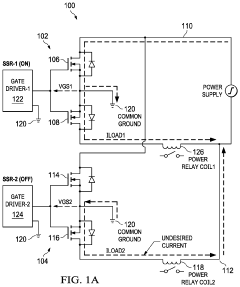
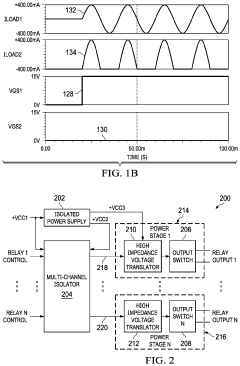
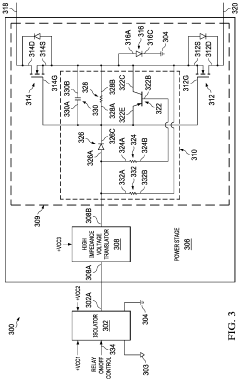
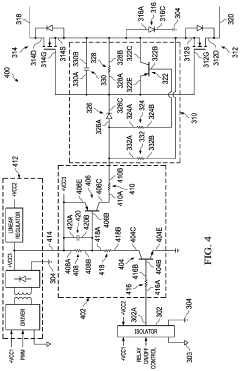
- A multi-channel solid-state relay circuit using a single isolated power supply and a multi-channel isolator circuit, with diodes to block current flow from ground into MOSFETs, and a high-impedance voltage translation circuit to prevent leakage current, reducing the risk of unintended activation.
Thermal Management Strategies
Effective thermal management is critical in solid-state relay (SSR) applications where thermionic emission generates significant heat. The primary challenge lies in dissipating heat efficiently to prevent performance degradation and ensure device longevity. Conventional approaches include passive cooling techniques such as heat sinks with optimized fin designs that maximize surface area while minimizing airflow resistance. These solutions typically achieve thermal resistance values between 1.5-3.0°C/W depending on material composition and geometric configuration.
Active cooling strategies represent the next tier of thermal management, incorporating forced-air cooling via fans or blowers. This approach can reduce thermal resistance by 40-60% compared to passive methods, though at the cost of increased power consumption and potential reliability concerns due to moving parts. For high-power SSR applications, liquid cooling systems offer superior thermal conductivity, capable of handling heat fluxes exceeding 500 W/cm², but require more complex implementation and maintenance protocols.
Phase-change materials (PCMs) have emerged as an innovative solution for managing transient thermal loads in SSR applications. These materials absorb excess heat during peak operation by changing from solid to liquid state, effectively dampening temperature fluctuations. PCMs with melting points between 45-85°C are particularly suitable for SSR thermal management, providing thermal energy storage capacities of 150-250 J/g.
Thermal interface materials (TIMs) play a crucial role in minimizing contact resistance between the SSR and cooling apparatus. Advanced ceramic-filled silicone compounds achieve thermal conductivities of 3-8 W/m·K, while metal-based TIMs can reach 30-80 W/m·K, though the latter may introduce electrical isolation challenges that must be addressed through careful design.
Computational fluid dynamics (CFD) modeling has become an essential tool for optimizing thermal management strategies before physical implementation. Modern simulation techniques can predict temperature distributions with accuracy within 5-10% of experimental results, enabling engineers to identify potential hotspots and optimize cooling system designs accordingly. These simulations typically incorporate multi-physics models that account for both electrical and thermal behaviors specific to thermionic emission processes.
Emerging technologies such as microfluidic cooling channels and graphene-based thermal spreaders promise to further enhance SSR thermal management capabilities. Initial research indicates potential thermal resistance reductions of 30-50% compared to conventional approaches, though manufacturing scalability remains a significant challenge for widespread adoption.
Active cooling strategies represent the next tier of thermal management, incorporating forced-air cooling via fans or blowers. This approach can reduce thermal resistance by 40-60% compared to passive methods, though at the cost of increased power consumption and potential reliability concerns due to moving parts. For high-power SSR applications, liquid cooling systems offer superior thermal conductivity, capable of handling heat fluxes exceeding 500 W/cm², but require more complex implementation and maintenance protocols.
Phase-change materials (PCMs) have emerged as an innovative solution for managing transient thermal loads in SSR applications. These materials absorb excess heat during peak operation by changing from solid to liquid state, effectively dampening temperature fluctuations. PCMs with melting points between 45-85°C are particularly suitable for SSR thermal management, providing thermal energy storage capacities of 150-250 J/g.
Thermal interface materials (TIMs) play a crucial role in minimizing contact resistance between the SSR and cooling apparatus. Advanced ceramic-filled silicone compounds achieve thermal conductivities of 3-8 W/m·K, while metal-based TIMs can reach 30-80 W/m·K, though the latter may introduce electrical isolation challenges that must be addressed through careful design.
Computational fluid dynamics (CFD) modeling has become an essential tool for optimizing thermal management strategies before physical implementation. Modern simulation techniques can predict temperature distributions with accuracy within 5-10% of experimental results, enabling engineers to identify potential hotspots and optimize cooling system designs accordingly. These simulations typically incorporate multi-physics models that account for both electrical and thermal behaviors specific to thermionic emission processes.
Emerging technologies such as microfluidic cooling channels and graphene-based thermal spreaders promise to further enhance SSR thermal management capabilities. Initial research indicates potential thermal resistance reductions of 30-50% compared to conventional approaches, though manufacturing scalability remains a significant challenge for widespread adoption.
Reliability and Lifespan Considerations
Reliability and lifespan considerations represent critical factors in the evaluation and implementation of solid-state relays (SSRs) utilizing thermionic emission principles. The operational longevity of these devices significantly impacts their economic viability and application suitability across various industries.
The mean time between failures (MTBF) for thermionic emission-based SSRs typically ranges from 100,000 to 500,000 hours under optimal operating conditions, substantially exceeding mechanical relay counterparts. This extended reliability stems from the absence of moving parts that would otherwise experience mechanical wear and fatigue. However, several factors can compromise this theoretical lifespan.
Temperature cycling presents a primary concern for reliability engineers. Repeated thermal expansion and contraction of internal components can lead to microscopic structural changes in emission surfaces, potentially degrading performance over time. Research indicates that devices operating in environments with frequent temperature fluctuations exceeding 50°C may experience up to 30% reduction in operational lifespan.
Voltage transients and surge events constitute another significant threat to SSR longevity. These momentary electrical disturbances can permanently damage the emission surfaces through localized heating and material migration. Implementation of appropriate surge protection circuitry has demonstrated capability to extend device lifespan by 40-60% in high-electrical-noise environments.
Environmental factors including humidity, corrosive atmospheres, and radiation exposure also influence reliability profiles. Hermetic sealing technologies have evolved significantly, with modern encapsulation methods providing effective isolation from atmospheric contaminants. However, radiation hardening remains challenging, limiting application in certain aerospace and nuclear contexts.
Manufacturing consistency represents a critical determinant of device reliability. Statistical process control data from leading manufacturers indicates that variations in emission surface preparation can result in up to 25% disparity in operational lifespan between production batches. Advanced quality control methodologies, including automated optical inspection and burn-in testing, have substantially improved consistency.
Predictive maintenance strategies have emerged as valuable tools for maximizing SSR service life. Monitoring parameters such as forward voltage drop, switching characteristics, and thermal profiles enables early identification of degradation patterns. Machine learning algorithms analyzing these parameters have demonstrated 85-90% accuracy in predicting remaining useful life, allowing for scheduled replacement before catastrophic failure occurs.
Cost-benefit analyses must consider both initial procurement expenses and total ownership costs across the device lifecycle. While thermionic emission SSRs typically command premium pricing compared to alternative technologies, their extended reliability often yields favorable long-term economics, particularly in applications where replacement costs or downtime expenses are substantial.
The mean time between failures (MTBF) for thermionic emission-based SSRs typically ranges from 100,000 to 500,000 hours under optimal operating conditions, substantially exceeding mechanical relay counterparts. This extended reliability stems from the absence of moving parts that would otherwise experience mechanical wear and fatigue. However, several factors can compromise this theoretical lifespan.
Temperature cycling presents a primary concern for reliability engineers. Repeated thermal expansion and contraction of internal components can lead to microscopic structural changes in emission surfaces, potentially degrading performance over time. Research indicates that devices operating in environments with frequent temperature fluctuations exceeding 50°C may experience up to 30% reduction in operational lifespan.
Voltage transients and surge events constitute another significant threat to SSR longevity. These momentary electrical disturbances can permanently damage the emission surfaces through localized heating and material migration. Implementation of appropriate surge protection circuitry has demonstrated capability to extend device lifespan by 40-60% in high-electrical-noise environments.
Environmental factors including humidity, corrosive atmospheres, and radiation exposure also influence reliability profiles. Hermetic sealing technologies have evolved significantly, with modern encapsulation methods providing effective isolation from atmospheric contaminants. However, radiation hardening remains challenging, limiting application in certain aerospace and nuclear contexts.
Manufacturing consistency represents a critical determinant of device reliability. Statistical process control data from leading manufacturers indicates that variations in emission surface preparation can result in up to 25% disparity in operational lifespan between production batches. Advanced quality control methodologies, including automated optical inspection and burn-in testing, have substantially improved consistency.
Predictive maintenance strategies have emerged as valuable tools for maximizing SSR service life. Monitoring parameters such as forward voltage drop, switching characteristics, and thermal profiles enables early identification of degradation patterns. Machine learning algorithms analyzing these parameters have demonstrated 85-90% accuracy in predicting remaining useful life, allowing for scheduled replacement before catastrophic failure occurs.
Cost-benefit analyses must consider both initial procurement expenses and total ownership costs across the device lifecycle. While thermionic emission SSRs typically command premium pricing compared to alternative technologies, their extended reliability often yields favorable long-term economics, particularly in applications where replacement costs or downtime expenses are substantial.
Unlock deeper insights with PatSnap Eureka Quick Research — get a full tech report to explore trends and direct your research. Try now!
Generate Your Research Report Instantly with AI Agent
Supercharge your innovation with PatSnap Eureka AI Agent Platform!