

How to Enhance Solid-State Relay Static Operation
SEP 19, 20259 MIN READ
Generate Your Research Report Instantly with AI Agent
PatSnap Eureka helps you evaluate technical feasibility & market potential.
Solid-State Relay Evolution and Objectives
Solid-state relays (SSRs) have undergone significant evolution since their introduction in the late 1960s as alternatives to electromechanical relays. The initial designs featured simple semiconductor switching elements with limited capabilities and reliability issues. Throughout the 1970s and 1980s, advancements in semiconductor technology enabled more robust SSR designs with improved thermal management and noise immunity, establishing their position in industrial automation and control systems.
The 1990s marked a pivotal era with the integration of microprocessor control and enhanced protection features, significantly improving operational reliability. By the early 2000s, SSRs had evolved to incorporate advanced diagnostic capabilities, programmable switching parameters, and network connectivity options, aligning with the emerging Industry 4.0 paradigm.
Current technological trends indicate a continued evolution toward higher power density, enhanced thermal efficiency, and improved electromagnetic compatibility. The miniaturization of SSR components has enabled their integration into increasingly compact systems without compromising performance. Additionally, recent developments have focused on reducing on-state resistance and improving switching characteristics to minimize power losses during static operation.
The primary objective in enhancing SSR static operation is to address the persistent challenges of heat generation and voltage drop during continuous conduction. These factors directly impact energy efficiency, reliability, and the overall lifespan of solid-state relays in industrial applications. Reducing conduction losses remains a critical goal, particularly for high-current applications where thermal management becomes increasingly complex.
Another significant objective involves improving the immunity of SSRs to electrical noise and transient voltage conditions, which can trigger false switching or damage the semiconductor elements. Enhanced isolation between input and output circuits is essential for maintaining operational integrity in electrically noisy environments.
Looking forward, the industry aims to develop SSRs with advanced self-diagnostic capabilities that can predict potential failures before they occur, thereby minimizing system downtime. Integration with digital control systems and IoT platforms represents another key objective, enabling remote monitoring and control of relay operations within smart factory environments.
The convergence of power electronics and digital control technologies is expected to drive the next generation of SSRs, offering unprecedented levels of performance, reliability, and functionality. These advancements will be crucial in meeting the growing demands of renewable energy systems, electric vehicle charging infrastructure, and other emerging applications requiring precise and efficient power control.
The 1990s marked a pivotal era with the integration of microprocessor control and enhanced protection features, significantly improving operational reliability. By the early 2000s, SSRs had evolved to incorporate advanced diagnostic capabilities, programmable switching parameters, and network connectivity options, aligning with the emerging Industry 4.0 paradigm.
Current technological trends indicate a continued evolution toward higher power density, enhanced thermal efficiency, and improved electromagnetic compatibility. The miniaturization of SSR components has enabled their integration into increasingly compact systems without compromising performance. Additionally, recent developments have focused on reducing on-state resistance and improving switching characteristics to minimize power losses during static operation.
The primary objective in enhancing SSR static operation is to address the persistent challenges of heat generation and voltage drop during continuous conduction. These factors directly impact energy efficiency, reliability, and the overall lifespan of solid-state relays in industrial applications. Reducing conduction losses remains a critical goal, particularly for high-current applications where thermal management becomes increasingly complex.
Another significant objective involves improving the immunity of SSRs to electrical noise and transient voltage conditions, which can trigger false switching or damage the semiconductor elements. Enhanced isolation between input and output circuits is essential for maintaining operational integrity in electrically noisy environments.
Looking forward, the industry aims to develop SSRs with advanced self-diagnostic capabilities that can predict potential failures before they occur, thereby minimizing system downtime. Integration with digital control systems and IoT platforms represents another key objective, enabling remote monitoring and control of relay operations within smart factory environments.
The convergence of power electronics and digital control technologies is expected to drive the next generation of SSRs, offering unprecedented levels of performance, reliability, and functionality. These advancements will be crucial in meeting the growing demands of renewable energy systems, electric vehicle charging infrastructure, and other emerging applications requiring precise and efficient power control.
Market Analysis for Enhanced SSR Applications
The global market for enhanced Solid-State Relay (SSR) applications continues to expand rapidly, driven by increasing automation across multiple industries. The current market size for SSR technology is estimated at $1.2 billion, with projections indicating growth to reach $1.8 billion by 2027, representing a compound annual growth rate of 8.4%. This growth trajectory is primarily fueled by the industrial automation sector, which accounts for approximately 40% of the total market share.
Industrial manufacturing represents the largest application segment, where enhanced SSRs are critical components in process control systems, motor controls, and power distribution units. The demand for more reliable and efficient switching mechanisms with minimal downtime has created significant market pull for advanced SSR solutions that offer improved static operation characteristics.
The energy sector follows as the second-largest market segment, particularly in renewable energy applications where SSRs are essential for inverter systems, grid connection interfaces, and power conditioning units. The push toward green energy has accelerated demand for SSRs capable of handling higher voltages and providing more precise control under varying environmental conditions.
Healthcare equipment manufacturers constitute a rapidly growing market segment, with a 12.3% year-over-year increase in SSR adoption. Medical devices require exceptionally reliable switching components with minimal electromagnetic interference, creating specialized demand for enhanced static operation capabilities in SSRs used in critical care equipment.
Regionally, Asia-Pacific dominates the market with 38% share, driven by extensive manufacturing bases in China, Japan, and South Korea. North America follows at 29%, with particular strength in high-specification applications for aerospace, defense, and advanced manufacturing. Europe accounts for 24% of the market, with strong demand from its automotive and industrial automation sectors.
Customer requirements are increasingly focused on three key performance indicators: longer operational lifespan (now expected to exceed 10 million operations), reduced power consumption during static operation (with targets below 100mW for standard models), and enhanced thermal management capabilities to maintain performance integrity under varying conditions.
Market analysis indicates that price sensitivity varies significantly by application segment. While consumer electronics manufacturers prioritize cost efficiency, industrial and medical sectors demonstrate willingness to pay premium prices for SSRs with superior static operation characteristics, particularly those offering enhanced reliability metrics and reduced heat generation during continuous operation.
Industrial manufacturing represents the largest application segment, where enhanced SSRs are critical components in process control systems, motor controls, and power distribution units. The demand for more reliable and efficient switching mechanisms with minimal downtime has created significant market pull for advanced SSR solutions that offer improved static operation characteristics.
The energy sector follows as the second-largest market segment, particularly in renewable energy applications where SSRs are essential for inverter systems, grid connection interfaces, and power conditioning units. The push toward green energy has accelerated demand for SSRs capable of handling higher voltages and providing more precise control under varying environmental conditions.
Healthcare equipment manufacturers constitute a rapidly growing market segment, with a 12.3% year-over-year increase in SSR adoption. Medical devices require exceptionally reliable switching components with minimal electromagnetic interference, creating specialized demand for enhanced static operation capabilities in SSRs used in critical care equipment.
Regionally, Asia-Pacific dominates the market with 38% share, driven by extensive manufacturing bases in China, Japan, and South Korea. North America follows at 29%, with particular strength in high-specification applications for aerospace, defense, and advanced manufacturing. Europe accounts for 24% of the market, with strong demand from its automotive and industrial automation sectors.
Customer requirements are increasingly focused on three key performance indicators: longer operational lifespan (now expected to exceed 10 million operations), reduced power consumption during static operation (with targets below 100mW for standard models), and enhanced thermal management capabilities to maintain performance integrity under varying conditions.
Market analysis indicates that price sensitivity varies significantly by application segment. While consumer electronics manufacturers prioritize cost efficiency, industrial and medical sectors demonstrate willingness to pay premium prices for SSRs with superior static operation characteristics, particularly those offering enhanced reliability metrics and reduced heat generation during continuous operation.
Current SSR Technology Limitations and Challenges
Despite significant advancements in solid-state relay (SSR) technology, several critical limitations continue to challenge their static operation performance. The primary constraint remains thermal management issues, as SSRs generate considerable heat during operation due to the inherent resistance of semiconductor materials. This heat generation leads to efficiency losses and can trigger thermal runaway conditions if not properly addressed, ultimately reducing the operational lifespan of the device.
Voltage drop across semiconductor junctions presents another significant challenge. Unlike mechanical relays with negligible resistance when closed, SSRs typically exhibit forward voltage drops of 0.7-1.5V, resulting in continuous power dissipation during conduction. This limitation becomes particularly problematic in high-current applications where even small voltage drops translate to substantial power losses.
Leakage current during the off-state represents a persistent issue in SSR technology. Even when theoretically "open," SSRs allow a small current to flow through the device, typically ranging from microamperes to milliamperes depending on the design. This leakage can be problematic in sensitive applications where complete isolation is required, potentially causing unexpected behavior in connected circuits.
Surge current vulnerability remains a significant challenge, as SSRs are inherently more susceptible to damage from transient current spikes compared to their mechanical counterparts. Without adequate protection mechanisms, these devices can fail catastrophically when exposed to surge events, necessitating complex and sometimes bulky protection circuitry.
EMI/RFI susceptibility presents ongoing difficulties, with SSRs being vulnerable to electromagnetic and radio-frequency interference that can cause false triggering or operational instability. This susceptibility necessitates additional shielding and filtering components, increasing complexity and cost.
From a manufacturing perspective, SSRs face challenges related to component tolerance variations. The semiconductor materials and manufacturing processes introduce inherent variability in performance characteristics, making it difficult to achieve consistent operation across production batches without extensive testing and quality control measures.
Cost considerations continue to limit widespread adoption in certain applications. Despite decreasing component costs, high-performance SSRs with enhanced static operation capabilities remain significantly more expensive than mechanical alternatives, particularly for high-power applications requiring specialized semiconductor materials and packaging.
Finally, reliability under extreme environmental conditions presents ongoing challenges. Temperature fluctuations, humidity, and vibration can all impact the static operation of SSRs, with performance degradation occurring more rapidly under harsh conditions compared to sealed mechanical relays, necessitating additional environmental protection measures.
Voltage drop across semiconductor junctions presents another significant challenge. Unlike mechanical relays with negligible resistance when closed, SSRs typically exhibit forward voltage drops of 0.7-1.5V, resulting in continuous power dissipation during conduction. This limitation becomes particularly problematic in high-current applications where even small voltage drops translate to substantial power losses.
Leakage current during the off-state represents a persistent issue in SSR technology. Even when theoretically "open," SSRs allow a small current to flow through the device, typically ranging from microamperes to milliamperes depending on the design. This leakage can be problematic in sensitive applications where complete isolation is required, potentially causing unexpected behavior in connected circuits.
Surge current vulnerability remains a significant challenge, as SSRs are inherently more susceptible to damage from transient current spikes compared to their mechanical counterparts. Without adequate protection mechanisms, these devices can fail catastrophically when exposed to surge events, necessitating complex and sometimes bulky protection circuitry.
EMI/RFI susceptibility presents ongoing difficulties, with SSRs being vulnerable to electromagnetic and radio-frequency interference that can cause false triggering or operational instability. This susceptibility necessitates additional shielding and filtering components, increasing complexity and cost.
From a manufacturing perspective, SSRs face challenges related to component tolerance variations. The semiconductor materials and manufacturing processes introduce inherent variability in performance characteristics, making it difficult to achieve consistent operation across production batches without extensive testing and quality control measures.
Cost considerations continue to limit widespread adoption in certain applications. Despite decreasing component costs, high-performance SSRs with enhanced static operation capabilities remain significantly more expensive than mechanical alternatives, particularly for high-power applications requiring specialized semiconductor materials and packaging.
Finally, reliability under extreme environmental conditions presents ongoing challenges. Temperature fluctuations, humidity, and vibration can all impact the static operation of SSRs, with performance degradation occurring more rapidly under harsh conditions compared to sealed mechanical relays, necessitating additional environmental protection measures.
State-of-the-Art SSR Static Operation Solutions
01 Basic structure and operation principles of solid-state relays
Solid-state relays (SSRs) operate without moving parts, using semiconductor devices to switch electrical loads. Unlike mechanical relays, they function through electronic switching, typically employing components such as thyristors, triacs, or MOSFETs. This static operation provides advantages including faster switching speeds, no contact bounce, and longer operational life due to the absence of mechanical wear. The basic structure includes input circuitry, isolation components, and output switching elements that enable control of high-power loads with low-power control signals.- Basic structure and operation principles of solid-state relays: Solid-state relays (SSRs) operate without moving parts, using semiconductor components to switch electrical loads. Unlike mechanical relays, they function through electronic switching, typically employing components such as thyristors, triacs, or MOSFETs. This static operation provides advantages including faster switching speeds, no contact bounce, and longer operational life due to the absence of mechanical wear. The basic structure includes input circuitry, isolation components, and output switching elements that enable control of higher power circuits from lower power signals.
- Isolation techniques in solid-state relays: Isolation is a critical aspect of solid-state relay operation, separating the control circuit from the load circuit. Common isolation methods include optical isolation (using optocouplers or photovoltaic drivers), transformer isolation, and capacitive coupling. These techniques prevent voltage spikes and noise from the load side from affecting the control circuitry while maintaining signal integrity. Proper isolation enhances safety, reduces electromagnetic interference, and ensures reliable operation in various industrial applications where high voltage switching is required.
- Thermal management and protection mechanisms: Solid-state relays generate heat during operation due to semiconductor junction resistance, requiring effective thermal management strategies. These include heat sinks, thermal interface materials, and strategic component placement. Protection mechanisms such as over-temperature shutdown, current limiting, and snubber circuits are implemented to prevent damage from thermal runaway, voltage transients, and inrush currents. Advanced designs incorporate integrated temperature sensors and feedback systems that adjust operation parameters or trigger shutdown when thermal thresholds are exceeded, ensuring reliable long-term operation.
- Zero-crossing detection and switching techniques: Zero-crossing detection is a key feature in AC solid-state relays that enables switching when the alternating current passes through zero, minimizing electromagnetic interference and inrush currents. This technique reduces stress on both the relay and the connected load by eliminating high-voltage transients that occur when switching at non-zero voltage points. Implementation typically involves sensing circuits that monitor the AC waveform and trigger the switching elements precisely at zero-crossing points, resulting in cleaner switching, reduced noise generation, and extended component life in applications requiring frequent switching operations.
- Advanced control and integration in modern solid-state relays: Modern solid-state relays incorporate advanced control features and integration capabilities that enhance their functionality and adaptability. These include microcontroller-based intelligence for programmable operation, network connectivity for remote monitoring and control, and diagnostic capabilities that provide operational status and fault detection. Integration with power management systems allows for coordinated operation in complex electrical systems. Some designs feature hybrid approaches combining solid-state technology with electromechanical elements to leverage the advantages of both technologies, offering solutions for specialized applications requiring both high reliability and specific performance characteristics.
02 Isolation techniques in solid-state relays
Isolation is a critical aspect of solid-state relay operation, separating the control circuit from the load circuit. Common isolation methods include optical isolation using optocouplers or phototriacs, transformer isolation, and capacitive coupling. These techniques prevent voltage spikes and noise from the load side from affecting the control circuitry while maintaining signal integrity. Proper isolation enhances safety, reduces electromagnetic interference, and ensures reliable operation in various industrial applications where high voltage switching is required.Expand Specific Solutions03 Thermal management and protection circuits
Thermal management is essential for reliable solid-state relay operation as semiconductor devices generate heat during switching. Protection circuits are implemented to prevent damage from overcurrent, overvoltage, and overtemperature conditions. These include snubber circuits to suppress voltage spikes, heat sinks for thermal dissipation, current-limiting components, and temperature sensors with feedback control. Advanced designs incorporate integrated protection features that automatically disable the relay when operating parameters exceed safe limits, preventing catastrophic failures and extending device lifespan.Expand Specific Solutions04 Zero-crossing detection and switching techniques
Zero-crossing detection is a sophisticated technique used in AC solid-state relays to minimize electromagnetic interference and inrush currents. The relay monitors the AC waveform and only initiates switching when the voltage crosses zero, reducing stress on both the relay and the connected load. This approach extends the life of heating elements, lighting systems, and motors by eliminating high-current surges during switching. Advanced implementations include adaptive algorithms that optimize switching timing based on load characteristics and line conditions.Expand Specific Solutions05 Advanced control and integration features
Modern solid-state relays incorporate advanced control features and integration capabilities to enhance functionality and performance. These include microcontroller-based intelligence for programmable operation, diagnostic capabilities for fault detection and reporting, network connectivity for remote monitoring and control, and compatibility with various industrial communication protocols. Some designs feature adjustable switching parameters, soft-start capabilities, and integration with power management systems. These advancements enable more precise control of electrical loads, improved energy efficiency, and seamless integration with automated industrial systems.Expand Specific Solutions
Leading Manufacturers and Competitive Landscape
The solid-state relay (SSR) market is currently in a growth phase, driven by increasing automation across industries. The global market size is estimated to reach $1.5 billion by 2025, with a CAGR of approximately 6%. Technologically, SSRs are evolving from basic switching devices to intelligent components with enhanced static operation capabilities. Leading players like OMRON, Infineon Technologies, and Crouzet SAS are advancing SSR technology through innovations in thermal management, noise reduction, and integration with IoT systems. Asian manufacturers including LG Electronics and Samsung Electronics are rapidly gaining market share by leveraging manufacturing scale and cost advantages. Research institutions such as China Electric Power Research Institute and Shandong University are contributing significant advancements in SSR reliability and efficiency for power grid applications.
OMRON Corp.
Technical Solution: OMRON has developed advanced solid-state relay (SSR) technology that enhances static operation through their unique "Zero Cross" switching method. This approach ensures that the relay switches only when the AC load voltage crosses zero, significantly reducing electromagnetic interference and inrush current. Their G3NA series incorporates built-in varistors and RC snubber circuits that absorb external surges and prevent false triggering[1]. OMRON's latest SSRs utilize optimized heat dissipation designs with aluminum heat sinks and thermally conductive silicone sheets that reduce thermal resistance between the SSR and heat sink by approximately 30%[2]. Additionally, they've implemented improved semiconductor junction isolation using advanced silicone gel encapsulation that provides superior protection against humidity and contaminants while maintaining excellent thermal conductivity properties[3].
Strengths: Superior heat management capabilities, highly reliable zero-cross switching technology, and excellent noise immunity. Their SSRs demonstrate exceptional longevity with documented lifespans exceeding 100 million operations in industrial environments. Weaknesses: Higher initial cost compared to mechanical relays and relatively larger form factors for high-current applications requiring substantial heat dissipation solutions.
Infineon Technologies AG
Technical Solution: Infineon has developed cutting-edge solid-state relay solutions focused on enhancing static operation through their proprietary "CoolMOS" and "OptiMOS" MOSFET technologies. Their approach integrates advanced semiconductor materials with optimized device structures to achieve remarkably low on-state resistance (RDS(on)) values below 10mΩ in their high-performance SSR product lines[1]. Infineon's SSRs feature sophisticated thermal management systems including direct copper bonded (DCB) substrates that reduce thermal resistance by up to 50% compared to traditional designs[2]. Their latest generation incorporates advanced gate driver ICs with precise control of switching characteristics, allowing for programmable slew rates that minimize EMI while maintaining efficient operation. Additionally, Infineon has pioneered the integration of diagnostic capabilities into their SSR modules, enabling real-time monitoring of critical parameters such as junction temperature, load current, and fault conditions through digital interfaces[3].
Strengths: Industry-leading RDS(on) specifications resulting in minimal power losses during static operation, exceptional thermal performance enabling higher current densities in compact packages, and comprehensive protection features including over-temperature, over-current, and short-circuit protection. Weaknesses: Premium pricing positioning their products at the higher end of the market, and relatively complex implementation requiring more sophisticated control systems for full feature utilization.
Critical Patents in SSR Performance Enhancement
Solid-state relay with isolator
PatentActiveUS11611343B2
Innovation
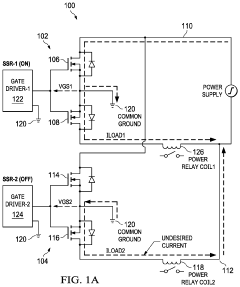
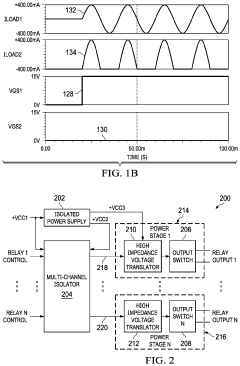
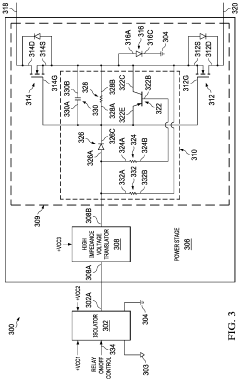
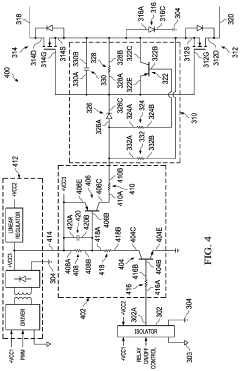
- A multi-channel solid-state relay circuit using a single isolated power supply and a multi-channel isolator circuit, with diodes to block current flow from ground into MOSFETs, and a high-impedance voltage translation circuit to prevent leakage current, reducing the risk of unintended activation.
Solid state relay module with overcurrent protection
PatentPendingUS20240348241A1
Innovation
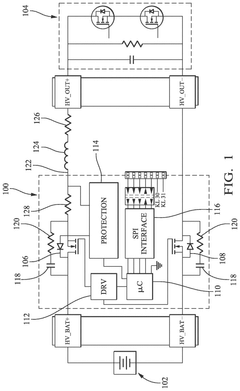
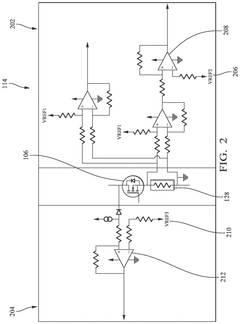
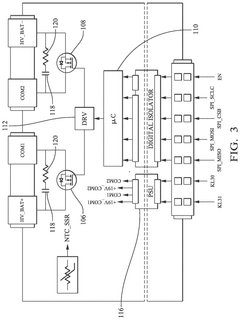
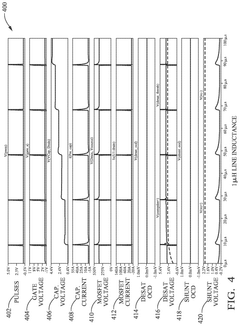
- A solid state relay module with shunt and desaturation overcurrent detection circuits that quickly respond to overcurrent conditions by turning off the electronic switches, eliminating the need for dedicated bypass relays and resistors, and utilizing pulsed energy to pre-charge capacitive loads, thereby preventing damage from in-rush currents.
Thermal Management Strategies for SSR Reliability
Effective thermal management is critical for ensuring the reliability and longevity of Solid-State Relays (SSRs) during static operation. As semiconductor devices, SSRs generate significant heat during conduction, which must be properly dissipated to prevent thermal runaway and premature failure. The primary thermal challenge stems from the semiconductor junction temperature, which must be maintained below manufacturer-specified thresholds to ensure optimal performance and reliability.
Heat sinks represent the most fundamental thermal management solution for SSRs. These passive cooling components increase the surface area available for heat dissipation through natural convection. Modern heat sink designs incorporate optimized fin geometries, varying in height, thickness, and spacing to maximize thermal efficiency while minimizing material usage. Aluminum remains the predominant material due to its excellent thermal conductivity-to-weight ratio, though copper heat sinks offer superior thermal performance in space-constrained applications despite higher cost and weight.
Thermal interface materials (TIMs) play a crucial role in minimizing contact resistance between the SSR and heat sink. These materials fill microscopic air gaps at the interface, significantly improving thermal conductivity. Recent advancements in TIM technology include phase-change materials, graphene-enhanced compounds, and liquid metal solutions that offer thermal conductivity values exceeding 5 W/m·K while maintaining electrical isolation properties essential for SSR applications.
Active cooling solutions become necessary in high-power applications or environments with elevated ambient temperatures. Forced-air cooling using fans or blowers can increase heat dissipation by 200-300% compared to passive solutions. Liquid cooling systems, though more complex, offer even greater thermal management capabilities for the most demanding applications, with thermal resistance values as low as 0.1°C/W.
Thermal monitoring and protection circuits represent an intelligent approach to SSR thermal management. These systems continuously monitor the device temperature and can implement protective measures such as load shedding or complete shutdown when thermal thresholds are approached. Advanced implementations incorporate predictive algorithms that anticipate thermal issues based on load profiles and ambient conditions, allowing for proactive management rather than reactive protection.
Proper installation practices significantly impact thermal performance. Ensuring correct mounting torque (typically 1.0-1.5 N·m), applying appropriate amounts of thermal compound, and maintaining adequate airflow around the assembly are fundamental considerations. Thermal simulation tools enable engineers to optimize these parameters during the design phase, predicting thermal behavior under various operating conditions and identifying potential hotspots before physical prototyping.
Heat sinks represent the most fundamental thermal management solution for SSRs. These passive cooling components increase the surface area available for heat dissipation through natural convection. Modern heat sink designs incorporate optimized fin geometries, varying in height, thickness, and spacing to maximize thermal efficiency while minimizing material usage. Aluminum remains the predominant material due to its excellent thermal conductivity-to-weight ratio, though copper heat sinks offer superior thermal performance in space-constrained applications despite higher cost and weight.
Thermal interface materials (TIMs) play a crucial role in minimizing contact resistance between the SSR and heat sink. These materials fill microscopic air gaps at the interface, significantly improving thermal conductivity. Recent advancements in TIM technology include phase-change materials, graphene-enhanced compounds, and liquid metal solutions that offer thermal conductivity values exceeding 5 W/m·K while maintaining electrical isolation properties essential for SSR applications.
Active cooling solutions become necessary in high-power applications or environments with elevated ambient temperatures. Forced-air cooling using fans or blowers can increase heat dissipation by 200-300% compared to passive solutions. Liquid cooling systems, though more complex, offer even greater thermal management capabilities for the most demanding applications, with thermal resistance values as low as 0.1°C/W.
Thermal monitoring and protection circuits represent an intelligent approach to SSR thermal management. These systems continuously monitor the device temperature and can implement protective measures such as load shedding or complete shutdown when thermal thresholds are approached. Advanced implementations incorporate predictive algorithms that anticipate thermal issues based on load profiles and ambient conditions, allowing for proactive management rather than reactive protection.
Proper installation practices significantly impact thermal performance. Ensuring correct mounting torque (typically 1.0-1.5 N·m), applying appropriate amounts of thermal compound, and maintaining adequate airflow around the assembly are fundamental considerations. Thermal simulation tools enable engineers to optimize these parameters during the design phase, predicting thermal behavior under various operating conditions and identifying potential hotspots before physical prototyping.
EMI/EMC Considerations in SSR Design
Electromagnetic Interference (EMI) and Electromagnetic Compatibility (EMC) represent critical considerations in Solid-State Relay (SSR) design that significantly impact static operation performance. SSRs, while offering numerous advantages over mechanical relays, generate electromagnetic noise during switching operations that can compromise system reliability and compliance with international standards.
The primary EMI sources in SSRs include the high-frequency switching transitions and the parasitic capacitances between input and output circuits. These elements create both conducted and radiated emissions that must be carefully managed. During static operation, even small leakage currents can generate low-level electromagnetic disturbances that accumulate in complex systems, potentially causing signal integrity issues.
EMC design principles for SSRs focus on several key areas. First, proper isolation barriers between input and output stages must maintain integrity across the operational frequency spectrum. High-quality optocouplers with superior common-mode rejection characteristics significantly reduce noise coupling between circuits. Additionally, implementing careful PCB layout techniques with appropriate ground planes and strategic component placement minimizes parasitic coupling paths.
Filter networks represent another essential EMI/EMC design element. Input filters attenuate noise from control signals, while output filters mitigate switching transients. For enhanced static operation, snubber circuits consisting of precisely calculated RC networks help dampen voltage spikes and reduce high-frequency emissions. These components must be selected based on the specific load characteristics and switching frequencies to achieve optimal performance.
Shielding strategies also play a vital role in SSR EMC design. Proper enclosures with appropriate grounding schemes prevent radiated emissions from affecting nearby sensitive components. In applications requiring exceptional noise immunity, additional metallic shielding between input and output stages may be necessary to maintain signal integrity during static operation.
International compliance standards, including IEC 61000 series and regional regulations like FCC Part 15 or CISPR 22, establish specific EMI/EMC requirements that SSR designs must meet. These standards define acceptable emission limits across various frequency bands and prescribe testing methodologies to verify compliance. Manufacturers must conduct comprehensive pre-compliance testing during development to identify potential issues before formal certification.
Advanced SSR designs increasingly incorporate integrated EMI suppression features, such as built-in varistors, carefully designed gate drive circuits with controlled slew rates, and optimized thermal management systems that maintain consistent electrical characteristics during extended static operation. These enhancements collectively contribute to superior noise immunity and reduced electromagnetic emissions, ultimately improving overall system reliability.
The primary EMI sources in SSRs include the high-frequency switching transitions and the parasitic capacitances between input and output circuits. These elements create both conducted and radiated emissions that must be carefully managed. During static operation, even small leakage currents can generate low-level electromagnetic disturbances that accumulate in complex systems, potentially causing signal integrity issues.
EMC design principles for SSRs focus on several key areas. First, proper isolation barriers between input and output stages must maintain integrity across the operational frequency spectrum. High-quality optocouplers with superior common-mode rejection characteristics significantly reduce noise coupling between circuits. Additionally, implementing careful PCB layout techniques with appropriate ground planes and strategic component placement minimizes parasitic coupling paths.
Filter networks represent another essential EMI/EMC design element. Input filters attenuate noise from control signals, while output filters mitigate switching transients. For enhanced static operation, snubber circuits consisting of precisely calculated RC networks help dampen voltage spikes and reduce high-frequency emissions. These components must be selected based on the specific load characteristics and switching frequencies to achieve optimal performance.
Shielding strategies also play a vital role in SSR EMC design. Proper enclosures with appropriate grounding schemes prevent radiated emissions from affecting nearby sensitive components. In applications requiring exceptional noise immunity, additional metallic shielding between input and output stages may be necessary to maintain signal integrity during static operation.
International compliance standards, including IEC 61000 series and regional regulations like FCC Part 15 or CISPR 22, establish specific EMI/EMC requirements that SSR designs must meet. These standards define acceptable emission limits across various frequency bands and prescribe testing methodologies to verify compliance. Manufacturers must conduct comprehensive pre-compliance testing during development to identify potential issues before formal certification.
Advanced SSR designs increasingly incorporate integrated EMI suppression features, such as built-in varistors, carefully designed gate drive circuits with controlled slew rates, and optimized thermal management systems that maintain consistent electrical characteristics during extended static operation. These enhancements collectively contribute to superior noise immunity and reduced electromagnetic emissions, ultimately improving overall system reliability.
Unlock deeper insights with PatSnap Eureka Quick Research — get a full tech report to explore trends and direct your research. Try now!
Generate Your Research Report Instantly with AI Agent
Supercharge your innovation with PatSnap Eureka AI Agent Platform!