
Solid-State Relay Versatility in Variable Frequency Drives
SEP 19, 20259 MIN READ
Generate Your Research Report Instantly with AI Agent
Patsnap Eureka helps you evaluate technical feasibility & market potential.
SSR Technology Background and Objectives
Solid-State Relays (SSRs) have evolved significantly since their inception in the 1970s, transforming from simple switching devices to sophisticated power control components. The technology originated as an alternative to electromechanical relays, offering advantages in reliability and longevity due to the absence of moving parts. Early SSRs utilized discrete semiconductor components, primarily thyristors and triacs, which limited their application scope and performance characteristics.
The evolution of semiconductor technology has dramatically enhanced SSR capabilities, particularly in power handling, switching speed, and integration possibilities. Modern SSRs incorporate advanced materials such as silicon carbide (SiC) and gallium nitride (GaN), enabling higher temperature operation, faster switching frequencies, and improved efficiency. This progression has positioned SSRs as critical components in precision control applications, including Variable Frequency Drives (VFDs).
In the context of VFDs, SSRs serve as crucial interfaces between control circuits and power stages, enabling precise manipulation of motor speed and torque characteristics. The integration of SSRs in VFDs represents a significant technological advancement over traditional contactor-based systems, offering enhanced control granularity and system responsiveness.
The primary objective of SSR implementation in VFDs is to achieve seamless power modulation while maintaining system reliability and efficiency. This includes enabling precise frequency control, minimizing harmonic distortion, reducing electromagnetic interference, and ensuring robust operation across diverse industrial environments. Additionally, SSRs must facilitate advanced protection features such as overcurrent detection, short circuit protection, and thermal management.
Current technological goals focus on further enhancing SSR performance metrics critical to VFD applications. These include reducing on-state resistance to minimize power losses, improving thermal dissipation capabilities, increasing switching speeds to support higher frequency operation, and enhancing isolation characteristics to ensure safety in high-voltage environments.
Future development trajectories aim to address emerging requirements in industrial automation and energy efficiency. This encompasses the integration of diagnostic capabilities for predictive maintenance, enhanced communication interfaces for Industry 4.0 compatibility, and improved energy management features to support sustainable manufacturing practices.
The convergence of SSR technology with digital control systems represents a particularly promising direction, potentially enabling adaptive control algorithms that optimize VFD performance based on real-time operational conditions. This synergy between power electronics and computational intelligence may fundamentally transform motor control paradigms across industrial applications.
The evolution of semiconductor technology has dramatically enhanced SSR capabilities, particularly in power handling, switching speed, and integration possibilities. Modern SSRs incorporate advanced materials such as silicon carbide (SiC) and gallium nitride (GaN), enabling higher temperature operation, faster switching frequencies, and improved efficiency. This progression has positioned SSRs as critical components in precision control applications, including Variable Frequency Drives (VFDs).
In the context of VFDs, SSRs serve as crucial interfaces between control circuits and power stages, enabling precise manipulation of motor speed and torque characteristics. The integration of SSRs in VFDs represents a significant technological advancement over traditional contactor-based systems, offering enhanced control granularity and system responsiveness.
The primary objective of SSR implementation in VFDs is to achieve seamless power modulation while maintaining system reliability and efficiency. This includes enabling precise frequency control, minimizing harmonic distortion, reducing electromagnetic interference, and ensuring robust operation across diverse industrial environments. Additionally, SSRs must facilitate advanced protection features such as overcurrent detection, short circuit protection, and thermal management.
Current technological goals focus on further enhancing SSR performance metrics critical to VFD applications. These include reducing on-state resistance to minimize power losses, improving thermal dissipation capabilities, increasing switching speeds to support higher frequency operation, and enhancing isolation characteristics to ensure safety in high-voltage environments.
Future development trajectories aim to address emerging requirements in industrial automation and energy efficiency. This encompasses the integration of diagnostic capabilities for predictive maintenance, enhanced communication interfaces for Industry 4.0 compatibility, and improved energy management features to support sustainable manufacturing practices.
The convergence of SSR technology with digital control systems represents a particularly promising direction, potentially enabling adaptive control algorithms that optimize VFD performance based on real-time operational conditions. This synergy between power electronics and computational intelligence may fundamentally transform motor control paradigms across industrial applications.
Market Analysis for SSRs in VFD Applications
The global market for Solid-State Relays (SSRs) in Variable Frequency Drive (VFD) applications is experiencing robust growth, driven by increasing industrial automation and the need for more efficient motor control systems. Current market valuations indicate that the SSR segment within industrial automation reached approximately 1.8 billion USD in 2022, with a compound annual growth rate (CAGR) projected at 6.2% through 2028.
The demand for SSRs in VFD applications is particularly strong in manufacturing sectors where precise motor control is critical, including automotive production, food processing, HVAC systems, and renewable energy installations. Market research indicates that manufacturing accounts for nearly 40% of SSR applications in VFDs, followed by energy management systems at 25%.
Regional analysis reveals that Asia-Pacific currently dominates the market with approximately 45% share, led by China's massive industrial automation initiatives and Japan's advanced manufacturing sector. North America follows with 28% market share, while Europe accounts for 22%. Emerging markets in Latin America and Africa are showing accelerated adoption rates, albeit from a smaller base.
Key market drivers include the increasing focus on energy efficiency regulations worldwide, with the EU's Ecodesign Directive and similar initiatives in North America creating substantial demand for VFD solutions incorporating SSRs. Additionally, the Industry 4.0 movement has accelerated the integration of smart control systems, where SSRs offer significant advantages over mechanical relays in terms of data collection and system monitoring capabilities.
Customer segment analysis indicates that large industrial enterprises constitute approximately 55% of end-users, while small and medium enterprises represent a growing segment at 35%. The remaining 10% comprises specialized applications in research, defense, and custom engineering solutions.
Price sensitivity varies significantly across applications, with mission-critical systems showing lower price elasticity compared to general-purpose industrial applications. The average selling price for industrial-grade SSRs suitable for VFD applications ranges from 35 to 120 USD depending on specifications, with a noted downward trend of approximately 3% annually due to manufacturing efficiencies and increased competition.
Market challenges include the persistent competition from traditional electromechanical relays in cost-sensitive applications and the need for enhanced thermal management solutions as power densities increase. Additionally, supply chain disruptions following global events have created volatility in component availability, affecting market dynamics and pricing structures throughout 2021-2023.
The demand for SSRs in VFD applications is particularly strong in manufacturing sectors where precise motor control is critical, including automotive production, food processing, HVAC systems, and renewable energy installations. Market research indicates that manufacturing accounts for nearly 40% of SSR applications in VFDs, followed by energy management systems at 25%.
Regional analysis reveals that Asia-Pacific currently dominates the market with approximately 45% share, led by China's massive industrial automation initiatives and Japan's advanced manufacturing sector. North America follows with 28% market share, while Europe accounts for 22%. Emerging markets in Latin America and Africa are showing accelerated adoption rates, albeit from a smaller base.
Key market drivers include the increasing focus on energy efficiency regulations worldwide, with the EU's Ecodesign Directive and similar initiatives in North America creating substantial demand for VFD solutions incorporating SSRs. Additionally, the Industry 4.0 movement has accelerated the integration of smart control systems, where SSRs offer significant advantages over mechanical relays in terms of data collection and system monitoring capabilities.
Customer segment analysis indicates that large industrial enterprises constitute approximately 55% of end-users, while small and medium enterprises represent a growing segment at 35%. The remaining 10% comprises specialized applications in research, defense, and custom engineering solutions.
Price sensitivity varies significantly across applications, with mission-critical systems showing lower price elasticity compared to general-purpose industrial applications. The average selling price for industrial-grade SSRs suitable for VFD applications ranges from 35 to 120 USD depending on specifications, with a noted downward trend of approximately 3% annually due to manufacturing efficiencies and increased competition.
Market challenges include the persistent competition from traditional electromechanical relays in cost-sensitive applications and the need for enhanced thermal management solutions as power densities increase. Additionally, supply chain disruptions following global events have created volatility in component availability, affecting market dynamics and pricing structures throughout 2021-2023.
Technical Challenges and Limitations of SSRs in VFDs
Despite their numerous advantages, Solid-State Relays (SSRs) face significant technical challenges when implemented in Variable Frequency Drive (VFD) applications. One primary limitation is heat dissipation. Unlike mechanical relays, SSRs generate considerable heat during operation due to the voltage drop across their semiconductor components. In VFD environments where high currents and frequent switching are common, this heat generation becomes particularly problematic, necessitating robust thermal management solutions including heat sinks, cooling fans, or derating the device's maximum current capacity.
Voltage transients present another critical challenge. VFDs inherently produce voltage spikes during switching operations, which can exceed the SSR's maximum voltage ratings. These transients can damage the semiconductor components within the SSR, leading to premature failure. While snubber circuits can mitigate this issue, they add complexity and cost to the overall system design.
The zero-crossing limitation of many SSRs creates functional constraints in VFD applications. Standard AC SSRs are designed to switch only at the zero-crossing point of the AC waveform to minimize electromagnetic interference. However, VFDs often require precise control of switching timing regardless of the AC cycle position, limiting the effectiveness of conventional SSRs in these applications.
Leakage current represents another significant technical hurdle. Even when in the "off" state, SSRs typically allow a small leakage current to flow through their semiconductor components. In sensitive VFD applications, this leakage can cause equipment malfunctions or safety concerns, particularly in applications requiring complete electrical isolation.
The frequency response characteristics of SSRs can also be problematic in VFD contexts. While VFDs operate across a wide frequency range, some SSRs may not maintain consistent performance across this entire spectrum, potentially leading to unreliable operation at certain frequencies.
Cost considerations remain a persistent limitation. High-quality SSRs capable of handling VFD requirements are significantly more expensive than traditional electromechanical relays, creating economic barriers to widespread adoption, especially in cost-sensitive industrial applications.
Finally, SSRs exhibit vulnerability to electromagnetic interference (EMI), which is abundant in VFD environments. The semiconductor components within SSRs can be affected by the electromagnetic noise generated by VFDs, potentially causing false triggering or erratic operation without proper shielding and filtering measures.
Voltage transients present another critical challenge. VFDs inherently produce voltage spikes during switching operations, which can exceed the SSR's maximum voltage ratings. These transients can damage the semiconductor components within the SSR, leading to premature failure. While snubber circuits can mitigate this issue, they add complexity and cost to the overall system design.
The zero-crossing limitation of many SSRs creates functional constraints in VFD applications. Standard AC SSRs are designed to switch only at the zero-crossing point of the AC waveform to minimize electromagnetic interference. However, VFDs often require precise control of switching timing regardless of the AC cycle position, limiting the effectiveness of conventional SSRs in these applications.
Leakage current represents another significant technical hurdle. Even when in the "off" state, SSRs typically allow a small leakage current to flow through their semiconductor components. In sensitive VFD applications, this leakage can cause equipment malfunctions or safety concerns, particularly in applications requiring complete electrical isolation.
The frequency response characteristics of SSRs can also be problematic in VFD contexts. While VFDs operate across a wide frequency range, some SSRs may not maintain consistent performance across this entire spectrum, potentially leading to unreliable operation at certain frequencies.
Cost considerations remain a persistent limitation. High-quality SSRs capable of handling VFD requirements are significantly more expensive than traditional electromechanical relays, creating economic barriers to widespread adoption, especially in cost-sensitive industrial applications.
Finally, SSRs exhibit vulnerability to electromagnetic interference (EMI), which is abundant in VFD environments. The semiconductor components within SSRs can be affected by the electromagnetic noise generated by VFDs, potentially causing false triggering or erratic operation without proper shielding and filtering measures.
Current SSR Implementation Strategies in VFDs
01 Applications in power control systems
Solid-state relays demonstrate versatility in power control systems by providing efficient switching capabilities for various electrical loads. They offer advantages over mechanical relays including faster response times, silent operation, and resistance to vibration. These relays can be implemented in industrial automation, HVAC systems, and power distribution networks where reliable control of electrical power is essential.- Applications in power control systems: Solid-state relays demonstrate versatility in power control systems by offering reliable switching capabilities for various electrical loads. They can be integrated into industrial automation, HVAC systems, and power distribution networks. These relays provide advantages such as fast response times, compatibility with different voltage levels, and the ability to handle both AC and DC loads, making them suitable for diverse power control applications.
- Integration with semiconductor technologies: The versatility of solid-state relays is enhanced through integration with advanced semiconductor technologies. By incorporating components such as MOSFETs, IGBTs, and thyristors, these relays achieve improved switching characteristics, reduced power consumption, and enhanced thermal management. This integration enables solid-state relays to operate efficiently across a wide range of temperatures and electrical conditions, expanding their application potential.
- Protection and safety features: Solid-state relays incorporate various protection and safety features that contribute to their versatility. These include overvoltage protection, overcurrent detection, thermal shutdown mechanisms, and isolation between control and load circuits. Such features allow solid-state relays to operate reliably in harsh environments and protect connected equipment from electrical faults, making them suitable for critical applications where safety and reliability are paramount.
- Miniaturization and packaging innovations: Innovations in miniaturization and packaging enhance the versatility of solid-state relays by enabling their integration into space-constrained applications. Advanced packaging techniques, including surface-mount designs, multi-chip modules, and integrated cooling solutions, allow for compact relay implementations without compromising performance. These developments facilitate the use of solid-state relays in portable devices, automotive systems, and other applications where space efficiency is critical.
- Control interface flexibility: Solid-state relays offer versatility through flexible control interfaces that enable integration with various control systems. These relays can be activated using different signal types, including digital logic, analog voltage levels, and communication protocols. Some designs incorporate programmable features, adjustable switching parameters, and feedback mechanisms, allowing for customization to specific application requirements and seamless integration with modern control architectures.
02 Integration with semiconductor technologies
The versatility of solid-state relays is enhanced through integration with advanced semiconductor technologies. These relays utilize various semiconductor components such as MOSFETs, IGBTs, and thyristors to achieve efficient switching operations. The semiconductor integration enables improved thermal management, reduced power consumption, and enhanced reliability in diverse operating conditions, making them suitable for a wide range of applications.Expand Specific Solutions03 Protection and safety features
Solid-state relays incorporate various protection and safety features that enhance their versatility. These include overvoltage protection, overcurrent protection, thermal shutdown capabilities, and isolation between control and load circuits. Such features make solid-state relays suitable for applications requiring high reliability and safety standards, particularly in environments with electrical noise, voltage fluctuations, or potential fault conditions.Expand Specific Solutions04 Miniaturization and space-efficient designs
The versatility of solid-state relays is further demonstrated through miniaturization and space-efficient designs. Compact form factors allow for integration into space-constrained applications and enable higher density installations. These designs incorporate advanced packaging techniques, thermal management solutions, and optimized circuit layouts to maintain performance while reducing physical footprint, making them suitable for modern electronic devices and systems.Expand Specific Solutions05 Control interface flexibility
Solid-state relays offer versatility through flexible control interfaces that can accommodate various input signal types and control methods. These relays can be controlled using DC or AC signals, digital logic levels, microcontroller outputs, or network communications. The ability to interface with different control systems makes solid-state relays adaptable to diverse applications ranging from simple on/off switching to complex programmable control schemes in automated systems.Expand Specific Solutions
Key Manufacturers and Competitive Landscape
The solid-state relay (SSR) market in variable frequency drives is currently in a growth phase, with increasing adoption across industrial automation and power management sectors. The market size is expanding rapidly due to the advantages SSRs offer over mechanical relays, including longer lifespan, faster switching speeds, and enhanced reliability. Technologically, the field shows varying maturity levels, with companies like Panasonic, OMRON, and TE Connectivity leading with established product lines, while newer entrants such as Novosense Microelectronics and Kudom Electronics are driving innovation through specialized applications. Schneider Toshiba Inverter and Sharp are advancing integration capabilities, while automotive players like Toyota and GM are exploring SSR applications in electric vehicles. The competitive landscape reflects a mix of global electronics conglomerates and specialized manufacturers focusing on niche applications in energy efficiency and industrial control systems.
Suzhou Novosense Microelectronics Co., Ltd.
Technical Solution: Novosense has developed a comprehensive portfolio of solid-state relay solutions tailored for VFD applications. Their NSR series integrates advanced power semiconductor technology with proprietary thermal management techniques, achieving industry-leading current density. Novosense's SSRs employ silicon carbide (SiC) MOSFETs that operate efficiently at higher switching frequencies (up to 100kHz), enabling more compact VFD designs with reduced filtering requirements. Their patented adaptive gate drive technology dynamically adjusts switching parameters based on load conditions, minimizing switching losses while maintaining safe operating areas. Novosense has also implemented innovative isolation barriers using reinforced insulation techniques that achieve isolation voltages exceeding 4000V, ensuring safety in high-voltage VFD applications.
Strengths: SiC technology enables higher efficiency and switching frequencies; compact form factors ideal for space-constrained applications; excellent price-performance ratio compared to competitors. Weaknesses: Relatively newer market entrant with less established field reliability data; limited global support infrastructure compared to larger competitors.
Schneider Toshiba Inverter Europe SAS
Technical Solution: Schneider Toshiba Inverter Europe has developed integrated VFD solutions that leverage advanced solid-state relay technology. Their Altivar series incorporates custom-designed SSRs that feature multi-point temperature sensing and dynamic thermal management algorithms. These SSRs utilize fourth-generation trench-gate IGBT technology with optimized gate drive circuits that reduce switching losses by approximately 30% compared to conventional designs. Their proprietary EMI suppression techniques include integrated common-mode filters and precisely controlled switching trajectories that minimize conducted and radiated emissions. Schneider Toshiba's SSRs also feature advanced short-circuit protection with response times under 5μs, providing robust protection for both the relay and connected equipment in VFD applications.
Strengths: Comprehensive integration with VFD systems provides optimized performance; advanced protection features ensure high reliability in demanding applications; global support network and extensive application expertise. Weaknesses: Solutions often tied to specific Schneider Toshiba VFD platforms, limiting flexibility; higher system complexity can increase implementation challenges.
Critical Patents and Innovations in SSR Technology
Solid-state replacement for locomotive relay
PatentInactiveUS7133272B2
Innovation
- A solid-state relay assembly using a DC-DC converter to operate from the locomotive's existing 74-volt electrical system, allowing direct replacement of mechanical relays without modifying the electrical wiring or adding external power supplies, and incorporating internal voltage regulation to step down voltage for solid-state relay operation.


High-frequency solid-state relay
PatentInactiveUS5298817A
Innovation
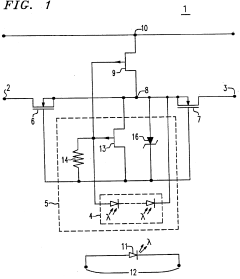
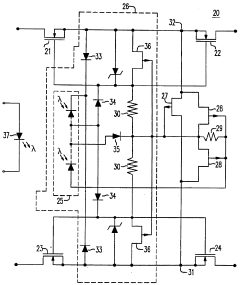
- A solid-state relay design featuring a control circuit driving pass transistors and a shunt transistor, utilizing MOSFETs and JFETs with opposite bias conductivities, to minimize feed-through and maintain high isolation during signal switching, with an optical control signal converting electrical signals to control transistor conductivity.
Thermal Management Solutions for SSRs in VFD Applications
Thermal management represents a critical challenge in the implementation of Solid-State Relays (SSRs) within Variable Frequency Drive (VFD) applications. As power electronic devices, SSRs generate significant heat during operation, particularly when handling the high switching frequencies and current loads typical in modern VFD systems. Without proper thermal management, these devices risk premature failure, reduced reliability, and compromised performance.
The primary thermal management approaches for SSRs in VFD applications include passive cooling solutions such as heat sinks and thermal interface materials. Heat sinks increase the surface area available for heat dissipation, while high-performance thermal interface materials minimize thermal resistance between the SSR and heat sink. These passive solutions offer simplicity and reliability but may prove insufficient for high-power applications.
Active cooling technologies provide enhanced thermal performance for demanding VFD implementations. Forced-air cooling systems utilizing fans or blowers significantly improve heat transfer rates compared to natural convection alone. For extreme thermal loads, liquid cooling solutions offer superior heat dissipation capabilities, though at the cost of increased system complexity and maintenance requirements.
Advanced thermal management techniques include phase-change materials that absorb heat during state transitions, providing effective temperature regulation during load fluctuations common in VFD operations. Thermally conductive polymers and ceramics are increasingly being incorporated into SSR packaging to improve heat spreading and reduce thermal resistance.
Temperature monitoring and adaptive control systems represent another critical aspect of thermal management. Integrated temperature sensors combined with microcontroller-based thermal management algorithms can dynamically adjust VFD operation parameters to prevent thermal runaway conditions. These systems can modulate switching frequencies or implement load-shedding protocols when temperature thresholds are approached.
Design considerations for optimal thermal management include proper component placement to minimize thermal coupling between heat-generating elements, strategic airflow channeling, and thermal isolation of temperature-sensitive components. Computational fluid dynamics (CFD) modeling has become an essential tool for predicting thermal behavior and optimizing cooling system design before physical implementation.
Industry standards such as UL 508C and IEC 61800-5-1 establish thermal performance requirements for VFD systems, including maximum temperature rise limits and thermal cycling endurance. Compliance with these standards necessitates comprehensive thermal management strategies that account for worst-case operating conditions and environmental factors.
The primary thermal management approaches for SSRs in VFD applications include passive cooling solutions such as heat sinks and thermal interface materials. Heat sinks increase the surface area available for heat dissipation, while high-performance thermal interface materials minimize thermal resistance between the SSR and heat sink. These passive solutions offer simplicity and reliability but may prove insufficient for high-power applications.
Active cooling technologies provide enhanced thermal performance for demanding VFD implementations. Forced-air cooling systems utilizing fans or blowers significantly improve heat transfer rates compared to natural convection alone. For extreme thermal loads, liquid cooling solutions offer superior heat dissipation capabilities, though at the cost of increased system complexity and maintenance requirements.
Advanced thermal management techniques include phase-change materials that absorb heat during state transitions, providing effective temperature regulation during load fluctuations common in VFD operations. Thermally conductive polymers and ceramics are increasingly being incorporated into SSR packaging to improve heat spreading and reduce thermal resistance.
Temperature monitoring and adaptive control systems represent another critical aspect of thermal management. Integrated temperature sensors combined with microcontroller-based thermal management algorithms can dynamically adjust VFD operation parameters to prevent thermal runaway conditions. These systems can modulate switching frequencies or implement load-shedding protocols when temperature thresholds are approached.
Design considerations for optimal thermal management include proper component placement to minimize thermal coupling between heat-generating elements, strategic airflow channeling, and thermal isolation of temperature-sensitive components. Computational fluid dynamics (CFD) modeling has become an essential tool for predicting thermal behavior and optimizing cooling system design before physical implementation.
Industry standards such as UL 508C and IEC 61800-5-1 establish thermal performance requirements for VFD systems, including maximum temperature rise limits and thermal cycling endurance. Compliance with these standards necessitates comprehensive thermal management strategies that account for worst-case operating conditions and environmental factors.
EMI/EMC Considerations for SSR Implementation in VFDs
The implementation of Solid-State Relays (SSRs) in Variable Frequency Drives (VFDs) introduces significant electromagnetic interference (EMI) and electromagnetic compatibility (EMC) challenges that must be addressed to ensure reliable system operation. SSRs, while offering numerous advantages over mechanical relays, generate high-frequency switching noise that can propagate throughout the VFD system and potentially interfere with sensitive control electronics.
Conducted EMI, which travels through power lines, represents a primary concern in SSR-based VFD applications. The rapid switching transitions of SSRs create high dv/dt (voltage change over time) and di/dt (current change over time) rates, generating broadband electromagnetic noise. This noise can propagate upstream to the power supply, affecting other connected equipment, or downstream to the motor, potentially causing insulation stress and premature bearing failure.
Radiated EMI presents another challenge, as the high-frequency components generated during switching can be transmitted through space, potentially interfering with nearby electronic systems. This is particularly problematic in industrial environments where multiple sensitive control systems operate in close proximity.
To mitigate these EMI/EMC issues, several design considerations must be implemented. Proper PCB layout techniques are essential, including minimizing loop areas in high-current paths, implementing ground planes, and careful routing of sensitive signal traces away from noise sources. Physical separation between power and control circuits further reduces coupling effects.
Filter networks play a crucial role in EMI suppression for SSR-VFD systems. Input filters with common-mode chokes and differential-mode capacitors can prevent conducted EMI from propagating back to the power source. Similarly, output filters between the SSR switching stage and the motor can reduce the harmful effects of fast-switching transients on motor windings and bearings.
Shielding strategies must be carefully considered, with proper grounding of shields to prevent the creation of ground loops that could exacerbate EMI problems. The enclosure design itself serves as an important EMI barrier, with attention to seams, apertures, and cable entry points being critical to maintaining shield integrity.
Compliance with international EMC standards, including IEC 61800-3 for VFDs and IEC 61000 series for general EMC requirements, necessitates comprehensive testing during development. This typically involves conducted and radiated emissions measurements, as well as immunity testing to ensure the system can withstand external electromagnetic disturbances.
Advanced SSR designs incorporating soft-switching techniques can significantly reduce EMI generation at the source by controlling the switching transition rates. Similarly, gate drive optimization in semiconductor-based SSRs can balance switching losses against EMI generation, finding an optimal operating point for the specific application requirements.
Conducted EMI, which travels through power lines, represents a primary concern in SSR-based VFD applications. The rapid switching transitions of SSRs create high dv/dt (voltage change over time) and di/dt (current change over time) rates, generating broadband electromagnetic noise. This noise can propagate upstream to the power supply, affecting other connected equipment, or downstream to the motor, potentially causing insulation stress and premature bearing failure.
Radiated EMI presents another challenge, as the high-frequency components generated during switching can be transmitted through space, potentially interfering with nearby electronic systems. This is particularly problematic in industrial environments where multiple sensitive control systems operate in close proximity.
To mitigate these EMI/EMC issues, several design considerations must be implemented. Proper PCB layout techniques are essential, including minimizing loop areas in high-current paths, implementing ground planes, and careful routing of sensitive signal traces away from noise sources. Physical separation between power and control circuits further reduces coupling effects.
Filter networks play a crucial role in EMI suppression for SSR-VFD systems. Input filters with common-mode chokes and differential-mode capacitors can prevent conducted EMI from propagating back to the power source. Similarly, output filters between the SSR switching stage and the motor can reduce the harmful effects of fast-switching transients on motor windings and bearings.
Shielding strategies must be carefully considered, with proper grounding of shields to prevent the creation of ground loops that could exacerbate EMI problems. The enclosure design itself serves as an important EMI barrier, with attention to seams, apertures, and cable entry points being critical to maintaining shield integrity.
Compliance with international EMC standards, including IEC 61800-3 for VFDs and IEC 61000 series for general EMC requirements, necessitates comprehensive testing during development. This typically involves conducted and radiated emissions measurements, as well as immunity testing to ensure the system can withstand external electromagnetic disturbances.
Advanced SSR designs incorporating soft-switching techniques can significantly reduce EMI generation at the source by controlling the switching transition rates. Similarly, gate drive optimization in semiconductor-based SSRs can balance switching losses against EMI generation, finding an optimal operating point for the specific application requirements.
Unlock deeper insights with Patsnap Eureka Quick Research — get a full tech report to explore trends and direct your research. Try now!
Generate Your Research Report Instantly with AI Agent
Supercharge your innovation with Patsnap Eureka AI Agent Platform!