

How to Validate Solid-State Relay for Custom Applications
SEP 19, 20259 MIN READ
Generate Your Research Report Instantly with AI Agent
PatSnap Eureka helps you evaluate technical feasibility & market potential.
SSR Technology Background and Validation Objectives
Solid-state relays (SSRs) have evolved significantly since their introduction in the 1970s as alternatives to electromechanical relays. These semiconductor-based switching devices utilize transistors, thyristors, or triacs to control electrical circuits without moving parts, offering advantages in reliability, longevity, and switching speed. The technology has progressed from simple on-off functionality to sophisticated devices capable of handling complex power management tasks across diverse applications.
The evolution of SSR technology has been driven by advancements in semiconductor materials, manufacturing processes, and circuit design. Early generations faced limitations in current handling capacity and suffered from voltage drops and heat dissipation issues. Modern SSRs incorporate improved thermal management, enhanced isolation barriers, and integrated protection features that have expanded their utility across industrial automation, medical equipment, transportation systems, and consumer electronics.
Recent technological trends in SSR development include miniaturization for space-constrained applications, increased power density, improved EMI/RFI immunity, and integration with digital control systems. The emergence of wide-bandgap semiconductors such as silicon carbide (SiC) and gallium nitride (GaN) has pushed performance boundaries, enabling SSRs to operate at higher temperatures, frequencies, and voltages while maintaining efficiency.
The primary objective of SSR validation for custom applications is to ensure reliable performance under specific operating conditions while meeting regulatory requirements and application-specific needs. This involves comprehensive testing to verify electrical characteristics, thermal behavior, isolation integrity, and long-term reliability. Validation must confirm that the selected SSR can withstand anticipated stresses throughout its operational lifetime without compromising system safety or functionality.
Custom applications present unique challenges for SSR validation, as they often involve non-standard operating environments, specialized control requirements, or critical safety considerations. The validation process must therefore be tailored to address application-specific factors such as switching frequency, load characteristics, ambient conditions, and failure mode implications.
A systematic validation approach aims to establish confidence in the SSR's performance boundaries and identify potential failure modes before deployment. This requires both standardized testing protocols and application-specific test scenarios that simulate real-world conditions. The ultimate goal is to develop a validation framework that balances thoroughness with practicality, providing meaningful data for engineering decisions while maintaining reasonable time and resource requirements.
The technological trajectory suggests that future SSR validation will increasingly incorporate advanced simulation tools, accelerated life testing methodologies, and data-driven predictive models to enhance efficiency and accuracy in performance verification.
The evolution of SSR technology has been driven by advancements in semiconductor materials, manufacturing processes, and circuit design. Early generations faced limitations in current handling capacity and suffered from voltage drops and heat dissipation issues. Modern SSRs incorporate improved thermal management, enhanced isolation barriers, and integrated protection features that have expanded their utility across industrial automation, medical equipment, transportation systems, and consumer electronics.
Recent technological trends in SSR development include miniaturization for space-constrained applications, increased power density, improved EMI/RFI immunity, and integration with digital control systems. The emergence of wide-bandgap semiconductors such as silicon carbide (SiC) and gallium nitride (GaN) has pushed performance boundaries, enabling SSRs to operate at higher temperatures, frequencies, and voltages while maintaining efficiency.
The primary objective of SSR validation for custom applications is to ensure reliable performance under specific operating conditions while meeting regulatory requirements and application-specific needs. This involves comprehensive testing to verify electrical characteristics, thermal behavior, isolation integrity, and long-term reliability. Validation must confirm that the selected SSR can withstand anticipated stresses throughout its operational lifetime without compromising system safety or functionality.
Custom applications present unique challenges for SSR validation, as they often involve non-standard operating environments, specialized control requirements, or critical safety considerations. The validation process must therefore be tailored to address application-specific factors such as switching frequency, load characteristics, ambient conditions, and failure mode implications.
A systematic validation approach aims to establish confidence in the SSR's performance boundaries and identify potential failure modes before deployment. This requires both standardized testing protocols and application-specific test scenarios that simulate real-world conditions. The ultimate goal is to develop a validation framework that balances thoroughness with practicality, providing meaningful data for engineering decisions while maintaining reasonable time and resource requirements.
The technological trajectory suggests that future SSR validation will increasingly incorporate advanced simulation tools, accelerated life testing methodologies, and data-driven predictive models to enhance efficiency and accuracy in performance verification.
Market Requirements for Custom SSR Applications
The solid-state relay (SSR) market is experiencing significant growth driven by increasing demand for custom applications across multiple industries. Current market analysis indicates that industrial automation remains the primary driver, with requirements focusing on high reliability, precise switching capabilities, and extended operational lifespans. Manufacturing sectors specifically require SSRs capable of withstanding harsh environments, including extreme temperatures, vibrations, and exposure to chemicals or dust.
The automotive industry represents another substantial market segment, where custom SSR applications are increasingly vital for electric vehicles, battery management systems, and advanced driver-assistance systems. These applications demand miniaturized form factors, extremely low power consumption, and compliance with automotive safety standards such as ISO 26262.
Healthcare equipment manufacturers require SSRs with exceptional isolation properties, ultra-low leakage currents, and medical-grade certifications. The growing trend toward portable and wearable medical devices has created demand for custom SSRs with minimal heat generation and compact designs.
Renewable energy systems present unique requirements for custom SSR applications, particularly in solar inverters and wind turbine control systems. These applications necessitate SSRs capable of handling high DC voltages, rapid switching frequencies, and operation in outdoor environments with temperature extremes.
Market data reveals a growing preference for customization options including specialized packaging, tailored thermal management solutions, and application-specific control interfaces. End-users increasingly demand programmable SSRs with diagnostic capabilities, remote monitoring features, and integration with IoT platforms for predictive maintenance.
Regulatory compliance represents a critical market requirement across all sectors. Custom SSR applications must adhere to region-specific standards including UL, CE, CSA, and VDE certifications. Additionally, RoHS and REACH compliance for environmental sustainability has become non-negotiable for global market access.
Cost sensitivity varies significantly by application segment. While consumer electronics manufacturers prioritize low unit costs, industrial and medical sectors demonstrate willingness to invest in premium SSRs that offer enhanced reliability and specialized features. The total cost of ownership, including energy efficiency and maintenance requirements, increasingly influences purchasing decisions.
Time-to-market pressures are intensifying across all sectors, with customers expecting rapid prototyping capabilities, flexible production volumes, and comprehensive technical support throughout the validation process. Manufacturers capable of providing turnkey validation solutions alongside custom SSR products gain significant competitive advantage in this evolving marketplace.
The automotive industry represents another substantial market segment, where custom SSR applications are increasingly vital for electric vehicles, battery management systems, and advanced driver-assistance systems. These applications demand miniaturized form factors, extremely low power consumption, and compliance with automotive safety standards such as ISO 26262.
Healthcare equipment manufacturers require SSRs with exceptional isolation properties, ultra-low leakage currents, and medical-grade certifications. The growing trend toward portable and wearable medical devices has created demand for custom SSRs with minimal heat generation and compact designs.
Renewable energy systems present unique requirements for custom SSR applications, particularly in solar inverters and wind turbine control systems. These applications necessitate SSRs capable of handling high DC voltages, rapid switching frequencies, and operation in outdoor environments with temperature extremes.
Market data reveals a growing preference for customization options including specialized packaging, tailored thermal management solutions, and application-specific control interfaces. End-users increasingly demand programmable SSRs with diagnostic capabilities, remote monitoring features, and integration with IoT platforms for predictive maintenance.
Regulatory compliance represents a critical market requirement across all sectors. Custom SSR applications must adhere to region-specific standards including UL, CE, CSA, and VDE certifications. Additionally, RoHS and REACH compliance for environmental sustainability has become non-negotiable for global market access.
Cost sensitivity varies significantly by application segment. While consumer electronics manufacturers prioritize low unit costs, industrial and medical sectors demonstrate willingness to invest in premium SSRs that offer enhanced reliability and specialized features. The total cost of ownership, including energy efficiency and maintenance requirements, increasingly influences purchasing decisions.
Time-to-market pressures are intensifying across all sectors, with customers expecting rapid prototyping capabilities, flexible production volumes, and comprehensive technical support throughout the validation process. Manufacturers capable of providing turnkey validation solutions alongside custom SSR products gain significant competitive advantage in this evolving marketplace.
Current SSR Validation Challenges and Limitations
The validation of Solid-State Relays (SSRs) for custom applications faces significant challenges in today's rapidly evolving industrial landscape. Traditional validation methods often fail to address the unique requirements of specialized applications, leading to reliability issues and performance gaps. The complexity of modern SSR designs, incorporating advanced semiconductor technologies and integrated protection features, has outpaced conventional testing protocols that were developed for simpler relay architectures.
One primary challenge is the inadequacy of standardized testing procedures when applied to custom environments. While industry standards like UL 508 and IEC 60947 provide baseline validation frameworks, they frequently fall short in addressing application-specific stressors and operational conditions. This gap becomes particularly problematic when SSRs are deployed in harsh industrial settings with extreme temperature fluctuations, high electromagnetic interference, or unusual switching patterns.
The validation of thermal performance represents another significant limitation. Current methodologies often rely on simplified thermal models that fail to account for the complex heat dissipation patterns in custom enclosures or non-standard mounting configurations. This discrepancy can lead to premature failures when SSRs operate within constrained spaces or alongside heat-generating components, situations common in custom applications but rarely addressed in standard validation protocols.
Surge immunity testing presents additional complications, particularly for SSRs designed for specialized power systems. The conventional surge testing parameters may not accurately represent the actual transient events encountered in specific industrial environments, such as those with regenerative loads or variable frequency drives. This mismatch between test conditions and real-world exposure can result in either over-engineered solutions that increase costs unnecessarily or under-protected implementations that compromise reliability.
The validation of switching characteristics across varied load types poses further challenges. While standard tests typically focus on resistive loads, many custom applications involve complex inductive, capacitive, or mixed loads with unique turn-on and turn-off requirements. Current validation methods often lack the sophistication to predict SSR behavior under these diverse loading conditions, particularly at the extremes of the operating envelope where most failures occur.
Lifecycle testing represents perhaps the most significant limitation in current validation approaches. Accelerated life testing methodologies frequently fail to accurately model the cumulative effects of application-specific stress factors over time. The correlation between accelerated test results and actual field reliability remains tenuous, especially for custom applications with unique duty cycles or operational profiles that deviate significantly from standard usage patterns.
One primary challenge is the inadequacy of standardized testing procedures when applied to custom environments. While industry standards like UL 508 and IEC 60947 provide baseline validation frameworks, they frequently fall short in addressing application-specific stressors and operational conditions. This gap becomes particularly problematic when SSRs are deployed in harsh industrial settings with extreme temperature fluctuations, high electromagnetic interference, or unusual switching patterns.
The validation of thermal performance represents another significant limitation. Current methodologies often rely on simplified thermal models that fail to account for the complex heat dissipation patterns in custom enclosures or non-standard mounting configurations. This discrepancy can lead to premature failures when SSRs operate within constrained spaces or alongside heat-generating components, situations common in custom applications but rarely addressed in standard validation protocols.
Surge immunity testing presents additional complications, particularly for SSRs designed for specialized power systems. The conventional surge testing parameters may not accurately represent the actual transient events encountered in specific industrial environments, such as those with regenerative loads or variable frequency drives. This mismatch between test conditions and real-world exposure can result in either over-engineered solutions that increase costs unnecessarily or under-protected implementations that compromise reliability.
The validation of switching characteristics across varied load types poses further challenges. While standard tests typically focus on resistive loads, many custom applications involve complex inductive, capacitive, or mixed loads with unique turn-on and turn-off requirements. Current validation methods often lack the sophistication to predict SSR behavior under these diverse loading conditions, particularly at the extremes of the operating envelope where most failures occur.
Lifecycle testing represents perhaps the most significant limitation in current validation approaches. Accelerated life testing methodologies frequently fail to accurately model the cumulative effects of application-specific stress factors over time. The correlation between accelerated test results and actual field reliability remains tenuous, especially for custom applications with unique duty cycles or operational profiles that deviate significantly from standard usage patterns.
Established SSR Validation Protocols and Standards
01 Testing and validation methods for solid-state relays
Various methods are employed to validate the functionality and reliability of solid-state relays. These include performance testing under different load conditions, verification of switching characteristics, and validation of electrical isolation properties. Testing procedures may involve measuring response times, checking for proper activation/deactivation, and ensuring the relay meets specified operational parameters across temperature ranges and environmental conditions.- Testing and validation methods for solid-state relays: Various methods and systems for testing and validating solid-state relays to ensure proper functionality and reliability. These include techniques for verifying switching characteristics, response times, and operational parameters under different load conditions. Validation procedures may involve automated test equipment that can simulate real-world operating conditions and detect potential failure modes before deployment.
- Thermal management and protection systems: Implementation of thermal management solutions to protect solid-state relays from overheating during operation. These systems include heat sinks, thermal sensors, and automatic shutdown mechanisms that activate when temperature thresholds are exceeded. Proper thermal validation ensures the relay can operate continuously within specified temperature ranges without degradation or failure.
- Fault detection and diagnostic capabilities: Advanced fault detection mechanisms integrated into solid-state relays to identify and respond to abnormal operating conditions. These features include current monitoring, voltage sensing, and diagnostic circuits that can detect short circuits, open circuits, or other electrical faults. Validation procedures verify that these protective functions operate correctly to prevent damage to connected equipment.
- EMI/EMC compliance validation: Methods for validating electromagnetic interference (EMI) and electromagnetic compatibility (EMC) characteristics of solid-state relays. These validation procedures ensure that relays operate reliably in electrically noisy environments without generating excessive electromagnetic emissions. Testing includes immunity to voltage transients, radio frequency interference, and electrostatic discharge according to industry standards.
- Integrated validation circuits and self-testing features: Design and implementation of built-in self-test capabilities and validation circuits integrated directly into solid-state relay modules. These features allow for continuous monitoring of relay status, automatic periodic testing, and immediate reporting of operational issues. Self-validation mechanisms can verify proper isolation between input and output circuits, switching functionality, and overall system integrity during operation.
02 Protection circuits for solid-state relay validation
Protection circuits are integrated into solid-state relay systems to validate proper operation and prevent damage. These circuits monitor for overcurrent, overvoltage, and thermal conditions that could affect relay performance. Validation mechanisms include fault detection systems, current limiting features, and thermal shutdown capabilities that ensure the relay operates within safe parameters and maintains reliability during abnormal conditions.Expand Specific Solutions03 Diagnostic and monitoring systems for solid-state relays
Advanced diagnostic and monitoring systems are implemented to continuously validate solid-state relay operation. These systems include real-time performance monitoring, fault prediction algorithms, and status reporting capabilities. Diagnostic features can detect degradation in switching characteristics, identify potential failure modes, and provide feedback on relay health, enabling preventive maintenance and ensuring system reliability.Expand Specific Solutions04 Validation of solid-state relay control interfaces
Validation procedures for solid-state relay control interfaces ensure proper communication and operation between control systems and relay components. These methods verify signal integrity, command execution accuracy, and interface compatibility. Testing includes validation of digital and analog control signals, verification of isolation between control and power circuits, and confirmation of proper response to control inputs across various operating conditions.Expand Specific Solutions05 Thermal validation and management in solid-state relays
Thermal validation is critical for ensuring reliable operation of solid-state relays. This involves testing heat dissipation capabilities, validating thermal management systems, and verifying performance under various temperature conditions. Validation procedures include thermal imaging, temperature cycling tests, and verification of thermal protection mechanisms to ensure the relay maintains operational integrity and longevity when subjected to thermal stress.Expand Specific Solutions
Leading SSR Manufacturers and Technology Providers
The solid-state relay (SSR) validation market is currently in a growth phase, driven by increasing demand for reliable switching solutions in industrial automation, smart grid applications, and IoT devices. The global market size is estimated to reach $1.5-2 billion by 2025, with a CAGR of approximately 6-8%. From a technical maturity perspective, the landscape is competitive with established players like Crouzet SAS and Robert Bosch GmbH leading with advanced validation methodologies, while companies such as NARI Technology and Huawei are rapidly advancing with innovative approaches integrating digital twins and AI-based testing frameworks. State Grid Corporation of China and its subsidiaries are focusing on high-voltage SSR validation for smart grid applications, while Teradyne offers specialized automated test equipment for semiconductor-based relays, demonstrating the technology's evolution from basic testing to comprehensive validation ecosystems incorporating reliability prediction and performance optimization.
NARI Technology Co., Ltd.
Technical Solution: NARI Technology has established a comprehensive solid-state relay validation framework specifically designed for power system protection and automation applications. Their methodology incorporates both electrical performance validation and system-level integration testing. NARI's approach begins with detailed characterization of SSR parameters including turn-on/turn-off times, blocking voltage capability, and on-state voltage drop across various temperature and load conditions. For power system applications, they've developed specialized test platforms that simulate grid fault conditions including short circuits, ground faults, and load rejection scenarios to verify SSR performance under extreme conditions. Their validation process includes extensive EMI/EMC testing to ensure reliable operation in electrically noisy substation environments. NARI implements accelerated life testing protocols that combine thermal cycling, humidity exposure, and electrical stress to predict long-term reliability. Their methodology also includes system-level validation where SSRs are tested as components within complete protection or automation systems to verify proper coordination with other devices.
Strengths: Deep expertise in power system protection applications; comprehensive system-level validation capabilities; strong focus on reliability under fault conditions. Weaknesses: Validation approach heavily oriented toward utility applications; may have limited experience with newer semiconductor technologies used in modern SSR designs.
Robert Bosch GmbH
Technical Solution: Bosch has developed a comprehensive solid-state relay validation methodology for custom applications that combines both hardware and software testing approaches. Their system employs a multi-stage validation process including initial characterization, environmental stress testing, and application-specific load testing. Bosch's methodology incorporates automated test equipment that simulates real-world conditions while monitoring key parameters such as switching time, on-state resistance, leakage current, and thermal performance. For automotive and industrial applications, they implement accelerated life testing protocols that subject SSRs to extreme temperature cycling (-40°C to +125°C), humidity variations, and vibration testing to validate long-term reliability. Their validation platform includes specialized circuitry for detecting partial failures and degradation patterns before catastrophic failure occurs, allowing for predictive maintenance in critical systems.
Strengths: Comprehensive testing methodology backed by extensive automotive and industrial experience; advanced failure prediction capabilities; established validation standards that exceed typical industry requirements. Weaknesses: Validation process can be time-consuming and resource-intensive; specialized equipment requirements may increase validation costs for smaller applications.
Critical Parameters and Testing Techniques for SSRs
Method of forming and operating a solid-state relay device
PatentPendingUS20250253844A1
Innovation
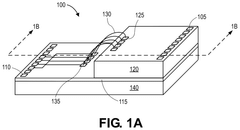
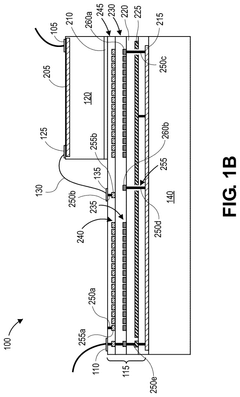
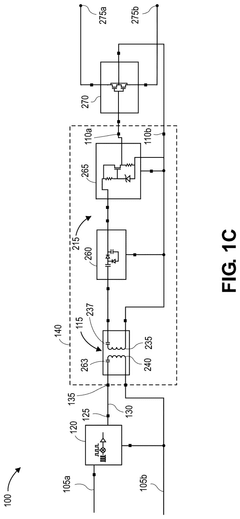
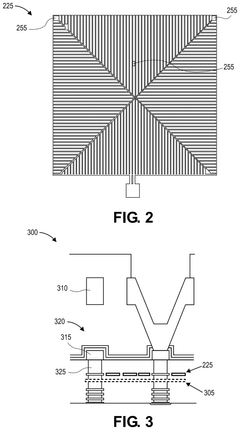
- A signal isolation device comprising a transmit die and a receiver die with a coupler region, including transmit and receiver coils, shield layers, and circuitry to generate an isolated drive signal for a solid-state switch, capable of high voltage operation and compact integration.
Method of validating a control/command system and control/command system that can be validated by the method
PatentWO2007144513A2
Innovation
- A method involving simulating one external event at a time from an initial stabilized global state, continuing until all possible combinations are simulated, with automatic modules ensuring only finite global states are achieved, and authorizing task execution only if no other task is in progress, effectively eliminating unpredictable combinations and allowing exhaustive validation.


Reliability and Longevity Assessment Methods
Assessing the reliability and longevity of solid-state relays (SSRs) requires systematic methodologies that evaluate performance under various operational conditions. Accelerated life testing represents a cornerstone approach, subjecting SSRs to elevated stress levels—including temperature cycling between extremes (typically -40°C to +125°C), high humidity environments (85-95% RH), and voltage variations (±20% of rated values)—to predict long-term behavior within compressed timeframes. These tests typically follow standards such as IEC 60068 or MIL-STD-202, with results analyzed using Weibull distribution models to estimate mean time between failures (MTBF) and failure rates.
Statistical process control techniques complement accelerated testing by monitoring key performance parameters throughout validation. Control charts tracking switching times, voltage drops, and leakage currents help identify trends that might indicate reliability concerns before catastrophic failures occur. Establishing upper and lower control limits based on application requirements ensures early detection of potential degradation patterns.
Failure mode and effects analysis (FMEA) provides a structured framework for identifying potential failure mechanisms specific to the application environment. For SSRs, common failure modes include thermal fatigue of semiconductor junctions, degradation of insulation materials, and contact oxidation. Each failure mode receives a risk priority number (RPN) calculated by multiplying severity, occurrence, and detection ratings, allowing engineers to prioritize mitigation strategies for the most critical risks.
Environmental stress screening (ESS) represents another vital assessment method, exposing production samples to combinations of thermal cycling, vibration, and electrical stress to precipitate early failures. This approach effectively eliminates "infant mortality" failures before deployment, significantly improving field reliability. For custom applications with unique environmental challenges, tailored ESS protocols may incorporate application-specific stressors such as salt spray for maritime environments or radiation exposure for aerospace applications.
Long-term reliability monitoring through field return analysis completes the assessment framework. Establishing a closed-loop system for analyzing failed units from the field provides invaluable data on actual failure mechanisms and rates under real-world conditions. This information feeds back into design improvements and validation protocol refinements, creating a continuous improvement cycle that progressively enhances reliability predictions and actual performance.
Statistical process control techniques complement accelerated testing by monitoring key performance parameters throughout validation. Control charts tracking switching times, voltage drops, and leakage currents help identify trends that might indicate reliability concerns before catastrophic failures occur. Establishing upper and lower control limits based on application requirements ensures early detection of potential degradation patterns.
Failure mode and effects analysis (FMEA) provides a structured framework for identifying potential failure mechanisms specific to the application environment. For SSRs, common failure modes include thermal fatigue of semiconductor junctions, degradation of insulation materials, and contact oxidation. Each failure mode receives a risk priority number (RPN) calculated by multiplying severity, occurrence, and detection ratings, allowing engineers to prioritize mitigation strategies for the most critical risks.
Environmental stress screening (ESS) represents another vital assessment method, exposing production samples to combinations of thermal cycling, vibration, and electrical stress to precipitate early failures. This approach effectively eliminates "infant mortality" failures before deployment, significantly improving field reliability. For custom applications with unique environmental challenges, tailored ESS protocols may incorporate application-specific stressors such as salt spray for maritime environments or radiation exposure for aerospace applications.
Long-term reliability monitoring through field return analysis completes the assessment framework. Establishing a closed-loop system for analyzing failed units from the field provides invaluable data on actual failure mechanisms and rates under real-world conditions. This information feeds back into design improvements and validation protocol refinements, creating a continuous improvement cycle that progressively enhances reliability predictions and actual performance.
Thermal Management Considerations in SSR Validation
Thermal management represents a critical aspect of solid-state relay (SSR) validation for custom applications. SSRs generate significant heat during operation due to power dissipation across semiconductor junctions, particularly under high load conditions. This heat must be effectively managed to prevent thermal runaway, which can lead to premature device failure or safety hazards.
When validating SSRs for custom applications, engineers must first establish the thermal profile of the specific application environment. This includes ambient temperature ranges, duty cycles, load characteristics, and enclosure constraints. These parameters directly influence the thermal behavior of the SSR and determine the cooling requirements necessary for reliable operation.
Heat sinks play a fundamental role in SSR thermal management. The selection of an appropriate heat sink involves calculating thermal resistance requirements based on maximum junction temperature, ambient temperature, and power dissipation. For custom applications, standard heat sink solutions may be insufficient, necessitating thermal modeling and custom heat sink designs to achieve optimal performance.
Thermal interface materials (TIMs) significantly impact heat transfer efficiency between the SSR and heat sink. During validation, various TIM options should be evaluated, including thermal greases, phase-change materials, and thermal pads. The selection criteria should consider thermal conductivity, long-term stability, ease of application, and compatibility with the specific SSR package.
Airflow considerations represent another critical validation parameter. Natural convection may be adequate for low-power applications, but forced-air cooling becomes essential for higher power densities. Validation protocols should include airflow characterization tests to verify cooling effectiveness under worst-case scenarios, particularly in confined spaces or when multiple heat-generating components are present.
Temperature monitoring during validation provides essential data for thermal management assessment. Strategic placement of thermocouples at critical points—including the SSR case, heat sink, and surrounding components—enables comprehensive thermal profiling. This data should be collected under various load conditions and duty cycles to identify potential hotspots and thermal bottlenecks.
Thermal cycling tests constitute a vital component of SSR validation, simulating the expansion and contraction that occurs during normal operation. These tests help identify potential mechanical stresses at interface points and verify the long-term reliability of thermal management solutions. For custom applications with unique thermal profiles, specialized cycling protocols may need to be developed.
Finally, thermal validation should include margin analysis to account for component tolerances, aging effects, and unexpected environmental conditions. This ensures that the SSR will operate reliably throughout its expected lifetime, even under less-than-ideal conditions that may occur in real-world applications.
When validating SSRs for custom applications, engineers must first establish the thermal profile of the specific application environment. This includes ambient temperature ranges, duty cycles, load characteristics, and enclosure constraints. These parameters directly influence the thermal behavior of the SSR and determine the cooling requirements necessary for reliable operation.
Heat sinks play a fundamental role in SSR thermal management. The selection of an appropriate heat sink involves calculating thermal resistance requirements based on maximum junction temperature, ambient temperature, and power dissipation. For custom applications, standard heat sink solutions may be insufficient, necessitating thermal modeling and custom heat sink designs to achieve optimal performance.
Thermal interface materials (TIMs) significantly impact heat transfer efficiency between the SSR and heat sink. During validation, various TIM options should be evaluated, including thermal greases, phase-change materials, and thermal pads. The selection criteria should consider thermal conductivity, long-term stability, ease of application, and compatibility with the specific SSR package.
Airflow considerations represent another critical validation parameter. Natural convection may be adequate for low-power applications, but forced-air cooling becomes essential for higher power densities. Validation protocols should include airflow characterization tests to verify cooling effectiveness under worst-case scenarios, particularly in confined spaces or when multiple heat-generating components are present.
Temperature monitoring during validation provides essential data for thermal management assessment. Strategic placement of thermocouples at critical points—including the SSR case, heat sink, and surrounding components—enables comprehensive thermal profiling. This data should be collected under various load conditions and duty cycles to identify potential hotspots and thermal bottlenecks.
Thermal cycling tests constitute a vital component of SSR validation, simulating the expansion and contraction that occurs during normal operation. These tests help identify potential mechanical stresses at interface points and verify the long-term reliability of thermal management solutions. For custom applications with unique thermal profiles, specialized cycling protocols may need to be developed.
Finally, thermal validation should include margin analysis to account for component tolerances, aging effects, and unexpected environmental conditions. This ensures that the SSR will operate reliably throughout its expected lifetime, even under less-than-ideal conditions that may occur in real-world applications.
Unlock deeper insights with PatSnap Eureka Quick Research — get a full tech report to explore trends and direct your research. Try now!
Generate Your Research Report Instantly with AI Agent
Supercharge your innovation with PatSnap Eureka AI Agent Platform!