
Solid-State Relay Impact on Circuit Stability
SEP 19, 20259 MIN READ
Generate Your Research Report Instantly with AI Agent
Patsnap Eureka helps you evaluate technical feasibility & market potential.
SSR Technology Background and Objectives
Solid-State Relays (SSRs) emerged in the late 1960s as an evolution of traditional electromechanical relays, offering a revolutionary approach to electrical switching without moving parts. The technology leverages semiconductor components, primarily thyristors, triacs, and MOSFETs, to achieve switching functionality through electronic means rather than mechanical contacts. This fundamental shift in design philosophy has transformed how engineers approach circuit control and protection systems across multiple industries.
The evolution of SSR technology has been closely tied to advancements in semiconductor manufacturing, with significant improvements in switching speeds, voltage isolation capabilities, and thermal management occurring throughout the 1980s and 1990s. Recent developments have focused on miniaturization, enhanced reliability in harsh environments, and integration with digital control systems, reflecting the broader trend toward smart industrial systems and IoT applications.
Current technological trajectories indicate continued refinement in SSR performance parameters, particularly in reducing on-state resistance, improving thermal dissipation characteristics, and enhancing immunity to electrical noise and transients. These improvements directly address the critical challenge of maintaining circuit stability under varying load conditions and environmental factors.
The primary technical objectives in SSR development center on optimizing the delicate balance between switching performance and circuit stability. This includes minimizing voltage spikes during switching operations, reducing electromagnetic interference (EMI) generation, and ensuring consistent behavior across temperature ranges. Additionally, there is significant focus on addressing the zero-crossing detection accuracy in AC applications, which directly impacts harmonic distortion and power quality in sensitive electronic systems.
From an industry perspective, SSR technology aims to enable more precise control in power distribution systems, enhance energy efficiency through optimized switching, and support the integration of renewable energy sources with traditional power grids. The technology's non-mechanical nature offers particular advantages in applications requiring high cycling rates, operation in explosive atmospheres, or deployment in locations with severe vibration or shock conditions.
Looking forward, SSR technology development is increasingly oriented toward supporting smart grid infrastructure, electric vehicle charging systems, and advanced manufacturing processes that demand microsecond-level switching precision. The convergence of SSR technology with digital control systems and predictive maintenance capabilities represents a significant frontier, potentially enabling self-diagnosing power systems that can anticipate and mitigate stability issues before they impact critical operations.
The evolution of SSR technology has been closely tied to advancements in semiconductor manufacturing, with significant improvements in switching speeds, voltage isolation capabilities, and thermal management occurring throughout the 1980s and 1990s. Recent developments have focused on miniaturization, enhanced reliability in harsh environments, and integration with digital control systems, reflecting the broader trend toward smart industrial systems and IoT applications.
Current technological trajectories indicate continued refinement in SSR performance parameters, particularly in reducing on-state resistance, improving thermal dissipation characteristics, and enhancing immunity to electrical noise and transients. These improvements directly address the critical challenge of maintaining circuit stability under varying load conditions and environmental factors.
The primary technical objectives in SSR development center on optimizing the delicate balance between switching performance and circuit stability. This includes minimizing voltage spikes during switching operations, reducing electromagnetic interference (EMI) generation, and ensuring consistent behavior across temperature ranges. Additionally, there is significant focus on addressing the zero-crossing detection accuracy in AC applications, which directly impacts harmonic distortion and power quality in sensitive electronic systems.
From an industry perspective, SSR technology aims to enable more precise control in power distribution systems, enhance energy efficiency through optimized switching, and support the integration of renewable energy sources with traditional power grids. The technology's non-mechanical nature offers particular advantages in applications requiring high cycling rates, operation in explosive atmospheres, or deployment in locations with severe vibration or shock conditions.
Looking forward, SSR technology development is increasingly oriented toward supporting smart grid infrastructure, electric vehicle charging systems, and advanced manufacturing processes that demand microsecond-level switching precision. The convergence of SSR technology with digital control systems and predictive maintenance capabilities represents a significant frontier, potentially enabling self-diagnosing power systems that can anticipate and mitigate stability issues before they impact critical operations.
Market Demand Analysis for SSR Applications
The global market for Solid-State Relay (SSR) applications has witnessed substantial growth over the past decade, driven primarily by increasing automation across industrial sectors. Current market valuations place the SSR market at approximately 1.5 billion USD, with projections indicating a compound annual growth rate of 6.8% through 2028. This growth trajectory reflects the expanding application scope of SSRs beyond traditional industrial controls into emerging sectors like renewable energy systems, electric vehicles, and smart grid infrastructure.
Industrial automation remains the dominant market segment, accounting for nearly 45% of total SSR demand. Manufacturing facilities are increasingly replacing electromagnetic relays with SSRs to enhance system reliability and reduce maintenance requirements. The automotive sector represents the fastest-growing application area, with demand increasing at nearly 9% annually as electric vehicle production scales up globally and requires more sophisticated power management solutions.
Market research indicates that circuit stability concerns are becoming a critical decision factor for procurement engineers. A recent industry survey revealed that 78% of system designers consider circuit stability impact when selecting relay technologies, compared to just 52% five years ago. This shift reflects growing awareness of how SSRs' switching characteristics can affect sensitive electronic systems, particularly in applications with variable loads or in environments with significant electromagnetic interference.
Regional analysis shows Asia-Pacific leading SSR market growth at 8.2% annually, driven by rapid industrial automation in China, India, and Southeast Asian nations. North America and Europe follow with steady growth rates of 5.7% and 5.3% respectively, primarily fueled by modernization of aging infrastructure and increasing adoption of Industry 4.0 technologies.
Application-specific demand patterns are emerging across different sectors. In renewable energy, SSRs optimized for high-voltage DC switching are seeing demand increase by 12% annually as solar and wind installations proliferate. Healthcare equipment manufacturers are increasingly specifying SSRs with enhanced circuit stability features for critical medical devices, creating a premium segment within the market.
Customer requirements are evolving toward SSRs with improved thermal management, lower leakage current, and enhanced immunity to voltage transients. Market data indicates willingness to pay 15-20% price premiums for SSRs that demonstrably improve circuit stability in sensitive applications. This trend is driving manufacturers to invest in advanced SSR designs that minimize voltage spikes during switching operations and provide better isolation between control and load circuits.
Industrial automation remains the dominant market segment, accounting for nearly 45% of total SSR demand. Manufacturing facilities are increasingly replacing electromagnetic relays with SSRs to enhance system reliability and reduce maintenance requirements. The automotive sector represents the fastest-growing application area, with demand increasing at nearly 9% annually as electric vehicle production scales up globally and requires more sophisticated power management solutions.
Market research indicates that circuit stability concerns are becoming a critical decision factor for procurement engineers. A recent industry survey revealed that 78% of system designers consider circuit stability impact when selecting relay technologies, compared to just 52% five years ago. This shift reflects growing awareness of how SSRs' switching characteristics can affect sensitive electronic systems, particularly in applications with variable loads or in environments with significant electromagnetic interference.
Regional analysis shows Asia-Pacific leading SSR market growth at 8.2% annually, driven by rapid industrial automation in China, India, and Southeast Asian nations. North America and Europe follow with steady growth rates of 5.7% and 5.3% respectively, primarily fueled by modernization of aging infrastructure and increasing adoption of Industry 4.0 technologies.
Application-specific demand patterns are emerging across different sectors. In renewable energy, SSRs optimized for high-voltage DC switching are seeing demand increase by 12% annually as solar and wind installations proliferate. Healthcare equipment manufacturers are increasingly specifying SSRs with enhanced circuit stability features for critical medical devices, creating a premium segment within the market.
Customer requirements are evolving toward SSRs with improved thermal management, lower leakage current, and enhanced immunity to voltage transients. Market data indicates willingness to pay 15-20% price premiums for SSRs that demonstrably improve circuit stability in sensitive applications. This trend is driving manufacturers to invest in advanced SSR designs that minimize voltage spikes during switching operations and provide better isolation between control and load circuits.
Current SSR Technology Challenges
Solid-State Relays (SSRs) currently face several significant technical challenges that impact their performance and reliability in circuit stability applications. The primary issue is heat dissipation, as SSRs generate considerable heat during operation due to the voltage drop across their semiconductor switching elements. This thermal management challenge becomes particularly acute in high-current applications or densely packed control systems, where accumulated heat can lead to premature device failure or unpredictable behavior.
Another critical challenge is the inherent leakage current that flows through SSRs even in their "off" state. Unlike mechanical relays with physical separation between contacts, semiconductor-based SSRs always permit a small current flow, typically ranging from 0.1mA to 10mA depending on the device quality and design. This leakage can cause unexpected circuit behavior, especially in sensitive applications or when controlling low-power devices that might remain partially activated.
SSRs also exhibit vulnerability to voltage transients and surges, which can damage the semiconductor components and lead to catastrophic failure. While manufacturers implement various protection mechanisms, the fundamental semiconductor structure remains susceptible to high-energy events that exceed design parameters. This vulnerability necessitates additional external protection circuitry in many applications, increasing system complexity and cost.
The switching characteristics of SSRs present another significant challenge. Zero-crossing SSRs, while reducing electromagnetic interference, introduce a half-cycle delay in response time. Random-turn-on SSRs offer faster response but generate more electromagnetic noise that can destabilize sensitive circuits. This trade-off between response time and noise generation remains a persistent engineering challenge.
Additionally, SSRs demonstrate a phenomenon called "latch-up" under certain conditions, where the device becomes stuck in the "on" state regardless of control signals. This failure mode can be particularly dangerous in safety-critical applications and requires sophisticated detection and protection mechanisms to mitigate.
The aging characteristics of SSR semiconductor materials also present long-term reliability concerns. Over time, thermal cycling and electrical stress cause gradual parameter drift, potentially leading to unpredictable behavior in previously stable circuits. This aging process is difficult to model accurately, complicating lifetime predictions and maintenance scheduling.
Finally, SSRs exhibit significantly higher on-state resistance compared to mechanical relays, resulting in greater power losses and voltage drops across the switching element. This characteristic not only reduces energy efficiency but can also affect the operation of voltage-sensitive loads, requiring additional compensation measures in precision applications.
Another critical challenge is the inherent leakage current that flows through SSRs even in their "off" state. Unlike mechanical relays with physical separation between contacts, semiconductor-based SSRs always permit a small current flow, typically ranging from 0.1mA to 10mA depending on the device quality and design. This leakage can cause unexpected circuit behavior, especially in sensitive applications or when controlling low-power devices that might remain partially activated.
SSRs also exhibit vulnerability to voltage transients and surges, which can damage the semiconductor components and lead to catastrophic failure. While manufacturers implement various protection mechanisms, the fundamental semiconductor structure remains susceptible to high-energy events that exceed design parameters. This vulnerability necessitates additional external protection circuitry in many applications, increasing system complexity and cost.
The switching characteristics of SSRs present another significant challenge. Zero-crossing SSRs, while reducing electromagnetic interference, introduce a half-cycle delay in response time. Random-turn-on SSRs offer faster response but generate more electromagnetic noise that can destabilize sensitive circuits. This trade-off between response time and noise generation remains a persistent engineering challenge.
Additionally, SSRs demonstrate a phenomenon called "latch-up" under certain conditions, where the device becomes stuck in the "on" state regardless of control signals. This failure mode can be particularly dangerous in safety-critical applications and requires sophisticated detection and protection mechanisms to mitigate.
The aging characteristics of SSR semiconductor materials also present long-term reliability concerns. Over time, thermal cycling and electrical stress cause gradual parameter drift, potentially leading to unpredictable behavior in previously stable circuits. This aging process is difficult to model accurately, complicating lifetime predictions and maintenance scheduling.
Finally, SSRs exhibit significantly higher on-state resistance compared to mechanical relays, resulting in greater power losses and voltage drops across the switching element. This characteristic not only reduces energy efficiency but can also affect the operation of voltage-sensitive loads, requiring additional compensation measures in precision applications.
Current SSR Circuit Stability Solutions
01 Thermal stability in solid-state relay circuits
Thermal management is crucial for solid-state relay circuit stability. Various techniques are employed to dissipate heat and prevent thermal runaway, including heat sinks, thermal isolation, and temperature monitoring systems. These approaches help maintain operational stability by keeping semiconductor components within safe temperature ranges, preventing thermal-induced failures and ensuring consistent switching performance under varying load conditions.- Thermal stability enhancement in solid-state relays: Thermal stability is critical for solid-state relay performance. Various techniques are employed to manage heat dissipation and prevent thermal runaway, including heat sinks, thermal interface materials, and optimized component layouts. These approaches help maintain stable operation under varying load conditions and ambient temperatures, extending relay lifespan and ensuring consistent switching behavior.
- Noise suppression and EMI reduction techniques: Electromagnetic interference (EMI) and electrical noise can significantly impact solid-state relay stability. Circuit designs incorporating snubber networks, filtering components, and proper shielding help reduce switching transients and prevent false triggering. These noise suppression techniques improve relay reliability in electrically noisy environments and minimize interference with nearby electronic systems.
- Voltage and current protection mechanisms: Protection circuits are essential for maintaining solid-state relay stability during abnormal operating conditions. These include overvoltage protection, overcurrent limiting, surge suppression, and fault detection mechanisms. Such protective features prevent relay damage during power surges or load faults, ensuring consistent operation and extending the service life of the relay circuit.
- Control circuit isolation and feedback systems: Effective isolation between control and power circuits is crucial for solid-state relay stability. Optocouplers, transformers, and other isolation techniques prevent control circuit interference while maintaining switching functionality. Advanced designs incorporate feedback mechanisms to monitor relay status and adjust control parameters, ensuring reliable operation across varying input conditions and load characteristics.
- Switching timing and synchronization optimization: Precise timing control in solid-state relay switching is vital for circuit stability. Zero-crossing detection circuits, phase-locked loops, and microcontroller-based timing systems help minimize switching transients and reduce stress on components. These timing optimization techniques ensure smooth transitions between on and off states, preventing voltage spikes and current surges that could destabilize the circuit or damage connected equipment.
02 Noise suppression and EMI reduction techniques
Electromagnetic interference (EMI) and electrical noise can significantly impact solid-state relay stability. Circuit designs incorporating snubber networks, filtering components, and proper shielding help reduce switching transients and noise propagation. These techniques prevent false triggering, improve immunity to external interference, and enhance overall circuit reliability, particularly in industrial environments where multiple electrical systems operate in close proximity.Expand Specific Solutions03 Protection mechanisms for overcurrent and overvoltage
Solid-state relay circuits require robust protection against electrical stresses to maintain stability. Integrated protection mechanisms such as current limiting circuits, voltage clamping devices, and fast-acting fuses help prevent damage during fault conditions. These protective elements ensure circuit longevity by safeguarding sensitive semiconductor components from transient events and abnormal operating conditions, thereby enhancing the overall reliability of the switching system.Expand Specific Solutions04 Gate drive optimization for switching stability
The stability of solid-state relay circuits heavily depends on proper gate drive design. Optimized gate drive circuits with controlled slew rates, appropriate isolation, and sufficient drive current ensure clean switching transitions. These designs minimize switching losses, reduce electromagnetic emissions, and prevent parasitic turn-on/turn-off events. Advanced gate drive techniques also compensate for temperature variations and component aging, maintaining consistent switching performance throughout the relay's operational life.Expand Specific Solutions05 Feedback control and monitoring systems
Implementing feedback control mechanisms significantly improves solid-state relay circuit stability. These systems continuously monitor critical parameters such as current, voltage, and temperature, making real-time adjustments to maintain optimal operation. Advanced designs incorporate microcontroller-based supervision, fault detection algorithms, and self-diagnostic capabilities. Such intelligent monitoring ensures stable performance across varying load conditions and provides early warning of potential failures, enhancing overall system reliability.Expand Specific Solutions
Major SSR Manufacturers and Competitors
The solid-state relay (SSR) market is currently in a growth phase, with increasing adoption across industrial automation, automotive, and consumer electronics sectors. The global market size is estimated to reach approximately $1.5 billion by 2025, driven by demand for more reliable circuit protection solutions. From a technical maturity perspective, the landscape shows varying degrees of advancement. Industry leaders like Texas Instruments, Littelfuse, and OMRON have established mature SSR technologies with enhanced thermal management and noise immunity features. Emerging players such as Suzhou Novosense and Xiamen Kudom are rapidly innovating with integrated diagnostic capabilities and bus-based intelligent switching. Companies including Panasonic, Vertiv, and TE Connectivity are focusing on miniaturization and efficiency improvements to address circuit stability challenges in high-frequency applications.
Texas Instruments Incorporated
Technical Solution: Texas Instruments has developed innovative solid-state relay solutions focused on circuit stability through their ISO family of digital isolators and integrated SSR drivers. Their approach leverages proprietary capacitive isolation technology that provides superior common-mode transient immunity (CMTI) exceeding 100 kV/μs, significantly outperforming traditional optocoupler-based SSRs in noisy industrial environments. TI's SSR solutions incorporate advanced power management ICs that maintain consistent gate drive voltages regardless of supply fluctuations, ensuring predictable switching characteristics even during brownout conditions. Their patented SiC MOSFET driver technology implements precise gate charge control with programmable slew rates (typically 2-20V/ns), allowing engineers to optimize the trade-off between switching losses and electromagnetic interference based on specific application requirements. TI has also developed integrated diagnostic features that continuously monitor SSR health parameters including temperature, current, and switching times, enabling predictive maintenance before circuit stability issues can develop.
Strengths: Industry-leading CMTI performance ensures stability in electrically noisy environments; programmable switching characteristics allow application-specific optimization; integrated diagnostics enable proactive maintenance. Weaknesses: Higher component cost compared to discrete solutions; requires microcontroller interface for advanced features; more complex implementation than traditional SSRs for basic applications.
Xiamen Hongfa Electric Appliance Co., Ltd.
Technical Solution: Hongfa has developed a comprehensive solid-state relay technology portfolio addressing circuit stability challenges through their JGX series. Their approach combines MOSFET and IGBT switching elements with advanced gate drive circuits that provide controlled switching slopes (dv/dt) typically between 5-50V/μs, minimizing electromagnetic interference. Hongfa's SSRs incorporate multi-layer varistor protection systems that respond to transients within nanoseconds, clamping overvoltage events before they can propagate through sensitive circuits. Their patented thermal distribution technology uses direct bonded copper (DBC) substrates with optimized heat spreading patterns, reducing thermal gradients across the semiconductor die and preventing localized hotspots that can lead to premature failure or inconsistent switching behavior. Hongfa has also implemented adaptive feedback control in their latest designs that monitors load conditions and adjusts switching parameters in real-time, maintaining optimal performance across varying environmental conditions and load impedances.
Strengths: Excellent thermal management through advanced DBC substrate design; comprehensive overvoltage protection; adaptive control systems maintain stability across varying loads. Weaknesses: Higher complexity increases potential failure points; requires more sophisticated control signals than basic SSRs; performance advantages diminish in simple on/off applications without variable loads.
Key SSR Stability Patents and Innovations
Solid state relay, power triac chip, and method for testing solid state relay
PatentWO2016194436A1
Innovation
- The design of the solid-state relay includes a power triac chip with reduced bidirectional repetitive peak-off voltage imbalance by setting the difference between mode I and mode III peak-off voltages within a predetermined tolerance range, ensuring the power triac chip's peak-off voltage is lower than the ignition triac chip's, and implementing a testing method to ensure products meet specific peak-off voltage standards for enhanced ESD resistance.
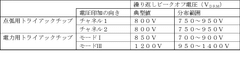
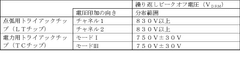
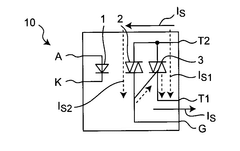
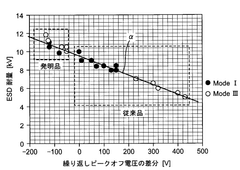
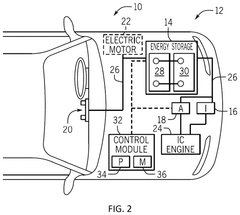
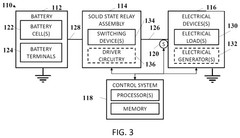
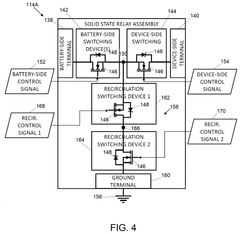
Solid-state relay dedicated recirculation path systems and methods
PatentActiveUS12113522B2
Innovation
- A solid-state relay system with a recirculation path is introduced, utilizing metal-oxide-semiconductor field-effect transistors (MOSFETs) for switching devices and driver circuitry, allowing for controlled current flow and routing excess energy away from electronics during irregular events, thereby protecting components.

Thermal Management in SSR Applications
Thermal management represents a critical aspect of solid-state relay (SSR) implementation that directly impacts circuit stability and operational reliability. SSRs generate significant heat during operation due to the inherent resistance of semiconductor materials when conducting current. This heat generation follows the power dissipation equation P = I²R, where higher load currents exponentially increase thermal output. Without proper management, excessive heat accumulation can trigger thermal runaway conditions, potentially leading to premature device failure or catastrophic circuit breakdown.
Effective thermal management strategies for SSRs typically incorporate multiple cooling approaches. Passive cooling solutions utilize heat sinks with optimized fin designs to maximize surface area for convective heat transfer. The thermal resistance of these heat sinks, measured in °C/W, determines their effectiveness in dissipating heat to the ambient environment. For applications with higher power requirements, active cooling methods including forced-air cooling with fans or liquid cooling systems may be necessary to maintain safe operating temperatures.
Thermal interface materials (TIMs) play a crucial role in establishing efficient thermal pathways between SSRs and heat dissipation components. These materials—ranging from thermal greases and phase-change materials to thermally conductive adhesives—fill microscopic air gaps at contact surfaces, significantly reducing thermal resistance at interfaces. Selection of appropriate TIMs must consider thermal conductivity, application method, long-term stability, and compatibility with the specific operating environment.
Temperature monitoring represents another essential component of comprehensive thermal management systems. Integrated temperature sensors, thermistors, or infrared thermal imaging can provide real-time temperature data, enabling protective measures before critical thresholds are reached. Advanced SSR designs increasingly incorporate built-in thermal protection circuits that automatically reduce current flow or completely disconnect when predetermined temperature limits are exceeded.
Environmental factors significantly influence thermal management requirements for SSR applications. Ambient temperature, air circulation patterns, enclosure design, and proximity to other heat-generating components all affect the thermal operating conditions. Derating curves provided by manufacturers establish safe operating parameters across varying environmental conditions, guiding engineers in appropriate device selection and implementation.
Thermal simulation and modeling tools have become invaluable for predicting heat distribution and identifying potential hotspots before physical implementation. Computational fluid dynamics (CFD) and finite element analysis (FEA) enable engineers to optimize thermal management solutions during the design phase, reducing development cycles and enhancing reliability. These simulation approaches are particularly valuable for complex installations where multiple SSRs operate in confined spaces with limited cooling options.
Effective thermal management strategies for SSRs typically incorporate multiple cooling approaches. Passive cooling solutions utilize heat sinks with optimized fin designs to maximize surface area for convective heat transfer. The thermal resistance of these heat sinks, measured in °C/W, determines their effectiveness in dissipating heat to the ambient environment. For applications with higher power requirements, active cooling methods including forced-air cooling with fans or liquid cooling systems may be necessary to maintain safe operating temperatures.
Thermal interface materials (TIMs) play a crucial role in establishing efficient thermal pathways between SSRs and heat dissipation components. These materials—ranging from thermal greases and phase-change materials to thermally conductive adhesives—fill microscopic air gaps at contact surfaces, significantly reducing thermal resistance at interfaces. Selection of appropriate TIMs must consider thermal conductivity, application method, long-term stability, and compatibility with the specific operating environment.
Temperature monitoring represents another essential component of comprehensive thermal management systems. Integrated temperature sensors, thermistors, or infrared thermal imaging can provide real-time temperature data, enabling protective measures before critical thresholds are reached. Advanced SSR designs increasingly incorporate built-in thermal protection circuits that automatically reduce current flow or completely disconnect when predetermined temperature limits are exceeded.
Environmental factors significantly influence thermal management requirements for SSR applications. Ambient temperature, air circulation patterns, enclosure design, and proximity to other heat-generating components all affect the thermal operating conditions. Derating curves provided by manufacturers establish safe operating parameters across varying environmental conditions, guiding engineers in appropriate device selection and implementation.
Thermal simulation and modeling tools have become invaluable for predicting heat distribution and identifying potential hotspots before physical implementation. Computational fluid dynamics (CFD) and finite element analysis (FEA) enable engineers to optimize thermal management solutions during the design phase, reducing development cycles and enhancing reliability. These simulation approaches are particularly valuable for complex installations where multiple SSRs operate in confined spaces with limited cooling options.
EMI/EMC Considerations for SSR Implementation
Solid-State Relays (SSRs) introduce unique electromagnetic interference (EMI) and electromagnetic compatibility (EMC) challenges that must be addressed for stable circuit operation. When implementing SSRs, their semiconductor-based switching mechanisms generate high-frequency noise during state transitions, particularly during turn-on and turn-off phases. This noise can propagate throughout the system, affecting sensitive components and potentially causing operational instability.
The zero-crossing switching capability of AC SSRs significantly reduces EMI generation compared to mechanical relays. However, this advantage is only realized when properly implemented with appropriate filtering components. Fast-switching DC SSRs present greater EMI challenges due to their rapid dV/dt and dI/dt characteristics, which can generate broadband electromagnetic noise spanning from kilohertz to megahertz frequencies.
Effective EMI mitigation strategies for SSR implementation include the strategic placement of snubber circuits consisting of RC networks across SSR terminals. These components dampen voltage spikes and reduce high-frequency oscillations during switching transitions. For particularly sensitive applications, ferrite beads or common-mode chokes installed on input/output lines provide additional high-frequency noise suppression without significantly affecting the desired signal integrity.
Physical layout considerations play a crucial role in EMC performance. Proper grounding techniques with low-impedance paths for noise currents help prevent ground loops and common-mode interference. Separation of control and power circuits minimizes coupling between low-level signals and high-power switching noise. Additionally, shielded enclosures and cable routing strategies that minimize parallel runs between power and signal lines further enhance EMC performance.
Regulatory compliance presents another critical dimension of SSR implementation. Devices must meet international standards such as IEC 61000 for electromagnetic compatibility and FCC Part 15 or CISPR 22 for emissions limits. These standards establish specific testing methodologies and acceptable performance criteria that vary by application environment and industry sector.
Testing protocols for SSR-based systems should include conducted emissions measurements on power lines, radiated emissions testing in anechoic chambers, and immunity testing against external electromagnetic disturbances. Particular attention should be paid to immunity against fast transients and surge events, as these can trigger false switching in SSRs if protection is inadequate.
Advanced SSR designs now incorporate integrated EMI filtering components and improved isolation barriers between input and output stages. These design enhancements, combined with proper implementation practices, enable SSRs to maintain circuit stability even in electromagnetically challenging environments such as industrial automation systems, medical equipment, and telecommunications infrastructure.
The zero-crossing switching capability of AC SSRs significantly reduces EMI generation compared to mechanical relays. However, this advantage is only realized when properly implemented with appropriate filtering components. Fast-switching DC SSRs present greater EMI challenges due to their rapid dV/dt and dI/dt characteristics, which can generate broadband electromagnetic noise spanning from kilohertz to megahertz frequencies.
Effective EMI mitigation strategies for SSR implementation include the strategic placement of snubber circuits consisting of RC networks across SSR terminals. These components dampen voltage spikes and reduce high-frequency oscillations during switching transitions. For particularly sensitive applications, ferrite beads or common-mode chokes installed on input/output lines provide additional high-frequency noise suppression without significantly affecting the desired signal integrity.
Physical layout considerations play a crucial role in EMC performance. Proper grounding techniques with low-impedance paths for noise currents help prevent ground loops and common-mode interference. Separation of control and power circuits minimizes coupling between low-level signals and high-power switching noise. Additionally, shielded enclosures and cable routing strategies that minimize parallel runs between power and signal lines further enhance EMC performance.
Regulatory compliance presents another critical dimension of SSR implementation. Devices must meet international standards such as IEC 61000 for electromagnetic compatibility and FCC Part 15 or CISPR 22 for emissions limits. These standards establish specific testing methodologies and acceptable performance criteria that vary by application environment and industry sector.
Testing protocols for SSR-based systems should include conducted emissions measurements on power lines, radiated emissions testing in anechoic chambers, and immunity testing against external electromagnetic disturbances. Particular attention should be paid to immunity against fast transients and surge events, as these can trigger false switching in SSRs if protection is inadequate.
Advanced SSR designs now incorporate integrated EMI filtering components and improved isolation barriers between input and output stages. These design enhancements, combined with proper implementation practices, enable SSRs to maintain circuit stability even in electromagnetically challenging environments such as industrial automation systems, medical equipment, and telecommunications infrastructure.
Unlock deeper insights with Patsnap Eureka Quick Research — get a full tech report to explore trends and direct your research. Try now!
Generate Your Research Report Instantly with AI Agent
Supercharge your innovation with Patsnap Eureka AI Agent Platform!