How to Evaluate FTIR Spectra for Consistency & Accuracy
SEP 22, 20259 MIN READ
Generate Your Research Report Instantly with AI Agent
PatSnap Eureka helps you evaluate technical feasibility & market potential.
FTIR Spectroscopy Background and Evaluation Objectives
Fourier Transform Infrared (FTIR) spectroscopy has evolved significantly since its inception in the mid-20th century, becoming a cornerstone analytical technique across numerous scientific and industrial domains. This powerful method enables the identification and quantification of chemical compounds by measuring how infrared radiation is absorbed by materials, creating distinctive spectral fingerprints that reveal molecular structures and compositions.
The evolution of FTIR technology has been marked by several transformative developments. Early infrared spectroscopy utilized dispersive instruments with limited capabilities, while modern FTIR systems employ interferometers and sophisticated computational algorithms to achieve superior resolution, sensitivity, and data acquisition speeds. Recent advancements include miniaturization, enhanced detector technologies, and integration with artificial intelligence for automated analysis.
In today's analytical landscape, ensuring consistency and accuracy in FTIR spectral evaluation has become increasingly critical as industries rely on these measurements for quality control, regulatory compliance, and research validation. The pharmaceutical, polymer, food, environmental, and materials science sectors all depend on reliable FTIR data for critical decision-making processes.
The primary objectives of FTIR spectral evaluation include establishing robust methodologies for verifying spectral quality, ensuring measurement reproducibility across different instruments and operators, and developing standardized protocols for data interpretation. These objectives address the fundamental challenges of spectral variability caused by instrumental factors, sample preparation inconsistencies, and environmental influences.
Current technological trends in FTIR evaluation focus on automated validation systems, cloud-based reference libraries, and machine learning algorithms that can identify subtle spectral anomalies. The integration of chemometric approaches has significantly enhanced the ability to extract meaningful information from complex spectral datasets, particularly in mixture analysis and trace component detection.
The anticipated technical goals for advancing FTIR spectral evaluation include developing universal calibration standards, creating intelligent software platforms capable of real-time quality assessment, and establishing industry-specific protocols that account for unique matrix effects and interference patterns. Additionally, there is growing interest in harmonizing evaluation methodologies across international standards organizations to facilitate global data comparability.
As FTIR technology continues to advance toward higher resolution, greater sensitivity, and more sophisticated data processing capabilities, the methodologies for evaluating spectral consistency and accuracy must evolve in parallel to maintain the integrity of analytical results and support increasingly demanding applications across scientific and industrial domains.
The evolution of FTIR technology has been marked by several transformative developments. Early infrared spectroscopy utilized dispersive instruments with limited capabilities, while modern FTIR systems employ interferometers and sophisticated computational algorithms to achieve superior resolution, sensitivity, and data acquisition speeds. Recent advancements include miniaturization, enhanced detector technologies, and integration with artificial intelligence for automated analysis.
In today's analytical landscape, ensuring consistency and accuracy in FTIR spectral evaluation has become increasingly critical as industries rely on these measurements for quality control, regulatory compliance, and research validation. The pharmaceutical, polymer, food, environmental, and materials science sectors all depend on reliable FTIR data for critical decision-making processes.
The primary objectives of FTIR spectral evaluation include establishing robust methodologies for verifying spectral quality, ensuring measurement reproducibility across different instruments and operators, and developing standardized protocols for data interpretation. These objectives address the fundamental challenges of spectral variability caused by instrumental factors, sample preparation inconsistencies, and environmental influences.
Current technological trends in FTIR evaluation focus on automated validation systems, cloud-based reference libraries, and machine learning algorithms that can identify subtle spectral anomalies. The integration of chemometric approaches has significantly enhanced the ability to extract meaningful information from complex spectral datasets, particularly in mixture analysis and trace component detection.
The anticipated technical goals for advancing FTIR spectral evaluation include developing universal calibration standards, creating intelligent software platforms capable of real-time quality assessment, and establishing industry-specific protocols that account for unique matrix effects and interference patterns. Additionally, there is growing interest in harmonizing evaluation methodologies across international standards organizations to facilitate global data comparability.
As FTIR technology continues to advance toward higher resolution, greater sensitivity, and more sophisticated data processing capabilities, the methodologies for evaluating spectral consistency and accuracy must evolve in parallel to maintain the integrity of analytical results and support increasingly demanding applications across scientific and industrial domains.
Market Demand for Accurate FTIR Spectral Analysis
The global market for Fourier Transform Infrared (FTIR) spectroscopy analysis solutions has experienced significant growth, driven by increasing demands for accurate material characterization across multiple industries. The current market size for FTIR spectroscopy equipment and related analytical services is estimated to reach $1.5 billion by 2025, with a compound annual growth rate of approximately 6.8% from 2020.
Pharmaceutical and biotechnology sectors represent the largest market segments, accounting for nearly 35% of the total demand. These industries require highly accurate spectral analysis for drug development, quality control, and regulatory compliance. The implementation of stringent quality standards such as FDA's Process Analytical Technology (PAT) initiative has further accelerated the need for consistent and accurate FTIR analysis methods.
Chemical manufacturing represents another significant market segment, where FTIR spectroscopy serves as a critical tool for raw material verification, reaction monitoring, and final product quality assurance. The growing emphasis on sustainable manufacturing practices has increased the demand for precise analytical methods that can detect impurities at lower concentrations.
Environmental monitoring applications have shown the fastest growth rate in recent years, expanding at approximately 8.5% annually. This growth is primarily driven by stricter environmental regulations and increased public awareness regarding pollution monitoring. Accurate FTIR analysis enables the detection and quantification of atmospheric pollutants, soil contaminants, and water quality parameters.
Academic and research institutions constitute about 15% of the market, with consistent demand for high-precision spectral analysis capabilities. The reproducibility crisis in scientific research has heightened awareness about the need for standardized analytical methods with demonstrable accuracy and consistency.
Market research indicates that end-users are increasingly prioritizing spectral data consistency and accuracy over initial equipment costs. A survey of laboratory managers revealed that 78% consider spectral accuracy as "extremely important" when making purchasing decisions for analytical equipment, while 65% reported experiencing challenges with spectral reproducibility across different instruments or operators.
The demand for automated validation and calibration solutions has grown by approximately 12% annually, reflecting the industry's focus on reducing human error and ensuring consistent results. Software solutions that incorporate machine learning algorithms for spectral interpretation and anomaly detection represent the fastest-growing segment within the FTIR analysis market.
Regional analysis shows North America leading with approximately 38% market share, followed by Europe (30%) and Asia-Pacific (25%). However, the Asia-Pacific region is projected to witness the highest growth rate due to expanding pharmaceutical manufacturing, chemical industries, and increasing adoption of advanced analytical technologies in countries like China, India, and South Korea.
Pharmaceutical and biotechnology sectors represent the largest market segments, accounting for nearly 35% of the total demand. These industries require highly accurate spectral analysis for drug development, quality control, and regulatory compliance. The implementation of stringent quality standards such as FDA's Process Analytical Technology (PAT) initiative has further accelerated the need for consistent and accurate FTIR analysis methods.
Chemical manufacturing represents another significant market segment, where FTIR spectroscopy serves as a critical tool for raw material verification, reaction monitoring, and final product quality assurance. The growing emphasis on sustainable manufacturing practices has increased the demand for precise analytical methods that can detect impurities at lower concentrations.
Environmental monitoring applications have shown the fastest growth rate in recent years, expanding at approximately 8.5% annually. This growth is primarily driven by stricter environmental regulations and increased public awareness regarding pollution monitoring. Accurate FTIR analysis enables the detection and quantification of atmospheric pollutants, soil contaminants, and water quality parameters.
Academic and research institutions constitute about 15% of the market, with consistent demand for high-precision spectral analysis capabilities. The reproducibility crisis in scientific research has heightened awareness about the need for standardized analytical methods with demonstrable accuracy and consistency.
Market research indicates that end-users are increasingly prioritizing spectral data consistency and accuracy over initial equipment costs. A survey of laboratory managers revealed that 78% consider spectral accuracy as "extremely important" when making purchasing decisions for analytical equipment, while 65% reported experiencing challenges with spectral reproducibility across different instruments or operators.
The demand for automated validation and calibration solutions has grown by approximately 12% annually, reflecting the industry's focus on reducing human error and ensuring consistent results. Software solutions that incorporate machine learning algorithms for spectral interpretation and anomaly detection represent the fastest-growing segment within the FTIR analysis market.
Regional analysis shows North America leading with approximately 38% market share, followed by Europe (30%) and Asia-Pacific (25%). However, the Asia-Pacific region is projected to witness the highest growth rate due to expanding pharmaceutical manufacturing, chemical industries, and increasing adoption of advanced analytical technologies in countries like China, India, and South Korea.
Current Challenges in FTIR Spectral Consistency
Despite significant advancements in Fourier Transform Infrared (FTIR) spectroscopy technology, several persistent challenges continue to impact spectral consistency and accuracy. One of the primary obstacles is environmental interference, where variations in humidity, temperature, and atmospheric CO2 levels can significantly alter baseline readings and introduce artifacts into spectral data. These environmental factors often necessitate complex correction algorithms that may themselves introduce inconsistencies if not properly calibrated.
Sample preparation remains another critical challenge, with inconsistencies in sample thickness, homogeneity, and positioning leading to substantial variations in spectral quality. Even minor differences in preparation techniques between operators can result in markedly different spectra for identical samples, complicating comparative analyses and database matching efforts.
Instrument-to-instrument variability presents a significant hurdle for multi-site operations and collaborative research. Different FTIR spectrometers, even those from the same manufacturer and model line, may produce slightly different spectral profiles for identical samples due to variations in optical components, detector sensitivity, and internal calibration. This variability undermines efforts to establish universal spectral libraries and standardized analytical methods.
Resolution limitations continue to affect spectral consistency, particularly when analyzing complex mixtures with overlapping absorption bands. The trade-off between spectral resolution and signal-to-noise ratio forces compromises that can impact data quality and interpretation, especially for trace component analysis or subtle structural characterizations.
Data processing workflows introduce additional consistency challenges, with different software packages employing varied algorithms for baseline correction, smoothing, and peak identification. The subjective nature of parameter selection during processing can lead to operator-dependent results, even when analyzing identical raw data sets.
Aging of optical components and gradual detector degradation contribute to temporal drift in instrument performance, requiring frequent recalibration and potentially introducing systematic errors that may go undetected without rigorous quality control protocols.
Quantitative analysis faces particular challenges in maintaining consistency, as variations in absorption coefficients due to matrix effects, band overlapping, and non-linear detector responses can significantly impact concentration calculations. The lack of universally accepted calibration standards for many applications further complicates efforts to achieve consistent quantitative results across different laboratories and instrument platforms.
Sample preparation remains another critical challenge, with inconsistencies in sample thickness, homogeneity, and positioning leading to substantial variations in spectral quality. Even minor differences in preparation techniques between operators can result in markedly different spectra for identical samples, complicating comparative analyses and database matching efforts.
Instrument-to-instrument variability presents a significant hurdle for multi-site operations and collaborative research. Different FTIR spectrometers, even those from the same manufacturer and model line, may produce slightly different spectral profiles for identical samples due to variations in optical components, detector sensitivity, and internal calibration. This variability undermines efforts to establish universal spectral libraries and standardized analytical methods.
Resolution limitations continue to affect spectral consistency, particularly when analyzing complex mixtures with overlapping absorption bands. The trade-off between spectral resolution and signal-to-noise ratio forces compromises that can impact data quality and interpretation, especially for trace component analysis or subtle structural characterizations.
Data processing workflows introduce additional consistency challenges, with different software packages employing varied algorithms for baseline correction, smoothing, and peak identification. The subjective nature of parameter selection during processing can lead to operator-dependent results, even when analyzing identical raw data sets.
Aging of optical components and gradual detector degradation contribute to temporal drift in instrument performance, requiring frequent recalibration and potentially introducing systematic errors that may go undetected without rigorous quality control protocols.
Quantitative analysis faces particular challenges in maintaining consistency, as variations in absorption coefficients due to matrix effects, band overlapping, and non-linear detector responses can significantly impact concentration calculations. The lack of universally accepted calibration standards for many applications further complicates efforts to achieve consistent quantitative results across different laboratories and instrument platforms.
Established Protocols for FTIR Spectra Quality Control
01 Calibration methods for FTIR spectroscopy
Calibration is essential for ensuring the consistency and accuracy of FTIR spectra. Various methods are employed to calibrate FTIR spectrometers, including the use of reference standards and automated calibration procedures. These methods help to correct for instrumental drift, environmental variations, and other factors that can affect spectral quality. Proper calibration ensures reproducible results across different instruments and over time, which is critical for analytical applications.- Calibration and standardization techniques for FTIR spectroscopy: Various calibration and standardization methods are employed to ensure the consistency and accuracy of FTIR spectral measurements. These include the use of reference standards, automated calibration procedures, and mathematical algorithms to correct for instrumental drift and environmental variations. Proper calibration helps maintain measurement accuracy over time and across different instruments, which is essential for reliable spectroscopic analysis in research and quality control applications.
- Advanced data processing algorithms for FTIR spectra: Sophisticated data processing algorithms enhance the consistency and accuracy of FTIR spectral analysis. These include baseline correction, noise reduction, spectral deconvolution, and multivariate statistical methods. Machine learning and artificial intelligence approaches are increasingly being applied to improve spectral interpretation and extract meaningful information from complex datasets. These computational methods help overcome limitations in raw spectral data and provide more reliable analytical results.
- Sample preparation and handling protocols for FTIR analysis: Proper sample preparation and handling are critical for obtaining consistent and accurate FTIR spectra. Techniques include standardized methods for sample grinding, pressing, dilution, and mounting to ensure reproducible results. Environmental controls during measurement, such as temperature and humidity regulation, minimize variations in spectral quality. Automated sample handling systems further reduce human error and improve measurement precision across multiple samples.
- Hardware innovations for improved FTIR spectral quality: Technological advancements in FTIR instrumentation have significantly improved spectral consistency and accuracy. These include high-precision interferometers, enhanced detector sensitivity, improved optical components, and vibration isolation systems. Modern FTIR spectrometers incorporate real-time monitoring and correction mechanisms to maintain optimal performance. Portable and miniaturized FTIR devices with robust design features ensure reliable measurements in diverse environments and field conditions.
- Quality control and validation methods for FTIR measurements: Comprehensive quality control and validation protocols ensure the reliability of FTIR spectral data. These include system suitability tests, performance verification using certified reference materials, and statistical methods to evaluate measurement uncertainty. Regular performance checks, proficiency testing, and adherence to standardized operating procedures maintain consistent analytical quality. Documentation and traceability systems support compliance with regulatory requirements in pharmaceutical, environmental, and industrial applications.
02 Data processing techniques for spectral enhancement
Advanced data processing techniques are employed to enhance the quality and reliability of FTIR spectra. These include noise reduction algorithms, baseline correction methods, and spectral deconvolution approaches. By applying these techniques, researchers can improve signal-to-noise ratios, remove artifacts, and extract more accurate information from the spectra. These processing methods are crucial for achieving consistent and accurate results, especially when analyzing complex samples or detecting subtle spectral features.Expand Specific Solutions03 Sample preparation protocols for reproducible measurements
Proper sample preparation is critical for obtaining consistent and accurate FTIR spectra. Standardized protocols for sample handling, preparation, and presentation to the instrument significantly impact spectral quality. Factors such as sample thickness, homogeneity, and positioning affect the reproducibility of measurements. Techniques like pellet formation with KBr, ATR (Attenuated Total Reflection) sampling, and thin film preparation must be carefully controlled to ensure reliable spectral data across multiple measurements and different operators.Expand Specific Solutions04 Environmental control and interference reduction
Environmental factors significantly impact FTIR spectral quality and consistency. Controlling temperature, humidity, and atmospheric conditions during measurements is essential for obtaining accurate results. Methods to reduce interference from water vapor, carbon dioxide, and other atmospheric components include purging the instrument with dry nitrogen, using sealed sample chambers, and applying mathematical corrections. These approaches minimize spectral artifacts and ensure that the collected data accurately represents the sample's chemical composition rather than environmental noise.Expand Specific Solutions05 Validation and quality control procedures
Implementing robust validation and quality control procedures ensures the reliability of FTIR spectral data. These procedures include regular performance verification using standard reference materials, system suitability tests, and statistical analysis of replicate measurements. Quality metrics such as spectral resolution, wavelength accuracy, and signal-to-noise ratio are monitored to detect instrumental problems. Establishing acceptance criteria and documentation protocols helps maintain consistent spectral quality over time and facilitates comparison of results between different laboratories or instruments.Expand Specific Solutions
Leading Manufacturers and Research Institutions in FTIR Technology
FTIR spectroscopy evaluation technology is currently in a mature growth phase, with an estimated global market size of $1.2-1.5 billion and steady annual growth of 5-7%. The competitive landscape features established analytical instrument manufacturers like Thermo Fisher Scientific, Agilent Technologies, and Shimadzu Corporation, who offer comprehensive FTIR solutions with advanced consistency and accuracy features. Emerging players such as Photothermal Spectroscopy Corp. and Daylight Solutions are disrupting the market with innovative approaches like Optical Photothermal IR spectroscopy and tunable laser technologies. Academic institutions including Heriot-Watt University and University of Strathclyde contribute significant research advancements, while industry-specific applications are being developed by companies like Saudi Aramco and Halliburton for petroleum analysis and KLA Corporation for semiconductor quality control.
Thermo Electron Scientific Instruments LLC
Technical Solution: Thermo Scientific has developed an integrated approach to FTIR spectral evaluation through their OMNIC software platform and ValPro system qualification package. Their methodology centers on a comprehensive validation framework that addresses both instrument performance and spectral quality assessment. The ValPro system performs automated tests for wavelength accuracy, photometric precision, signal-to-noise ratio, and resolution using NIST-traceable standards[7]. For consistency evaluation, Thermo's QCheck algorithm performs quantitative comparison between sample spectra and reference libraries, generating correlation coefficients that objectively measure spectral similarity. Their TQ Analyst software implements multivariate statistical methods including Principal Component Analysis (PCA) to identify outliers and detect subtle spectral variations that might indicate inconsistency issues. Thermo's patented "Performance Verification" workflow combines hardware diagnostics with spectral validation, automatically documenting system suitability according to pharmacopeia requirements (USP, EP, JP)[8]. Additionally, their OMNIC Specta software provides advanced tools for spectral subtraction, baseline correction, and atmospheric compensation to ensure accurate interpretation of complex spectra.
Strengths: Comprehensive validation package meeting pharmaceutical regulatory requirements; sophisticated multivariate statistical tools for detecting subtle spectral inconsistencies; excellent documentation capabilities for audit trails. Weaknesses: Complete validation system requires multiple software modules increasing total cost; some advanced validation features have steep learning curves for new users.
Bruker Optik Holding GmbH
Technical Solution: Bruker has developed comprehensive FTIR evaluation solutions centered around their OPUS spectroscopy software with advanced algorithms for spectral validation and consistency checking. Their approach includes automated quality control parameters such as signal-to-noise ratio (SNR) assessment, wavenumber accuracy verification using standard reference materials, and baseline stability monitoring. Bruker's systems implement continuous performance verification (CPV) protocols that automatically compare instrument performance against factory standards and historical data[1]. Their FTIR spectrometers feature built-in validation cells containing certified reference materials that provide traceable standards for wavelength accuracy verification. Additionally, Bruker has pioneered the implementation of digital twin technology that creates a virtual reference model of the instrument's optimal performance state, allowing real-time comparison of current spectra against expected results to identify deviations before they impact analytical outcomes[2].
Strengths: Industry-leading spectral validation algorithms with exceptional precision and reproducibility; comprehensive software integration allowing seamless validation workflows; automated performance verification reducing operator dependency. Weaknesses: Higher initial investment compared to some competitors; complex validation systems may require specialized training; proprietary software ecosystem can create vendor lock-in for laboratories.
Critical Techniques for FTIR Spectral Interpretation
Fourier transform infrared spectrophotometer
PatentPendingJP2023122114A
Innovation
- A Fourier transform infrared spectrophotometer that uses a solid reference sample, such as a polystyrene film, with temperature and current adjustments for the semiconductor laser, and interpolation methods to accurately correct wavenumbers, enabling smooth and precise wavenumber correction.
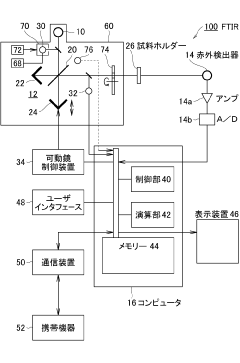
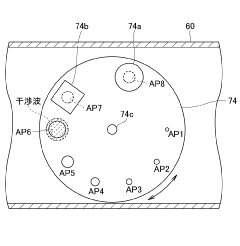
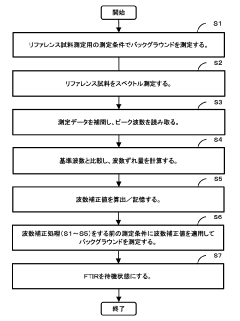
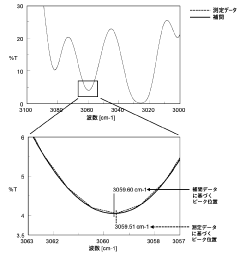
Fourier transform infrared spectrometer
PatentWO2014132379A1
Innovation
- A Fourier Transform Infrared Spectrophotometer with a detachable sample chamber and interference optical system on a common base, featuring accessory information reading and setting condition changing means to adjust the interference optical system based on the type of accessory attached, ensuring optimal measurement conditions by compensating for base distortion and varying optical throughput.


Reference Standards and Calibration Methodologies
Reference standards and calibration methodologies form the cornerstone of reliable FTIR spectroscopy analysis. The establishment of proper reference materials is essential for ensuring measurement accuracy across different instruments and laboratories. Primary reference standards typically include well-characterized materials with known spectral properties, such as polystyrene films for mid-IR calibration or NIST-traceable standards that provide benchmark absorption bands at precisely defined wavenumbers.
Calibration protocols must address both wavelength (x-axis) and absorbance (y-axis) accuracy. For wavelength calibration, materials with sharp, well-defined peaks at known positions are utilized, allowing for precise adjustment of the wavenumber scale. Common calibrants include polystyrene, water vapor, or inorganic compounds with characteristic absorption bands. These standards enable the verification of spectral resolution and wavenumber accuracy, which should typically be maintained within ±0.1 cm⁻¹ for high-precision applications.
Absorbance calibration requires materials with certified absorption coefficients to establish linearity across the dynamic range of the instrument. This process involves creating calibration curves using standards of varying concentrations to verify the Beer-Lambert relationship is maintained. Regular validation using these curves helps identify detector non-linearity or stray light issues that may compromise quantitative measurements.
Transfer standards play a crucial role in harmonizing measurements across multiple instruments or laboratories. These intermediate reference materials enable the comparison of results between different FTIR systems, ensuring consistency in multi-site studies or when transitioning between instruments. The development of robust transfer protocols minimizes systematic errors and enhances inter-laboratory reproducibility.
Modern calibration approaches increasingly incorporate multivariate statistical methods to account for matrix effects and spectral interferences. Techniques such as partial least squares (PLS) regression allow for the development of more robust calibration models that can compensate for sample variability and environmental factors. These advanced methodologies improve the accuracy of quantitative analysis, particularly in complex sample matrices.
Traceability to international standards is paramount for ensuring global consistency in FTIR measurements. Organizations such as NIST, ISO, and pharmacopeial bodies provide certified reference materials and standardized protocols that establish an unbroken chain of comparisons to primary measurement standards. This traceability framework enables meaningful comparison of results across geographical boundaries and regulatory jurisdictions.
Calibration protocols must address both wavelength (x-axis) and absorbance (y-axis) accuracy. For wavelength calibration, materials with sharp, well-defined peaks at known positions are utilized, allowing for precise adjustment of the wavenumber scale. Common calibrants include polystyrene, water vapor, or inorganic compounds with characteristic absorption bands. These standards enable the verification of spectral resolution and wavenumber accuracy, which should typically be maintained within ±0.1 cm⁻¹ for high-precision applications.
Absorbance calibration requires materials with certified absorption coefficients to establish linearity across the dynamic range of the instrument. This process involves creating calibration curves using standards of varying concentrations to verify the Beer-Lambert relationship is maintained. Regular validation using these curves helps identify detector non-linearity or stray light issues that may compromise quantitative measurements.
Transfer standards play a crucial role in harmonizing measurements across multiple instruments or laboratories. These intermediate reference materials enable the comparison of results between different FTIR systems, ensuring consistency in multi-site studies or when transitioning between instruments. The development of robust transfer protocols minimizes systematic errors and enhances inter-laboratory reproducibility.
Modern calibration approaches increasingly incorporate multivariate statistical methods to account for matrix effects and spectral interferences. Techniques such as partial least squares (PLS) regression allow for the development of more robust calibration models that can compensate for sample variability and environmental factors. These advanced methodologies improve the accuracy of quantitative analysis, particularly in complex sample matrices.
Traceability to international standards is paramount for ensuring global consistency in FTIR measurements. Organizations such as NIST, ISO, and pharmacopeial bodies provide certified reference materials and standardized protocols that establish an unbroken chain of comparisons to primary measurement standards. This traceability framework enables meaningful comparison of results across geographical boundaries and regulatory jurisdictions.
Data Processing Algorithms for Spectral Consistency
Data processing algorithms play a crucial role in ensuring spectral consistency when evaluating FTIR (Fourier Transform Infrared) spectra. These algorithms transform raw spectral data into reliable, reproducible results that can be confidently used for qualitative and quantitative analysis. The foundation of spectral consistency begins with preprocessing techniques that address common issues in raw FTIR data.
Baseline correction algorithms represent a fundamental preprocessing step, removing artificial baseline shifts caused by scattering effects or instrumental drift. Advanced methods include polynomial fitting, asymmetric least squares, and wavelet-based approaches that adaptively identify and correct baseline distortions without compromising spectral features. These algorithms significantly improve inter-sample comparability by establishing a consistent zero reference point.
Noise reduction techniques further enhance spectral consistency through methods such as Savitzky-Golay filtering, wavelet denoising, and moving average filters. The selection of appropriate parameters for these algorithms is critical, as excessive smoothing can eliminate subtle spectral features while insufficient processing leaves noise that impacts consistency measures.
Spectral normalization algorithms address variations in sample thickness or concentration by scaling spectra to a common reference. Vector normalization, standard normal variate (SNV), and multiplicative scatter correction (MSC) effectively minimize these variations. For FTIR specifically, normalization to internal standard peaks or total area normalization provides robust consistency across different measurement conditions.
Advanced consistency algorithms incorporate multivariate statistical approaches such as Principal Component Analysis (PCA) and Partial Least Squares (PLS) to identify and quantify spectral variations. These methods can distinguish between meaningful chemical differences and instrumental or preparation artifacts, establishing objective metrics for spectral consistency.
Machine learning algorithms have emerged as powerful tools for spectral consistency evaluation. Convolutional neural networks (CNNs) and autoencoders can learn complex patterns in spectral data and identify anomalous spectra that deviate from expected consistency parameters. These approaches are particularly valuable when dealing with large spectral datasets where manual inspection becomes impractical.
Automated quality control algorithms implement predefined consistency criteria to flag problematic spectra. These systems typically evaluate signal-to-noise ratios, peak positions, relative intensities, and spectral correlation coefficients against reference standards. The integration of these algorithms into FTIR workflow software enables real-time consistency monitoring and immediate feedback during data acquisition.
Baseline correction algorithms represent a fundamental preprocessing step, removing artificial baseline shifts caused by scattering effects or instrumental drift. Advanced methods include polynomial fitting, asymmetric least squares, and wavelet-based approaches that adaptively identify and correct baseline distortions without compromising spectral features. These algorithms significantly improve inter-sample comparability by establishing a consistent zero reference point.
Noise reduction techniques further enhance spectral consistency through methods such as Savitzky-Golay filtering, wavelet denoising, and moving average filters. The selection of appropriate parameters for these algorithms is critical, as excessive smoothing can eliminate subtle spectral features while insufficient processing leaves noise that impacts consistency measures.
Spectral normalization algorithms address variations in sample thickness or concentration by scaling spectra to a common reference. Vector normalization, standard normal variate (SNV), and multiplicative scatter correction (MSC) effectively minimize these variations. For FTIR specifically, normalization to internal standard peaks or total area normalization provides robust consistency across different measurement conditions.
Advanced consistency algorithms incorporate multivariate statistical approaches such as Principal Component Analysis (PCA) and Partial Least Squares (PLS) to identify and quantify spectral variations. These methods can distinguish between meaningful chemical differences and instrumental or preparation artifacts, establishing objective metrics for spectral consistency.
Machine learning algorithms have emerged as powerful tools for spectral consistency evaluation. Convolutional neural networks (CNNs) and autoencoders can learn complex patterns in spectral data and identify anomalous spectra that deviate from expected consistency parameters. These approaches are particularly valuable when dealing with large spectral datasets where manual inspection becomes impractical.
Automated quality control algorithms implement predefined consistency criteria to flag problematic spectra. These systems typically evaluate signal-to-noise ratios, peak positions, relative intensities, and spectral correlation coefficients against reference standards. The integration of these algorithms into FTIR workflow software enables real-time consistency monitoring and immediate feedback during data acquisition.
Unlock deeper insights with PatSnap Eureka Quick Research — get a full tech report to explore trends and direct your research. Try now!
Generate Your Research Report Instantly with AI Agent
Supercharge your innovation with PatSnap Eureka AI Agent Platform!