

How to Optimize Hydrofluoric Acid Concentration in Processes
AUG 25, 202510 MIN READ
Generate Your Research Report Instantly with AI Agent
PatSnap Eureka helps you evaluate technical feasibility & market potential.
HF Concentration Optimization Background and Objectives
Hydrofluoric acid (HF) has been a critical component in various industrial processes since its first commercial production in the early 20th century. The evolution of HF concentration optimization techniques has progressed from rudimentary manual adjustments to sophisticated automated control systems incorporating advanced sensors and real-time monitoring capabilities. This technological progression has been driven by the dual imperatives of enhancing process efficiency and addressing the significant safety concerns associated with this highly corrosive and toxic substance.
The optimization of hydrofluoric acid concentration represents a complex balance between achieving desired process outcomes and minimizing risks. In semiconductor manufacturing, precise HF concentration control at parts-per-billion levels has become essential for producing high-performance microchips with increasingly smaller feature sizes. Similarly, in petroleum refining, optimal HF concentration in alkylation units directly impacts product quality and catalyst longevity while presenting substantial safety considerations.
Current market trends indicate a growing demand for more precise, reliable, and safer methods of HF concentration management across industries. This demand is further intensified by increasingly stringent environmental regulations and workplace safety standards worldwide. The global push toward sustainability has also created pressure to minimize HF usage while maintaining or improving process outcomes, driving innovation in concentration optimization technologies.
The primary technical objectives for HF concentration optimization encompass several dimensions. First, achieving higher precision in concentration control, with target variations of less than ±0.1% in critical applications. Second, developing more robust real-time monitoring systems capable of continuous operation in harsh chemical environments. Third, creating integrated systems that automatically adjust concentration levels in response to process parameters and product quality metrics.
Additionally, there are significant objectives related to safety enhancement, including the development of fail-safe systems that can rapidly neutralize or contain HF in case of anomalies, and remote monitoring capabilities that minimize human exposure. Energy efficiency also represents an important goal, as concentration adjustment processes often require substantial heating or cooling energy inputs that could be optimized.
Looking forward, the technological roadmap for HF concentration optimization aims to incorporate artificial intelligence and machine learning algorithms that can predict optimal concentration levels based on multiple input variables and historical performance data. The integration of these advanced control systems with broader manufacturing execution systems represents the next frontier in this field, potentially enabling unprecedented levels of process efficiency and safety in HF-dependent industrial applications.
The optimization of hydrofluoric acid concentration represents a complex balance between achieving desired process outcomes and minimizing risks. In semiconductor manufacturing, precise HF concentration control at parts-per-billion levels has become essential for producing high-performance microchips with increasingly smaller feature sizes. Similarly, in petroleum refining, optimal HF concentration in alkylation units directly impacts product quality and catalyst longevity while presenting substantial safety considerations.
Current market trends indicate a growing demand for more precise, reliable, and safer methods of HF concentration management across industries. This demand is further intensified by increasingly stringent environmental regulations and workplace safety standards worldwide. The global push toward sustainability has also created pressure to minimize HF usage while maintaining or improving process outcomes, driving innovation in concentration optimization technologies.
The primary technical objectives for HF concentration optimization encompass several dimensions. First, achieving higher precision in concentration control, with target variations of less than ±0.1% in critical applications. Second, developing more robust real-time monitoring systems capable of continuous operation in harsh chemical environments. Third, creating integrated systems that automatically adjust concentration levels in response to process parameters and product quality metrics.
Additionally, there are significant objectives related to safety enhancement, including the development of fail-safe systems that can rapidly neutralize or contain HF in case of anomalies, and remote monitoring capabilities that minimize human exposure. Energy efficiency also represents an important goal, as concentration adjustment processes often require substantial heating or cooling energy inputs that could be optimized.
Looking forward, the technological roadmap for HF concentration optimization aims to incorporate artificial intelligence and machine learning algorithms that can predict optimal concentration levels based on multiple input variables and historical performance data. The integration of these advanced control systems with broader manufacturing execution systems represents the next frontier in this field, potentially enabling unprecedented levels of process efficiency and safety in HF-dependent industrial applications.
Market Analysis for HF-Based Industrial Applications
The global hydrofluoric acid (HF) market demonstrates robust growth, valued at approximately $2.3 billion in 2022 and projected to reach $3.1 billion by 2028, with a compound annual growth rate of 5.1%. This growth is primarily driven by increasing demand across multiple industrial sectors where HF serves as a critical component.
The semiconductor industry represents the largest application segment, accounting for nearly 35% of global HF consumption. As microchip manufacturing continues to expand globally, particularly in Asia, the demand for high-purity HF for etching and cleaning processes has increased substantially. The industry's push toward smaller node sizes and more complex architectures requires increasingly precise HF concentration management.
Fluorochemical production constitutes the second-largest market segment at approximately 28% of global consumption. HF serves as a fundamental building block for refrigerants, fluoropolymers (such as PTFE and PVDF), and various fluorine-containing compounds. Despite environmental regulations limiting certain fluorochemical applications, new environmentally acceptable alternatives continue to drive demand.
The petroleum alkylation sector represents about 18% of the market, using HF as a catalyst in the production of high-octane gasoline components. While this segment faces pressure from alternative alkylation technologies, existing HF alkylation units continue to operate with enhanced safety measures and optimized concentration management systems.
Metal treatment and glass etching applications account for approximately 12% of the market. These industries require precise HF concentration control to achieve desired surface properties while minimizing material waste and environmental impact. The growing demand for specialized glass products in electronics and architectural applications has sustained growth in this segment.
Regional analysis reveals Asia-Pacific as the dominant market, representing over 45% of global HF consumption, with China alone accounting for nearly 30%. North America and Europe follow with approximately 25% and 20% market shares respectively. Emerging economies in South America and the Middle East show accelerating adoption rates, particularly in petroleum refining and mining applications.
Market dynamics are increasingly influenced by regulatory frameworks governing HF handling, with stringent safety and environmental regulations driving investment in advanced concentration monitoring and control technologies. This regulatory landscape has created a distinct market segment for HF optimization solutions, including real-time monitoring systems, automated concentration adjustment technologies, and specialized containment equipment.
The competitive landscape features both large chemical conglomerates and specialized technology providers focusing on HF concentration management solutions. Recent market trends indicate growing interest in closed-loop systems that minimize HF consumption while maintaining process efficiency, reflecting broader industrial sustainability initiatives.
The semiconductor industry represents the largest application segment, accounting for nearly 35% of global HF consumption. As microchip manufacturing continues to expand globally, particularly in Asia, the demand for high-purity HF for etching and cleaning processes has increased substantially. The industry's push toward smaller node sizes and more complex architectures requires increasingly precise HF concentration management.
Fluorochemical production constitutes the second-largest market segment at approximately 28% of global consumption. HF serves as a fundamental building block for refrigerants, fluoropolymers (such as PTFE and PVDF), and various fluorine-containing compounds. Despite environmental regulations limiting certain fluorochemical applications, new environmentally acceptable alternatives continue to drive demand.
The petroleum alkylation sector represents about 18% of the market, using HF as a catalyst in the production of high-octane gasoline components. While this segment faces pressure from alternative alkylation technologies, existing HF alkylation units continue to operate with enhanced safety measures and optimized concentration management systems.
Metal treatment and glass etching applications account for approximately 12% of the market. These industries require precise HF concentration control to achieve desired surface properties while minimizing material waste and environmental impact. The growing demand for specialized glass products in electronics and architectural applications has sustained growth in this segment.
Regional analysis reveals Asia-Pacific as the dominant market, representing over 45% of global HF consumption, with China alone accounting for nearly 30%. North America and Europe follow with approximately 25% and 20% market shares respectively. Emerging economies in South America and the Middle East show accelerating adoption rates, particularly in petroleum refining and mining applications.
Market dynamics are increasingly influenced by regulatory frameworks governing HF handling, with stringent safety and environmental regulations driving investment in advanced concentration monitoring and control technologies. This regulatory landscape has created a distinct market segment for HF optimization solutions, including real-time monitoring systems, automated concentration adjustment technologies, and specialized containment equipment.
The competitive landscape features both large chemical conglomerates and specialized technology providers focusing on HF concentration management solutions. Recent market trends indicate growing interest in closed-loop systems that minimize HF consumption while maintaining process efficiency, reflecting broader industrial sustainability initiatives.
Current Challenges in HF Concentration Control
Despite significant advancements in industrial processes utilizing hydrofluoric acid (HF), maintaining optimal concentration levels remains one of the most challenging aspects of HF management. Current monitoring systems often suffer from response lag, creating a critical time gap between concentration changes and detection. This delay can lead to process inefficiencies, product quality issues, and potentially hazardous situations in manufacturing environments.
Traditional concentration measurement techniques, including titration and density measurements, require manual sampling which introduces both human error and safety risks due to HF's highly corrosive and toxic nature. These methods also fail to provide real-time data necessary for dynamic process control, resulting in suboptimal production conditions and increased operational costs.
Temperature fluctuations within processing systems significantly impact HF concentration stability, yet many existing control systems lack adequate temperature compensation mechanisms. This deficiency is particularly problematic in semiconductor manufacturing and chemical processing industries where precise concentration control directly affects product quality and yield rates.
Material compatibility presents another substantial challenge. HF's aggressive nature causes gradual degradation of sensors and monitoring equipment, leading to drift in measurement accuracy over time. Current sensor technologies often require frequent recalibration or replacement, creating maintenance burdens and process interruptions that impact productivity and increase operational expenses.
The integration of concentration control systems with broader process automation frameworks remains inadequate in many industrial settings. Isolated control loops without comprehensive data integration limit the ability to implement advanced process control strategies that could otherwise optimize HF usage while maintaining process parameters within tight specifications.
Environmental and safety regulations increasingly demand more precise accounting of HF usage and emissions, yet current monitoring systems often lack the precision needed for regulatory compliance reporting. This regulatory gap creates both compliance risks and challenges in implementing sustainable manufacturing practices.
Cost-effective solutions for continuous, reliable HF concentration monitoring remain elusive, particularly for small and medium-sized enterprises. High-precision monitoring systems typically involve significant capital investment, creating barriers to adoption despite their potential for process improvement and safety enhancement.
The development of robust mathematical models for predicting HF concentration behavior under varying process conditions is still in its infancy. Without accurate predictive capabilities, proactive concentration management strategies remain difficult to implement, forcing many operations to rely on reactive approaches that compromise efficiency and safety margins.
Traditional concentration measurement techniques, including titration and density measurements, require manual sampling which introduces both human error and safety risks due to HF's highly corrosive and toxic nature. These methods also fail to provide real-time data necessary for dynamic process control, resulting in suboptimal production conditions and increased operational costs.
Temperature fluctuations within processing systems significantly impact HF concentration stability, yet many existing control systems lack adequate temperature compensation mechanisms. This deficiency is particularly problematic in semiconductor manufacturing and chemical processing industries where precise concentration control directly affects product quality and yield rates.
Material compatibility presents another substantial challenge. HF's aggressive nature causes gradual degradation of sensors and monitoring equipment, leading to drift in measurement accuracy over time. Current sensor technologies often require frequent recalibration or replacement, creating maintenance burdens and process interruptions that impact productivity and increase operational expenses.
The integration of concentration control systems with broader process automation frameworks remains inadequate in many industrial settings. Isolated control loops without comprehensive data integration limit the ability to implement advanced process control strategies that could otherwise optimize HF usage while maintaining process parameters within tight specifications.
Environmental and safety regulations increasingly demand more precise accounting of HF usage and emissions, yet current monitoring systems often lack the precision needed for regulatory compliance reporting. This regulatory gap creates both compliance risks and challenges in implementing sustainable manufacturing practices.
Cost-effective solutions for continuous, reliable HF concentration monitoring remain elusive, particularly for small and medium-sized enterprises. High-precision monitoring systems typically involve significant capital investment, creating barriers to adoption despite their potential for process improvement and safety enhancement.
The development of robust mathematical models for predicting HF concentration behavior under varying process conditions is still in its infancy. Without accurate predictive capabilities, proactive concentration management strategies remain difficult to implement, forcing many operations to rely on reactive approaches that compromise efficiency and safety margins.
Current HF Concentration Monitoring Solutions
01 Hydrofluoric acid concentration measurement techniques
Various techniques are employed to measure and monitor hydrofluoric acid concentration in industrial processes. These include spectroscopic methods, electrochemical sensors, and automated monitoring systems that provide real-time concentration data. Accurate measurement is critical for process control, quality assurance, and safety in semiconductor manufacturing, chemical processing, and metal treatment applications.- Methods for measuring hydrofluoric acid concentration: Various analytical techniques are employed to accurately measure hydrofluoric acid concentration in solutions. These methods include titration, spectroscopic analysis, and electrochemical sensors that can detect and quantify HF levels. Precise measurement is critical for quality control in industrial processes and ensuring safety when handling this corrosive acid.
- Hydrofluoric acid concentration control systems: Automated systems for monitoring and controlling hydrofluoric acid concentration in industrial applications have been developed. These systems incorporate sensors, feedback mechanisms, and precision dispensing equipment to maintain optimal HF concentrations. Such control systems are particularly important in semiconductor manufacturing, metal treatment, and chemical processing industries where precise acid concentrations are required.
- Dilution and preparation methods for hydrofluoric acid solutions: Specific techniques for safely diluting concentrated hydrofluoric acid and preparing solutions of precise concentrations have been developed. These methods include controlled addition protocols, specialized mixing equipment, and stabilization procedures to ensure consistent acid concentration. Proper dilution is essential for both safety and effectiveness in applications requiring specific HF concentrations.
- Hydrofluoric acid concentration for etching applications: The concentration of hydrofluoric acid significantly impacts its effectiveness in etching applications, particularly in semiconductor manufacturing and glass processing. Different concentrations are optimal for various materials and desired etch rates. Buffered hydrofluoric acid solutions with specific concentration ratios are used to achieve controlled etching profiles and surface characteristics.
- Safety systems for handling concentrated hydrofluoric acid: Specialized safety systems have been developed for the handling, storage, and transport of concentrated hydrofluoric acid. These include containment vessels, neutralization systems, detection equipment, and emergency response protocols designed to mitigate risks associated with HF exposure. Safety measures are particularly important given the severe health hazards posed by high-concentration hydrofluoric acid.
02 Hydrofluoric acid concentration control systems
Specialized systems for controlling hydrofluoric acid concentration in industrial processes have been developed. These systems incorporate feedback mechanisms, automated dilution equipment, and precision dosing technologies to maintain optimal acid concentration levels. Such control systems are essential in semiconductor etching, glass manufacturing, and metal surface treatment where precise concentration management directly impacts product quality and process efficiency.Expand Specific Solutions03 Safety measures for handling concentrated hydrofluoric acid
Safety protocols and equipment for handling concentrated hydrofluoric acid include specialized containment vessels, neutralization systems, and personal protective equipment. These measures address the unique hazards associated with hydrofluoric acid, which can cause severe tissue damage and systemic toxicity. Advanced detection systems and emergency response equipment are also implemented to minimize risks in industrial settings where concentrated hydrofluoric acid is used.Expand Specific Solutions04 Hydrofluoric acid concentration in semiconductor processing
Specific hydrofluoric acid concentrations are utilized in semiconductor manufacturing processes, particularly for silicon wafer etching, oxide removal, and surface cleaning. The concentration levels are precisely formulated to achieve optimal etching rates, surface quality, and selectivity. Dilution systems and mixture preparations are designed to maintain consistent acid concentrations throughout the semiconductor fabrication process to ensure uniform results and prevent defects.Expand Specific Solutions05 Hydrofluoric acid recycling and concentration recovery
Methods for recycling and recovering hydrofluoric acid from industrial waste streams involve concentration techniques, purification processes, and regeneration systems. These approaches reduce environmental impact and operational costs by allowing the reuse of hydrofluoric acid in manufacturing processes. Distillation, membrane separation, and chemical treatment are employed to restore the acid to the required concentration levels while removing contaminants that could affect performance.Expand Specific Solutions
Leading Companies in HF Process Management
The hydrofluoric acid concentration optimization market is currently in a growth phase, with increasing demand driven by semiconductor manufacturing, chemical processing, and electronics industries. The global market size is estimated to exceed $2 billion, expanding at approximately 5-7% CAGR. Leading players include established chemical giants like Honeywell International Technologies, DuPont de Nemours, and Air Liquide SA, who offer comprehensive solutions with advanced process control technologies. Asian manufacturers such as Do-Fluoride New Materials, Crystal Clear Electronic Material, and Jianghua Micro-electronics are rapidly gaining market share by focusing on high-purity electronic-grade HF products. The technology landscape shows varying maturity levels, with companies like DAIKIN and Stella Chemifa leading in ultra-high purity applications, while Arkema and Chemours focus on environmentally sustainable concentration management systems. Academic-industry partnerships with institutions like Tohoku University and Shandong University are accelerating innovation in this space.
Honeywell International Technologies Ltd.
Technical Solution: Honeywell has developed an integrated digital solution for hydrofluoric acid concentration optimization called HF-Optima™. This technology combines advanced process control with machine learning algorithms to dynamically adjust HF concentration in real-time. The system utilizes Honeywell's proprietary Experion® PKS platform with specialized HF-resistant sensors that provide continuous monitoring without degradation in harsh environments. Their approach incorporates predictive maintenance capabilities that identify potential issues before they affect process efficiency. Honeywell's solution includes a digital twin modeling system that simulates process conditions to identify optimal concentration parameters without risking actual production. The technology also features automated safety protocols that respond to concentration deviations with millisecond response times, significantly enhancing workplace safety.
Strengths: Comprehensive integration with existing industrial control systems; reduces HF consumption by up to 25%; advanced predictive analytics minimize process variability. Weaknesses: Complex implementation requiring specialized expertise; significant initial investment; ongoing software licensing costs.
Stella Chemifa Corp.
Technical Solution: Stella Chemifa has developed a proprietary distillation-based technology for ultra-precise hydrofluoric acid concentration control. Their system employs multi-stage fractional distillation columns with specialized materials designed specifically for HF handling. The technology incorporates advanced thermal management systems that maintain precise temperature gradients throughout the distillation process, enabling concentration control with accuracy to within 0.1%. Stella Chemifa's approach includes proprietary catalytic systems that enhance separation efficiency while reducing energy requirements. Their process features continuous inline analysis using specialized spectroscopic techniques that provide real-time concentration data without sample extraction. The technology also incorporates automated feed-forward control systems that anticipate concentration changes based on upstream process variations.
Strengths: Achieves highest purity levels in the industry (>99.99%); specialized equipment design minimizes maintenance requirements; lower operating costs over system lifetime. Weaknesses: Higher initial capital investment; larger physical footprint compared to membrane technologies; longer system startup times.
Key Patents in HF Concentration Optimization
Method for detecting a concentration of a solution
PatentInactiveUS6706533B2
Innovation
- A method and apparatus that measure electrical conductivity and temperature using the equation C=(D-aT-b)/(AT+B) to calculate concentration, where constants A, B, a, and b are determined by the least squares method from multiple temperature and concentration measurements, allowing for real-time concentration detection without strict temperature control, and a dilution apparatus with a conductivity measuring means and arithmetic operation means to adjust concentrations accurately.


Composition and method for treating a subterranean formation
PatentInactiveUS6806236B2
Innovation
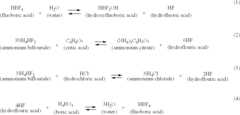
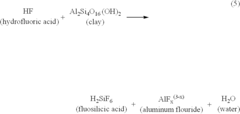
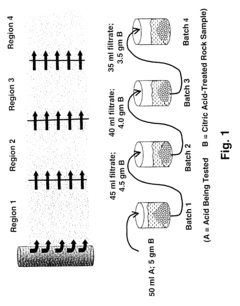
- The development of acidic compositions comprising fluoboric acid, boron sources, and chelating agents like citric acid, which slowly generate hydrofluoric acid in situ, effectively increasing permeability by stabilizing clays and preventing precipitation of aluminum fluorides and hydrated silica, thereby extending the treatment's effectiveness deeper into the formation.
Safety Protocols and Risk Mitigation Strategies
Hydrofluoric acid (HF) presents significant safety challenges due to its highly corrosive nature and ability to penetrate skin, causing severe tissue damage and potential systemic toxicity. Implementing comprehensive safety protocols is paramount when optimizing HF concentration in industrial processes.
Personal protective equipment (PPE) forms the first line of defense against HF exposure. Workers must utilize impervious gloves (typically neoprene or butyl rubber), face shields, chemical splash goggles, and acid-resistant clothing. For processes involving higher concentrations, full-body protection including respiratory equipment may be necessary. Regular inspection and replacement schedules for all PPE components should be strictly enforced.
Engineering controls represent a critical aspect of risk mitigation. These include closed-system processing equipment, automated handling systems, continuous monitoring devices for HF vapor detection, and properly designed ventilation systems with scrubbers. Double-containment systems should be implemented for storage and transfer operations to prevent accidental releases.
Emergency response protocols must be established and regularly practiced. These should include clearly defined evacuation procedures, decontamination stations with calcium gluconate gel (the specific antidote for HF exposure), eyewash stations, and emergency showers positioned strategically throughout the facility. Medical response teams should receive specialized training in treating HF exposures.
Process safety management approaches should incorporate detailed risk assessments specific to HF concentration optimization. This includes hazard and operability studies (HAZOP), failure mode and effects analysis (FMEA), and quantitative risk assessments. Standard operating procedures should detail concentration verification methods, handling protocols, and process control parameters with clearly defined safety margins.
Training programs require particular attention, with comprehensive education on HF hazards, exposure symptoms, emergency response procedures, and proper handling techniques. Certification should be mandatory before personnel work with HF, with regular refresher courses and practical drills to maintain competency.
Waste management and disposal strategies must address the specific challenges of HF-containing materials. Neutralization procedures, dedicated containment systems, and specialized disposal contractors should be utilized. Environmental monitoring programs should be implemented to detect potential releases before they become significant hazards.
Continuous improvement mechanisms should include incident investigation protocols, near-miss reporting systems, and regular safety audits. Lessons learned from the industry should be incorporated into updated safety protocols, creating a dynamic safety culture that evolves with technological advancements in HF handling and concentration optimization.
Personal protective equipment (PPE) forms the first line of defense against HF exposure. Workers must utilize impervious gloves (typically neoprene or butyl rubber), face shields, chemical splash goggles, and acid-resistant clothing. For processes involving higher concentrations, full-body protection including respiratory equipment may be necessary. Regular inspection and replacement schedules for all PPE components should be strictly enforced.
Engineering controls represent a critical aspect of risk mitigation. These include closed-system processing equipment, automated handling systems, continuous monitoring devices for HF vapor detection, and properly designed ventilation systems with scrubbers. Double-containment systems should be implemented for storage and transfer operations to prevent accidental releases.
Emergency response protocols must be established and regularly practiced. These should include clearly defined evacuation procedures, decontamination stations with calcium gluconate gel (the specific antidote for HF exposure), eyewash stations, and emergency showers positioned strategically throughout the facility. Medical response teams should receive specialized training in treating HF exposures.
Process safety management approaches should incorporate detailed risk assessments specific to HF concentration optimization. This includes hazard and operability studies (HAZOP), failure mode and effects analysis (FMEA), and quantitative risk assessments. Standard operating procedures should detail concentration verification methods, handling protocols, and process control parameters with clearly defined safety margins.
Training programs require particular attention, with comprehensive education on HF hazards, exposure symptoms, emergency response procedures, and proper handling techniques. Certification should be mandatory before personnel work with HF, with regular refresher courses and practical drills to maintain competency.
Waste management and disposal strategies must address the specific challenges of HF-containing materials. Neutralization procedures, dedicated containment systems, and specialized disposal contractors should be utilized. Environmental monitoring programs should be implemented to detect potential releases before they become significant hazards.
Continuous improvement mechanisms should include incident investigation protocols, near-miss reporting systems, and regular safety audits. Lessons learned from the industry should be incorporated into updated safety protocols, creating a dynamic safety culture that evolves with technological advancements in HF handling and concentration optimization.
Environmental Impact and Regulatory Compliance
Hydrofluoric acid (HF) usage in industrial processes presents significant environmental challenges due to its high toxicity and corrosive properties. When released into the environment, HF can contaminate soil, groundwater, and surface water, causing severe ecological damage and posing risks to human health. Emissions from HF-based processes can contribute to air pollution, particularly in areas surrounding manufacturing facilities, semiconductor plants, and chemical processing units.
Regulatory frameworks governing HF usage have become increasingly stringent worldwide. In the United States, the Environmental Protection Agency (EPA) regulates HF under multiple statutes including the Clean Air Act, Clean Water Act, and the Resource Conservation and Recovery Act. The Occupational Safety and Health Administration (OSHA) has established a permissible exposure limit (PEL) of 3 ppm as an 8-hour time-weighted average. Similarly, the European Union's REACH regulation classifies HF as a substance of very high concern, requiring strict authorization procedures and usage limitations.
Compliance with these regulations necessitates comprehensive monitoring systems for HF concentration levels throughout processing operations. Modern facilities implement real-time monitoring technologies including ion-selective electrodes, spectrophotometric analyzers, and advanced sensor networks that can detect HF at concentrations as low as parts per billion. These systems must be integrated with automated control mechanisms to ensure immediate response to concentration fluctuations.
Waste management represents another critical aspect of environmental compliance. Neutralization processes using calcium or sodium compounds are commonly employed to convert waste HF into less hazardous fluoride salts before disposal. Advanced treatment technologies such as ion exchange, precipitation, and membrane filtration have demonstrated effectiveness in reducing fluoride concentrations in wastewater to meet increasingly strict discharge limits, typically below 10-20 mg/L depending on local regulations.
Optimization strategies that reduce HF concentration while maintaining process efficiency offer dual benefits of regulatory compliance and environmental protection. Closed-loop recycling systems can recover and purify spent HF, reducing both waste generation and fresh acid requirements by up to 60-80%. Substitution with less hazardous alternatives, where technically feasible, represents another optimization approach gaining traction in industries traditionally dependent on HF.
Companies must develop comprehensive environmental management plans that address emergency response protocols for potential HF releases. These plans typically include containment strategies, neutralization procedures, and community notification systems. Regular environmental audits and continuous improvement programs are essential components of maintaining regulatory compliance while progressively reducing the environmental footprint of HF-dependent processes.
Regulatory frameworks governing HF usage have become increasingly stringent worldwide. In the United States, the Environmental Protection Agency (EPA) regulates HF under multiple statutes including the Clean Air Act, Clean Water Act, and the Resource Conservation and Recovery Act. The Occupational Safety and Health Administration (OSHA) has established a permissible exposure limit (PEL) of 3 ppm as an 8-hour time-weighted average. Similarly, the European Union's REACH regulation classifies HF as a substance of very high concern, requiring strict authorization procedures and usage limitations.
Compliance with these regulations necessitates comprehensive monitoring systems for HF concentration levels throughout processing operations. Modern facilities implement real-time monitoring technologies including ion-selective electrodes, spectrophotometric analyzers, and advanced sensor networks that can detect HF at concentrations as low as parts per billion. These systems must be integrated with automated control mechanisms to ensure immediate response to concentration fluctuations.
Waste management represents another critical aspect of environmental compliance. Neutralization processes using calcium or sodium compounds are commonly employed to convert waste HF into less hazardous fluoride salts before disposal. Advanced treatment technologies such as ion exchange, precipitation, and membrane filtration have demonstrated effectiveness in reducing fluoride concentrations in wastewater to meet increasingly strict discharge limits, typically below 10-20 mg/L depending on local regulations.
Optimization strategies that reduce HF concentration while maintaining process efficiency offer dual benefits of regulatory compliance and environmental protection. Closed-loop recycling systems can recover and purify spent HF, reducing both waste generation and fresh acid requirements by up to 60-80%. Substitution with less hazardous alternatives, where technically feasible, represents another optimization approach gaining traction in industries traditionally dependent on HF.
Companies must develop comprehensive environmental management plans that address emergency response protocols for potential HF releases. These plans typically include containment strategies, neutralization procedures, and community notification systems. Regular environmental audits and continuous improvement programs are essential components of maintaining regulatory compliance while progressively reducing the environmental footprint of HF-dependent processes.
Unlock deeper insights with PatSnap Eureka Quick Research — get a full tech report to explore trends and direct your research. Try now!
Generate Your Research Report Instantly with AI Agent
Supercharge your innovation with PatSnap Eureka AI Agent Platform!