How to Simulate Hall Effect Sensor Environments for Testing
SEP 22, 202510 MIN READ
Generate Your Research Report Instantly with AI Agent
PatSnap Eureka helps you evaluate technical feasibility & market potential.
Hall Sensor Simulation Background and Objectives
Hall Effect sensors have evolved significantly since their discovery by Edwin Hall in 1879, transforming from laboratory curiosities to essential components in modern electronics and automotive systems. These sensors leverage the Hall Effect principle, where a voltage difference is generated perpendicular to both the current flow and magnetic field when a conductor carrying current is placed in a magnetic field. This fundamental physical phenomenon has enabled the development of robust, non-contact sensing solutions for position detection, speed measurement, and current sensing applications.
The technological evolution of Hall Effect sensors has accelerated particularly in the last two decades, with advancements in semiconductor manufacturing enabling miniaturization, improved sensitivity, and enhanced reliability. Modern Hall sensors incorporate sophisticated signal processing capabilities, temperature compensation mechanisms, and integrated diagnostic features, making them critical components in safety-critical automotive systems, industrial automation, consumer electronics, and renewable energy applications.
As these sensors become increasingly integrated into complex systems, the need for comprehensive testing methodologies has grown exponentially. Traditional testing approaches often involve physical magnets and mechanical fixtures, which present significant limitations in terms of reproducibility, precision, and testing efficiency. These constraints have created a pressing need for advanced simulation environments that can accurately replicate the magnetic field conditions experienced by Hall Effect sensors in real-world applications.
The primary objective of Hall Effect sensor simulation is to create controlled, repeatable testing environments that can accurately reproduce the magnetic field conditions encountered in actual applications. This includes simulating various magnetic field strengths, orientations, gradients, and dynamic changes that would be difficult or impossible to achieve with physical testing setups. Such simulation capabilities are essential for comprehensive validation of sensor performance across their entire operating range and under extreme conditions.
Additionally, simulation environments aim to accelerate the development cycle by enabling rapid prototyping and testing of sensor designs without the need for physical prototypes. This capability is particularly valuable in the early stages of product development, where design iterations occur frequently and the cost of physical prototyping can be prohibitive.
Furthermore, these simulation tools must support the increasing complexity of modern Hall Effect sensor applications, including multi-axis sensing, integrated signal processing, and system-level interactions. The ability to model these complex behaviors accurately is crucial for ensuring sensor reliability in safety-critical applications and optimizing performance in demanding environments.
The technological evolution of Hall Effect sensors has accelerated particularly in the last two decades, with advancements in semiconductor manufacturing enabling miniaturization, improved sensitivity, and enhanced reliability. Modern Hall sensors incorporate sophisticated signal processing capabilities, temperature compensation mechanisms, and integrated diagnostic features, making them critical components in safety-critical automotive systems, industrial automation, consumer electronics, and renewable energy applications.
As these sensors become increasingly integrated into complex systems, the need for comprehensive testing methodologies has grown exponentially. Traditional testing approaches often involve physical magnets and mechanical fixtures, which present significant limitations in terms of reproducibility, precision, and testing efficiency. These constraints have created a pressing need for advanced simulation environments that can accurately replicate the magnetic field conditions experienced by Hall Effect sensors in real-world applications.
The primary objective of Hall Effect sensor simulation is to create controlled, repeatable testing environments that can accurately reproduce the magnetic field conditions encountered in actual applications. This includes simulating various magnetic field strengths, orientations, gradients, and dynamic changes that would be difficult or impossible to achieve with physical testing setups. Such simulation capabilities are essential for comprehensive validation of sensor performance across their entire operating range and under extreme conditions.
Additionally, simulation environments aim to accelerate the development cycle by enabling rapid prototyping and testing of sensor designs without the need for physical prototypes. This capability is particularly valuable in the early stages of product development, where design iterations occur frequently and the cost of physical prototyping can be prohibitive.
Furthermore, these simulation tools must support the increasing complexity of modern Hall Effect sensor applications, including multi-axis sensing, integrated signal processing, and system-level interactions. The ability to model these complex behaviors accurately is crucial for ensuring sensor reliability in safety-critical applications and optimizing performance in demanding environments.
Market Analysis for Hall Effect Sensor Testing Solutions
The global market for Hall Effect sensor testing solutions is experiencing robust growth, driven by increasing demand across automotive, industrial automation, consumer electronics, and aerospace sectors. Current market valuation stands at approximately 1.2 billion USD with a compound annual growth rate projected at 7.8% through 2028. This growth trajectory is primarily fueled by the expanding application scope of Hall Effect sensors in emerging technologies such as electric vehicles, renewable energy systems, and IoT devices.
The automotive sector represents the largest market segment, accounting for nearly 35% of the total market share. This dominance stems from the critical role Hall Effect sensors play in modern vehicles for applications including wheel speed detection, throttle position sensing, and battery management systems. The increasing electrification of vehicles has further accelerated demand for sophisticated testing solutions that can simulate complex magnetic field environments with high precision.
Industrial automation follows as the second-largest market segment, where Hall Effect sensors are extensively utilized in position detection, speed monitoring, and current measurement applications. The Industry 4.0 revolution has significantly amplified the need for reliable sensor testing solutions as manufacturing processes become increasingly automated and interconnected.
Regional analysis reveals that Asia-Pacific currently leads the market with approximately 40% share, primarily due to the strong manufacturing base in countries like China, Japan, and South Korea. North America and Europe follow closely, each representing about 25% of the global market. These regions demonstrate higher adoption rates of advanced testing methodologies, particularly in aerospace and defense applications where sensor reliability is paramount.
The market landscape is characterized by varying customer segments with distinct needs. Large OEMs typically require comprehensive testing systems with high throughput capabilities, while smaller manufacturers and research institutions often seek more flexible, cost-effective solutions. This diversity has created opportunities for both integrated testing platforms and specialized niche solutions.
Price sensitivity varies significantly across market segments. While automotive and aerospace industries prioritize precision and reliability over cost, consumer electronics manufacturers are more price-conscious, seeking cost-effective testing solutions that can be scaled for high-volume production. This dynamic has fostered innovation in testing methodologies, with increasing focus on virtual simulation environments that can reduce physical testing requirements.
Market forecasts indicate that the demand for Hall Effect sensor testing solutions will continue to grow, with particular acceleration in emerging markets as manufacturing capabilities expand globally. The shift toward more sophisticated sensors with higher sensitivity and wider detection ranges will necessitate corresponding advancements in testing technologies, creating substantial market opportunities for innovative solution providers.
The automotive sector represents the largest market segment, accounting for nearly 35% of the total market share. This dominance stems from the critical role Hall Effect sensors play in modern vehicles for applications including wheel speed detection, throttle position sensing, and battery management systems. The increasing electrification of vehicles has further accelerated demand for sophisticated testing solutions that can simulate complex magnetic field environments with high precision.
Industrial automation follows as the second-largest market segment, where Hall Effect sensors are extensively utilized in position detection, speed monitoring, and current measurement applications. The Industry 4.0 revolution has significantly amplified the need for reliable sensor testing solutions as manufacturing processes become increasingly automated and interconnected.
Regional analysis reveals that Asia-Pacific currently leads the market with approximately 40% share, primarily due to the strong manufacturing base in countries like China, Japan, and South Korea. North America and Europe follow closely, each representing about 25% of the global market. These regions demonstrate higher adoption rates of advanced testing methodologies, particularly in aerospace and defense applications where sensor reliability is paramount.
The market landscape is characterized by varying customer segments with distinct needs. Large OEMs typically require comprehensive testing systems with high throughput capabilities, while smaller manufacturers and research institutions often seek more flexible, cost-effective solutions. This diversity has created opportunities for both integrated testing platforms and specialized niche solutions.
Price sensitivity varies significantly across market segments. While automotive and aerospace industries prioritize precision and reliability over cost, consumer electronics manufacturers are more price-conscious, seeking cost-effective testing solutions that can be scaled for high-volume production. This dynamic has fostered innovation in testing methodologies, with increasing focus on virtual simulation environments that can reduce physical testing requirements.
Market forecasts indicate that the demand for Hall Effect sensor testing solutions will continue to grow, with particular acceleration in emerging markets as manufacturing capabilities expand globally. The shift toward more sophisticated sensors with higher sensitivity and wider detection ranges will necessitate corresponding advancements in testing technologies, creating substantial market opportunities for innovative solution providers.
Current Challenges in Hall Sensor Simulation Technologies
Despite significant advancements in Hall effect sensor simulation technologies, several critical challenges persist that impede the development of comprehensive testing environments. The primary obstacle remains the accurate replication of complex magnetic field distributions that sensors encounter in real-world applications. Current simulation tools struggle to model dynamic magnetic field changes with sufficient temporal and spatial resolution, particularly when simulating rapid transitions or complex three-dimensional field gradients.
Material property simulation presents another significant challenge. Real-world Hall sensors interact with various materials that affect magnetic field propagation, yet simulation environments often employ simplified material models that fail to account for temperature dependencies, hysteresis effects, and material aging characteristics. This discrepancy leads to testing environments that inadequately represent operational conditions.
Environmental noise simulation constitutes a persistent difficulty in creating realistic test scenarios. Actual Hall sensors operate amidst electromagnetic interference from nearby components, power supply fluctuations, and thermal noise. Current simulation technologies frequently underrepresent these noise factors or implement them as simplistic statistical models rather than as context-dependent variables that interact with the sensor's operation.
The integration of mechanical effects with electromagnetic simulation remains problematic. In applications where Hall sensors experience vibration, mechanical stress, or positional variations, simulation environments often treat these factors as separate phenomena rather than as integrated influences on sensor performance. This separation creates artificial boundaries in testing that don't exist in real-world implementations.
Computational efficiency continues to challenge developers of simulation environments. High-fidelity magnetic field simulations demand substantial computational resources, creating a trade-off between simulation accuracy and processing time. This limitation particularly affects iterative testing methodologies where rapid feedback is essential for design optimization.
Cross-domain simulation integration represents perhaps the most complex challenge. Hall sensors typically function within larger systems involving mechanical, thermal, and electrical domains. Current simulation technologies struggle to seamlessly integrate these multiple physical domains into a cohesive testing environment, often requiring separate simulations with manual data transfer between different modeling tools.
Validation methodologies for simulation environments themselves remain underdeveloped. Without standardized approaches to verify that simulation results accurately predict real-world sensor behavior, confidence in testing outcomes is compromised. This validation gap creates uncertainty in the reliability of simulation-based design decisions.
Material property simulation presents another significant challenge. Real-world Hall sensors interact with various materials that affect magnetic field propagation, yet simulation environments often employ simplified material models that fail to account for temperature dependencies, hysteresis effects, and material aging characteristics. This discrepancy leads to testing environments that inadequately represent operational conditions.
Environmental noise simulation constitutes a persistent difficulty in creating realistic test scenarios. Actual Hall sensors operate amidst electromagnetic interference from nearby components, power supply fluctuations, and thermal noise. Current simulation technologies frequently underrepresent these noise factors or implement them as simplistic statistical models rather than as context-dependent variables that interact with the sensor's operation.
The integration of mechanical effects with electromagnetic simulation remains problematic. In applications where Hall sensors experience vibration, mechanical stress, or positional variations, simulation environments often treat these factors as separate phenomena rather than as integrated influences on sensor performance. This separation creates artificial boundaries in testing that don't exist in real-world implementations.
Computational efficiency continues to challenge developers of simulation environments. High-fidelity magnetic field simulations demand substantial computational resources, creating a trade-off between simulation accuracy and processing time. This limitation particularly affects iterative testing methodologies where rapid feedback is essential for design optimization.
Cross-domain simulation integration represents perhaps the most complex challenge. Hall sensors typically function within larger systems involving mechanical, thermal, and electrical domains. Current simulation technologies struggle to seamlessly integrate these multiple physical domains into a cohesive testing environment, often requiring separate simulations with manual data transfer between different modeling tools.
Validation methodologies for simulation environments themselves remain underdeveloped. Without standardized approaches to verify that simulation results accurately predict real-world sensor behavior, confidence in testing outcomes is compromised. This validation gap creates uncertainty in the reliability of simulation-based design decisions.
Existing Hall Effect Sensor Simulation Methodologies
01 Virtual simulation environments for Hall effect sensors
Virtual simulation environments provide a platform for testing Hall effect sensors without physical hardware. These environments can simulate various magnetic field conditions, sensor responses, and operational scenarios. They allow for rapid prototyping, validation of sensor designs, and performance evaluation under different conditions before physical implementation.- Virtual simulation environments for Hall effect sensors: Virtual simulation environments are used to test Hall effect sensors by creating digital models that replicate real-world conditions. These environments allow for the simulation of magnetic fields, sensor responses, and various operating conditions without physical hardware. This approach enables efficient testing of sensor designs, performance evaluation under different scenarios, and validation of sensor behavior before physical prototyping.
- Hardware-in-the-loop testing systems for Hall sensors: Hardware-in-the-loop (HIL) testing systems integrate physical Hall effect sensors with simulated environments to evaluate performance under controlled conditions. These systems combine real sensor hardware with simulated magnetic fields and electrical inputs, allowing for comprehensive testing of sensor response, accuracy, and reliability. HIL testing bridges the gap between pure simulation and real-world implementation, providing more realistic validation of sensor behavior.
- Magnetic field generation and control for sensor testing: Specialized equipment and methods for generating and precisely controlling magnetic fields are essential for Hall effect sensor testing. These systems can produce static, dynamic, or pulsed magnetic fields with controlled strength, direction, and gradient to evaluate sensor performance under various conditions. Advanced magnetic field generators enable accurate calibration, sensitivity testing, and validation of sensor response across their operational range.
- Automated test equipment and fixtures for Hall sensors: Automated test equipment and specialized fixtures are designed for efficient and repeatable testing of Hall effect sensors. These systems incorporate precision positioning mechanisms, environmental controls, and integrated measurement instruments to evaluate sensor characteristics. Automated testing platforms can perform high-throughput validation of multiple sensors, execute standardized test sequences, and collect comprehensive performance data for quality assurance and certification.
- Integrated circuit testing for Hall effect sensor components: Testing methodologies specifically designed for integrated circuits containing Hall effect sensor elements focus on evaluating semiconductor performance, signal processing capabilities, and interface functionality. These approaches include wafer-level testing, package-level validation, and system integration verification to ensure proper operation of the sensor IC. Advanced techniques can detect manufacturing defects, verify calibration parameters, and assess the sensor's resistance to environmental factors.
02 Hardware-in-the-loop testing systems
Hardware-in-the-loop testing systems integrate physical Hall effect sensors with simulated environments. These systems allow real sensors to interact with virtual magnetic field models, enabling comprehensive testing of sensor behavior under controlled conditions. They bridge the gap between pure simulation and real-world testing, providing more accurate validation of sensor performance.Expand Specific Solutions03 Automated test equipment for Hall sensor validation
Specialized automated test equipment is designed for validating Hall effect sensors through standardized testing protocols. These systems can perform calibration, sensitivity testing, linearity checks, and temperature response validation. They often include precision magnetic field generators, environmental chambers, and data acquisition systems to ensure comprehensive sensor evaluation.Expand Specific Solutions04 Fault simulation and reliability testing frameworks
Testing environments specifically designed to simulate fault conditions and assess the reliability of Hall effect sensors. These frameworks can introduce controlled defects, environmental stresses, and boundary conditions to evaluate sensor robustness. They help identify failure modes, determine operational limits, and validate sensor performance under extreme conditions.Expand Specific Solutions05 Integrated circuit testing platforms for Hall sensor arrays
Specialized testing platforms for evaluating Hall effect sensor arrays integrated into semiconductor devices. These systems can test multiple sensors simultaneously, characterize cross-talk between adjacent sensors, and validate signal processing circuits. They typically include wafer-level testing capabilities, integrated signal analysis tools, and automated calibration procedures.Expand Specific Solutions
Leading Companies in Hall Sensor Simulation Industry
The Hall Effect Sensor simulation testing market is currently in a growth phase, with increasing demand driven by automotive, industrial automation, and consumer electronics applications. The market size is expanding steadily as manufacturers seek more efficient testing solutions for sensor-based systems. Technologically, the field shows varying maturity levels, with established players like Texas Instruments, Honeywell, and Robert Bosch leading with comprehensive simulation environments and testing protocols. STMicroelectronics and Cirrus Logic have developed specialized testing platforms, while emerging companies like Paragraf are introducing innovative graphene-based Hall sensor technologies. Academic institutions including the University of California and Zhejiang University are contributing fundamental research, creating a competitive landscape balanced between established industrial solutions and emerging technologies.
Texas Instruments Incorporated
Technical Solution: Texas Instruments has developed a versatile Hall Effect sensor simulation platform that combines hardware emulation with software modeling capabilities. Their approach utilizes programmable current sources and magnetic field generators to create precise magnetic environments for sensor testing. TI's simulation system incorporates SPICE models of their Hall Effect sensors, allowing designers to validate circuit behavior before physical implementation. The platform features configurable noise injection capabilities to test sensor performance under various electromagnetic interference conditions. TI has implemented automated test sequences that can rapidly cycle through multiple magnetic field strengths, orientations, and temperatures to comprehensively characterize sensor response. Their simulation environment includes specialized signal conditioning circuits that can emulate various sensor output formats including analog, PWM, and digital interfaces, enabling end-to-end system testing with actual microcontrollers and processing circuits.
Strengths: Excellent integration with electronic design automation tools; comprehensive coverage of different sensor output interfaces; well-documented test methodologies. Weaknesses: Less specialized for extreme environmental conditions compared to automotive-focused solutions; requires integration with additional test equipment for complete environmental simulation.
STMicroelectronics International NV
Technical Solution: STMicroelectronics has created an integrated Hall Effect sensor simulation environment that combines physical magnetic field generation with advanced digital modeling. Their system employs programmable electromagnetic actuators capable of producing dynamic magnetic field patterns with precise timing control. ST's approach incorporates specialized test fixtures that can position sensors in multiple orientations relative to the generated fields, enabling comprehensive characterization of angular response. The simulation platform includes temperature-controlled environments that can evaluate sensor performance from -40°C to 150°C. ST has developed proprietary software tools that can model complex magnetic field interactions, including the effects of nearby ferromagnetic materials and external interference sources. Their simulation environment features automated calibration procedures that ensure measurement accuracy across different test setups and locations. The system also includes specialized signal processing capabilities to analyze sensor noise characteristics, hysteresis, and linearity under various operating conditions.
Strengths: Excellent integration with ST's microcontroller development environments; comprehensive characterization of sensor dynamic response; well-established validation methodologies. Weaknesses: Requires significant expertise to fully utilize all simulation capabilities; some components optimized specifically for ST's sensor portfolio.
Key Technical Innovations in Magnetic Field Simulation
Systems and methods for operating a hall-effect sensor without an applied magnetic field
PatentActiveUS20150276892A1
Innovation
- A method and system that apply a Hall current signal and a biasing signal to a Hall-effect element to generate a Hall output voltage indistinguishable from that produced by an applied magnetic field, allowing for the simulation of magnetic field conditions without an external magnetic field, thereby verifying the sensor's operation.


Hall effect sensor system with diagnostic capabilities
PatentActiveCA2921687C
Innovation
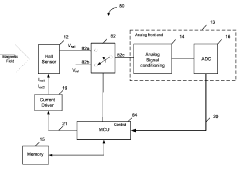
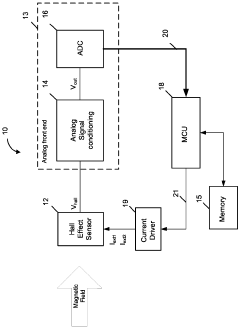
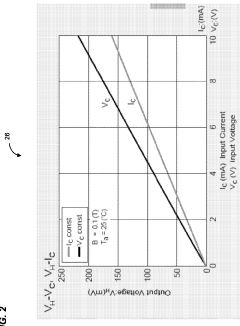
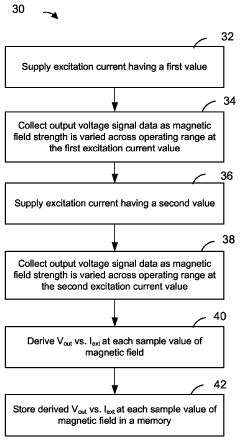
- A method and system that utilize a microcontroller to supply excitation current at different values to the hall effect sensor, obtain corresponding voltage measurements, and verify the sensor's operation based on calibration data, detecting faults in the analog front end and automatically setting the system to a safe mode if measurements are invalid.
Hardware-Software Integration for Comprehensive Testing
Effective Hall Effect sensor testing requires seamless integration between hardware components and software systems. This integration creates a comprehensive testing environment that can accurately simulate real-world conditions while providing precise control and measurement capabilities. The hardware components typically include magnetic field generators, positioning systems, temperature control units, and data acquisition systems. These physical elements must work in concert with specialized software that controls test parameters, records sensor responses, and analyzes performance metrics.
A well-designed hardware-software integration framework begins with a robust communication protocol between physical test equipment and the control software. Industry standards such as VISA, SCPI, or custom APIs enable reliable command transmission and data collection. The software layer should provide intuitive interfaces for test configuration while abstracting the complexity of hardware control operations from test engineers.
Real-time monitoring capabilities represent a critical aspect of integrated testing systems. The software must continuously capture sensor outputs while simultaneously controlling magnetic field parameters, sensor positioning, and environmental conditions. This synchronization ensures that cause-effect relationships between stimulus and response can be accurately documented and analyzed. Advanced systems implement closed-loop feedback mechanisms that automatically adjust test parameters based on sensor performance.
Test automation frameworks significantly enhance testing efficiency when properly integrated with hardware systems. These frameworks allow for the creation of complex test sequences that can run unattended, cycling through numerous test conditions while logging results. Automation reduces human error, increases test coverage, and enables regression testing when sensor designs or firmware are modified. Modern systems often incorporate machine learning algorithms to identify optimal test parameters and detect anomalous sensor behaviors.
Data management represents another crucial element of hardware-software integration. The testing platform must efficiently store large volumes of sensor response data while providing tools for visualization and analysis. Effective systems implement database solutions that maintain test histories, enabling comparison between different sensor versions or manufacturing batches. Advanced analytics tools can process this historical data to identify performance trends and potential quality issues.
Calibration procedures benefit significantly from tight hardware-software integration. Software-controlled calibration routines can automatically adjust sensor parameters based on measured responses to known magnetic field conditions. This process ensures that sensors maintain accuracy across their operating range and compensates for manufacturing variations. The calibration data can be stored digitally with each sensor, creating a traceable record of performance characteristics throughout the product lifecycle.
A well-designed hardware-software integration framework begins with a robust communication protocol between physical test equipment and the control software. Industry standards such as VISA, SCPI, or custom APIs enable reliable command transmission and data collection. The software layer should provide intuitive interfaces for test configuration while abstracting the complexity of hardware control operations from test engineers.
Real-time monitoring capabilities represent a critical aspect of integrated testing systems. The software must continuously capture sensor outputs while simultaneously controlling magnetic field parameters, sensor positioning, and environmental conditions. This synchronization ensures that cause-effect relationships between stimulus and response can be accurately documented and analyzed. Advanced systems implement closed-loop feedback mechanisms that automatically adjust test parameters based on sensor performance.
Test automation frameworks significantly enhance testing efficiency when properly integrated with hardware systems. These frameworks allow for the creation of complex test sequences that can run unattended, cycling through numerous test conditions while logging results. Automation reduces human error, increases test coverage, and enables regression testing when sensor designs or firmware are modified. Modern systems often incorporate machine learning algorithms to identify optimal test parameters and detect anomalous sensor behaviors.
Data management represents another crucial element of hardware-software integration. The testing platform must efficiently store large volumes of sensor response data while providing tools for visualization and analysis. Effective systems implement database solutions that maintain test histories, enabling comparison between different sensor versions or manufacturing batches. Advanced analytics tools can process this historical data to identify performance trends and potential quality issues.
Calibration procedures benefit significantly from tight hardware-software integration. Software-controlled calibration routines can automatically adjust sensor parameters based on measured responses to known magnetic field conditions. This process ensures that sensors maintain accuracy across their operating range and compensates for manufacturing variations. The calibration data can be stored digitally with each sensor, creating a traceable record of performance characteristics throughout the product lifecycle.
Environmental Factors Affecting Hall Sensor Performance
Hall Effect sensors operate on the principle of electromagnetic interaction, making them susceptible to various environmental factors that can significantly impact their performance and measurement accuracy. Temperature variations represent one of the most critical environmental challenges, as they can alter the magnetic properties of materials and affect semiconductor behavior within the sensor. At high temperatures, the sensitivity of Hall sensors typically decreases due to increased carrier mobility, while extremely low temperatures may cause brittleness in sensor components and affect response characteristics.
Magnetic field interference from external sources constitutes another major environmental concern. Nearby electrical equipment, power lines, or other magnetic field generators can introduce noise and distortion into Hall sensor readings. This interference becomes particularly problematic in industrial settings where multiple electromagnetic devices operate in close proximity, necessitating proper shielding and calibration techniques during simulation.
Humidity and moisture exposure present significant risks to Hall sensor functionality. While many modern sensors incorporate protective encapsulation, prolonged exposure to high humidity environments can lead to corrosion of electrical contacts and degradation of semiconductor materials. Simulation environments must accurately replicate these moisture conditions to evaluate long-term reliability and potential failure modes.
Mechanical stress and vibration represent additional environmental factors that can alter sensor characteristics. Physical deformation of the sensor package due to mounting pressure or thermal expansion can change the relative positioning of sensing elements, affecting measurement accuracy. Similarly, continuous vibration may lead to fatigue in connection points and gradual drift in sensor calibration parameters.
Atmospheric pressure variations, though often overlooked, can impact sensor performance in aerospace and altitude-sensitive applications. Changes in pressure can affect the physical dimensions of sensor components and potentially influence the magnetic field distribution around the sensor. Comprehensive testing environments should incorporate pressure variation capabilities when simulating conditions for applications operating across different altitudes.
Radiation exposure presents a critical environmental factor for Hall sensors deployed in space applications, nuclear facilities, or medical equipment. High-energy radiation can cause semiconductor degradation through ionization effects and lattice displacement, potentially leading to sensitivity drift or complete failure. Simulation of radiation environments requires specialized equipment and safety protocols to accurately reproduce these extreme conditions.
Magnetic field interference from external sources constitutes another major environmental concern. Nearby electrical equipment, power lines, or other magnetic field generators can introduce noise and distortion into Hall sensor readings. This interference becomes particularly problematic in industrial settings where multiple electromagnetic devices operate in close proximity, necessitating proper shielding and calibration techniques during simulation.
Humidity and moisture exposure present significant risks to Hall sensor functionality. While many modern sensors incorporate protective encapsulation, prolonged exposure to high humidity environments can lead to corrosion of electrical contacts and degradation of semiconductor materials. Simulation environments must accurately replicate these moisture conditions to evaluate long-term reliability and potential failure modes.
Mechanical stress and vibration represent additional environmental factors that can alter sensor characteristics. Physical deformation of the sensor package due to mounting pressure or thermal expansion can change the relative positioning of sensing elements, affecting measurement accuracy. Similarly, continuous vibration may lead to fatigue in connection points and gradual drift in sensor calibration parameters.
Atmospheric pressure variations, though often overlooked, can impact sensor performance in aerospace and altitude-sensitive applications. Changes in pressure can affect the physical dimensions of sensor components and potentially influence the magnetic field distribution around the sensor. Comprehensive testing environments should incorporate pressure variation capabilities when simulating conditions for applications operating across different altitudes.
Radiation exposure presents a critical environmental factor for Hall sensors deployed in space applications, nuclear facilities, or medical equipment. High-energy radiation can cause semiconductor degradation through ionization effects and lattice displacement, potentially leading to sensitivity drift or complete failure. Simulation of radiation environments requires specialized equipment and safety protocols to accurately reproduce these extreme conditions.
Unlock deeper insights with PatSnap Eureka Quick Research — get a full tech report to explore trends and direct your research. Try now!
Generate Your Research Report Instantly with AI Agent
Supercharge your innovation with PatSnap Eureka AI Agent Platform!