How to Utilize FTIR for Efficient Consumer Product Testing
SEP 22, 20259 MIN READ
Generate Your Research Report Instantly with AI Agent
Patsnap Eureka helps you evaluate technical feasibility & market potential.
FTIR Technology Background and Testing Objectives
Fourier Transform Infrared Spectroscopy (FTIR) has evolved significantly since its inception in the mid-20th century. Initially developed as an analytical technique for chemical identification, FTIR has transformed from bulky laboratory equipment to versatile, portable devices capable of rapid analysis. This evolution has been driven by advancements in computing power, detector sensitivity, and optical components, making FTIR increasingly accessible for industrial applications beyond traditional research settings.
The fundamental principle of FTIR involves measuring how infrared radiation is absorbed by materials, creating a unique spectral fingerprint that identifies molecular structures and chemical compositions. This non-destructive analytical method has become invaluable across multiple industries, particularly in quality control and material verification processes where rapid, accurate identification is essential.
In the consumer products sector, FTIR technology addresses critical challenges including material authentication, contaminant detection, formulation consistency, and regulatory compliance verification. The ability to quickly analyze products without extensive sample preparation represents a significant advantage over traditional testing methodologies that often require time-consuming chemical extractions or destructive testing.
Current technological trends in FTIR for consumer product testing include miniaturization of equipment, enhanced spectral libraries for automated identification, cloud-based data processing, and integration with artificial intelligence for pattern recognition. These developments are collectively pushing FTIR toward more accessible, faster, and more reliable testing protocols suitable for production environments.
The primary objectives for FTIR implementation in consumer product testing encompass several dimensions. First, efficiency enhancement through rapid testing protocols that can be integrated into production lines without creating bottlenecks. Second, cost reduction by minimizing sample preparation requirements and enabling non-specialized personnel to conduct routine analyses. Third, accuracy improvement through advanced spectral analysis algorithms and comprehensive reference libraries tailored to specific product categories.
Additional objectives include developing standardized testing methodologies that ensure consistent results across different testing environments and equipment configurations. This standardization is particularly important for global manufacturers who must maintain uniform quality control processes across multiple production facilities while meeting diverse regulatory requirements in different markets.
The ultimate goal is to establish FTIR as a cornerstone technology in consumer product quality assurance, enabling manufacturers to implement comprehensive testing regimes that protect brand reputation, ensure consumer safety, and maintain regulatory compliance while optimizing production efficiency and minimizing testing-related costs.
The fundamental principle of FTIR involves measuring how infrared radiation is absorbed by materials, creating a unique spectral fingerprint that identifies molecular structures and chemical compositions. This non-destructive analytical method has become invaluable across multiple industries, particularly in quality control and material verification processes where rapid, accurate identification is essential.
In the consumer products sector, FTIR technology addresses critical challenges including material authentication, contaminant detection, formulation consistency, and regulatory compliance verification. The ability to quickly analyze products without extensive sample preparation represents a significant advantage over traditional testing methodologies that often require time-consuming chemical extractions or destructive testing.
Current technological trends in FTIR for consumer product testing include miniaturization of equipment, enhanced spectral libraries for automated identification, cloud-based data processing, and integration with artificial intelligence for pattern recognition. These developments are collectively pushing FTIR toward more accessible, faster, and more reliable testing protocols suitable for production environments.
The primary objectives for FTIR implementation in consumer product testing encompass several dimensions. First, efficiency enhancement through rapid testing protocols that can be integrated into production lines without creating bottlenecks. Second, cost reduction by minimizing sample preparation requirements and enabling non-specialized personnel to conduct routine analyses. Third, accuracy improvement through advanced spectral analysis algorithms and comprehensive reference libraries tailored to specific product categories.
Additional objectives include developing standardized testing methodologies that ensure consistent results across different testing environments and equipment configurations. This standardization is particularly important for global manufacturers who must maintain uniform quality control processes across multiple production facilities while meeting diverse regulatory requirements in different markets.
The ultimate goal is to establish FTIR as a cornerstone technology in consumer product quality assurance, enabling manufacturers to implement comprehensive testing regimes that protect brand reputation, ensure consumer safety, and maintain regulatory compliance while optimizing production efficiency and minimizing testing-related costs.
Market Demand Analysis for FTIR in Consumer Product Testing
The global market for FTIR (Fourier Transform Infrared) spectroscopy in consumer product testing has experienced significant growth in recent years, driven by increasing regulatory requirements and consumer demand for product safety and quality. The market size for analytical instrumentation in consumer goods testing, including FTIR technology, was valued at approximately $4.8 billion in 2022 and is projected to grow at a CAGR of 5.7% through 2028.
Consumer product manufacturers face mounting pressure to ensure product compliance with stringent safety regulations across different markets. This has created substantial demand for rapid, reliable testing methods like FTIR, which can identify chemical compositions and contaminants without destructive testing. The cosmetics and personal care sector represents the largest market segment, accounting for nearly 28% of FTIR applications in consumer product testing, followed by food and beverage at 23%.
Regulatory developments have significantly influenced market demand. The EU's REACH regulations, California's Proposition 65, and similar frameworks in Asia-Pacific markets have mandated more comprehensive chemical testing for consumer products. This regulatory landscape has created a 37% increase in demand for advanced spectroscopic techniques like FTIR over the past five years.
The market shows strong regional variations. North America currently leads with approximately 35% market share, followed by Europe (30%) and Asia-Pacific (25%). However, the Asia-Pacific region demonstrates the fastest growth rate at 7.2% annually, driven by expanding manufacturing bases and strengthening regulatory frameworks in China, India, and Southeast Asian countries.
Industry surveys indicate that 76% of consumer product manufacturers cite speed of analysis as their primary consideration when adopting new testing technologies. FTIR meets this need by providing results in minutes rather than hours required by traditional methods. Additionally, 64% of manufacturers value the non-destructive nature of FTIR testing, which preserves sample integrity and reduces material costs.
The portable FTIR segment is experiencing particularly robust growth at 9.3% annually, reflecting industry demand for on-site testing capabilities. This trend aligns with broader industry movements toward decentralized quality control and supply chain verification. Market research indicates that manufacturers are willing to invest 15-20% more in testing equipment that offers portability without compromising analytical accuracy.
Cost considerations remain significant, with mid-sized manufacturers citing initial investment costs as the primary barrier to FTIR adoption. However, the total cost of ownership analysis reveals that FTIR systems typically achieve return on investment within 14-18 months through reduced external testing costs and faster time-to-market for new products.
Consumer product manufacturers face mounting pressure to ensure product compliance with stringent safety regulations across different markets. This has created substantial demand for rapid, reliable testing methods like FTIR, which can identify chemical compositions and contaminants without destructive testing. The cosmetics and personal care sector represents the largest market segment, accounting for nearly 28% of FTIR applications in consumer product testing, followed by food and beverage at 23%.
Regulatory developments have significantly influenced market demand. The EU's REACH regulations, California's Proposition 65, and similar frameworks in Asia-Pacific markets have mandated more comprehensive chemical testing for consumer products. This regulatory landscape has created a 37% increase in demand for advanced spectroscopic techniques like FTIR over the past five years.
The market shows strong regional variations. North America currently leads with approximately 35% market share, followed by Europe (30%) and Asia-Pacific (25%). However, the Asia-Pacific region demonstrates the fastest growth rate at 7.2% annually, driven by expanding manufacturing bases and strengthening regulatory frameworks in China, India, and Southeast Asian countries.
Industry surveys indicate that 76% of consumer product manufacturers cite speed of analysis as their primary consideration when adopting new testing technologies. FTIR meets this need by providing results in minutes rather than hours required by traditional methods. Additionally, 64% of manufacturers value the non-destructive nature of FTIR testing, which preserves sample integrity and reduces material costs.
The portable FTIR segment is experiencing particularly robust growth at 9.3% annually, reflecting industry demand for on-site testing capabilities. This trend aligns with broader industry movements toward decentralized quality control and supply chain verification. Market research indicates that manufacturers are willing to invest 15-20% more in testing equipment that offers portability without compromising analytical accuracy.
Cost considerations remain significant, with mid-sized manufacturers citing initial investment costs as the primary barrier to FTIR adoption. However, the total cost of ownership analysis reveals that FTIR systems typically achieve return on investment within 14-18 months through reduced external testing costs and faster time-to-market for new products.
Current FTIR Implementation Challenges in Product Testing
Despite the widespread adoption of Fourier Transform Infrared Spectroscopy (FTIR) in consumer product testing, several significant implementation challenges persist that limit its efficiency and effectiveness. The integration of FTIR into high-throughput testing environments faces substantial obstacles related to sample preparation complexity. Many consumer products contain multiple components with varying physical properties, requiring specialized preparation techniques that are often time-consuming and labor-intensive. This preparation variability can introduce inconsistencies in results, particularly when dealing with heterogeneous materials common in consumer goods.
Data interpretation represents another major challenge, as FTIR spectra from complex consumer products frequently exhibit overlapping bands and interference patterns that complicate analysis. The absence of standardized interpretation protocols across different industries further exacerbates this issue, leading to potential discrepancies in test results between different laboratories or testing facilities. This lack of standardization impedes the establishment of universal quality control parameters.
Technical limitations of current FTIR instrumentation also present significant hurdles. Many conventional FTIR systems lack the sensitivity required to detect trace contaminants or additives that may be critical for consumer safety assessments. Additionally, the spatial resolution of standard FTIR equipment often proves insufficient for analyzing microscopic features or defects in consumer products, necessitating complementary analytical techniques that increase testing complexity and cost.
The integration of FTIR with existing quality control workflows presents operational challenges. Many manufacturing environments struggle to incorporate FTIR testing seamlessly into production lines due to equipment size constraints, environmental sensitivity requirements, and the need for specialized operators. Real-time monitoring capabilities remain limited, creating bottlenecks in production processes where immediate feedback is crucial.
Cost considerations further complicate widespread FTIR implementation. High-quality FTIR instrumentation requires substantial capital investment, while ongoing maintenance, calibration, and operator training add to operational expenses. For smaller manufacturers or testing facilities, these costs can be prohibitive, limiting access to this valuable analytical tool.
Environmental factors also impact FTIR testing reliability. Ambient humidity, temperature fluctuations, and atmospheric CO2 can interfere with spectral acquisition, necessitating controlled testing environments that may be difficult to maintain in typical manufacturing settings. These environmental dependencies reduce the robustness of FTIR as a universal testing solution for diverse production environments.
Finally, regulatory compliance presents a growing challenge. As consumer product safety standards evolve globally, FTIR testing protocols must continuously adapt to meet new requirements. The lack of harmonized international standards for FTIR testing methodologies creates compliance uncertainties, particularly for products destined for multiple international markets.
Data interpretation represents another major challenge, as FTIR spectra from complex consumer products frequently exhibit overlapping bands and interference patterns that complicate analysis. The absence of standardized interpretation protocols across different industries further exacerbates this issue, leading to potential discrepancies in test results between different laboratories or testing facilities. This lack of standardization impedes the establishment of universal quality control parameters.
Technical limitations of current FTIR instrumentation also present significant hurdles. Many conventional FTIR systems lack the sensitivity required to detect trace contaminants or additives that may be critical for consumer safety assessments. Additionally, the spatial resolution of standard FTIR equipment often proves insufficient for analyzing microscopic features or defects in consumer products, necessitating complementary analytical techniques that increase testing complexity and cost.
The integration of FTIR with existing quality control workflows presents operational challenges. Many manufacturing environments struggle to incorporate FTIR testing seamlessly into production lines due to equipment size constraints, environmental sensitivity requirements, and the need for specialized operators. Real-time monitoring capabilities remain limited, creating bottlenecks in production processes where immediate feedback is crucial.
Cost considerations further complicate widespread FTIR implementation. High-quality FTIR instrumentation requires substantial capital investment, while ongoing maintenance, calibration, and operator training add to operational expenses. For smaller manufacturers or testing facilities, these costs can be prohibitive, limiting access to this valuable analytical tool.
Environmental factors also impact FTIR testing reliability. Ambient humidity, temperature fluctuations, and atmospheric CO2 can interfere with spectral acquisition, necessitating controlled testing environments that may be difficult to maintain in typical manufacturing settings. These environmental dependencies reduce the robustness of FTIR as a universal testing solution for diverse production environments.
Finally, regulatory compliance presents a growing challenge. As consumer product safety standards evolve globally, FTIR testing protocols must continuously adapt to meet new requirements. The lack of harmonized international standards for FTIR testing methodologies creates compliance uncertainties, particularly for products destined for multiple international markets.
Current FTIR Testing Methodologies and Protocols
01 Advanced FTIR system designs for improved efficiency
Modern FTIR spectroscopy systems incorporate innovative designs to enhance measurement efficiency. These include optimized optical configurations, improved interferometer designs, and advanced signal processing algorithms. Such enhancements allow for faster scan rates, higher resolution, and better signal-to-noise ratios, ultimately improving the overall efficiency of FTIR analysis.- Advanced FTIR detection systems: Modern FTIR spectroscopy systems incorporate advanced detection technologies to improve efficiency and sensitivity. These innovations include specialized detectors, signal processing algorithms, and optical configurations that enhance the signal-to-noise ratio. Such advancements allow for faster scanning speeds, higher resolution, and improved detection limits, making FTIR analysis more efficient for various applications including material characterization and chemical identification.
- FTIR sample handling and preparation techniques: Efficient sample handling and preparation methods significantly impact FTIR spectroscopy performance. Innovations in this area include automated sample positioning systems, specialized sample holders, and preparation protocols that optimize the interaction between the infrared beam and the sample. These techniques minimize contamination, reduce analysis time, and improve reproducibility, thereby enhancing the overall efficiency of FTIR analysis across different sample types and states.
- Miniaturized and portable FTIR systems: Compact and portable FTIR spectroscopy systems have been developed to enable field analysis and point-of-use applications. These systems incorporate miniaturized components, integrated optics, and power-efficient designs while maintaining analytical performance. The portability enhances efficiency by eliminating sample transport requirements and allowing for real-time analysis in various environments, from industrial settings to remote field locations.
- FTIR data processing and analysis algorithms: Advanced computational methods and algorithms have been developed to enhance FTIR data processing efficiency. These include automated baseline correction, spectral deconvolution techniques, chemometric analysis, and machine learning approaches for spectral interpretation. Such algorithms improve the speed and accuracy of data analysis, enable the extraction of more information from complex spectra, and facilitate the identification of subtle spectral features that might otherwise be overlooked.
- Hyphenated FTIR techniques and multi-modal systems: Integration of FTIR with complementary analytical techniques creates powerful hyphenated systems that enhance analytical efficiency. These combinations include FTIR-microscopy, FTIR-chromatography, and FTIR with other spectroscopic methods. Such multi-modal approaches provide comprehensive characterization capabilities, reduce the need for multiple separate analyses, and enable correlation between different analytical dimensions, thereby improving overall analytical efficiency and information content.
02 Sample preparation and handling techniques
Efficient sample preparation and handling methods significantly impact FTIR analysis performance. Specialized sample holders, automated sample introduction systems, and preparation protocols optimize the interaction between the infrared beam and the sample. These techniques minimize contamination, reduce analysis time, and improve reproducibility, thereby enhancing the overall efficiency of FTIR spectroscopy.Expand Specific Solutions03 Miniaturization and portable FTIR solutions
Compact and portable FTIR systems have been developed to enable on-site analysis without sacrificing performance. These systems utilize miniaturized components, integrated circuits, and power-efficient designs to maintain analytical capabilities while reducing size and power consumption. Portable FTIR solutions improve efficiency by eliminating sample transport requirements and enabling real-time decision making in field applications.Expand Specific Solutions04 Data processing and analysis algorithms
Advanced computational methods enhance FTIR spectroscopy efficiency through improved data processing. Machine learning algorithms, automated peak identification, and spectral database matching accelerate analysis and interpretation of complex spectra. These computational approaches reduce manual processing time, minimize human error, and enable the extraction of more information from spectral data.Expand Specific Solutions05 Integration with other analytical techniques
Combining FTIR with complementary analytical methods creates synergistic systems that enhance overall analytical efficiency. Hyphenated techniques such as FTIR-microscopy, FTIR-chromatography, and FTIR with multivariate analysis provide more comprehensive characterization of complex samples. These integrated approaches maximize information output while minimizing sample requirements and analysis time.Expand Specific Solutions
Leading FTIR Equipment Manufacturers and Testing Service Providers
The FTIR consumer product testing market is in a growth phase, characterized by increasing adoption across industries for quality control and regulatory compliance. The market size is expanding due to rising consumer safety concerns and stringent product standards. Technologically, FTIR testing has reached moderate maturity with established applications, though innovation continues. Leading players include MKS Inc. and Shimazu KK offering advanced instrumentation, while Koninklijke Philips and ZTE Corp. integrate FTIR into their product development processes. Research institutions like Peking University and McGill University are advancing methodological applications. The competitive landscape features specialized testing providers like Pulmonir Ltd. alongside industrial giants such as Saudi Arabian Oil Co. and China Petroleum & Chemical Corp. that utilize FTIR for quality assurance in consumer-facing products.
Shimazu KK
Technical Solution: Shimazu KK has developed comprehensive FTIR solutions for consumer product testing centered around their IRTracer and IRSpirit series spectrometers. Their approach combines high-sensitivity FTIR hardware with specialized sampling accessories designed specifically for consumer product analysis. The company's LabSolutions IR software platform features automated identification algorithms that can rapidly match sample spectra against extensive libraries of consumer materials, additives, and contaminants[2]. Shimazu's FTIR systems employ patented interferometer technology that provides exceptional stability and wavelength precision, enabling reliable identification of material composition variations as small as 0.5%[4]. For consumer product applications, they've developed specialized ATR accessories with different crystal materials optimized for various product types, from textiles to electronics components. Their systems also incorporate rapid-scan capabilities that can complete full spectral acquisition in under 30 seconds, making them suitable for high-throughput quality control environments in consumer goods manufacturing[6].
Strengths: Exceptional wavelength precision and stability; specialized accessories designed specifically for different consumer product categories; rapid analysis capabilities suitable for production environments. Weaknesses: Premium pricing compared to basic FTIR systems; requires periodic recalibration for optimal performance; some complex samples may require additional preparation techniques beyond standard ATR.
Foss Analytical A/S
Technical Solution: Foss Analytical has pioneered specialized FTIR solutions for consumer product testing with a focus on food, beverage, and agricultural products. Their approach centers on dedicated analyzers that combine FTIR technology with automated sampling systems and application-specific calibrations. The company's MilkoScan™ and FoodScan™ platforms utilize FTIR to provide rapid compositional analysis of consumer food products, delivering results in under a minute for parameters like fat, protein, moisture, and adulterants[1]. Their systems employ proprietary sample presentation techniques that minimize preparation requirements while maintaining high accuracy, with typical precision better than ±0.5% for major components[3]. Foss has developed specialized algorithms that can identify multiple quality parameters simultaneously from a single FTIR scan, enabling comprehensive product characterization. Their networked FTIR solutions allow integration with production management systems for real-time quality control, with automated alerts when products fall outside specification limits[7].
Strengths: Highly specialized solutions optimized for specific consumer product categories; exceptional speed of analysis; robust calibrations developed from thousands of reference samples. Weaknesses: Less flexibility for analyzing novel materials outside established calibrations; primarily focused on food/agricultural applications rather than general consumer goods; requires periodic recalibration to maintain accuracy across different product formulations.
Key FTIR Spectral Analysis Techniques and Innovations
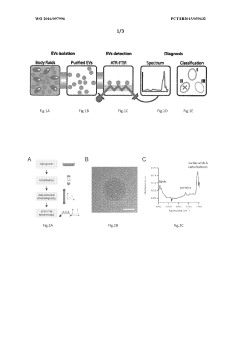
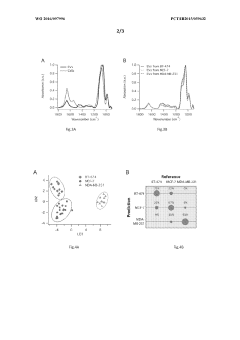
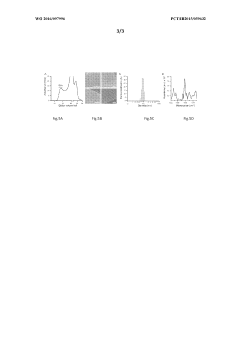
Use of fourier transform infrared spectroscopy analysis of extracellular vesicles isolated from body fluids for diagnosing, prognosing and monitoring pathophysiological states and method therfor
PatentWO2016097996A1
Innovation
- The use of Fourier Transform Infrared Spectroscopy (FTIR) to analyze extracellular vesicles (EVs) isolated from body fluids, combined with multivariate analysis, provides a non-invasive and label-free method for classifying EVs based on their molecular composition, enabling early diagnosis, prognosis, and monitoring of cancer and other proliferative diseases.
Method and apparatus for characterization of ultrathin silicon oxide films using mirror-enhanced polarized reflectance fourier transform infrared spectroscopy
PatentInactiveUS6818894B2
Innovation
- The implementation of Mirror-Enhanced Polarized Reflectance Fourier Transform Infrared (MEPR-FTIR) spectroscopy, which enhances IR intensity by attaching a mirror to the wafer sample, allowing for P-polarized beam usage and increasing absorption intensity through redirected beams, enabling precise characterization of ultrathin silicon oxide films down to one monolayer thickness.


Cost-Benefit Analysis of FTIR Implementation in Production Lines
Implementing FTIR (Fourier Transform Infrared Spectroscopy) technology in production lines requires careful financial consideration to justify the substantial initial investment. The acquisition costs for a standard FTIR system suitable for consumer product testing typically range from $30,000 to $100,000, depending on resolution capabilities, sampling accessories, and software packages. Additional expenses include facility modifications, which may require $5,000-$15,000 for proper ventilation, vibration isolation, and temperature control systems essential for accurate spectroscopic measurements.
When evaluating operational costs, companies must account for annual maintenance contracts ($2,000-$5,000), consumables such as sample holders and reference materials ($1,500-$3,000 annually), and specialized training for technicians ($2,000-$4,000 per employee). Energy consumption, though relatively modest compared to other analytical equipment, adds approximately $500-$1,000 to annual operating expenses.
The return on investment timeline typically spans 2-4 years, contingent upon testing volume and the specific industry application. Manufacturing facilities processing over 1,000 samples monthly generally achieve faster ROI compared to smaller operations. The most significant financial benefits derive from reduced product recalls, with studies indicating potential savings of $50,000-$500,000 per avoided incident depending on product type and market reach.
Quality control improvements represent another substantial benefit, with FTIR implementation typically reducing defect rates by 15-30% through early detection of formulation inconsistencies. This translates to approximately $20,000-$100,000 in annual savings for medium-sized production facilities. Labor efficiency gains of 30-50% in quality testing workflows further contribute to cost reduction, as FTIR analysis requires minimal sample preparation and provides results within minutes rather than hours.
Regulatory compliance benefits, while more difficult to quantify precisely, offer significant value through streamlined documentation processes and reduced risk of non-compliance penalties. Companies in highly regulated industries such as pharmaceuticals, food, and cosmetics report administrative cost reductions of 10-20% related to quality assurance documentation.
For optimal financial performance, companies should consider phased implementation strategies, beginning with critical product lines before expanding to comprehensive coverage. Leasing options and shared equipment arrangements can reduce initial capital requirements, while outsourcing complex analyses during implementation phases helps maintain operational continuity while building internal expertise.
When evaluating operational costs, companies must account for annual maintenance contracts ($2,000-$5,000), consumables such as sample holders and reference materials ($1,500-$3,000 annually), and specialized training for technicians ($2,000-$4,000 per employee). Energy consumption, though relatively modest compared to other analytical equipment, adds approximately $500-$1,000 to annual operating expenses.
The return on investment timeline typically spans 2-4 years, contingent upon testing volume and the specific industry application. Manufacturing facilities processing over 1,000 samples monthly generally achieve faster ROI compared to smaller operations. The most significant financial benefits derive from reduced product recalls, with studies indicating potential savings of $50,000-$500,000 per avoided incident depending on product type and market reach.
Quality control improvements represent another substantial benefit, with FTIR implementation typically reducing defect rates by 15-30% through early detection of formulation inconsistencies. This translates to approximately $20,000-$100,000 in annual savings for medium-sized production facilities. Labor efficiency gains of 30-50% in quality testing workflows further contribute to cost reduction, as FTIR analysis requires minimal sample preparation and provides results within minutes rather than hours.
Regulatory compliance benefits, while more difficult to quantify precisely, offer significant value through streamlined documentation processes and reduced risk of non-compliance penalties. Companies in highly regulated industries such as pharmaceuticals, food, and cosmetics report administrative cost reductions of 10-20% related to quality assurance documentation.
For optimal financial performance, companies should consider phased implementation strategies, beginning with critical product lines before expanding to comprehensive coverage. Leasing options and shared equipment arrangements can reduce initial capital requirements, while outsourcing complex analyses during implementation phases helps maintain operational continuity while building internal expertise.
Regulatory Compliance and Standards for FTIR Testing Methods
The regulatory landscape for FTIR testing in consumer products is governed by a complex framework of international, regional, and national standards. Organizations such as the International Organization for Standardization (ISO), ASTM International, and the European Committee for Standardization (CEN) have established specific protocols for FTIR analysis across various product categories. These standards ensure consistency, reliability, and comparability of test results across different laboratories and jurisdictions.
ISO 14624-2 and ASTM E1252 provide comprehensive guidelines for sample preparation and data interpretation in FTIR spectroscopy, which are particularly relevant for consumer product testing. These standards outline specific procedures for quantitative and qualitative analysis, including calibration requirements and acceptable margins of error. Adherence to these standards is crucial for ensuring that FTIR test results will be recognized by regulatory authorities worldwide.
In the United States, the Consumer Product Safety Commission (CPSC) references FTIR testing methods in its compliance verification protocols, particularly for identifying restricted substances in children's products and household items. Similarly, the European Union's REACH regulation and RoHS directive incorporate FTIR as an accepted analytical method for detecting and quantifying restricted chemicals in consumer goods.
For food contact materials, FDA 21 CFR 177 and EU Regulation 10/2011 specify FTIR testing parameters for identifying potential migrants from packaging into food products. These regulations establish specific detection limits and testing conditions that must be met to demonstrate compliance. Manufacturers must ensure their FTIR testing protocols align with these requirements to gain market access.
The pharmaceutical industry faces particularly stringent requirements under USP <197> and Ph. Eur. 2.2.24, which detail specific FTIR methodologies for identifying active pharmaceutical ingredients and excipients in consumer healthcare products. These standards mandate specific resolution parameters, signal-to-noise ratios, and reference libraries that must be utilized during analysis.
Emerging regulations in developing markets, particularly in Asia-Pacific regions, are increasingly harmonizing with international standards while adding market-specific requirements. China's GB standards and India's BIS specifications now include FTIR testing protocols that manufacturers must navigate to access these growing consumer markets.
Laboratory accreditation under ISO/IEC 17025 has become a de facto requirement for facilities conducting regulatory FTIR testing. This standard ensures that laboratories maintain appropriate quality management systems and technical competence for generating valid test results that will withstand regulatory scrutiny and potential legal challenges.
ISO 14624-2 and ASTM E1252 provide comprehensive guidelines for sample preparation and data interpretation in FTIR spectroscopy, which are particularly relevant for consumer product testing. These standards outline specific procedures for quantitative and qualitative analysis, including calibration requirements and acceptable margins of error. Adherence to these standards is crucial for ensuring that FTIR test results will be recognized by regulatory authorities worldwide.
In the United States, the Consumer Product Safety Commission (CPSC) references FTIR testing methods in its compliance verification protocols, particularly for identifying restricted substances in children's products and household items. Similarly, the European Union's REACH regulation and RoHS directive incorporate FTIR as an accepted analytical method for detecting and quantifying restricted chemicals in consumer goods.
For food contact materials, FDA 21 CFR 177 and EU Regulation 10/2011 specify FTIR testing parameters for identifying potential migrants from packaging into food products. These regulations establish specific detection limits and testing conditions that must be met to demonstrate compliance. Manufacturers must ensure their FTIR testing protocols align with these requirements to gain market access.
The pharmaceutical industry faces particularly stringent requirements under USP <197> and Ph. Eur. 2.2.24, which detail specific FTIR methodologies for identifying active pharmaceutical ingredients and excipients in consumer healthcare products. These standards mandate specific resolution parameters, signal-to-noise ratios, and reference libraries that must be utilized during analysis.
Emerging regulations in developing markets, particularly in Asia-Pacific regions, are increasingly harmonizing with international standards while adding market-specific requirements. China's GB standards and India's BIS specifications now include FTIR testing protocols that manufacturers must navigate to access these growing consumer markets.
Laboratory accreditation under ISO/IEC 17025 has become a de facto requirement for facilities conducting regulatory FTIR testing. This standard ensures that laboratories maintain appropriate quality management systems and technical competence for generating valid test results that will withstand regulatory scrutiny and potential legal challenges.
Unlock deeper insights with Patsnap Eureka Quick Research — get a full tech report to explore trends and direct your research. Try now!
Generate Your Research Report Instantly with AI Agent
Supercharge your innovation with Patsnap Eureka AI Agent Platform!