What Are the Key Challenges in Amorphous Metal Fabrication
OCT 11, 20259 MIN READ
Generate Your Research Report Instantly with AI Agent
PatSnap Eureka helps you evaluate technical feasibility & market potential.
Amorphous Metal Development History and Objectives
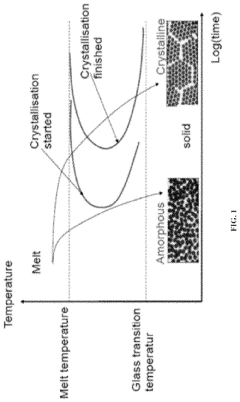
Amorphous metals, also known as metallic glasses, represent a unique class of materials that lack the long-range atomic order characteristic of conventional crystalline metals. The history of amorphous metals dates back to 1960 when Pol Duwez and his colleagues at Caltech first produced an Au-Si alloy with amorphous structure through rapid quenching techniques. This breakthrough demonstrated that under extreme cooling rates (exceeding 10^6 K/s), certain metal alloys could solidify without crystallization, preserving their liquid-like atomic arrangement.
The 1970s marked significant advancement with the development of ribbon-forming techniques, particularly melt spinning, which enabled continuous production of amorphous metal ribbons. This period saw the emergence of commercially viable Fe-based and Co-based amorphous alloys, primarily utilized in transformer cores due to their superior magnetic properties.
A pivotal moment in amorphous metal development occurred in the late 1980s when Akihisa Inoue and his team at Tohoku University discovered bulk metallic glass (BMG) forming alloys. These multicomponent systems (typically containing three or more elements) exhibited significantly reduced critical cooling rates, allowing the production of amorphous samples with thicknesses exceeding 1mm for the first time.
The 1990s witnessed the commercialization of Zr-based BMGs, particularly Vitreloy alloys developed at Caltech, which found applications in sporting goods and electronic casings. This period also saw increased understanding of the fundamental principles governing glass-forming ability, including the importance of atomic size differences, negative heats of mixing, and deep eutectics.
Since 2000, research has expanded to explore a wider compositional range, including non-traditional systems such as precious metal-based and aluminum-based amorphous alloys. Concurrent development of processing techniques like suction casting, copper mold casting, and spark plasma sintering has enabled more complex geometries and larger sample sizes.
The primary objectives driving amorphous metal research include overcoming size limitations, as most BMGs remain restricted to centimeter-scale dimensions due to critical cooling rate requirements. Researchers aim to develop alloys with enhanced glass-forming ability that can be produced in larger sections while maintaining their amorphous structure. Additionally, addressing the inherent brittleness of many BMGs remains crucial for expanding their structural applications.
Current research goals also focus on cost reduction by developing Fe-based and Al-based BMGs with reduced reliance on expensive elements like zirconium and palladium. Furthermore, researchers seek to enhance processing techniques to enable more complex geometries and improve reproducibility in manufacturing. The ultimate objective is to leverage the exceptional properties of amorphous metals—including high strength, elasticity, corrosion resistance, and unique magnetic characteristics—to create advanced materials for applications ranging from biomedical implants to aerospace components.
The 1970s marked significant advancement with the development of ribbon-forming techniques, particularly melt spinning, which enabled continuous production of amorphous metal ribbons. This period saw the emergence of commercially viable Fe-based and Co-based amorphous alloys, primarily utilized in transformer cores due to their superior magnetic properties.
A pivotal moment in amorphous metal development occurred in the late 1980s when Akihisa Inoue and his team at Tohoku University discovered bulk metallic glass (BMG) forming alloys. These multicomponent systems (typically containing three or more elements) exhibited significantly reduced critical cooling rates, allowing the production of amorphous samples with thicknesses exceeding 1mm for the first time.
The 1990s witnessed the commercialization of Zr-based BMGs, particularly Vitreloy alloys developed at Caltech, which found applications in sporting goods and electronic casings. This period also saw increased understanding of the fundamental principles governing glass-forming ability, including the importance of atomic size differences, negative heats of mixing, and deep eutectics.
Since 2000, research has expanded to explore a wider compositional range, including non-traditional systems such as precious metal-based and aluminum-based amorphous alloys. Concurrent development of processing techniques like suction casting, copper mold casting, and spark plasma sintering has enabled more complex geometries and larger sample sizes.
The primary objectives driving amorphous metal research include overcoming size limitations, as most BMGs remain restricted to centimeter-scale dimensions due to critical cooling rate requirements. Researchers aim to develop alloys with enhanced glass-forming ability that can be produced in larger sections while maintaining their amorphous structure. Additionally, addressing the inherent brittleness of many BMGs remains crucial for expanding their structural applications.
Current research goals also focus on cost reduction by developing Fe-based and Al-based BMGs with reduced reliance on expensive elements like zirconium and palladium. Furthermore, researchers seek to enhance processing techniques to enable more complex geometries and improve reproducibility in manufacturing. The ultimate objective is to leverage the exceptional properties of amorphous metals—including high strength, elasticity, corrosion resistance, and unique magnetic characteristics—to create advanced materials for applications ranging from biomedical implants to aerospace components.
Market Applications and Demand Analysis for Amorphous Metals
The global market for amorphous metals, also known as metallic glasses, has been experiencing steady growth driven by their exceptional properties including high strength, superior corrosion resistance, and unique magnetic characteristics. Current market valuations indicate the amorphous metals market reached approximately 1.2 billion USD in 2022, with projections suggesting a compound annual growth rate of 7.8% through 2030.
The electronics industry represents the largest application segment, accounting for roughly 32% of total demand. Amorphous metal transformers and magnetic cores have gained significant traction due to their energy efficiency advantages, with studies demonstrating 70-80% reduction in core losses compared to conventional silicon steel alternatives. This efficiency translates to substantial energy savings in power distribution systems, aligning with global sustainability initiatives.
Aerospace and defense sectors have emerged as high-value application areas, where the exceptional strength-to-weight ratio of amorphous metals provides critical performance advantages. The materials' ability to withstand extreme conditions while maintaining structural integrity has led to increased adoption in specialized components, despite the fabrication challenges.
Medical device manufacturing represents a rapidly expanding application segment, growing at approximately 9.5% annually. The biocompatibility of certain amorphous metal compositions, combined with their wear resistance and non-magnetic properties, makes them ideal for implantable devices and surgical instruments. The aging global population and increasing prevalence of chronic diseases continue to drive demand in this sector.
Consumer electronics manufacturers have shown increasing interest in amorphous metals for smartphone frames, wearable devices, and other applications requiring both strength and aesthetic appeal. The materials' ability to be molded into complex shapes while maintaining structural integrity presents significant opportunities, though cost factors remain a constraint.
Regional analysis reveals Asia-Pacific as the dominant market, accounting for approximately 45% of global consumption, followed by North America and Europe. China's manufacturing sector has become particularly aggressive in adopting amorphous metal technologies, supported by government initiatives promoting advanced materials development.
Market penetration remains constrained by fabrication challenges, particularly the difficulty in producing amorphous metals in large volumes and complex geometries. The critical cooling rates required to maintain the amorphous structure limit production capabilities and increase manufacturing costs. Industry surveys indicate that fabrication costs remain 2.5-3 times higher than conventional metal processing, representing a significant barrier to wider adoption.
The electronics industry represents the largest application segment, accounting for roughly 32% of total demand. Amorphous metal transformers and magnetic cores have gained significant traction due to their energy efficiency advantages, with studies demonstrating 70-80% reduction in core losses compared to conventional silicon steel alternatives. This efficiency translates to substantial energy savings in power distribution systems, aligning with global sustainability initiatives.
Aerospace and defense sectors have emerged as high-value application areas, where the exceptional strength-to-weight ratio of amorphous metals provides critical performance advantages. The materials' ability to withstand extreme conditions while maintaining structural integrity has led to increased adoption in specialized components, despite the fabrication challenges.
Medical device manufacturing represents a rapidly expanding application segment, growing at approximately 9.5% annually. The biocompatibility of certain amorphous metal compositions, combined with their wear resistance and non-magnetic properties, makes them ideal for implantable devices and surgical instruments. The aging global population and increasing prevalence of chronic diseases continue to drive demand in this sector.
Consumer electronics manufacturers have shown increasing interest in amorphous metals for smartphone frames, wearable devices, and other applications requiring both strength and aesthetic appeal. The materials' ability to be molded into complex shapes while maintaining structural integrity presents significant opportunities, though cost factors remain a constraint.
Regional analysis reveals Asia-Pacific as the dominant market, accounting for approximately 45% of global consumption, followed by North America and Europe. China's manufacturing sector has become particularly aggressive in adopting amorphous metal technologies, supported by government initiatives promoting advanced materials development.
Market penetration remains constrained by fabrication challenges, particularly the difficulty in producing amorphous metals in large volumes and complex geometries. The critical cooling rates required to maintain the amorphous structure limit production capabilities and increase manufacturing costs. Industry surveys indicate that fabrication costs remain 2.5-3 times higher than conventional metal processing, representing a significant barrier to wider adoption.
Current Fabrication Limitations and Technical Barriers
Despite significant advancements in amorphous metal technology, fabrication remains constrained by several critical limitations. The most fundamental challenge lies in the required rapid cooling rates, typically exceeding 10^6 K/s, to prevent crystallization during solidification. This cooling rate requirement severely restricts specimen dimensions, with most commercially available amorphous metals limited to thicknesses below 10mm, creating significant barriers for structural applications.
Conventional casting methods face inherent thermal transfer limitations when attempting to achieve uniform cooling throughout larger volumes. The interior regions of bulk specimens cool more slowly than surface areas, leading to partial crystallization and heterogeneous microstructures that compromise the material's unique properties. This thermal gradient problem becomes increasingly problematic as dimensions increase.
Processing temperature control presents another significant challenge. The working temperature window between the glass transition temperature (Tg) and crystallization temperature (Tx) is extremely narrow for most amorphous alloy compositions, typically spanning only 20-50°C. This limited "supercooled liquid region" creates substantial difficulties in thermoplastic forming operations, requiring precise temperature control systems beyond the capabilities of many manufacturing facilities.
Material costs and compositional complexity further hinder widespread adoption. Most commercially viable amorphous metals require expensive elements like palladium, platinum, or rare earth metals. The precise stoichiometric requirements leave little room for compositional variation or impurities, necessitating high-purity raw materials and sophisticated mixing technologies that significantly increase production costs.
Surface quality control during fabrication represents another persistent challenge. Amorphous metals exhibit high reactivity with mold materials at processing temperatures, leading to surface contamination, micro-defects, and localized crystallization. These surface imperfections often serve as stress concentration points, dramatically reducing mechanical performance and corrosion resistance.
Joining and assembly techniques for amorphous metals remain underdeveloped compared to conventional metals. Traditional welding processes induce localized heating that triggers crystallization in the heat-affected zone, compromising the amorphous structure. Alternative joining methods like laser welding, friction stir welding, and specialized adhesives show promise but lack standardization and widespread industrial implementation.
Quality control and non-destructive testing methods specifically calibrated for amorphous metals are also insufficient. The absence of grain boundaries and conventional microstructural features renders traditional metallurgical inspection techniques less effective, creating significant challenges in defect detection and quality assurance throughout the manufacturing process.
Conventional casting methods face inherent thermal transfer limitations when attempting to achieve uniform cooling throughout larger volumes. The interior regions of bulk specimens cool more slowly than surface areas, leading to partial crystallization and heterogeneous microstructures that compromise the material's unique properties. This thermal gradient problem becomes increasingly problematic as dimensions increase.
Processing temperature control presents another significant challenge. The working temperature window between the glass transition temperature (Tg) and crystallization temperature (Tx) is extremely narrow for most amorphous alloy compositions, typically spanning only 20-50°C. This limited "supercooled liquid region" creates substantial difficulties in thermoplastic forming operations, requiring precise temperature control systems beyond the capabilities of many manufacturing facilities.
Material costs and compositional complexity further hinder widespread adoption. Most commercially viable amorphous metals require expensive elements like palladium, platinum, or rare earth metals. The precise stoichiometric requirements leave little room for compositional variation or impurities, necessitating high-purity raw materials and sophisticated mixing technologies that significantly increase production costs.
Surface quality control during fabrication represents another persistent challenge. Amorphous metals exhibit high reactivity with mold materials at processing temperatures, leading to surface contamination, micro-defects, and localized crystallization. These surface imperfections often serve as stress concentration points, dramatically reducing mechanical performance and corrosion resistance.
Joining and assembly techniques for amorphous metals remain underdeveloped compared to conventional metals. Traditional welding processes induce localized heating that triggers crystallization in the heat-affected zone, compromising the amorphous structure. Alternative joining methods like laser welding, friction stir welding, and specialized adhesives show promise but lack standardization and widespread industrial implementation.
Quality control and non-destructive testing methods specifically calibrated for amorphous metals are also insufficient. The absence of grain boundaries and conventional microstructural features renders traditional metallurgical inspection techniques less effective, creating significant challenges in defect detection and quality assurance throughout the manufacturing process.
State-of-the-Art Fabrication Methodologies
01 Manufacturing processes for amorphous metals
Various manufacturing processes can be employed to produce amorphous metals, including rapid solidification techniques that prevent crystallization. These methods involve quickly cooling molten metal to bypass the crystalline structure formation, resulting in a disordered atomic arrangement. Specific techniques include melt spinning, vapor deposition, and mechanical alloying, which enable the production of amorphous metals with unique properties not achievable in conventional crystalline metals.- Manufacturing processes for amorphous metals: Various manufacturing processes can be employed to produce amorphous metals, including rapid solidification techniques that prevent crystallization. These methods involve cooling molten metal at extremely high rates to bypass crystal formation, resulting in a disordered atomic structure. Techniques such as melt spinning, vapor deposition, and mechanical alloying are commonly used to achieve the amorphous state. The processing parameters must be carefully controlled to maintain the desired amorphous structure and properties.
- Magnetic properties and applications of amorphous metals: Amorphous metals exhibit unique magnetic properties that make them valuable in various applications. Their lack of crystalline structure results in low magnetic coercivity, high permeability, and reduced core losses compared to conventional crystalline materials. These properties make amorphous metals particularly suitable for transformer cores, magnetic sensors, and electromagnetic shielding applications. The soft magnetic characteristics can be further enhanced through specific heat treatments while maintaining the amorphous structure.
- Composition and alloying elements in amorphous metals: The composition of amorphous metals significantly influences their properties and glass-forming ability. Common amorphous metal systems include iron-based, zirconium-based, and palladium-based alloys. The addition of metalloid elements such as boron, silicon, and phosphorus enhances glass-forming ability by disrupting crystallization. Rare earth elements and transition metals are also incorporated to tailor specific properties such as mechanical strength, corrosion resistance, and thermal stability. The precise control of composition is crucial for achieving desired characteristics in amorphous metal products.
- Mechanical properties and structural applications: Amorphous metals possess exceptional mechanical properties including high strength, hardness, and elastic limit compared to their crystalline counterparts. The absence of grain boundaries contributes to their superior wear resistance and fatigue properties. These materials can exhibit strength-to-weight ratios that exceed those of conventional structural materials, making them attractive for aerospace, automotive, and sporting goods applications. However, their limited ductility at room temperature presents challenges for certain forming operations and structural applications.
- Electronic and semiconductor applications: Amorphous metals find important applications in electronic and semiconductor industries due to their unique electrical properties and processing capabilities. They can be used as diffusion barriers in integrated circuits, interconnect materials, and in microelectromechanical systems (MEMS). Their uniform structure without grain boundaries makes them advantageous for thin film applications where consistent electrical properties are required. Additionally, some amorphous metal compositions exhibit superconductivity at low temperatures, opening possibilities for specialized electronic applications.
02 Magnetic properties and applications
Amorphous metals exhibit exceptional magnetic properties, including high permeability, low coercivity, and reduced core losses, making them ideal for electromagnetic applications. These materials are widely used in transformer cores, magnetic sensors, and electronic devices where energy efficiency is crucial. The absence of crystalline boundaries allows for rapid magnetization reversal and reduced hysteresis losses, contributing to their superior performance in power distribution systems and electronic components.Expand Specific Solutions03 Mechanical and structural characteristics
Amorphous metals possess remarkable mechanical properties including high strength, hardness, and elastic limit compared to their crystalline counterparts. The absence of grain boundaries contributes to their exceptional wear resistance and corrosion resistance. These materials can exhibit nearly theoretical strength values and superior elastic behavior, making them suitable for structural applications requiring high performance under stress. Their unique combination of toughness and elasticity enables applications in aerospace, defense, and high-stress mechanical systems.Expand Specific Solutions04 Composition and alloying elements
The composition of amorphous metals typically includes combinations of transition metals with metalloid elements that facilitate glass formation. Common base metals include iron, cobalt, nickel, and zirconium, while elements like boron, silicon, phosphorus, and carbon serve as glass formers. The specific composition significantly influences the material's properties, including glass-forming ability, thermal stability, and mechanical characteristics. By carefully selecting alloying elements, researchers can tailor amorphous metals for specific applications and enhance their resistance to crystallization.Expand Specific Solutions05 Joining and integration techniques
Specialized techniques have been developed for joining amorphous metals to themselves or other materials while preserving their unique properties. These methods include laser welding, ultrasonic bonding, and specialized adhesives that maintain the amorphous structure at the joint interface. The challenge lies in preventing crystallization during the joining process, which would compromise the material's advantageous properties. Advanced bonding approaches enable the integration of amorphous metals into complex assemblies for electronics, medical devices, and structural applications.Expand Specific Solutions
Leading Manufacturers and Research Institutions
The amorphous metal fabrication market is currently in a growth phase, characterized by increasing applications in automotive, electronics, and industrial sectors. The global market size is estimated to reach $500 million by 2025, with a CAGR of approximately 8-10%. Technical maturity varies significantly across applications, with leading players demonstrating different specialization levels. Companies like Heraeus Amloy Technologies and Vulkam SAS are pioneering advanced fabrication techniques, while established corporations such as BYD and Hitachi Industrial Equipment Systems are integrating amorphous metals into commercial applications. Academic-industrial partnerships involving Zhejiang University, California Institute of Technology, and Harbin Institute of Technology are accelerating innovation in overcoming key challenges related to processing stability, scalability, and cost-effectiveness, particularly for complex geometries and larger components.
Heraeus Amloy Technologies GmbH
Technical Solution: Heraeus Amloy has developed a proprietary injection molding process for amorphous metals that addresses several key fabrication challenges. Their technology enables the production of complex geometries with high precision while maintaining the material's amorphous structure. The process involves rapid cooling rates (>10^6 K/s) to prevent crystallization, utilizing specialized equipment that can inject molten alloys into molds under controlled conditions. Their AMLOY® product line features zirconium-based bulk metallic glasses with tailored compositions to enhance glass-forming ability and reduce critical cooling rates. The company has also developed specialized surface treatment techniques to improve corrosion resistance and wear properties without compromising the amorphous structure. Heraeus Amloy's manufacturing approach integrates computational modeling to predict flow behavior and cooling dynamics, optimizing process parameters for consistent quality across production batches.
Strengths: Superior process control allowing for complex geometries while maintaining amorphous structure; proprietary alloy compositions with enhanced glass-forming ability; integrated computational modeling for process optimization. Weaknesses: Limited to smaller components due to cooling rate constraints; higher production costs compared to conventional metals; requires specialized equipment that limits manufacturing scalability.
Inoue KK
Technical Solution: Inoue KK, founded by Professor Akihisa Inoue (a pioneer in bulk metallic glass research), has developed innovative approaches to overcome key challenges in amorphous metal fabrication. Their technology centers on the development of multi-component alloy systems following the empirical rules established by Inoue himself—significant atomic size differences, negative heats of mixing, and at least three elements. Their proprietary "flux treatment" method removes heterogeneous nucleation sites from the melt, dramatically improving glass-forming ability by suppressing crystallization. Inoue KK has also pioneered thermoplastic forming techniques that exploit the supercooled liquid region of bulk metallic glasses, allowing for near-net-shape forming at temperatures between the glass transition and crystallization temperatures. This approach circumvents the extreme cooling rate requirements of traditional casting methods. Additionally, they've developed specialized copper mold casting techniques with optimized thermal management systems that achieve the necessary cooling rates while minimizing internal stresses and defects.
Strengths: World-leading expertise in alloy design based on fundamental scientific principles; innovative processing techniques that reduce cooling rate requirements; ability to produce larger amorphous components than many competitors. Weaknesses: Relatively high material costs due to complex alloy compositions; limited shape complexity compared to injection molding approaches; challenges in joining and integrating amorphous components with conventional materials.
Critical Patents and Breakthroughs in Processing Techniques
Method of producing amorphous alloy excellent in flexural strength and impact strength
PatentInactiveEP1036612B1
Innovation
- The method involves pressure-solidifying molten alloy under a pressure exceeding atmospheric pressure, with a cooling rate difference between the surface and interior using a cooling medium of appropriate heat capacity to create a compressive stress layer on the surface and a tensile stress layer inside, optimizing manufacturing conditions to enhance bending and impact strength while avoiding stress concentration at casting defects.


Ultrasonic additive manufacturing of cladded amorphous metal products
PatentActiveUS20230191527A1
Innovation
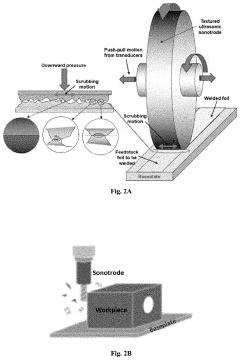
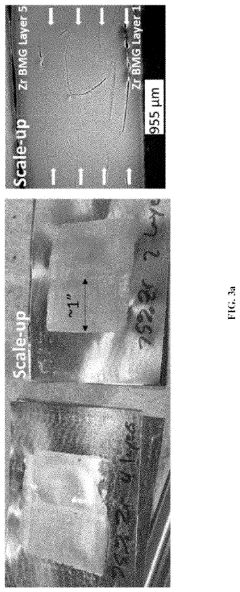
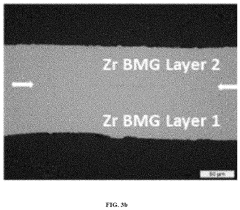
- Ultrasonic Additive Manufacturing (UAM) is employed to metallurgically bond amorphous metal foils to substrates through plastic deformation, creating a strong, amorphous microstructure with minimal crystallinity and porosity, allowing for the production of ductile and fracture-resistant composite materials with enhanced corrosion and wear resistance.
Material Characterization and Quality Control Methods
The characterization and quality control of amorphous metals present unique challenges due to their non-crystalline structure and metastable nature. Traditional metallurgical testing methods often prove inadequate for these advanced materials, necessitating specialized approaches. X-ray diffraction (XRD) remains the gold standard for confirming the amorphous structure, with the absence of sharp diffraction peaks indicating successful glass formation. However, XRD alone cannot detect nano-crystallization or provide quantitative measures of the amorphous fraction.
Differential scanning calorimetry (DSC) serves as a complementary technique, revealing critical thermal parameters including glass transition temperature, crystallization temperature, and supercooled liquid region. These thermal signatures not only confirm amorphous structure but also predict stability during processing and service. The enthalpy of crystallization measured through DSC provides valuable insights into the degree of amorphization achieved.
Microscopy techniques have evolved significantly for amorphous metal characterization. Transmission electron microscopy (TEM) can detect nano-crystallites as small as 2-5 nm, while high-resolution TEM coupled with selected area electron diffraction enables direct visualization of short-range ordering. Atom probe tomography has emerged as a powerful tool for mapping elemental distribution at the atomic scale, critical for understanding phase separation phenomena that may precede crystallization.
Non-destructive testing methods have gained prominence in production environments. Ultrasonic testing exploits the unique acoustic properties of amorphous metals, while eddy current testing leverages their distinctive electromagnetic response. These techniques enable real-time monitoring during manufacturing, facilitating immediate process adjustments to maintain quality.
Statistical process control methodologies tailored specifically for amorphous metal production have been developed in recent years. These systems integrate multiple sensor inputs to create comprehensive quality metrics, enabling manufacturers to establish robust process windows. Machine learning algorithms increasingly supplement traditional statistical approaches, identifying subtle correlations between processing parameters and final material properties.
The development of standardized testing protocols represents a significant challenge in the field. Unlike crystalline alloys, which benefit from decades of standardization efforts, amorphous metals lack universally accepted quality metrics. Industry consortia and standards organizations have begun addressing this gap, with initial focus on mechanical property testing and structural characterization methodologies that account for the unique properties of these materials.
Differential scanning calorimetry (DSC) serves as a complementary technique, revealing critical thermal parameters including glass transition temperature, crystallization temperature, and supercooled liquid region. These thermal signatures not only confirm amorphous structure but also predict stability during processing and service. The enthalpy of crystallization measured through DSC provides valuable insights into the degree of amorphization achieved.
Microscopy techniques have evolved significantly for amorphous metal characterization. Transmission electron microscopy (TEM) can detect nano-crystallites as small as 2-5 nm, while high-resolution TEM coupled with selected area electron diffraction enables direct visualization of short-range ordering. Atom probe tomography has emerged as a powerful tool for mapping elemental distribution at the atomic scale, critical for understanding phase separation phenomena that may precede crystallization.
Non-destructive testing methods have gained prominence in production environments. Ultrasonic testing exploits the unique acoustic properties of amorphous metals, while eddy current testing leverages their distinctive electromagnetic response. These techniques enable real-time monitoring during manufacturing, facilitating immediate process adjustments to maintain quality.
Statistical process control methodologies tailored specifically for amorphous metal production have been developed in recent years. These systems integrate multiple sensor inputs to create comprehensive quality metrics, enabling manufacturers to establish robust process windows. Machine learning algorithms increasingly supplement traditional statistical approaches, identifying subtle correlations between processing parameters and final material properties.
The development of standardized testing protocols represents a significant challenge in the field. Unlike crystalline alloys, which benefit from decades of standardization efforts, amorphous metals lack universally accepted quality metrics. Industry consortia and standards organizations have begun addressing this gap, with initial focus on mechanical property testing and structural characterization methodologies that account for the unique properties of these materials.
Sustainability and Cost Considerations in Production
The sustainability and cost considerations in amorphous metal fabrication represent critical factors that significantly impact the commercial viability and environmental footprint of these advanced materials. Current production methods for amorphous metals, particularly rapid solidification techniques, demand substantial energy inputs to achieve the necessary cooling rates exceeding 10^6 K/s. This energy-intensive process contributes to both high production costs and considerable carbon emissions, creating barriers to widespread industrial adoption.
Material efficiency presents another sustainability challenge, as current fabrication methods often result in significant material waste. Melt spinning, a common technique for producing amorphous metal ribbons, typically yields only 30-40% usable material, with the remainder requiring recycling or disposal. This inefficiency drives up raw material costs and creates additional environmental burdens through increased resource extraction and processing.
The rare element content in many commercial amorphous metal formulations further complicates the sustainability equation. Elements such as palladium, niobium, and rare earth metals are often incorporated to enhance glass-forming ability and mechanical properties. These elements face supply constraints, geopolitical risks, and significant environmental impacts during mining and refining, adding premium costs to the final products and raising concerns about long-term resource availability.
Production scale remains a persistent economic challenge, with most amorphous metal manufacturing limited to batch processes rather than continuous production. This limitation restricts economies of scale and keeps unit costs elevated compared to conventional crystalline metals. The specialized equipment required for precise thermal control during fabrication further increases capital investment requirements, creating significant barriers to entry for new manufacturers.
Life cycle assessment studies indicate that despite these production challenges, amorphous metals can offer sustainability advantages through their superior performance characteristics. Their exceptional strength-to-weight ratios, corrosion resistance, and magnetic properties can enable energy savings and extended service life in applications ranging from electrical transformers to lightweight structural components, potentially offsetting initial production impacts.
Recent innovations show promising directions for improving sustainability metrics. These include the development of lean compositions with reduced rare element content, recycling-friendly alloy designs, and energy-efficient processing routes such as flash annealing and selective laser melting. Additionally, emerging circular economy approaches that incorporate end-of-life recovery and reprocessing of amorphous metals are beginning to address full life cycle impacts, though these systems remain in early development stages.
Material efficiency presents another sustainability challenge, as current fabrication methods often result in significant material waste. Melt spinning, a common technique for producing amorphous metal ribbons, typically yields only 30-40% usable material, with the remainder requiring recycling or disposal. This inefficiency drives up raw material costs and creates additional environmental burdens through increased resource extraction and processing.
The rare element content in many commercial amorphous metal formulations further complicates the sustainability equation. Elements such as palladium, niobium, and rare earth metals are often incorporated to enhance glass-forming ability and mechanical properties. These elements face supply constraints, geopolitical risks, and significant environmental impacts during mining and refining, adding premium costs to the final products and raising concerns about long-term resource availability.
Production scale remains a persistent economic challenge, with most amorphous metal manufacturing limited to batch processes rather than continuous production. This limitation restricts economies of scale and keeps unit costs elevated compared to conventional crystalline metals. The specialized equipment required for precise thermal control during fabrication further increases capital investment requirements, creating significant barriers to entry for new manufacturers.
Life cycle assessment studies indicate that despite these production challenges, amorphous metals can offer sustainability advantages through their superior performance characteristics. Their exceptional strength-to-weight ratios, corrosion resistance, and magnetic properties can enable energy savings and extended service life in applications ranging from electrical transformers to lightweight structural components, potentially offsetting initial production impacts.
Recent innovations show promising directions for improving sustainability metrics. These include the development of lean compositions with reduced rare element content, recycling-friendly alloy designs, and energy-efficient processing routes such as flash annealing and selective laser melting. Additionally, emerging circular economy approaches that incorporate end-of-life recovery and reprocessing of amorphous metals are beginning to address full life cycle impacts, though these systems remain in early development stages.
Unlock deeper insights with PatSnap Eureka Quick Research — get a full tech report to explore trends and direct your research. Try now!
Generate Your Research Report Instantly with AI Agent
Supercharge your innovation with PatSnap Eureka AI Agent Platform!