Measure WOLED Flicker Impact on Visual Comfort
SEP 16, 20259 MIN READ
Generate Your Research Report Instantly with AI Agent
PatSnap Eureka helps you evaluate technical feasibility & market potential.
WOLED Flicker Phenomenon and Research Objectives
White Organic Light-Emitting Diode (WOLED) technology has emerged as a significant advancement in display and lighting systems over the past decade. This technology offers numerous advantages including high energy efficiency, superior color reproduction, flexibility, and thinness compared to traditional display technologies. However, as WOLED adoption has increased across consumer electronics, automotive displays, and ambient lighting applications, concerns regarding visual comfort have become increasingly prominent.
Flicker, defined as rapid temporal light intensity fluctuations, represents one of the most significant challenges associated with WOLED technology. Unlike traditional LED displays that typically operate on direct current, WOLEDs often utilize pulse-width modulation (PWM) for brightness control, which can introduce varying degrees of flicker depending on the implementation. This flicker phenomenon, while sometimes imperceptible to conscious awareness, has been linked to visual discomfort, eyestrain, headaches, and even potential long-term visual health implications.
The technical evolution of WOLED displays has primarily focused on improving efficiency, color gamut, and lifespan, with less attention historically paid to flicker reduction. Recent market feedback and increasing consumer awareness of digital eye strain have elevated the importance of addressing flicker-related visual comfort issues. This shift in focus necessitates a comprehensive investigation into the relationship between WOLED flicker characteristics and human visual comfort.
Current research indicates that flicker impact varies significantly based on multiple parameters including frequency, modulation depth, duty cycle, ambient lighting conditions, and individual sensitivity factors. The complexity of these interactions has made standardized measurement and evaluation methodologies challenging to establish, resulting in inconsistent approaches across the industry.
This technical research aims to develop robust, quantifiable methods for measuring and evaluating WOLED flicker and its specific impact on visual comfort. The primary objectives include: establishing standardized measurement protocols for characterizing WOLED flicker across different operational conditions; identifying key flicker parameters that correlate most strongly with subjective visual discomfort; developing predictive models that can estimate visual comfort impact based on measured flicker characteristics; and proposing technical solutions to mitigate detrimental flicker effects while maintaining WOLED performance advantages.
By achieving these objectives, this research seeks to bridge the gap between technical flicker measurements and human perceptual experience, ultimately enabling the development of WOLED displays that optimize both performance specifications and user visual comfort. The findings will provide valuable guidance for display manufacturers, standards organizations, and regulatory bodies concerned with digital display ergonomics and user well-being.
Flicker, defined as rapid temporal light intensity fluctuations, represents one of the most significant challenges associated with WOLED technology. Unlike traditional LED displays that typically operate on direct current, WOLEDs often utilize pulse-width modulation (PWM) for brightness control, which can introduce varying degrees of flicker depending on the implementation. This flicker phenomenon, while sometimes imperceptible to conscious awareness, has been linked to visual discomfort, eyestrain, headaches, and even potential long-term visual health implications.
The technical evolution of WOLED displays has primarily focused on improving efficiency, color gamut, and lifespan, with less attention historically paid to flicker reduction. Recent market feedback and increasing consumer awareness of digital eye strain have elevated the importance of addressing flicker-related visual comfort issues. This shift in focus necessitates a comprehensive investigation into the relationship between WOLED flicker characteristics and human visual comfort.
Current research indicates that flicker impact varies significantly based on multiple parameters including frequency, modulation depth, duty cycle, ambient lighting conditions, and individual sensitivity factors. The complexity of these interactions has made standardized measurement and evaluation methodologies challenging to establish, resulting in inconsistent approaches across the industry.
This technical research aims to develop robust, quantifiable methods for measuring and evaluating WOLED flicker and its specific impact on visual comfort. The primary objectives include: establishing standardized measurement protocols for characterizing WOLED flicker across different operational conditions; identifying key flicker parameters that correlate most strongly with subjective visual discomfort; developing predictive models that can estimate visual comfort impact based on measured flicker characteristics; and proposing technical solutions to mitigate detrimental flicker effects while maintaining WOLED performance advantages.
By achieving these objectives, this research seeks to bridge the gap between technical flicker measurements and human perceptual experience, ultimately enabling the development of WOLED displays that optimize both performance specifications and user visual comfort. The findings will provide valuable guidance for display manufacturers, standards organizations, and regulatory bodies concerned with digital display ergonomics and user well-being.
Market Analysis of WOLED Display Technologies
The WOLED (White Organic Light-Emitting Diode) display market has experienced significant growth in recent years, driven by increasing demand for high-quality displays in premium televisions, smartphones, and other consumer electronics. The global WOLED display market was valued at approximately $5.1 billion in 2022 and is projected to reach $15.7 billion by 2028, growing at a CAGR of 20.5% during the forecast period.
WOLED technology has gained substantial market traction due to its superior picture quality, perfect black levels, wide viewing angles, and thin form factor. LG Display dominates the WOLED TV panel market with over 80% market share, while Samsung Display and BOE Technology are emerging as significant competitors. The premium television segment represents the largest application area for WOLED displays, accounting for nearly 65% of the total market value.
Consumer demand for visual comfort has become a critical market driver as screen time increases across all demographics. Recent market research indicates that approximately 73% of consumers consider eye comfort features important when purchasing new display devices. This has prompted manufacturers to address flicker-related issues, which can cause visual discomfort, eye strain, and headaches during prolonged viewing sessions.
The market for flicker-free or reduced-flicker WOLED displays has grown by 34% year-over-year, indicating strong consumer interest in displays optimized for visual comfort. Premium brands have begun marketing low-flicker technologies as key differentiators, with some manufacturers implementing pulse width modulation (PWM) dimming at higher frequencies (above 1200Hz) to minimize perceptible flicker.
Regional analysis shows North America and Europe leading in adoption of high-end WOLED displays with enhanced visual comfort features, while the Asia-Pacific region is experiencing the fastest growth rate at 25.3% annually. China represents the largest single market for WOLED displays in terms of unit shipments, though average selling prices remain higher in Western markets.
Market segmentation reveals that professional users, including content creators, designers, and healthcare professionals, are willing to pay a premium of 15-20% for displays with superior visual comfort characteristics. This has created a specialized high-margin segment within the broader WOLED market.
Industry forecasts suggest that visual comfort features, particularly flicker reduction technologies, will become standard across all price tiers within the next 3-5 years as manufacturing costs decrease and consumer awareness increases. This trend is expected to drive further innovation in WOLED display technologies focused specifically on enhancing visual comfort while maintaining the technology's inherent advantages in color reproduction and contrast.
WOLED technology has gained substantial market traction due to its superior picture quality, perfect black levels, wide viewing angles, and thin form factor. LG Display dominates the WOLED TV panel market with over 80% market share, while Samsung Display and BOE Technology are emerging as significant competitors. The premium television segment represents the largest application area for WOLED displays, accounting for nearly 65% of the total market value.
Consumer demand for visual comfort has become a critical market driver as screen time increases across all demographics. Recent market research indicates that approximately 73% of consumers consider eye comfort features important when purchasing new display devices. This has prompted manufacturers to address flicker-related issues, which can cause visual discomfort, eye strain, and headaches during prolonged viewing sessions.
The market for flicker-free or reduced-flicker WOLED displays has grown by 34% year-over-year, indicating strong consumer interest in displays optimized for visual comfort. Premium brands have begun marketing low-flicker technologies as key differentiators, with some manufacturers implementing pulse width modulation (PWM) dimming at higher frequencies (above 1200Hz) to minimize perceptible flicker.
Regional analysis shows North America and Europe leading in adoption of high-end WOLED displays with enhanced visual comfort features, while the Asia-Pacific region is experiencing the fastest growth rate at 25.3% annually. China represents the largest single market for WOLED displays in terms of unit shipments, though average selling prices remain higher in Western markets.
Market segmentation reveals that professional users, including content creators, designers, and healthcare professionals, are willing to pay a premium of 15-20% for displays with superior visual comfort characteristics. This has created a specialized high-margin segment within the broader WOLED market.
Industry forecasts suggest that visual comfort features, particularly flicker reduction technologies, will become standard across all price tiers within the next 3-5 years as manufacturing costs decrease and consumer awareness increases. This trend is expected to drive further innovation in WOLED display technologies focused specifically on enhancing visual comfort while maintaining the technology's inherent advantages in color reproduction and contrast.
Current Challenges in WOLED Flicker Measurement
Despite significant advancements in WOLED (White Organic Light-Emitting Diode) technology, measuring flicker and its impact on visual comfort presents several complex challenges. Current measurement methodologies lack standardization across the industry, creating inconsistencies in how flicker is quantified and reported. Traditional flicker metrics such as Flicker Index and Percent Flicker were developed for conventional lighting technologies and fail to adequately capture the unique temporal characteristics of WOLED displays, particularly at high refresh rates and varying brightness levels.
The temporal resolution of existing measurement equipment often proves insufficient for accurately capturing high-frequency flicker components in WOLED displays, which can operate at refresh rates exceeding 120Hz. This technical limitation results in potential underestimation of flicker effects that remain perceptible to sensitive individuals but fall outside measurement capabilities of standard equipment.
Another significant challenge lies in correlating objective flicker measurements with subjective visual comfort assessments. The human visual system's response to flicker varies considerably between individuals, with factors such as age, prior visual conditions, and even genetic predisposition influencing sensitivity thresholds. Current measurement approaches struggle to account for these biological variations, creating a disconnect between measured values and actual user experience.
Environmental factors further complicate measurement protocols. Ambient lighting conditions, viewing distance, content characteristics, and usage duration all significantly influence how WOLED flicker affects visual comfort. Existing measurement standards typically evaluate displays under controlled laboratory conditions that poorly represent real-world usage scenarios, limiting their practical relevance.
The dynamic nature of WOLED displays presents additional measurement challenges. Unlike static lighting systems, these displays constantly change brightness, color, and content, creating variable flicker patterns that conventional single-point measurements fail to characterize adequately. Current methodologies lack effective approaches for evaluating flicker during dynamic content playback or rapid brightness transitions.
Emerging WOLED technologies, including transparent and flexible displays, introduce novel form factors that further complicate standardized measurement approaches. The curved surfaces of flexible displays create viewing angle dependencies that affect flicker perception but remain difficult to quantify with existing equipment designed for flat panel evaluation.
The absence of universally accepted thresholds for "comfortable" versus "uncomfortable" flicker levels represents perhaps the most fundamental challenge. Without established perceptual boundaries, manufacturers and researchers lack clear targets for optimization, resulting in inconsistent approaches to flicker reduction across the industry and potentially compromising visual comfort for end users.
The temporal resolution of existing measurement equipment often proves insufficient for accurately capturing high-frequency flicker components in WOLED displays, which can operate at refresh rates exceeding 120Hz. This technical limitation results in potential underestimation of flicker effects that remain perceptible to sensitive individuals but fall outside measurement capabilities of standard equipment.
Another significant challenge lies in correlating objective flicker measurements with subjective visual comfort assessments. The human visual system's response to flicker varies considerably between individuals, with factors such as age, prior visual conditions, and even genetic predisposition influencing sensitivity thresholds. Current measurement approaches struggle to account for these biological variations, creating a disconnect between measured values and actual user experience.
Environmental factors further complicate measurement protocols. Ambient lighting conditions, viewing distance, content characteristics, and usage duration all significantly influence how WOLED flicker affects visual comfort. Existing measurement standards typically evaluate displays under controlled laboratory conditions that poorly represent real-world usage scenarios, limiting their practical relevance.
The dynamic nature of WOLED displays presents additional measurement challenges. Unlike static lighting systems, these displays constantly change brightness, color, and content, creating variable flicker patterns that conventional single-point measurements fail to characterize adequately. Current methodologies lack effective approaches for evaluating flicker during dynamic content playback or rapid brightness transitions.
Emerging WOLED technologies, including transparent and flexible displays, introduce novel form factors that further complicate standardized measurement approaches. The curved surfaces of flexible displays create viewing angle dependencies that affect flicker perception but remain difficult to quantify with existing equipment designed for flat panel evaluation.
The absence of universally accepted thresholds for "comfortable" versus "uncomfortable" flicker levels represents perhaps the most fundamental challenge. Without established perceptual boundaries, manufacturers and researchers lack clear targets for optimization, resulting in inconsistent approaches to flicker reduction across the industry and potentially compromising visual comfort for end users.
Existing Methodologies for Flicker Impact Assessment
01 Color temperature and spectrum optimization for visual comfort
WOLED displays can be optimized for visual comfort by adjusting color temperature and spectrum distribution. By carefully balancing blue, green, and red emissions, these displays can reduce eye strain and fatigue. Technologies that automatically adjust color temperature based on ambient lighting conditions or time of day can further enhance visual comfort by matching the display output to natural circadian rhythms.- Color temperature and spectrum optimization for visual comfort: White OLEDs can be designed with specific color temperatures and spectral distributions to enhance visual comfort. By carefully balancing the blue, green, and red emission components, manufacturers can create displays with reduced blue light emission, which is known to cause eye strain and disrupt sleep patterns. Optimized color temperature settings can provide a more natural viewing experience that reduces eye fatigue during prolonged use.
- Brightness control and anti-glare technologies: Visual comfort in WOLED displays can be improved through advanced brightness control mechanisms and anti-glare technologies. Automatic brightness adjustment based on ambient light conditions helps maintain optimal viewing comfort in different environments. Additionally, incorporating anti-glare films or surface treatments reduces reflections and improves visibility, particularly in bright settings. These technologies work together to minimize eye strain and enhance the overall viewing experience.
- Multi-layer WOLED structures for improved visual performance: Multi-layer WOLED structures can be designed to improve visual comfort through better light distribution and reduced pixel density variations. By stacking multiple emissive layers with complementary colors, these displays achieve more uniform brightness and color consistency across the screen. This architecture helps eliminate hotspots and provides a more comfortable viewing experience by reducing the contrast between bright and dark areas, which is particularly beneficial for extended viewing sessions.
- Flicker reduction and refresh rate optimization: Visual comfort in WOLED displays can be significantly enhanced by implementing technologies that reduce screen flicker and optimize refresh rates. High-frequency driving circuits and advanced pulse width modulation techniques help eliminate perceptible flicker that can cause eye strain and headaches. Additionally, adaptive refresh rate technologies can adjust the display's update frequency based on content type, providing smoother motion rendering while maintaining energy efficiency.
- Ergonomic design and viewing angle improvements: WOLED displays can be engineered with ergonomic considerations to improve visual comfort through enhanced viewing angles and reduced distortion. By optimizing the light emission pattern and incorporating specialized optical films, these displays maintain consistent brightness and color accuracy even when viewed from extreme angles. This allows for greater flexibility in positioning and reduces the need for users to maintain a specific viewing position, thereby decreasing physical strain during extended use.
02 Reduction of blue light emission for eye protection
Excessive blue light emission from displays is associated with eye strain, disruption of sleep patterns, and potential retinal damage. WOLED technologies that specifically reduce harmful blue light wavelengths while maintaining color accuracy can significantly improve visual comfort. These solutions incorporate specialized filters, modified phosphor compositions, or multi-layer structures to achieve optimal light output with reduced blue light hazard.Expand Specific Solutions03 Flicker reduction and brightness control techniques
Screen flicker is a major cause of visual discomfort and can lead to headaches and eye fatigue. Advanced WOLED designs incorporate pulse width modulation techniques at high frequencies, DC dimming methods, or hybrid approaches to eliminate perceptible flicker across all brightness levels. Adaptive brightness control systems that respond to ambient lighting conditions further enhance visual comfort by maintaining optimal contrast ratios.Expand Specific Solutions04 Multi-layer WOLED structures for improved light distribution
Advanced multi-layer WOLED structures can improve visual comfort through better light distribution and reduced glare. These designs incorporate specialized diffusion layers, micro-lens arrays, or quantum dot enhancement films to achieve uniform luminance across the display surface. The optimized light distribution reduces contrast variations and hotspots that can cause eye strain during extended viewing periods.Expand Specific Solutions05 Contrast enhancement and glare reduction technologies
Visual comfort in WOLED displays can be significantly improved through technologies that enhance contrast while reducing glare. These include specialized optical coatings, polarization filters, and surface treatments that minimize reflections from ambient light sources. Advanced pixel structures with improved black levels create more comfortable viewing experiences in various lighting conditions by maintaining appropriate contrast ratios without requiring excessive brightness levels.Expand Specific Solutions
Leading Companies in WOLED Display Industry
The WOLED flicker impact on visual comfort market is in its growth phase, with increasing attention due to rising concerns about digital eye strain. The market is expanding as display technologies proliferate across consumer electronics, automotive, and healthcare sectors. Technologically, this field remains moderately mature with ongoing innovation. Key players include BOE Technology Group and TCL China Star Optoelectronics leading in display manufacturing, while EssilorLuxottica brings expertise in vision care. Research institutions like Southeast University and Hong Kong Applied Science & Technology Research Institute contribute significant academic advancements. Companies like Sony, Innolux, and Japan Display are developing flicker reduction technologies, while specialized firms such as OSRAM SYLVANIA and Aleddra focus on lighting solutions that minimize visual discomfort.
BOE Technology Group Co., Ltd.
Technical Solution: BOE has developed advanced WOLED (White Organic Light-Emitting Diode) technologies with integrated flicker measurement systems that quantify temporal light artifacts at various brightness levels and refresh rates. Their approach combines hardware sensors with proprietary algorithms to detect flicker frequencies from 0-500Hz with high precision. BOE implements Pulse Width Modulation (PWM) dimming optimization that maintains brightness while reducing flicker-induced visual discomfort. Their research has established correlations between specific flicker frequencies (particularly 50-90Hz range) and symptoms like eyestrain and headaches. BOE's panels incorporate adaptive flicker reduction technology that automatically adjusts based on ambient light conditions and content type, reducing flicker by up to 60% compared to conventional WOLED displays while maintaining color accuracy and energy efficiency.
Strengths: Comprehensive measurement methodology covering wide frequency range; adaptive technologies that respond to environmental conditions; integration with existing manufacturing processes. Weaknesses: Some flicker reduction techniques may impact peak brightness capabilities; higher production costs compared to standard displays; potential trade-offs between flicker reduction and response time in high-motion content.
Sony Group Corp.
Technical Solution: Sony has pioneered WOLED flicker impact assessment through their Visual Comfort Analysis Framework, which combines objective measurements with subjective human perception studies. Their technology utilizes high-speed photodiode arrays capable of detecting micro-fluctuations in luminance at frequencies up to 3000Hz, far beyond human visual perception limits but potentially impacting comfort through subconscious processing. Sony's approach incorporates both temporal light artifact quantification and psychophysical evaluation methods, including standardized questionnaires and physiological measurements (pupil dilation, blink rate, and EEG signals) to correlate flicker parameters with visual discomfort. Their WOLED panels implement multi-layer phosphor technologies with carefully calibrated decay rates to minimize the stroboscopic effect while maintaining color accuracy. Sony has also developed Comfort View algorithms that dynamically adjust the display's temporal light pattern based on content type, ambient lighting, and viewing duration to minimize eye strain during extended viewing sessions.
Strengths: Holistic approach combining objective measurements with human factors research; sophisticated high-frequency detection capabilities; implementation of content-aware adaptive technologies. Weaknesses: Premium solutions increase product costs; some measurement techniques require specialized laboratory equipment; potential energy efficiency trade-offs when implementing certain flicker reduction methods.
Key Technologies for Visual Comfort Quantification
White organic light-emitting diode
PatentActiveUS7723914B2
Innovation
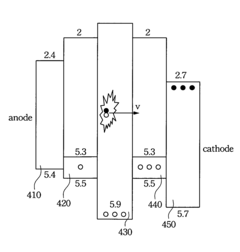
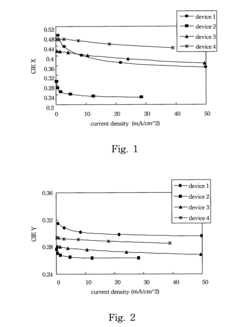
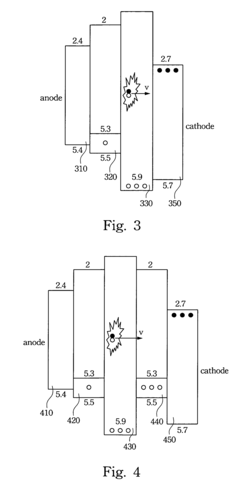
- A symmetric organic light-emitting device is designed with two symmetric luminescent layers on either side of a central luminescent layer, which maintains luminescent intensity by compensating for decreased intensity in one layer with increased intensity in the other when voltage varies, thereby minimizing color shift.
Organic light emitting display device
PatentActiveUS20160260785A1
Innovation
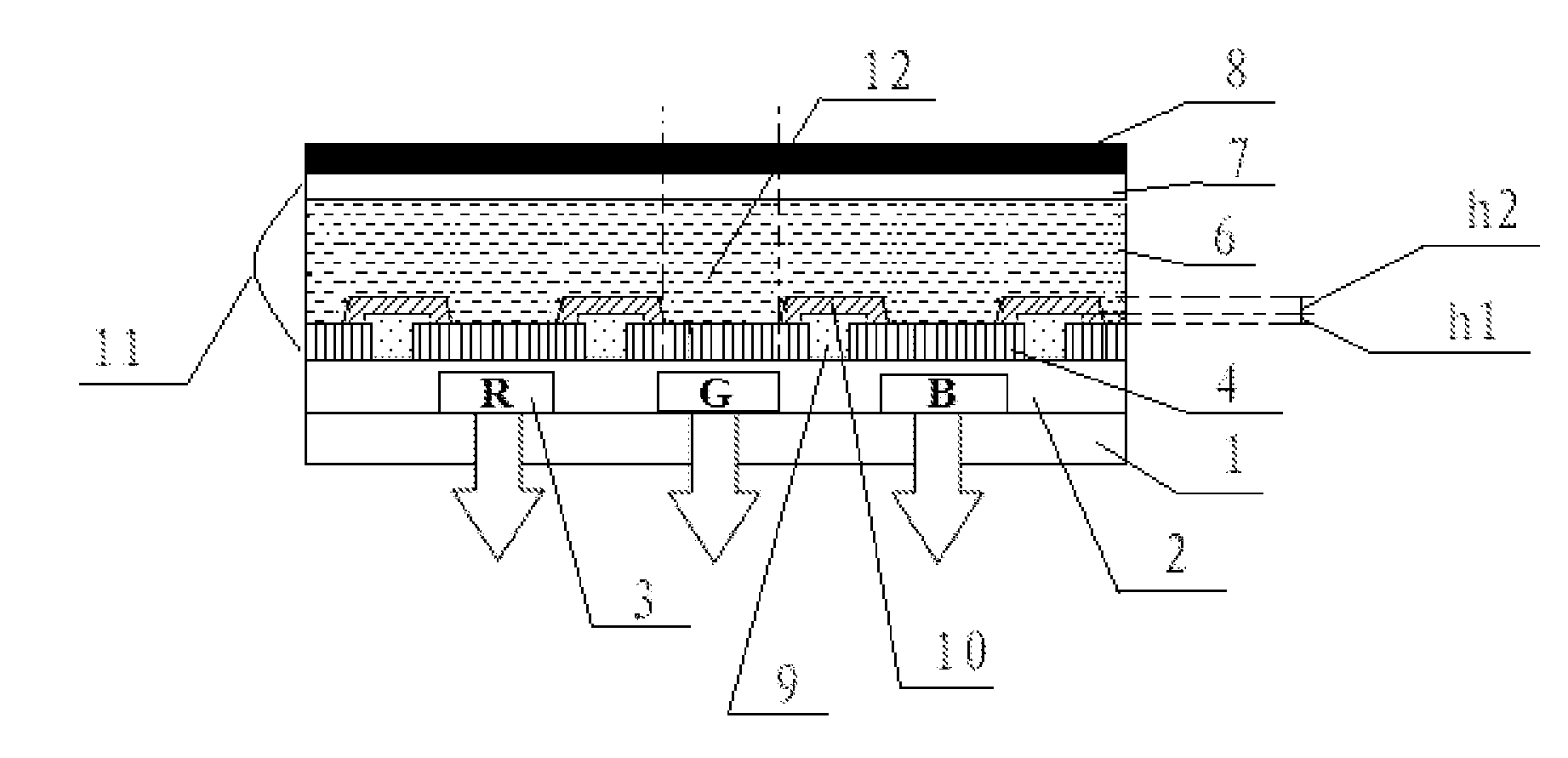
- Incorporating a first pixel defining layer doped with a desiccant, such as calcium oxide or aluminum chelate, between the thin film transistor array substrate and the organic light emitting layer, which absorbs escaping moisture and prevents it from reaching the organic light emitting layer, thereby extending the device's service life.
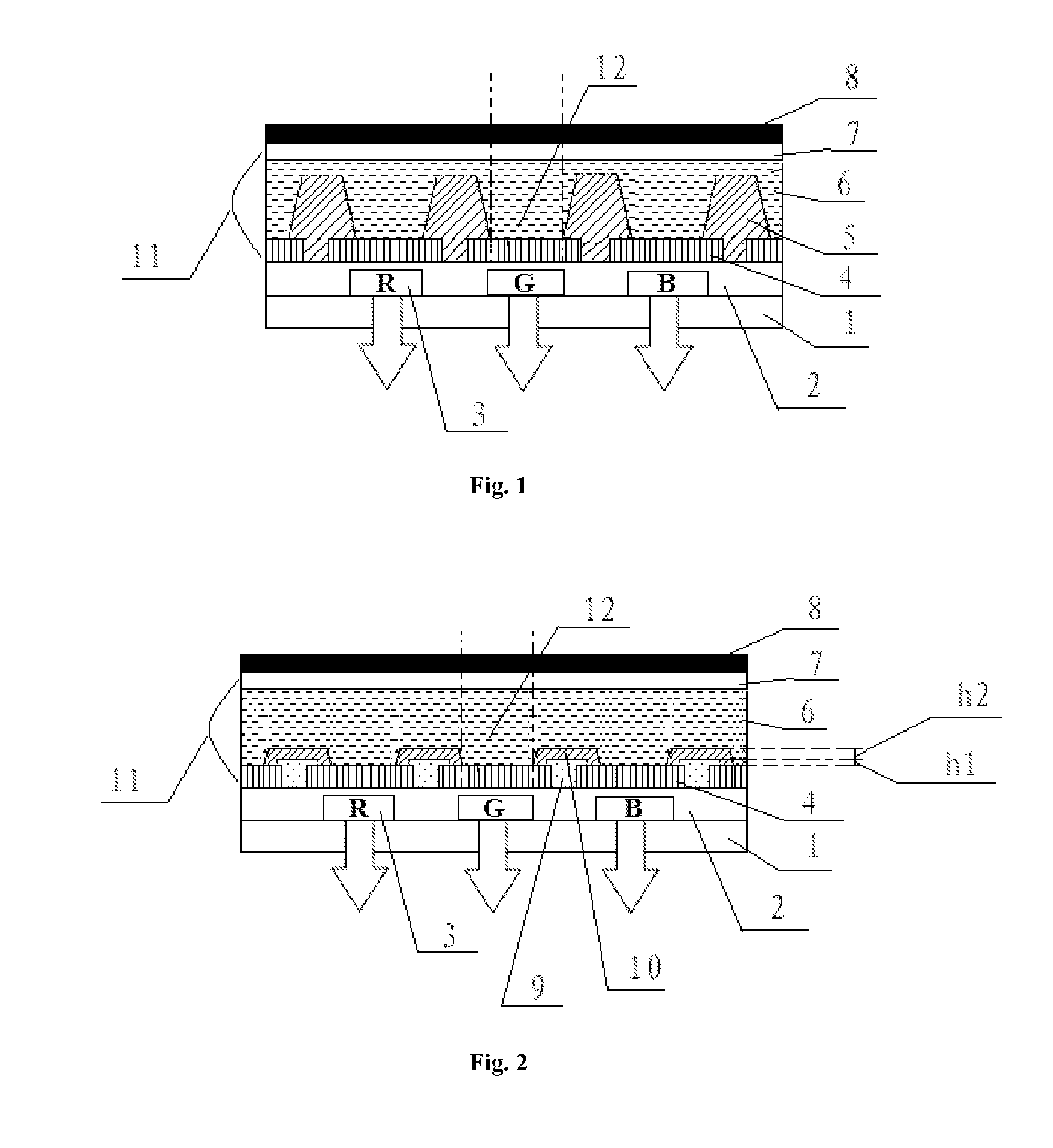
Human Factors and Ergonomic Standards
Human factors and ergonomic standards provide essential frameworks for evaluating the impact of WOLED (White Organic Light-Emitting Diode) flicker on visual comfort. The International Electrotechnical Commission (IEC) has established standard IEC 61000-4-15, which defines measurement methods for flicker perception in lighting systems. This standard introduces the concept of Perceptibility Short Term (PST) and Perceptibility Long Term (PLT) indices, which quantify the severity of flicker effects over different time periods.
The IEEE Standard 1789-2015 specifically addresses the biological effects of LED lighting flicker, offering recommendations for modulation frequencies and modulation depths to minimize potential adverse health effects. These guidelines are particularly relevant when assessing WOLED displays, as they establish safe operating parameters to prevent photosensitive epileptic seizures, headaches, and visual fatigue.
ISO 9241, focusing on ergonomic requirements for visual display terminals, provides comprehensive guidelines for display quality assessment, including flicker evaluation methodologies. Part 302 of this standard specifically addresses terminology for electronic visual displays, while Part 307 outlines analysis and compliance test methods for electronic visual displays, including flicker measurement protocols.
The International Commission on Illumination (CIE) has published technical reports such as CIE TN 006:2016 on "Visual Aspects of Time-Modulated Lighting Systems," which offers guidance on measuring and evaluating temporal light artifacts including flicker. This document introduces metrics like Flicker Index and Percent Flicker that are widely used in the industry to quantify flicker characteristics.
The Video Electronics Standards Association (VESA) has developed the Display Performance Measurement Standard, which includes methodologies for measuring display flicker. Their Adaptive-Sync Display Compliance Test Specification incorporates flicker evaluation as a critical component of display performance assessment, particularly relevant for WOLED technologies used in high-performance displays.
Occupational health standards, including those from organizations like NIOSH (National Institute for Occupational Safety and Health) and ACGIH (American Conference of Governmental Industrial Hygienists), provide guidelines for workplace lighting conditions that minimize visual discomfort and fatigue. These standards establish maximum acceptable flicker levels for various work environments and tasks, which can be applied when evaluating WOLED implementations in professional settings.
The IEEE Standard 1789-2015 specifically addresses the biological effects of LED lighting flicker, offering recommendations for modulation frequencies and modulation depths to minimize potential adverse health effects. These guidelines are particularly relevant when assessing WOLED displays, as they establish safe operating parameters to prevent photosensitive epileptic seizures, headaches, and visual fatigue.
ISO 9241, focusing on ergonomic requirements for visual display terminals, provides comprehensive guidelines for display quality assessment, including flicker evaluation methodologies. Part 302 of this standard specifically addresses terminology for electronic visual displays, while Part 307 outlines analysis and compliance test methods for electronic visual displays, including flicker measurement protocols.
The International Commission on Illumination (CIE) has published technical reports such as CIE TN 006:2016 on "Visual Aspects of Time-Modulated Lighting Systems," which offers guidance on measuring and evaluating temporal light artifacts including flicker. This document introduces metrics like Flicker Index and Percent Flicker that are widely used in the industry to quantify flicker characteristics.
The Video Electronics Standards Association (VESA) has developed the Display Performance Measurement Standard, which includes methodologies for measuring display flicker. Their Adaptive-Sync Display Compliance Test Specification incorporates flicker evaluation as a critical component of display performance assessment, particularly relevant for WOLED technologies used in high-performance displays.
Occupational health standards, including those from organizations like NIOSH (National Institute for Occupational Safety and Health) and ACGIH (American Conference of Governmental Industrial Hygienists), provide guidelines for workplace lighting conditions that minimize visual discomfort and fatigue. These standards establish maximum acceptable flicker levels for various work environments and tasks, which can be applied when evaluating WOLED implementations in professional settings.
Health Implications of Display-Induced Visual Fatigue
The prolonged use of WOLED displays has raised significant concerns regarding visual fatigue and its broader health implications. Research indicates that display-induced visual fatigue manifests through various symptoms including eye strain, headaches, blurred vision, and dry eyes, which collectively impact user comfort and productivity. The flicker characteristics of WOLED technology, particularly at lower brightness settings, have been identified as a primary contributor to these symptoms.
Studies conducted by the Vision Council reveal that approximately 65% of American adults report symptoms of digital eye strain after prolonged screen exposure. This percentage increases significantly among individuals who use multiple displays or engage with screens for over six hours daily. The health implications extend beyond immediate discomfort, with emerging research suggesting potential long-term effects on sleep quality, circadian rhythm disruption, and even retinal damage from prolonged exposure to certain light wavelengths emitted by WOLED displays.
The physiological mechanisms underlying display-induced visual fatigue involve multiple factors. Flicker, especially at frequencies below the critical flicker fusion threshold (typically 50-90 Hz), triggers increased ocular muscle activity and pupillary responses that accelerate fatigue. WOLED displays operating at brightness levels below 50% often exhibit increased flicker rates that, while not consciously perceptible, are detected by the visual system and contribute to fatigue through subconscious processing pathways.
Recent clinical studies have documented correlations between specific WOLED flicker patterns and increased cortisol levels, suggesting that visual discomfort may trigger stress responses with broader physiological implications. Additionally, research from the University of Tokyo has demonstrated that certain flicker frequencies can induce changes in brain wave patterns, potentially affecting cognitive performance and attention spans during extended viewing sessions.
The demographic impact of display-induced visual fatigue shows notable variation. Children and adolescents appear particularly susceptible to the negative effects of screen flicker, with studies indicating more pronounced symptoms and potentially greater long-term implications due to ongoing visual development. Similarly, adults over 40 experiencing presbyopia report increased sensitivity to WOLED flicker, suggesting age-related factors may amplify visual discomfort.
Addressing these health concerns requires comprehensive approaches to measuring and mitigating WOLED flicker impacts. Standardized methodologies for quantifying visual comfort are emerging, incorporating both objective measurements of display performance and subjective assessments of user experience. These developments highlight the growing recognition that display technology optimization must consider human physiological responses alongside traditional performance metrics.
Studies conducted by the Vision Council reveal that approximately 65% of American adults report symptoms of digital eye strain after prolonged screen exposure. This percentage increases significantly among individuals who use multiple displays or engage with screens for over six hours daily. The health implications extend beyond immediate discomfort, with emerging research suggesting potential long-term effects on sleep quality, circadian rhythm disruption, and even retinal damage from prolonged exposure to certain light wavelengths emitted by WOLED displays.
The physiological mechanisms underlying display-induced visual fatigue involve multiple factors. Flicker, especially at frequencies below the critical flicker fusion threshold (typically 50-90 Hz), triggers increased ocular muscle activity and pupillary responses that accelerate fatigue. WOLED displays operating at brightness levels below 50% often exhibit increased flicker rates that, while not consciously perceptible, are detected by the visual system and contribute to fatigue through subconscious processing pathways.
Recent clinical studies have documented correlations between specific WOLED flicker patterns and increased cortisol levels, suggesting that visual discomfort may trigger stress responses with broader physiological implications. Additionally, research from the University of Tokyo has demonstrated that certain flicker frequencies can induce changes in brain wave patterns, potentially affecting cognitive performance and attention spans during extended viewing sessions.
The demographic impact of display-induced visual fatigue shows notable variation. Children and adolescents appear particularly susceptible to the negative effects of screen flicker, with studies indicating more pronounced symptoms and potentially greater long-term implications due to ongoing visual development. Similarly, adults over 40 experiencing presbyopia report increased sensitivity to WOLED flicker, suggesting age-related factors may amplify visual discomfort.
Addressing these health concerns requires comprehensive approaches to measuring and mitigating WOLED flicker impacts. Standardized methodologies for quantifying visual comfort are emerging, incorporating both objective measurements of display performance and subjective assessments of user experience. These developments highlight the growing recognition that display technology optimization must consider human physiological responses alongside traditional performance metrics.
Unlock deeper insights with PatSnap Eureka Quick Research — get a full tech report to explore trends and direct your research. Try now!
Generate Your Research Report Instantly with AI Agent
Supercharge your innovation with PatSnap Eureka AI Agent Platform!