

Multiscale Modeling Of Microstructure Evolution During PBF-LB
SEP 3, 20259 MIN READ
Generate Your Research Report Instantly with AI Agent
PatSnap Eureka helps you evaluate technical feasibility & market potential.
PBF-LB Microstructure Evolution Background and Objectives
Powder Bed Fusion-Laser Beam (PBF-LB) technology has emerged as a revolutionary additive manufacturing process that enables the production of complex metal components with unprecedented design freedom. The evolution of microstructure during PBF-LB processing represents a critical aspect that directly influences the mechanical properties and performance of manufactured parts. Over the past decade, significant advancements have been made in understanding the complex physical phenomena occurring during the rapid melting and solidification processes inherent to PBF-LB.
The historical development of microstructure modeling in PBF-LB began with simplified analytical approaches in the early 2010s, which provided fundamental insights but lacked the ability to capture the multiscale nature of the process. As computational capabilities advanced, researchers progressively incorporated more sophisticated models that could account for the thermal gradients, cooling rates, and phase transformations occurring at different spatial and temporal scales.
Current technological trends in this field are moving toward integrated multiscale modeling frameworks that can bridge the gap between microscopic phenomena (grain nucleation, dendrite growth) and macroscopic properties (residual stress, distortion). These models aim to establish predictive capabilities that can guide process parameter optimization and microstructure engineering for specific applications.
The primary technical objective of multiscale modeling of microstructure evolution during PBF-LB is to develop comprehensive computational frameworks that can accurately predict the formation and evolution of microstructures across multiple length and time scales. This includes modeling phenomena ranging from nanometer-scale defect formation to millimeter-scale grain structures, while accounting for the extreme thermal conditions characteristic of laser-material interactions.
Secondary objectives include establishing quantitative relationships between process parameters (laser power, scan speed, hatch spacing) and resulting microstructural features (grain size, phase distribution, texture), as well as developing in-situ monitoring and control strategies based on real-time microstructure predictions. These capabilities would enable closed-loop control systems that can adapt processing conditions to achieve desired microstructural outcomes.
The ultimate goal is to transition from empirical trial-and-error approaches to knowledge-based design of PBF-LB processes, where microstructures can be engineered with precision to meet specific performance requirements. This would significantly reduce development time for new materials and applications, while enhancing the reliability and reproducibility of additively manufactured components across industries including aerospace, medical, and automotive sectors.
The historical development of microstructure modeling in PBF-LB began with simplified analytical approaches in the early 2010s, which provided fundamental insights but lacked the ability to capture the multiscale nature of the process. As computational capabilities advanced, researchers progressively incorporated more sophisticated models that could account for the thermal gradients, cooling rates, and phase transformations occurring at different spatial and temporal scales.
Current technological trends in this field are moving toward integrated multiscale modeling frameworks that can bridge the gap between microscopic phenomena (grain nucleation, dendrite growth) and macroscopic properties (residual stress, distortion). These models aim to establish predictive capabilities that can guide process parameter optimization and microstructure engineering for specific applications.
The primary technical objective of multiscale modeling of microstructure evolution during PBF-LB is to develop comprehensive computational frameworks that can accurately predict the formation and evolution of microstructures across multiple length and time scales. This includes modeling phenomena ranging from nanometer-scale defect formation to millimeter-scale grain structures, while accounting for the extreme thermal conditions characteristic of laser-material interactions.
Secondary objectives include establishing quantitative relationships between process parameters (laser power, scan speed, hatch spacing) and resulting microstructural features (grain size, phase distribution, texture), as well as developing in-situ monitoring and control strategies based on real-time microstructure predictions. These capabilities would enable closed-loop control systems that can adapt processing conditions to achieve desired microstructural outcomes.
The ultimate goal is to transition from empirical trial-and-error approaches to knowledge-based design of PBF-LB processes, where microstructures can be engineered with precision to meet specific performance requirements. This would significantly reduce development time for new materials and applications, while enhancing the reliability and reproducibility of additively manufactured components across industries including aerospace, medical, and automotive sectors.
Market Applications for PBF-LB Multiscale Modeling
The Powder Bed Fusion-Laser Beam (PBF-LB) multiscale modeling technology has found significant applications across various industrial sectors, transforming manufacturing capabilities and product development approaches. The aerospace industry represents one of the primary markets, where PBF-LB modeling enables the design and production of lightweight components with complex geometries that maintain structural integrity under extreme conditions. Companies like GE Aviation and Airbus have implemented these modeling techniques to optimize turbine blades and structural components, reducing weight by up to 30% while maintaining or improving performance characteristics.
In the medical device industry, PBF-LB multiscale modeling facilitates the creation of patient-specific implants and prosthetics with optimized microstructures. This technology allows manufacturers to design porous structures that promote osseointegration while maintaining mechanical properties that closely match surrounding tissues. The global medical 3D printing market, where this technology plays a crucial role, is experiencing rapid growth as personalized medicine becomes increasingly important.
The automotive sector has embraced PBF-LB modeling for developing lightweight components with enhanced performance characteristics. Manufacturers utilize this technology to design heat exchangers, structural components, and powertrain parts with optimized microstructures that improve fuel efficiency and reduce emissions. Companies like BMW and Volkswagen have established dedicated additive manufacturing facilities incorporating these modeling approaches.
Energy sector applications include the development of more efficient heat exchangers, fuel cells, and components for renewable energy systems. The ability to predict and control microstructure evolution enables the creation of materials with enhanced thermal conductivity, corrosion resistance, and mechanical properties tailored to specific operating conditions.
The tooling and industrial equipment market represents another significant application area. PBF-LB multiscale modeling enables the creation of conformal cooling channels in injection molds, significantly reducing cycle times and improving part quality. Tool manufacturers can design and produce components with gradient properties that extend service life in high-wear applications.
Research institutions and material development companies utilize this technology to accelerate the development of new alloys specifically designed for additive manufacturing processes. The ability to predict microstructure evolution based on process parameters reduces the experimental iterations required to qualify new materials.
As sustainability concerns grow across industries, PBF-LB modeling contributes to more efficient material utilization and enables design optimization that reduces material consumption while maintaining or improving performance. This aligns with the increasing focus on circular economy principles and sustainable manufacturing practices.
In the medical device industry, PBF-LB multiscale modeling facilitates the creation of patient-specific implants and prosthetics with optimized microstructures. This technology allows manufacturers to design porous structures that promote osseointegration while maintaining mechanical properties that closely match surrounding tissues. The global medical 3D printing market, where this technology plays a crucial role, is experiencing rapid growth as personalized medicine becomes increasingly important.
The automotive sector has embraced PBF-LB modeling for developing lightweight components with enhanced performance characteristics. Manufacturers utilize this technology to design heat exchangers, structural components, and powertrain parts with optimized microstructures that improve fuel efficiency and reduce emissions. Companies like BMW and Volkswagen have established dedicated additive manufacturing facilities incorporating these modeling approaches.
Energy sector applications include the development of more efficient heat exchangers, fuel cells, and components for renewable energy systems. The ability to predict and control microstructure evolution enables the creation of materials with enhanced thermal conductivity, corrosion resistance, and mechanical properties tailored to specific operating conditions.
The tooling and industrial equipment market represents another significant application area. PBF-LB multiscale modeling enables the creation of conformal cooling channels in injection molds, significantly reducing cycle times and improving part quality. Tool manufacturers can design and produce components with gradient properties that extend service life in high-wear applications.
Research institutions and material development companies utilize this technology to accelerate the development of new alloys specifically designed for additive manufacturing processes. The ability to predict microstructure evolution based on process parameters reduces the experimental iterations required to qualify new materials.
As sustainability concerns grow across industries, PBF-LB modeling contributes to more efficient material utilization and enables design optimization that reduces material consumption while maintaining or improving performance. This aligns with the increasing focus on circular economy principles and sustainable manufacturing practices.
Current Challenges in Multiscale Modeling for Additive Manufacturing
Despite significant advancements in multiscale modeling for additive manufacturing, particularly for Powder Bed Fusion-Laser Beam (PBF-LB) processes, several critical challenges continue to impede comprehensive microstructure evolution prediction. The inherent complexity of bridging multiple length and time scales remains a fundamental obstacle, as phenomena ranging from atomic interactions to macroscopic part properties must be coherently integrated.
Computational efficiency presents a persistent challenge, with high-fidelity models requiring prohibitive computational resources. Current multiscale frameworks struggle to balance accuracy with practical simulation times, particularly when modeling large components or complex geometries typical in industrial applications. Even with high-performance computing, full-part simulations with microstructural detail remain largely unfeasible.
Data integration across scales introduces significant complexity, as information must be effectively transferred between models operating at different resolutions. The development of robust scale-bridging techniques that preserve critical information while managing computational overhead continues to challenge researchers. Current approaches often sacrifice important microstructural details when transitioning between scales.
Validation of multiscale models presents another substantial hurdle. Experimental techniques for in-situ observation of microstructure evolution during rapid solidification processes like PBF-LB remain limited, particularly at the microscale. This creates difficulties in verifying model predictions and calibrating simulation parameters across multiple scales simultaneously.
Material property prediction from simulated microstructures represents an ongoing challenge. While models may accurately predict grain morphology or phase distribution, translating these microstructural features into mechanical properties, thermal behavior, or long-term performance characteristics requires additional modeling layers that are not yet fully developed.
The stochastic nature of PBF-LB processes introduces significant uncertainty into multiscale models. Variations in powder characteristics, laser parameters, and environmental conditions create probabilistic outcomes that deterministic models struggle to capture. Incorporating uncertainty quantification into multiscale frameworks remains an active research area with considerable challenges.
Lastly, the interdisciplinary nature of multiscale modeling demands expertise across materials science, computational mechanics, thermodynamics, and computer science. Developing integrated software platforms that can accommodate diverse modeling approaches while remaining accessible to researchers and industry practitioners represents a significant challenge for widespread adoption of multiscale modeling techniques in additive manufacturing.
Computational efficiency presents a persistent challenge, with high-fidelity models requiring prohibitive computational resources. Current multiscale frameworks struggle to balance accuracy with practical simulation times, particularly when modeling large components or complex geometries typical in industrial applications. Even with high-performance computing, full-part simulations with microstructural detail remain largely unfeasible.
Data integration across scales introduces significant complexity, as information must be effectively transferred between models operating at different resolutions. The development of robust scale-bridging techniques that preserve critical information while managing computational overhead continues to challenge researchers. Current approaches often sacrifice important microstructural details when transitioning between scales.
Validation of multiscale models presents another substantial hurdle. Experimental techniques for in-situ observation of microstructure evolution during rapid solidification processes like PBF-LB remain limited, particularly at the microscale. This creates difficulties in verifying model predictions and calibrating simulation parameters across multiple scales simultaneously.
Material property prediction from simulated microstructures represents an ongoing challenge. While models may accurately predict grain morphology or phase distribution, translating these microstructural features into mechanical properties, thermal behavior, or long-term performance characteristics requires additional modeling layers that are not yet fully developed.
The stochastic nature of PBF-LB processes introduces significant uncertainty into multiscale models. Variations in powder characteristics, laser parameters, and environmental conditions create probabilistic outcomes that deterministic models struggle to capture. Incorporating uncertainty quantification into multiscale frameworks remains an active research area with considerable challenges.
Lastly, the interdisciplinary nature of multiscale modeling demands expertise across materials science, computational mechanics, thermodynamics, and computer science. Developing integrated software platforms that can accommodate diverse modeling approaches while remaining accessible to researchers and industry practitioners represents a significant challenge for widespread adoption of multiscale modeling techniques in additive manufacturing.
State-of-the-Art Multiscale Modeling Approaches for PBF-LB
01 Computational methods for microstructure evolution simulation
Advanced computational methods are employed to simulate microstructure evolution across multiple scales. These methods include finite element analysis, phase field modeling, and cellular automata that can predict how material microstructures develop under various conditions. The simulations account for complex physical phenomena such as grain growth, phase transformations, and recrystallization processes, enabling researchers to understand material behavior at different length and time scales.- Computational methods for microstructure evolution simulation: Various computational methods are employed to simulate microstructure evolution across multiple scales. These include finite element analysis, phase field modeling, and molecular dynamics simulations that can predict how material microstructures develop under different conditions. These methods enable researchers to understand complex phenomena such as grain growth, phase transformations, and defect formation without extensive physical experimentation.
- Integration of atomistic and continuum models: Multiscale modeling approaches that bridge atomistic and continuum scales are crucial for comprehensive microstructure evolution analysis. These integrated models connect atomic-level phenomena with macroscopic material behavior by transferring information between different length and time scales. This integration allows for more accurate predictions of material properties and microstructural development during processing and service conditions.
- Machine learning applications in microstructure prediction: Machine learning algorithms are increasingly being applied to multiscale modeling of microstructure evolution. These techniques can identify patterns in complex microstructural data, accelerate simulations, and predict microstructure development under various conditions. Neural networks and other AI methods help establish relationships between processing parameters and resulting microstructures, enabling more efficient materials design and optimization.
- Experimental validation and data integration frameworks: Frameworks that integrate experimental data with multiscale models are essential for validating and improving microstructure evolution predictions. These systems incorporate characterization techniques such as electron microscopy, X-ray diffraction, and spectroscopy to inform and validate computational models. The integration of experimental and computational approaches enables more accurate representation of real-world microstructural phenomena across multiple length and time scales.
- Industry-specific microstructure evolution modeling: Specialized multiscale modeling approaches have been developed for specific industrial applications such as additive manufacturing, heat treatment processes, and semiconductor fabrication. These tailored models account for the unique processing conditions and material requirements of each industry, enabling more accurate predictions of microstructure evolution during manufacturing processes. Such industry-specific models help optimize process parameters and improve final product quality.
02 Integration of atomistic and continuum models
Multiscale modeling approaches bridge the gap between atomistic and continuum scales by integrating models that operate at different length scales. These integrated frameworks combine molecular dynamics simulations at the atomic level with finite element methods at the macroscopic level. This integration allows for more accurate predictions of material properties and microstructure evolution by capturing phenomena that occur across multiple scales, from atomic interactions to bulk material behavior.Expand Specific Solutions03 Machine learning techniques for microstructure prediction
Machine learning algorithms are increasingly being applied to multiscale modeling of microstructure evolution. These techniques can identify patterns in complex microstructural data, predict material properties, and optimize processing parameters. Deep learning models, neural networks, and data-driven approaches enable faster and more accurate predictions of microstructure development compared to traditional simulation methods, particularly for materials with complex phase transformations.Expand Specific Solutions04 Experimental validation and calibration of multiscale models
Effective multiscale modeling requires validation and calibration against experimental data. Advanced characterization techniques such as electron microscopy, X-ray diffraction, and in-situ testing are used to gather real-time information about microstructure evolution. This experimental data is then used to refine and validate computational models, ensuring that simulations accurately represent physical phenomena across different scales and processing conditions.Expand Specific Solutions05 Application-specific multiscale modeling frameworks
Specialized multiscale modeling frameworks have been developed for specific applications and material systems. These frameworks address unique challenges in areas such as additive manufacturing, heat treatment processes, and alloy design. By incorporating material-specific properties and process parameters, these tailored approaches can more accurately predict microstructure evolution in complex engineering applications, leading to improved material performance and process optimization.Expand Specific Solutions
Leading Research Groups and Industrial Players in PBF-LB Modeling
The multiscale modeling of microstructure evolution during Powder Bed Fusion-Laser Beam (PBF-LB) is currently in a growth phase, with the market expanding rapidly due to increasing adoption of additive manufacturing technologies. The global market is estimated to reach several billion dollars by 2025, driven by aerospace, automotive, and medical applications. Leading academic institutions like Massachusetts Institute of Technology, Beihang University, and Northwestern University are advancing fundamental research, while industrial players including Airbus, RTX Corp., and Baker Hughes are developing practical applications. The technology maturity varies across simulation scales, with mesoscale modeling showing significant progress through contributions from companies like Texas Instruments and Samsung Electronics, who are integrating these models into manufacturing processes. However, nanoscale modeling remains less mature, presenting opportunities for further development.
Massachusetts Institute of Technology
Technical Solution: MIT has developed comprehensive multiscale modeling frameworks for PBF-LB processes that integrate meso-scale and micro-scale simulations. Their approach combines finite element modeling with cellular automata and phase field methods to predict microstructure evolution during laser-material interactions. MIT researchers have created models that account for rapid solidification kinetics, thermal gradients, and melt pool dynamics to accurately predict grain morphology and texture development. Their models incorporate machine learning algorithms to optimize process parameters based on desired microstructural outcomes, enabling the prediction of mechanical properties from process conditions. MIT has also pioneered the integration of in-situ monitoring data with multiscale models to create digital twins of the PBF-LB process, allowing real-time adjustments to achieve targeted microstructures.
Strengths: Superior integration of multiple physical phenomena across length scales; advanced computational efficiency through parallel processing techniques; validated models with experimental data across multiple alloy systems. Weaknesses: High computational requirements limit industrial implementation; models require extensive calibration for new materials; simplified assumptions about powder characteristics may reduce accuracy in some applications.
Airbus SAS
Technical Solution: Airbus has developed sophisticated multiscale modeling capabilities for PBF-LB processes focused on aerospace-grade aluminum, titanium, and nickel-based alloys. Their approach integrates thermal-mechanical simulations with microstructure evolution models to predict part performance characteristics from process parameters. Airbus' modeling framework incorporates powder characteristics, laser-powder interactions, and solidification dynamics to predict grain structure development during layer-by-layer building. Their models specifically address the challenges of thin-walled structures and complex geometries common in aerospace components. Airbus has pioneered the integration of multiscale models with topology optimization algorithms to design components that leverage the unique microstructural characteristics achievable through PBF-LB. Their framework includes specialized modules for predicting fatigue performance based on process-induced microstructures, enabling qualification of critical flight components manufactured via PBF-LB processes.
Strengths: Exceptional integration with aerospace certification requirements; validated models for flight-critical applications; practical implementation in production environments. Weaknesses: Models highly specialized for aerospace alloys; limited public disclosure of methodologies due to proprietary concerns; computational approaches may prioritize reliability over capturing all physical phenomena.
Key Scientific Breakthroughs in PBF-LB Microstructure Prediction
Method and pyriform process metric to predict and mitigate spatter- induced defects in powder bed fusion-laser beam metals additive manufacturing
PatentPendingUS20230373008A1
Innovation
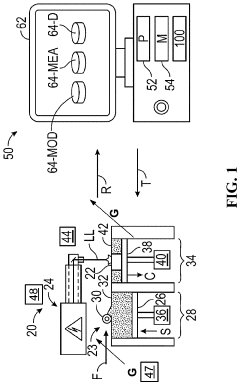
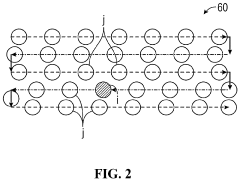
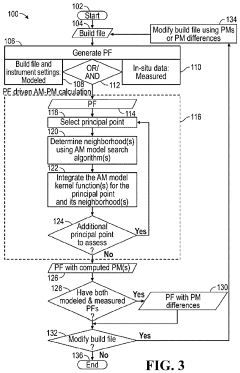
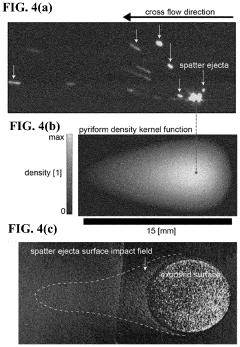
- A method involving a hatch progression angle and pyriform density function process metric is used to control spatter-induced porosity by computing a spatter exposure metric, which involves selecting principal points, determining neighborhoods, and integrating a pyriform kernel function to update the build file and design a build strategy that mitigates spatter, ensuring the hatch progression angle is aligned with the crossflow direction.
Material Property Prediction and Validation Methodologies
Material property prediction in the context of Powder Bed Fusion Laser Beam (PBF-LB) processes requires sophisticated methodologies that bridge microscale phenomena with macroscale performance characteristics. Current prediction methodologies primarily utilize computational models that integrate phase-field simulations with finite element analysis to capture the complex thermal history and resultant microstructural evolution. These models incorporate key process parameters such as laser power, scan speed, and powder characteristics to predict grain morphology, texture, and defect formation.
Validation of these predictions necessitates a multi-faceted approach combining in-situ monitoring techniques with post-process characterization. Advanced synchrotron X-ray diffraction methods enable real-time observation of phase transformations during the PBF-LB process, providing critical data for model validation. Electron backscatter diffraction (EBSD) and transmission electron microscopy (TEM) offer complementary insights into crystallographic orientation and nanoscale features that influence material properties.
Machine learning algorithms have emerged as powerful tools for enhancing prediction accuracy by establishing correlations between process parameters, microstructural features, and resultant mechanical properties. Neural networks trained on extensive datasets can identify non-linear relationships that traditional physics-based models might overlook, particularly in complex alloy systems with multiple phases and precipitation mechanisms.
Digital twin frameworks represent the cutting edge of validation methodologies, creating virtual replicas of physical components that evolve in parallel with their real-world counterparts. These frameworks integrate sensor data from the manufacturing process with simulation results, continuously refining predictions through feedback loops and reducing the gap between theoretical models and actual performance.
Uncertainty quantification has become increasingly important in property prediction, acknowledging the stochastic nature of the PBF-LB process. Statistical methods such as Monte Carlo simulations and Bayesian inference help quantify confidence levels in predictions and identify the most influential parameters affecting variability in material properties.
Standardization efforts are underway to establish benchmarks for validation protocols, ensuring consistency across different research groups and industrial applications. Round-robin testing involving multiple institutions has proven valuable in assessing the robustness of prediction methodologies across different equipment configurations and material systems, ultimately accelerating the adoption of reliable simulation tools for industrial applications.
Validation of these predictions necessitates a multi-faceted approach combining in-situ monitoring techniques with post-process characterization. Advanced synchrotron X-ray diffraction methods enable real-time observation of phase transformations during the PBF-LB process, providing critical data for model validation. Electron backscatter diffraction (EBSD) and transmission electron microscopy (TEM) offer complementary insights into crystallographic orientation and nanoscale features that influence material properties.
Machine learning algorithms have emerged as powerful tools for enhancing prediction accuracy by establishing correlations between process parameters, microstructural features, and resultant mechanical properties. Neural networks trained on extensive datasets can identify non-linear relationships that traditional physics-based models might overlook, particularly in complex alloy systems with multiple phases and precipitation mechanisms.
Digital twin frameworks represent the cutting edge of validation methodologies, creating virtual replicas of physical components that evolve in parallel with their real-world counterparts. These frameworks integrate sensor data from the manufacturing process with simulation results, continuously refining predictions through feedback loops and reducing the gap between theoretical models and actual performance.
Uncertainty quantification has become increasingly important in property prediction, acknowledging the stochastic nature of the PBF-LB process. Statistical methods such as Monte Carlo simulations and Bayesian inference help quantify confidence levels in predictions and identify the most influential parameters affecting variability in material properties.
Standardization efforts are underway to establish benchmarks for validation protocols, ensuring consistency across different research groups and industrial applications. Round-robin testing involving multiple institutions has proven valuable in assessing the robustness of prediction methodologies across different equipment configurations and material systems, ultimately accelerating the adoption of reliable simulation tools for industrial applications.
Computational Resources and Implementation Strategies
The implementation of multiscale modeling for microstructure evolution during Powder Bed Fusion-Laser Beam (PBF-LB) processes demands substantial computational resources and strategic implementation approaches. High-performance computing (HPC) clusters are essential for executing complex simulations that span multiple length and time scales. These clusters typically require 64-512 CPU cores for mesoscale simulations, while more detailed microscale models may necessitate 1,000+ cores to achieve reasonable computation times. GPU acceleration has emerged as a critical technology, offering 5-10x speedup for certain simulation components, particularly for phase field and cellular automata models that benefit from parallel processing architectures.
Cloud computing platforms provide scalable alternatives to on-premises HPC systems, with providers like AWS, Google Cloud, and Microsoft Azure offering specialized instances for scientific computing. These platforms enable researchers to dynamically allocate resources based on simulation complexity, though data transfer bottlenecks between simulation scales remain a challenge.
Memory requirements vary significantly across simulation scales, with macroscale models typically requiring 32-64GB RAM, while microscale models with high-resolution microstructure representation may demand 128-512GB or more. Storage considerations are equally important, as multiscale simulations generate massive datasets, often in the terabyte range, necessitating efficient data management strategies.
Implementation strategies focus on coupling different simulation methods across scales. Loose coupling approaches, where information is transferred between scales at predetermined intervals, offer computational efficiency but may sacrifice accuracy. Tight coupling, while more accurate, introduces significant computational overhead. Adaptive mesh refinement techniques optimize resource allocation by concentrating computational power on regions of interest, such as melt pools or phase boundaries.
Software frameworks like MOOSE, DREAM.3D, and OpenFOAM provide foundational tools for multiscale modeling, though significant custom development is typically required. Containerization technologies like Docker and Singularity enhance reproducibility and portability across computing environments. Workflow management systems such as Nextflow and Pegasus are increasingly utilized to orchestrate complex simulation pipelines, automating data transfer between scales and managing computational resources efficiently.
The computational challenges in multiscale PBF-LB modeling have spurred interest in machine learning approaches to reduce computational demands. Surrogate models trained on high-fidelity simulation data can approximate certain aspects of the simulation, potentially reducing computation time by orders of magnitude for parameter studies and optimization tasks.
Cloud computing platforms provide scalable alternatives to on-premises HPC systems, with providers like AWS, Google Cloud, and Microsoft Azure offering specialized instances for scientific computing. These platforms enable researchers to dynamically allocate resources based on simulation complexity, though data transfer bottlenecks between simulation scales remain a challenge.
Memory requirements vary significantly across simulation scales, with macroscale models typically requiring 32-64GB RAM, while microscale models with high-resolution microstructure representation may demand 128-512GB or more. Storage considerations are equally important, as multiscale simulations generate massive datasets, often in the terabyte range, necessitating efficient data management strategies.
Implementation strategies focus on coupling different simulation methods across scales. Loose coupling approaches, where information is transferred between scales at predetermined intervals, offer computational efficiency but may sacrifice accuracy. Tight coupling, while more accurate, introduces significant computational overhead. Adaptive mesh refinement techniques optimize resource allocation by concentrating computational power on regions of interest, such as melt pools or phase boundaries.
Software frameworks like MOOSE, DREAM.3D, and OpenFOAM provide foundational tools for multiscale modeling, though significant custom development is typically required. Containerization technologies like Docker and Singularity enhance reproducibility and portability across computing environments. Workflow management systems such as Nextflow and Pegasus are increasingly utilized to orchestrate complex simulation pipelines, automating data transfer between scales and managing computational resources efficiently.
The computational challenges in multiscale PBF-LB modeling have spurred interest in machine learning approaches to reduce computational demands. Surrogate models trained on high-fidelity simulation data can approximate certain aspects of the simulation, potentially reducing computation time by orders of magnitude for parameter studies and optimization tasks.
Unlock deeper insights with PatSnap Eureka Quick Research — get a full tech report to explore trends and direct your research. Try now!
Generate Your Research Report Instantly with AI Agent
Supercharge your innovation with PatSnap Eureka AI Agent Platform!