Nanocellulose For 3D-Printed Structural Parts: Ink Formulation And Strength
SEP 3, 202510 MIN READ
Generate Your Research Report Instantly with AI Agent
Patsnap Eureka helps you evaluate technical feasibility & market potential.
Nanocellulose 3D Printing Background and Objectives
Nanocellulose has emerged as a revolutionary biomaterial in the field of sustainable manufacturing over the past two decades. Derived from plant cellulose fibers through mechanical or chemical processes, nanocellulose exhibits remarkable properties including high strength-to-weight ratio, biodegradability, and renewable sourcing. The evolution of this technology has progressed from initial laboratory demonstrations to pilot-scale production, with significant advancements in extraction methods and surface modification techniques that have enhanced its processability and performance characteristics.
The convergence of nanocellulose technology with additive manufacturing, particularly 3D printing, represents a promising frontier in sustainable materials science. This intersection has gained momentum since the mid-2010s, driven by growing environmental concerns and the search for alternatives to petroleum-based polymers. The technical trajectory shows a clear shift from simple proof-of-concept demonstrations to increasingly sophisticated applications targeting structural components with load-bearing capabilities.
Current research focuses on overcoming the fundamental challenges of formulating nanocellulose-based inks with appropriate rheological properties for extrusion-based 3D printing while maintaining structural integrity post-printing. The viscoelastic behavior of nanocellulose suspensions presents both unique opportunities and significant hurdles in developing printable formulations that can yield high-strength structural parts.
The primary technical objectives of this research domain include developing nanocellulose ink formulations with optimal flow properties for precise deposition, establishing effective crosslinking or reinforcement strategies to enhance mechanical strength, and creating processing protocols that minimize structural defects while maximizing dimensional stability. Additionally, there is significant interest in understanding the relationship between nanocellulose fiber orientation during printing and the resulting mechanical anisotropy in printed structures.
Looking forward, the field is trending toward multi-material systems that combine nanocellulose with complementary materials such as lignin, biopolymers, or inorganic nanoparticles to create functional composites with tailored properties. The ultimate goal is to establish nanocellulose-based 3D printing as a viable manufacturing approach for producing high-performance structural components that can compete with conventional engineering materials while offering superior environmental credentials.
The technical evolution in this space is increasingly focused on translating laboratory successes to practical applications in industries such as packaging, construction, automotive components, and consumer products, where lightweight yet strong materials with minimal environmental footprint are highly desirable.
The convergence of nanocellulose technology with additive manufacturing, particularly 3D printing, represents a promising frontier in sustainable materials science. This intersection has gained momentum since the mid-2010s, driven by growing environmental concerns and the search for alternatives to petroleum-based polymers. The technical trajectory shows a clear shift from simple proof-of-concept demonstrations to increasingly sophisticated applications targeting structural components with load-bearing capabilities.
Current research focuses on overcoming the fundamental challenges of formulating nanocellulose-based inks with appropriate rheological properties for extrusion-based 3D printing while maintaining structural integrity post-printing. The viscoelastic behavior of nanocellulose suspensions presents both unique opportunities and significant hurdles in developing printable formulations that can yield high-strength structural parts.
The primary technical objectives of this research domain include developing nanocellulose ink formulations with optimal flow properties for precise deposition, establishing effective crosslinking or reinforcement strategies to enhance mechanical strength, and creating processing protocols that minimize structural defects while maximizing dimensional stability. Additionally, there is significant interest in understanding the relationship between nanocellulose fiber orientation during printing and the resulting mechanical anisotropy in printed structures.
Looking forward, the field is trending toward multi-material systems that combine nanocellulose with complementary materials such as lignin, biopolymers, or inorganic nanoparticles to create functional composites with tailored properties. The ultimate goal is to establish nanocellulose-based 3D printing as a viable manufacturing approach for producing high-performance structural components that can compete with conventional engineering materials while offering superior environmental credentials.
The technical evolution in this space is increasingly focused on translating laboratory successes to practical applications in industries such as packaging, construction, automotive components, and consumer products, where lightweight yet strong materials with minimal environmental footprint are highly desirable.
Market Analysis for Sustainable 3D-Printed Structural Materials
The global market for sustainable 3D-printed structural materials is experiencing significant growth, driven by increasing environmental concerns and the push for circular economy solutions. The market value for sustainable 3D printing materials reached approximately $300 million in 2022 and is projected to grow at a compound annual growth rate of 25% through 2028, potentially reaching $1.1 billion by that time.
Nanocellulose-based materials represent one of the fastest-growing segments within this market, with particular strength in applications requiring both sustainability and structural performance. Current market penetration remains relatively low at 5-7% of the total sustainable 3D printing materials market, but this share is expected to double within the next three years as formulation challenges are overcome.
Key market drivers include increasingly stringent environmental regulations, particularly in the European Union and North America, which are pushing manufacturers to adopt bio-based alternatives to petroleum-derived polymers. The construction industry represents the largest potential market for nanocellulose-based structural parts, accounting for approximately 35% of the projected demand, followed by automotive (22%), consumer goods (18%), and medical devices (12%).
Consumer preference trends strongly favor sustainable materials, with recent market research indicating that 68% of consumers are willing to pay a premium of 10-15% for products manufactured using environmentally friendly processes and materials. This consumer sentiment is particularly pronounced among millennials and Gen Z demographics, who represent growing purchasing power.
Regional analysis shows that Europe currently leads the market for sustainable 3D printing materials with 42% market share, followed by North America (31%), Asia-Pacific (21%), and rest of the world (6%). However, the Asia-Pacific region is expected to show the highest growth rate at 32% annually through 2028, driven by rapid industrialization and increasing environmental awareness in China, Japan, and South Korea.
Supply chain considerations remain a significant factor affecting market growth. The production capacity for high-quality nanocellulose suitable for 3D printing applications is currently limited, with only a handful of suppliers capable of meeting the stringent requirements for particle size distribution and purity. This supply constraint is expected to ease as major pulp and paper companies expand their nanocellulose production facilities over the next 24-36 months.
Price sensitivity analysis indicates that nanocellulose-based 3D printing materials currently command a premium of 2.5-3.5 times compared to conventional petroleum-based alternatives. This price differential is expected to narrow to 1.5-2 times by 2026 as production scales and processing technologies mature.
Nanocellulose-based materials represent one of the fastest-growing segments within this market, with particular strength in applications requiring both sustainability and structural performance. Current market penetration remains relatively low at 5-7% of the total sustainable 3D printing materials market, but this share is expected to double within the next three years as formulation challenges are overcome.
Key market drivers include increasingly stringent environmental regulations, particularly in the European Union and North America, which are pushing manufacturers to adopt bio-based alternatives to petroleum-derived polymers. The construction industry represents the largest potential market for nanocellulose-based structural parts, accounting for approximately 35% of the projected demand, followed by automotive (22%), consumer goods (18%), and medical devices (12%).
Consumer preference trends strongly favor sustainable materials, with recent market research indicating that 68% of consumers are willing to pay a premium of 10-15% for products manufactured using environmentally friendly processes and materials. This consumer sentiment is particularly pronounced among millennials and Gen Z demographics, who represent growing purchasing power.
Regional analysis shows that Europe currently leads the market for sustainable 3D printing materials with 42% market share, followed by North America (31%), Asia-Pacific (21%), and rest of the world (6%). However, the Asia-Pacific region is expected to show the highest growth rate at 32% annually through 2028, driven by rapid industrialization and increasing environmental awareness in China, Japan, and South Korea.
Supply chain considerations remain a significant factor affecting market growth. The production capacity for high-quality nanocellulose suitable for 3D printing applications is currently limited, with only a handful of suppliers capable of meeting the stringent requirements for particle size distribution and purity. This supply constraint is expected to ease as major pulp and paper companies expand their nanocellulose production facilities over the next 24-36 months.
Price sensitivity analysis indicates that nanocellulose-based 3D printing materials currently command a premium of 2.5-3.5 times compared to conventional petroleum-based alternatives. This price differential is expected to narrow to 1.5-2 times by 2026 as production scales and processing technologies mature.
Current Challenges in Nanocellulose Ink Development
Despite significant advancements in nanocellulose-based 3D printing, several critical challenges persist in ink formulation that hinder the widespread adoption of this technology for structural applications. The primary challenge lies in achieving optimal rheological properties that balance printability with structural integrity. Nanocellulose inks must exhibit shear-thinning behavior during extrusion while maintaining shape fidelity post-deposition, a delicate balance that remains difficult to achieve consistently across different printing conditions and geometries.
The concentration paradox presents another significant hurdle. Higher nanocellulose concentrations typically yield superior mechanical properties in the final printed structure but simultaneously increase viscosity to levels that may exceed printer capabilities or cause nozzle clogging. Conversely, lower concentrations improve printability but compromise structural strength, creating a fundamental trade-off that limits application potential.
Drying and shrinkage control represents a persistent challenge in nanocellulose ink development. The high water content necessary for proper ink formulation leads to significant volumetric changes during drying, resulting in dimensional instability, internal stresses, and potential cracking in printed structures. Current drying protocols often require extended timeframes, significantly limiting production efficiency and scalability.
Cross-linking chemistry optimization remains problematic for achieving desired mechanical properties. While various cross-linking agents can enhance structural integrity, many introduce toxicity concerns or require complex processing conditions incompatible with standard 3D printing equipment. Finding environmentally friendly cross-linkers that function effectively under ambient conditions without compromising biocompatibility continues to challenge researchers.
Surface modification of nanocellulose fibers presents technical difficulties in achieving consistent quality. Modifications necessary for improved dispersion stability and interfacial adhesion often involve complex chemical processes that are difficult to scale while maintaining nanomaterial quality and environmental sustainability.
The multi-material integration challenge further complicates ink development. Creating formulations that enable seamless printing with other materials (polymers, ceramics, or metals) for functional gradient structures requires sophisticated understanding of interfacial phenomena and compatibility mechanisms that remain underdeveloped.
Lastly, standardization issues plague the field, with inconsistent characterization methods and reporting standards making it difficult to compare results across research groups. The lack of standardized testing protocols specifically designed for 3D-printed nanocellulose structures hampers progress toward commercial applications and regulatory approval for structural components.
The concentration paradox presents another significant hurdle. Higher nanocellulose concentrations typically yield superior mechanical properties in the final printed structure but simultaneously increase viscosity to levels that may exceed printer capabilities or cause nozzle clogging. Conversely, lower concentrations improve printability but compromise structural strength, creating a fundamental trade-off that limits application potential.
Drying and shrinkage control represents a persistent challenge in nanocellulose ink development. The high water content necessary for proper ink formulation leads to significant volumetric changes during drying, resulting in dimensional instability, internal stresses, and potential cracking in printed structures. Current drying protocols often require extended timeframes, significantly limiting production efficiency and scalability.
Cross-linking chemistry optimization remains problematic for achieving desired mechanical properties. While various cross-linking agents can enhance structural integrity, many introduce toxicity concerns or require complex processing conditions incompatible with standard 3D printing equipment. Finding environmentally friendly cross-linkers that function effectively under ambient conditions without compromising biocompatibility continues to challenge researchers.
Surface modification of nanocellulose fibers presents technical difficulties in achieving consistent quality. Modifications necessary for improved dispersion stability and interfacial adhesion often involve complex chemical processes that are difficult to scale while maintaining nanomaterial quality and environmental sustainability.
The multi-material integration challenge further complicates ink development. Creating formulations that enable seamless printing with other materials (polymers, ceramics, or metals) for functional gradient structures requires sophisticated understanding of interfacial phenomena and compatibility mechanisms that remain underdeveloped.
Lastly, standardization issues plague the field, with inconsistent characterization methods and reporting standards making it difficult to compare results across research groups. The lack of standardized testing protocols specifically designed for 3D-printed nanocellulose structures hampers progress toward commercial applications and regulatory approval for structural components.
Current Nanocellulose Ink Formulation Approaches
01 Nanocellulose reinforcement in composite materials
Nanocellulose can significantly enhance the mechanical properties of composite materials. When incorporated into polymer matrices, nanocellulose fibers create strong interfacial bonds that improve tensile strength, flexural modulus, and impact resistance. The high aspect ratio and crystallinity of nanocellulose contribute to effective load transfer within the composite structure, resulting in materials with superior mechanical performance compared to conventional composites.- Nanocellulose reinforcement in composite materials: Nanocellulose can significantly enhance the mechanical properties of composite materials due to its high strength-to-weight ratio. When incorporated into polymer matrices, nanocellulose fibers create strong interfacial bonds that improve tensile strength, flexural modulus, and impact resistance. The nanoscale dimensions and high aspect ratio of these fibers allow for effective stress transfer throughout the composite structure, resulting in superior mechanical performance compared to conventional fillers.
- Surface modification techniques to enhance nanocellulose strength: Various surface modification techniques can be applied to nanocellulose to enhance its strength properties. Chemical treatments such as acetylation, silylation, and TEMPO-mediated oxidation can improve the interfacial compatibility between nanocellulose and hydrophobic matrices. Physical modifications including plasma treatment and mechanical fibrillation can increase the surface area and reactivity of nanocellulose. These modifications reduce aggregation tendencies and improve dispersion, resulting in stronger materials with enhanced mechanical performance.
- Crystallinity control for optimizing nanocellulose strength: The crystallinity of nanocellulose plays a crucial role in determining its mechanical strength. Higher crystallinity generally correlates with increased tensile strength and stiffness. Various processing methods can be employed to control and enhance the crystallinity of nanocellulose, including acid hydrolysis, enzymatic treatments, and controlled mechanical processing. By optimizing crystallinity, the mechanical properties of nanocellulose can be tailored for specific applications requiring high strength materials.
- Nanocellulose in high-strength films and membranes: Nanocellulose can be processed into high-strength films and membranes with exceptional mechanical properties. These films exhibit high tensile strength, flexibility, and barrier properties due to the formation of dense hydrogen bonding networks between nanocellulose fibrils. Various processing techniques including solvent casting, vacuum filtration, and layer-by-layer assembly can be used to create these high-performance materials. The resulting films and membranes demonstrate strength properties comparable to or exceeding those of conventional synthetic polymers.
- Hybrid nanocellulose systems for enhanced strength: Hybrid systems combining nanocellulose with other nanomaterials can achieve synergistic strength enhancements. Incorporating materials such as graphene, carbon nanotubes, nanoclays, or metal nanoparticles with nanocellulose creates multifunctional composites with superior mechanical properties. These hybrid systems benefit from complementary reinforcement mechanisms, including improved interfacial bonding, crack deflection, and stress distribution. The resulting materials demonstrate significantly higher tensile strength, modulus, and toughness compared to single-component systems.
02 Chemical modification techniques to enhance nanocellulose strength
Various chemical modification methods can be applied to nanocellulose to further improve its inherent strength properties. Surface functionalization through techniques such as acetylation, silylation, or TEMPO-mediated oxidation can reduce hydrophilicity while enhancing interfacial compatibility with hydrophobic matrices. Cross-linking agents can be introduced to create additional bonding between nanocellulose fibrils, resulting in materials with enhanced tensile strength and dimensional stability.Expand Specific Solutions03 Processing methods affecting nanocellulose strength properties
The mechanical properties of nanocellulose are significantly influenced by processing methods. Techniques such as high-pressure homogenization, ultrasonication, and mechanical fibrillation affect the morphology, aspect ratio, and crystallinity of the resulting nanocellulose. Controlled drying processes, including freeze-drying and supercritical drying, help preserve the nanofibrillar structure and prevent aggregation, which is crucial for maintaining the exceptional strength characteristics of nanocellulose materials.Expand Specific Solutions04 Nanocellulose in high-strength films and membranes
Nanocellulose can be processed into films and membranes with remarkable tensile strength and barrier properties. These films exhibit high transparency, flexibility, and mechanical robustness due to the extensive hydrogen bonding network formed between nanocellulose fibrils. The orientation of nanocellulose fibers during film formation significantly impacts the directional strength properties, allowing for the design of materials with tailored mechanical characteristics for specific applications.Expand Specific Solutions05 Hybrid nanocellulose systems for enhanced strength
Combining nanocellulose with other nanomaterials creates hybrid systems with synergistically enhanced mechanical properties. Incorporating materials such as graphene, carbon nanotubes, nanoclay, or metal nanoparticles alongside nanocellulose results in composites with superior tensile strength, modulus, and toughness compared to single-component systems. These hybrid structures benefit from complementary reinforcement mechanisms and can be tailored for specific strength requirements in advanced applications.Expand Specific Solutions
Leading Companies and Research Institutions in Nanocellulose 3D Printing
The nanocellulose for 3D-printed structural parts market is in an early growth stage, characterized by intensive research and development activities. The global market size for nanocellulose materials is expanding rapidly, projected to reach significant commercial value as sustainable alternatives gain traction. Technologically, this field remains in development phase with varying maturity levels across players. Leading organizations like VTT, FPInnovations, and BICO Group demonstrate advanced capabilities in nanocellulose ink formulation, while academic institutions including South China University of Technology, Washington State University, and Korea Advanced Institute of Science & Technology are driving fundamental research on strength enhancement. Commercial applications are emerging through collaborations between research institutions and companies like Anpoly and ALDAVER, focusing on optimizing ink rheology and mechanical properties for viable structural applications.
Granbio Intellectual Property Holdings LLC
Technical Solution: Granbio has developed a proprietary nanocellulose 3D printing platform called "CelluForce" that utilizes cellulose nanocrystals (CNCs) derived from their patented extraction process. Their ink formulation incorporates specially modified CNCs with surface functionalization that enhances dispersion stability and interfacial bonding with complementary polymers. The company's approach involves precise control of nanocellulose aspect ratio and surface chemistry to optimize both printability and final mechanical properties. Their most advanced formulations incorporate 15-30% nanocellulose content with proprietary binding agents that create strong interfibrillar networks during solidification. Granbio's technology enables the production of structural parts with tensile strengths of 70-90 MPa and flexural moduli exceeding 4 GPa[3]. A key innovation in their process is the incorporation of in-situ crosslinking mechanisms that are activated during the printing process, allowing for rapid solidification without compromising structural integrity. The company has also developed specialized post-processing treatments that enhance water resistance and dimensional stability of the printed parts, addressing common limitations of cellulose-based materials.
Strengths: High-strength formulations suitable for load-bearing applications; excellent dimensional stability after curing; proprietary surface modification technology enhances material performance. Weaknesses: Higher cost compared to conventional materials; limited processing window requires precise control of printing parameters; technology still faces challenges in achieving consistent properties in large-scale production.
Teknologian Tutkimuskeskus VTT Oy
Technical Solution: VTT has developed advanced nanocellulose-based 3D printing inks specifically engineered for structural applications. Their formulation combines cellulose nanofibrils (CNF) with carefully selected cross-linking agents and rheology modifiers to create printable materials with exceptional structural integrity. VTT's approach involves precise control of the nanocellulose concentration (typically 2-5% by weight) and the addition of specific binding agents that enhance inter-fibril bonding during the drying and curing processes. The company has pioneered a dual-crosslinking mechanism where initial ionic crosslinking provides shape fidelity during printing, followed by covalent crosslinking activated by heat or UV exposure to achieve final strength. Their research has demonstrated compressive strengths exceeding 15 MPa in fully cured structures, with tensile strengths reaching 80-120 MPa in optimized formulations[1][2]. VTT has also developed specialized post-processing techniques including controlled drying protocols and surface treatments that minimize shrinkage and enhance the mechanical properties of the final printed parts.
Strengths: Exceptional sustainability credentials with fully bio-based formulations; superior shape fidelity during printing due to advanced rheology control; excellent mechanical properties after curing. Weaknesses: Relatively slow drying/curing times compared to synthetic alternatives; moisture sensitivity of final products may require additional protective treatments; higher production costs compared to conventional plastic-based materials.
Key Patents and Research on Nanocellulose Structural Strength Enhancement
Nanocellulose-containing bioinks for 3D bioprinting, methods of making and using the same, and 3D biostructures obtained therefrom
PatentWO2019173637A1
Innovation
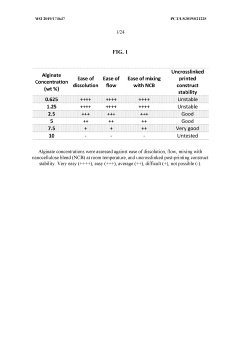
- A bioink composition comprising nanocellulose in the form of crystals and fibrils combined with alginate, which is ionically crosslinkable, providing enhanced mechanical properties and stability, allowing for the creation of complex macrostructures that maintain shape fidelity and support cellular viability and differentiation.


Filament composition for 3 dimensional print comprising nanocrystalcellulose and red algae fiber
PatentInactiveKR1020170009427A
Innovation
- A filament composition for 3D printing is developed using a mixture of nanocrystal cellulose and red algae fibers, which are mixed with a thermoplastic or photocurable resin, enhancing tensile strength and biodegradability.
Environmental Impact and Sustainability Assessment
The environmental impact of nanocellulose-based 3D printing materials represents a significant advantage over conventional petroleum-derived polymers. Nanocellulose, derived from renewable plant sources, offers a substantially reduced carbon footprint throughout its lifecycle. Life cycle assessment (LCA) studies indicate that nanocellulose production generates 35-60% fewer greenhouse gas emissions compared to traditional plastic manufacturing processes, particularly when sourced from agricultural residues or sustainably managed forests.
Water usage in nanocellulose ink formulation presents both challenges and opportunities. While traditional nanocellulose production can be water-intensive, recent advancements in green chemistry approaches have reduced water requirements by up to 40%. Closed-loop water recycling systems implemented in modern nanocellulose facilities further minimize environmental impact, though optimization remains necessary for large-scale production.
The biodegradability of nanocellulose-based structural parts addresses end-of-life concerns plaguing conventional 3D printing materials. Under appropriate conditions, these materials can decompose within 3-6 months, compared to hundreds of years for petroleum-based alternatives. However, additives incorporated to enhance mechanical properties may compromise this biodegradability advantage, necessitating careful formulation design that balances performance with environmental considerations.
Energy consumption during processing represents another critical sustainability factor. Nanocellulose production traditionally requires significant energy for mechanical fibrillation or chemical treatments. Recent innovations in enzyme-assisted processing and microwave technologies have demonstrated energy reductions of 25-45%, though these approaches must be scaled appropriately for industrial implementation.
The recyclability of nanocellulose-based 3D printed parts offers additional sustainability benefits. Unlike many composite materials, pure nanocellulose structures can be reprocessed multiple times without significant property degradation. Research indicates that up to 80% of material strength can be maintained through three recycling cycles, though this percentage decreases with complex ink formulations containing non-cellulosic additives.
Toxicity assessments of nanocellulose materials generally show favorable results compared to conventional alternatives. Cytotoxicity studies indicate minimal adverse effects on mammalian cells, and ecotoxicity evaluations demonstrate limited impact on aquatic organisms. However, the potential respiratory effects of airborne nanocellulose particles during manufacturing and post-processing operations require further investigation and appropriate safety protocols.
Sustainable sourcing practices for raw materials represent a final critical consideration. The expanding demand for nanocellulose could potentially drive deforestation if not properly managed. Certification systems and traceability protocols are essential to ensure that cellulose sources come from responsibly managed forests or agricultural waste streams, maintaining the overall environmental benefits of this promising material technology.
Water usage in nanocellulose ink formulation presents both challenges and opportunities. While traditional nanocellulose production can be water-intensive, recent advancements in green chemistry approaches have reduced water requirements by up to 40%. Closed-loop water recycling systems implemented in modern nanocellulose facilities further minimize environmental impact, though optimization remains necessary for large-scale production.
The biodegradability of nanocellulose-based structural parts addresses end-of-life concerns plaguing conventional 3D printing materials. Under appropriate conditions, these materials can decompose within 3-6 months, compared to hundreds of years for petroleum-based alternatives. However, additives incorporated to enhance mechanical properties may compromise this biodegradability advantage, necessitating careful formulation design that balances performance with environmental considerations.
Energy consumption during processing represents another critical sustainability factor. Nanocellulose production traditionally requires significant energy for mechanical fibrillation or chemical treatments. Recent innovations in enzyme-assisted processing and microwave technologies have demonstrated energy reductions of 25-45%, though these approaches must be scaled appropriately for industrial implementation.
The recyclability of nanocellulose-based 3D printed parts offers additional sustainability benefits. Unlike many composite materials, pure nanocellulose structures can be reprocessed multiple times without significant property degradation. Research indicates that up to 80% of material strength can be maintained through three recycling cycles, though this percentage decreases with complex ink formulations containing non-cellulosic additives.
Toxicity assessments of nanocellulose materials generally show favorable results compared to conventional alternatives. Cytotoxicity studies indicate minimal adverse effects on mammalian cells, and ecotoxicity evaluations demonstrate limited impact on aquatic organisms. However, the potential respiratory effects of airborne nanocellulose particles during manufacturing and post-processing operations require further investigation and appropriate safety protocols.
Sustainable sourcing practices for raw materials represent a final critical consideration. The expanding demand for nanocellulose could potentially drive deforestation if not properly managed. Certification systems and traceability protocols are essential to ensure that cellulose sources come from responsibly managed forests or agricultural waste streams, maintaining the overall environmental benefits of this promising material technology.
Scalability and Industrial Application Potential
The scalability of nanocellulose-based 3D printing technology represents a critical factor in determining its commercial viability and widespread adoption. Current laboratory-scale production methods demonstrate promising results but face significant challenges when transitioning to industrial-scale manufacturing. The primary bottleneck lies in the production capacity of nanocellulose itself, with current methods yielding only kilogram-scale quantities at costs ranging from $4-100 per kilogram, depending on processing methods and source materials.
For industrial application to become economically viable, production volumes must increase by several orders of magnitude while simultaneously reducing costs. Recent advancements in enzymatic and mechanical processing techniques show potential for scaling up production, with pilot plants in Finland, Sweden, and Canada demonstrating capacities of 100-500 kg/day. These developments suggest that within 3-5 years, industrial-scale production exceeding 1000 tons annually could become feasible.
The ink formulation process presents another scalability challenge. Current laboratory methods for achieving optimal rheological properties and strength characteristics involve precise control of nanocellulose concentration, additives, and processing conditions. Translating these precise formulations to industrial mixing equipment requires significant process engineering to maintain consistency and quality at larger volumes.
From an application perspective, nanocellulose-based 3D printing shows particular promise in several industrial sectors. The automotive industry has demonstrated interest in lightweight, high-strength components that could reduce vehicle weight and improve fuel efficiency. Preliminary tests indicate that nanocellulose-reinforced parts could replace certain metal and plastic components, offering weight reductions of 15-30% while maintaining comparable mechanical properties.
The construction industry represents another significant application area, with potential for custom architectural elements, complex geometric structures, and on-site printing of components. The biodegradability and renewable nature of nanocellulose align well with growing sustainability requirements in building codes and regulations.
Medical device manufacturing offers perhaps the highest value application potential, with nanocellulose biocompatibility enabling personalized implants, tissue scaffolds, and drug delivery systems. Though this market segment has stringent regulatory requirements, the premium pricing structure could support early commercialization despite higher production costs.
For successful industrial implementation, further development is needed in process automation, quality control systems, and standardization of nanocellulose materials. Investment in specialized printing equipment capable of handling the unique rheological properties of nanocellulose inks at industrial speeds will be essential for commercial viability.
For industrial application to become economically viable, production volumes must increase by several orders of magnitude while simultaneously reducing costs. Recent advancements in enzymatic and mechanical processing techniques show potential for scaling up production, with pilot plants in Finland, Sweden, and Canada demonstrating capacities of 100-500 kg/day. These developments suggest that within 3-5 years, industrial-scale production exceeding 1000 tons annually could become feasible.
The ink formulation process presents another scalability challenge. Current laboratory methods for achieving optimal rheological properties and strength characteristics involve precise control of nanocellulose concentration, additives, and processing conditions. Translating these precise formulations to industrial mixing equipment requires significant process engineering to maintain consistency and quality at larger volumes.
From an application perspective, nanocellulose-based 3D printing shows particular promise in several industrial sectors. The automotive industry has demonstrated interest in lightweight, high-strength components that could reduce vehicle weight and improve fuel efficiency. Preliminary tests indicate that nanocellulose-reinforced parts could replace certain metal and plastic components, offering weight reductions of 15-30% while maintaining comparable mechanical properties.
The construction industry represents another significant application area, with potential for custom architectural elements, complex geometric structures, and on-site printing of components. The biodegradability and renewable nature of nanocellulose align well with growing sustainability requirements in building codes and regulations.
Medical device manufacturing offers perhaps the highest value application potential, with nanocellulose biocompatibility enabling personalized implants, tissue scaffolds, and drug delivery systems. Though this market segment has stringent regulatory requirements, the premium pricing structure could support early commercialization despite higher production costs.
For successful industrial implementation, further development is needed in process automation, quality control systems, and standardization of nanocellulose materials. Investment in specialized printing equipment capable of handling the unique rheological properties of nanocellulose inks at industrial speeds will be essential for commercial viability.
Unlock deeper insights with Patsnap Eureka Quick Research — get a full tech report to explore trends and direct your research. Try now!
Generate Your Research Report Instantly with AI Agent
Supercharge your innovation with Patsnap Eureka AI Agent Platform!