
Optimizing FTIR Calibration for Accurate Spectroscopy
SEP 22, 202510 MIN READ
Generate Your Research Report Instantly with AI Agent
Patsnap Eureka helps you evaluate technical feasibility & market potential.
FTIR Spectroscopy Background and Calibration Objectives
Fourier Transform Infrared (FTIR) spectroscopy has evolved significantly since its inception in the mid-20th century, revolutionizing analytical chemistry and materials science. The technique emerged from traditional dispersive infrared spectroscopy, with the breakthrough application of the Fourier transform algorithm in the 1960s dramatically enhancing data acquisition speed and signal-to-noise ratios. This mathematical innovation, coupled with advances in computing power, transformed infrared spectroscopy into one of the most versatile analytical tools available to modern scientists.
FTIR spectroscopy operates on the principle that molecular bonds absorb infrared radiation at specific frequencies corresponding to their vibrational modes. By measuring these absorption patterns across the infrared spectrum, researchers can identify molecular structures and quantify chemical components with remarkable precision. The technology has progressively improved in resolution, sensitivity, and reliability, transitioning from laboratory-bound instruments to portable field devices capable of real-time analysis.
Recent technological trends in FTIR spectroscopy include miniaturization, integration with artificial intelligence for spectral interpretation, and development of specialized accessories for diverse sample types. The push toward non-destructive, rapid analysis has driven innovations in attenuated total reflection (ATR) techniques, microsampling capabilities, and hyphenated systems that combine FTIR with complementary analytical methods.
Despite these advances, calibration remains the cornerstone of accurate FTIR analysis. Calibration challenges have persisted throughout the evolution of this technology, becoming increasingly complex as applications expand into new domains such as biomedical diagnostics, environmental monitoring, and quality control in pharmaceutical manufacturing. The fundamental goal of calibration is to establish a reliable relationship between spectral features and analyte concentrations, accounting for instrumental variations and environmental interferences.
The primary objectives of optimizing FTIR calibration include enhancing measurement accuracy across diverse sample matrices, improving reproducibility between different instruments and operators, reducing calibration maintenance requirements, and extending calibration stability over time. Additionally, there is growing emphasis on developing robust calibration transfer protocols that allow models developed on one instrument to be applied successfully on others, facilitating standardization across laboratory networks.
Modern calibration approaches increasingly leverage multivariate statistical methods, machine learning algorithms, and automated validation procedures to overcome traditional limitations. The integration of reference databases and standardized protocols has further contributed to improving calibration reliability. The ultimate aim is to develop calibration methodologies that can adapt to changing environmental conditions, compensate for instrumental drift, and maintain accuracy across the wide dynamic range required by contemporary applications.
As FTIR technology continues to penetrate new markets and application areas, optimized calibration strategies represent a critical enabler for realizing the full potential of this powerful analytical technique in addressing complex analytical challenges across diverse scientific and industrial domains.
FTIR spectroscopy operates on the principle that molecular bonds absorb infrared radiation at specific frequencies corresponding to their vibrational modes. By measuring these absorption patterns across the infrared spectrum, researchers can identify molecular structures and quantify chemical components with remarkable precision. The technology has progressively improved in resolution, sensitivity, and reliability, transitioning from laboratory-bound instruments to portable field devices capable of real-time analysis.
Recent technological trends in FTIR spectroscopy include miniaturization, integration with artificial intelligence for spectral interpretation, and development of specialized accessories for diverse sample types. The push toward non-destructive, rapid analysis has driven innovations in attenuated total reflection (ATR) techniques, microsampling capabilities, and hyphenated systems that combine FTIR with complementary analytical methods.
Despite these advances, calibration remains the cornerstone of accurate FTIR analysis. Calibration challenges have persisted throughout the evolution of this technology, becoming increasingly complex as applications expand into new domains such as biomedical diagnostics, environmental monitoring, and quality control in pharmaceutical manufacturing. The fundamental goal of calibration is to establish a reliable relationship between spectral features and analyte concentrations, accounting for instrumental variations and environmental interferences.
The primary objectives of optimizing FTIR calibration include enhancing measurement accuracy across diverse sample matrices, improving reproducibility between different instruments and operators, reducing calibration maintenance requirements, and extending calibration stability over time. Additionally, there is growing emphasis on developing robust calibration transfer protocols that allow models developed on one instrument to be applied successfully on others, facilitating standardization across laboratory networks.
Modern calibration approaches increasingly leverage multivariate statistical methods, machine learning algorithms, and automated validation procedures to overcome traditional limitations. The integration of reference databases and standardized protocols has further contributed to improving calibration reliability. The ultimate aim is to develop calibration methodologies that can adapt to changing environmental conditions, compensate for instrumental drift, and maintain accuracy across the wide dynamic range required by contemporary applications.
As FTIR technology continues to penetrate new markets and application areas, optimized calibration strategies represent a critical enabler for realizing the full potential of this powerful analytical technique in addressing complex analytical challenges across diverse scientific and industrial domains.
Market Demand Analysis for Precision Spectroscopy Solutions
The global market for precision spectroscopy solutions has witnessed substantial growth in recent years, driven primarily by increasing demands for accurate analytical tools across various industries. The FTIR (Fourier Transform Infrared) spectroscopy segment, in particular, has experienced significant expansion due to its versatility and reliability in molecular analysis applications.
Healthcare and pharmaceutical sectors represent the largest market segments, with an estimated annual growth rate exceeding the industry average. These sectors require highly calibrated FTIR systems for drug development, quality control, and diagnostic applications. The demand for optimized calibration solutions stems from stringent regulatory requirements that mandate precise analytical results for product approval and patient safety.
Industrial manufacturing constitutes another major market driver, particularly in chemical, polymer, and materials science industries. Companies in these sectors increasingly rely on accurately calibrated FTIR systems to ensure product quality, process optimization, and compliance with environmental regulations. The ability to detect minute compositional variations through properly calibrated spectroscopy directly impacts production efficiency and product consistency.
Environmental monitoring applications have emerged as a rapidly growing market segment. Government agencies, research institutions, and private environmental service providers utilize FTIR spectroscopy for air quality monitoring, water analysis, and soil contamination assessment. The demand for field-deployable, accurately calibrated systems has risen substantially as environmental regulations become more stringent globally.
Academic and research institutions continue to drive innovation in FTIR calibration techniques. The market for advanced calibration solutions in this segment is characterized by requirements for higher resolution, greater sensitivity, and more comprehensive reference databases. Research funding directed toward spectroscopic method development further stimulates market growth in this sector.
Geographically, North America and Europe dominate the market for precision spectroscopy solutions, owing to their established research infrastructure and industrial base. However, the Asia-Pacific region demonstrates the fastest growth rate, fueled by expanding pharmaceutical manufacturing, environmental concerns, and increasing R&D investments in countries like China, Japan, and India.
Market analysis indicates a clear shift toward automated calibration solutions that reduce human error and increase reproducibility. End-users increasingly demand integrated software platforms that streamline the calibration process while providing comprehensive data analysis capabilities. This trend aligns with the broader movement toward laboratory automation and data-driven decision-making across industries.
Healthcare and pharmaceutical sectors represent the largest market segments, with an estimated annual growth rate exceeding the industry average. These sectors require highly calibrated FTIR systems for drug development, quality control, and diagnostic applications. The demand for optimized calibration solutions stems from stringent regulatory requirements that mandate precise analytical results for product approval and patient safety.
Industrial manufacturing constitutes another major market driver, particularly in chemical, polymer, and materials science industries. Companies in these sectors increasingly rely on accurately calibrated FTIR systems to ensure product quality, process optimization, and compliance with environmental regulations. The ability to detect minute compositional variations through properly calibrated spectroscopy directly impacts production efficiency and product consistency.
Environmental monitoring applications have emerged as a rapidly growing market segment. Government agencies, research institutions, and private environmental service providers utilize FTIR spectroscopy for air quality monitoring, water analysis, and soil contamination assessment. The demand for field-deployable, accurately calibrated systems has risen substantially as environmental regulations become more stringent globally.
Academic and research institutions continue to drive innovation in FTIR calibration techniques. The market for advanced calibration solutions in this segment is characterized by requirements for higher resolution, greater sensitivity, and more comprehensive reference databases. Research funding directed toward spectroscopic method development further stimulates market growth in this sector.
Geographically, North America and Europe dominate the market for precision spectroscopy solutions, owing to their established research infrastructure and industrial base. However, the Asia-Pacific region demonstrates the fastest growth rate, fueled by expanding pharmaceutical manufacturing, environmental concerns, and increasing R&D investments in countries like China, Japan, and India.
Market analysis indicates a clear shift toward automated calibration solutions that reduce human error and increase reproducibility. End-users increasingly demand integrated software platforms that streamline the calibration process while providing comprehensive data analysis capabilities. This trend aligns with the broader movement toward laboratory automation and data-driven decision-making across industries.
Current FTIR Calibration Challenges and Limitations
Fourier Transform Infrared (FTIR) spectroscopy faces significant calibration challenges that limit its accuracy and reliability in various applications. The primary challenge stems from instrument drift over time, causing baseline shifts and intensity variations that compromise measurement consistency. Environmental factors such as temperature fluctuations, humidity changes, and atmospheric CO2 levels further complicate calibration efforts by introducing unpredictable spectral interferences.
Traditional calibration methods often rely on single-point or linear calibration approaches that fail to account for the complex, non-linear response characteristics of modern FTIR systems. This discrepancy becomes particularly problematic when analyzing samples with complex matrices or when quantifying trace components, where signal-to-noise ratios are already challenging.
Sample preparation inconsistencies represent another significant limitation, as variations in sample thickness, homogeneity, and positioning can dramatically affect spectral quality and reproducibility. The lack of standardized protocols across different laboratories and industries further exacerbates these issues, making cross-comparison of results difficult if not impossible.
Reference material limitations pose additional challenges, as many industries lack certified reference materials that accurately represent the complex matrices encountered in real-world applications. This deficiency forces researchers to develop in-house standards that may lack traceability to recognized metrological standards.
Data processing algorithms present their own set of limitations, with many current systems employing outdated chemometric models that fail to leverage recent advances in machine learning and artificial intelligence. These algorithms often struggle with spectral overlap, baseline correction, and the identification of minor components in complex mixtures.
Instrument-to-instrument variability remains a persistent issue, with spectral differences observed between instruments of the same model, let alone different manufacturers. This variability necessitates instrument-specific calibration procedures that are time-consuming and resource-intensive.
The increasing demand for portable and field-deployable FTIR systems introduces additional calibration challenges, as these compact instruments typically offer reduced spectral resolution and stability compared to their laboratory counterparts. Maintaining calibration integrity in changing field conditions requires robust calibration strategies that current methodologies struggle to provide.
Finally, there exists a significant knowledge gap between theoretical spectroscopy and practical application, with many operators lacking comprehensive understanding of the fundamental principles governing calibration procedures. This disconnect often leads to improper calibration practices and misinterpretation of spectral data, further compromising the reliability of FTIR analysis in critical applications.
Traditional calibration methods often rely on single-point or linear calibration approaches that fail to account for the complex, non-linear response characteristics of modern FTIR systems. This discrepancy becomes particularly problematic when analyzing samples with complex matrices or when quantifying trace components, where signal-to-noise ratios are already challenging.
Sample preparation inconsistencies represent another significant limitation, as variations in sample thickness, homogeneity, and positioning can dramatically affect spectral quality and reproducibility. The lack of standardized protocols across different laboratories and industries further exacerbates these issues, making cross-comparison of results difficult if not impossible.
Reference material limitations pose additional challenges, as many industries lack certified reference materials that accurately represent the complex matrices encountered in real-world applications. This deficiency forces researchers to develop in-house standards that may lack traceability to recognized metrological standards.
Data processing algorithms present their own set of limitations, with many current systems employing outdated chemometric models that fail to leverage recent advances in machine learning and artificial intelligence. These algorithms often struggle with spectral overlap, baseline correction, and the identification of minor components in complex mixtures.
Instrument-to-instrument variability remains a persistent issue, with spectral differences observed between instruments of the same model, let alone different manufacturers. This variability necessitates instrument-specific calibration procedures that are time-consuming and resource-intensive.
The increasing demand for portable and field-deployable FTIR systems introduces additional calibration challenges, as these compact instruments typically offer reduced spectral resolution and stability compared to their laboratory counterparts. Maintaining calibration integrity in changing field conditions requires robust calibration strategies that current methodologies struggle to provide.
Finally, there exists a significant knowledge gap between theoretical spectroscopy and practical application, with many operators lacking comprehensive understanding of the fundamental principles governing calibration procedures. This disconnect often leads to improper calibration practices and misinterpretation of spectral data, further compromising the reliability of FTIR analysis in critical applications.
Current FTIR Calibration Optimization Approaches
01 Calibration methods for improving FTIR accuracy
Various calibration methods can be employed to enhance the accuracy of FTIR spectroscopy measurements. These methods include using reference standards, developing specialized algorithms, and implementing mathematical models to correct for systematic errors. Proper calibration procedures ensure that the FTIR instrument provides reliable and accurate spectral data, which is essential for quantitative analysis in various applications.- Calibration methods for improving FTIR accuracy: Various calibration methods can be employed to enhance the accuracy of FTIR spectroscopy measurements. These methods include using reference standards, developing specialized calibration algorithms, and implementing mathematical correction models. Proper calibration procedures ensure that the FTIR instrument provides reliable and reproducible results by compensating for instrumental drift, environmental variations, and other factors that might affect measurement accuracy.
- Hardware solutions for FTIR calibration accuracy: Hardware components and configurations play a crucial role in maintaining FTIR calibration accuracy. These include precision optical components, temperature-controlled sample chambers, and specialized detectors. Advanced hardware designs incorporate features that minimize interference, reduce noise, and maintain stable measurement conditions, thereby enhancing the overall accuracy of FTIR spectroscopic analysis.
- Software and algorithm approaches for FTIR accuracy: Software solutions and specialized algorithms are essential for improving FTIR calibration accuracy. These include data processing techniques, spectral correction algorithms, and automated calibration routines. Advanced software can perform real-time analysis, apply complex mathematical models for error correction, and integrate machine learning approaches to continuously improve calibration accuracy over time.
- Environmental factors affecting FTIR calibration: Environmental conditions significantly impact FTIR calibration accuracy. Factors such as temperature fluctuations, humidity variations, and atmospheric composition can introduce measurement errors. Controlling these environmental parameters or implementing compensation mechanisms is crucial for maintaining calibration accuracy. Solutions include environmentally controlled measurement chambers, atmospheric compensation algorithms, and regular recalibration procedures based on environmental monitoring.
- Industry-specific FTIR calibration techniques: Different industries require specialized FTIR calibration approaches to achieve the necessary accuracy for their specific applications. These include pharmaceutical quality control, environmental monitoring, food safety testing, and materials analysis. Industry-specific calibration techniques involve using application-relevant reference standards, developing specialized sampling methods, and implementing validation protocols that meet regulatory requirements for the particular field.
02 Hardware components affecting FTIR calibration accuracy
The accuracy of FTIR calibration is significantly influenced by hardware components such as detectors, interferometers, and optical elements. Advanced detector technologies, precision interferometer designs, and high-quality optical components can minimize measurement errors and improve calibration accuracy. Regular maintenance and optimization of these hardware components are crucial for maintaining consistent calibration performance.Expand Specific Solutions03 Software solutions for FTIR calibration accuracy
Specialized software solutions play a vital role in enhancing FTIR calibration accuracy. These include advanced data processing algorithms, automated calibration routines, and statistical analysis tools that can identify and correct for measurement errors. Software solutions can also facilitate the integration of calibration data with other analytical techniques, providing more comprehensive and accurate results.Expand Specific Solutions04 Environmental factors affecting FTIR calibration accuracy
Environmental conditions such as temperature, humidity, and atmospheric composition can significantly impact FTIR calibration accuracy. Controlling these environmental factors or implementing compensation mechanisms is essential for maintaining calibration stability. Some advanced FTIR systems incorporate environmental monitoring and automatic adjustment features to minimize the effects of environmental variations on measurement accuracy.Expand Specific Solutions05 Validation and verification of FTIR calibration accuracy
Regular validation and verification procedures are necessary to ensure the ongoing accuracy of FTIR calibration. These procedures may include periodic testing with certified reference materials, inter-laboratory comparisons, and statistical analysis of measurement uncertainties. Implementing robust validation protocols helps to identify calibration drift or systematic errors before they significantly impact analytical results.Expand Specific Solutions
Leading Manufacturers and Research Institutions in FTIR Technology
The FTIR calibration optimization market is currently in a growth phase, characterized by increasing demand for accurate spectroscopy solutions across multiple industries. The global spectroscopy market is expanding at approximately 7-8% CAGR, with FTIR technology representing a significant segment valued at over $1 billion. Technologically, the field shows varying maturity levels, with established players like Thermo Electron Scientific Instruments, Bruker Optik, and Shimadzu offering sophisticated commercial solutions, while newer entrants like Focused Photonics and Hangzhou Puyu Technology are driving innovation in specialized applications. Research institutions including Shanghai Institute of Technical Physics and École Polytechnique Fédérale de Lausanne are advancing fundamental calibration methodologies, while industrial leaders such as Horiba, ABB, and Siemens Healthcare are integrating enhanced FTIR capabilities into sector-specific analytical systems.
Thermo Electron Scientific Instruments LLC
Technical Solution: Thermo Electron's FTIR calibration optimization strategy revolves around their OMNIC software platform with ValPro System Validation package that provides automated qualification, performance verification, and calibration routines. Their approach incorporates NIST-traceable polystyrene film standards for wavelength accuracy verification across multiple spectral points. The company has developed Smart Accessory technology that automatically recognizes sampling accessories and applies appropriate calibration parameters[3]. Their calibration methodology includes advanced algorithms for baseline correction, atmospheric compensation, and spectral subtraction to minimize environmental interferences. Thermo's Nicolet FTIR systems feature permanent laser calibration with automatic alignment verification to maintain wavelength accuracy over time. Their TQ Analyst software implements multivariate calibration models with built-in validation tools to ensure analytical method robustness[4].
Strengths: Comprehensive validation software with automated qualification routines; NIST-traceable standards for reliable calibration; Smart Accessory technology for simplified calibration workflows. Weaknesses: Some calibration features require premium software packages at additional cost; calibration transfer between different instrument models can be challenging; system may require more frequent recalibration in high-humidity environments.
Horiba Ltd.
Technical Solution: Horiba's approach to FTIR calibration optimization centers on their LabSpec software platform with advanced chemometric tools for developing robust calibration models. Their systems incorporate automatic performance verification routines that monitor key instrument parameters including energy throughput, wavelength accuracy, and resolution. Horiba has developed specialized calibration cells with precise pathlengths for quantitative analysis in both transmission and reflectance modes. Their calibration methodology includes comprehensive wavelength calibration using multiple reference materials across different spectral regions, with automatic correction factors applied through their calibration transfer protocols[5]. Horiba's FTIR systems feature temperature-stabilized detectors and interferometers to minimize thermal drift during extended measurement sessions. Their One-Click analysis packages include pre-calibrated methods for specific applications, with built-in quality control parameters to ensure measurement reliability[6].
Strengths: Advanced chemometric tools for robust calibration model development; comprehensive performance verification routines; specialized calibration cells for quantitative analysis. Weaknesses: Calibration transfer between different instrument models requires additional validation steps; some advanced calibration features limited to higher-end models; calibration maintenance may require more frequent service visits in challenging environments.
Key Innovations in FTIR Reference Materials and Standards
Fourier transform infrared spectrophotometer
PatentPendingJP2023122114A
Innovation
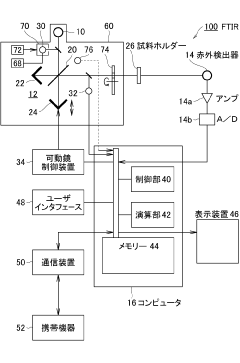
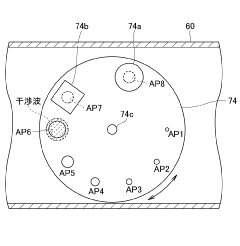
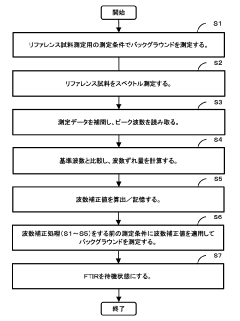
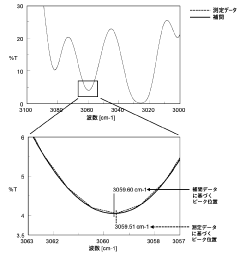
- A Fourier transform infrared spectrophotometer that uses a solid reference sample, such as a polystyrene film, with temperature and current adjustments for the semiconductor laser, and interpolation methods to accurately correct wavenumbers, enabling smooth and precise wavenumber correction.
Fourier transform infrared spectrometer
PatentWO2014132379A1
Innovation
- A Fourier Transform Infrared Spectrophotometer with a detachable sample chamber and interference optical system on a common base, featuring accessory information reading and setting condition changing means to adjust the interference optical system based on the type of accessory attached, ensuring optimal measurement conditions by compensating for base distortion and varying optical throughput.


Environmental Factors Affecting FTIR Measurement Accuracy
Environmental factors play a crucial role in determining the accuracy and reliability of Fourier Transform Infrared (FTIR) spectroscopy measurements. Temperature fluctuations represent one of the most significant environmental challenges, as they can cause thermal expansion or contraction of optical components, leading to wavelength shifts and baseline drift. Studies have shown that even minor temperature variations of ±2°C can result in measurement errors exceeding 5% for certain analytes, particularly in the fingerprint region (1500-500 cm⁻¹).
Humidity presents another critical environmental factor affecting FTIR performance. Water vapor absorbs strongly in multiple infrared regions, creating interference bands that can mask or distort spectral features of interest. High humidity environments (>60% RH) significantly impact measurements in the 3500-3900 cm⁻¹ and 1300-1800 cm⁻¹ regions, necessitating robust atmospheric compensation algorithms or controlled measurement environments.
Atmospheric composition variations, particularly fluctuating CO₂ levels, introduce additional measurement challenges. Carbon dioxide exhibits strong absorption bands around 2350 cm⁻¹ and 667 cm⁻¹, which can interfere with sample analysis. In industrial settings or laboratories with poor ventilation, CO₂ concentration may vary by 200-500 ppm throughout a workday, introducing systematic measurement errors if not properly compensated.
Mechanical vibrations transmitted through building structures or from nearby equipment can degrade FTIR performance by affecting interferometer alignment and mirror movement precision. Research indicates that vibrations above 0.1g acceleration can introduce significant noise across the spectral range, with particularly pronounced effects at higher wavenumbers (>3000 cm⁻¹).
Electromagnetic interference (EMI) from nearby electronic equipment can introduce noise patterns in FTIR measurements, particularly affecting the detector and signal processing components. Modern FTIR systems incorporate EMI shielding, but proximity to high-power equipment like NMR spectrometers or MRI machines can still compromise measurement quality.
Dust and particulate contamination represent a persistent challenge in maintaining FTIR accuracy. Particulates on optical surfaces reduce throughput and can introduce scattering effects that alter baseline characteristics. Studies demonstrate that even microscopic contamination can reduce signal-to-noise ratios by 15-30% and introduce subtle spectral artifacts that may be misinterpreted as sample features.
Barometric pressure variations, while often overlooked, can affect the refractive index of air and subsequently impact infrared beam paths and focusing. This effect becomes particularly relevant in high-precision applications or when operating at different elevations without recalibration. Pressure changes of 20 mbar have been shown to introduce subtle but measurable shifts in peak positions for gas-phase measurements.
Humidity presents another critical environmental factor affecting FTIR performance. Water vapor absorbs strongly in multiple infrared regions, creating interference bands that can mask or distort spectral features of interest. High humidity environments (>60% RH) significantly impact measurements in the 3500-3900 cm⁻¹ and 1300-1800 cm⁻¹ regions, necessitating robust atmospheric compensation algorithms or controlled measurement environments.
Atmospheric composition variations, particularly fluctuating CO₂ levels, introduce additional measurement challenges. Carbon dioxide exhibits strong absorption bands around 2350 cm⁻¹ and 667 cm⁻¹, which can interfere with sample analysis. In industrial settings or laboratories with poor ventilation, CO₂ concentration may vary by 200-500 ppm throughout a workday, introducing systematic measurement errors if not properly compensated.
Mechanical vibrations transmitted through building structures or from nearby equipment can degrade FTIR performance by affecting interferometer alignment and mirror movement precision. Research indicates that vibrations above 0.1g acceleration can introduce significant noise across the spectral range, with particularly pronounced effects at higher wavenumbers (>3000 cm⁻¹).
Electromagnetic interference (EMI) from nearby electronic equipment can introduce noise patterns in FTIR measurements, particularly affecting the detector and signal processing components. Modern FTIR systems incorporate EMI shielding, but proximity to high-power equipment like NMR spectrometers or MRI machines can still compromise measurement quality.
Dust and particulate contamination represent a persistent challenge in maintaining FTIR accuracy. Particulates on optical surfaces reduce throughput and can introduce scattering effects that alter baseline characteristics. Studies demonstrate that even microscopic contamination can reduce signal-to-noise ratios by 15-30% and introduce subtle spectral artifacts that may be misinterpreted as sample features.
Barometric pressure variations, while often overlooked, can affect the refractive index of air and subsequently impact infrared beam paths and focusing. This effect becomes particularly relevant in high-precision applications or when operating at different elevations without recalibration. Pressure changes of 20 mbar have been shown to introduce subtle but measurable shifts in peak positions for gas-phase measurements.
Cross-Industry Applications and Validation Protocols
FTIR spectroscopy has demonstrated remarkable versatility across multiple industries, with optimized calibration protocols enabling its successful implementation in diverse applications. In pharmaceutical manufacturing, FTIR calibration techniques have been refined to meet stringent regulatory requirements, allowing for real-time monitoring of active pharmaceutical ingredient concentrations during production processes. These calibration protocols typically involve multivariate analysis methods combined with reference standards traceable to national metrology institutes, ensuring measurement accuracy within ±0.5% across production batches.
The food and beverage industry has adopted specialized FTIR calibration approaches focusing on complex organic matrices. Validation protocols in this sector emphasize robustness against sample variability, with cross-validation techniques commonly employed to verify calibration models across different production lots and seasonal variations. Industry leaders have established collaborative networks to develop standardized calibration transfer protocols, enabling consistent measurements across multiple manufacturing facilities.
Environmental monitoring represents another critical application domain where FTIR calibration has been optimized for field deployability. Validation protocols in this sector incorporate challenging environmental conditions, including temperature fluctuations, humidity variations, and the presence of interfering compounds. Multi-site validation studies have demonstrated that properly calibrated portable FTIR systems can achieve detection limits comparable to laboratory-based instruments when appropriate environmental correction factors are applied.
The petrochemical industry has pioneered advanced validation approaches for FTIR calibration, particularly for in-line process monitoring applications. These protocols typically involve comprehensive robustness testing against process variations, including pressure fluctuations, flow rate changes, and catalyst aging effects. Statistical process control methodologies are integrated with calibration validation to ensure measurement stability over extended operational periods, with recalibration triggers based on statistical control limits rather than arbitrary time intervals.
Cross-industry validation standards have emerged through collaborative efforts between instrument manufacturers, metrology institutes, and industry consortia. These standards emphasize performance verification under actual operating conditions rather than idealized laboratory environments. Key validation metrics include spectral reproducibility, calibration model transferability between instruments, long-term stability, and measurement uncertainty under varying environmental conditions. The development of digital twins for FTIR systems has further enhanced validation capabilities by enabling virtual testing of calibration robustness against simulated process disturbances before implementation in production environments.
The food and beverage industry has adopted specialized FTIR calibration approaches focusing on complex organic matrices. Validation protocols in this sector emphasize robustness against sample variability, with cross-validation techniques commonly employed to verify calibration models across different production lots and seasonal variations. Industry leaders have established collaborative networks to develop standardized calibration transfer protocols, enabling consistent measurements across multiple manufacturing facilities.
Environmental monitoring represents another critical application domain where FTIR calibration has been optimized for field deployability. Validation protocols in this sector incorporate challenging environmental conditions, including temperature fluctuations, humidity variations, and the presence of interfering compounds. Multi-site validation studies have demonstrated that properly calibrated portable FTIR systems can achieve detection limits comparable to laboratory-based instruments when appropriate environmental correction factors are applied.
The petrochemical industry has pioneered advanced validation approaches for FTIR calibration, particularly for in-line process monitoring applications. These protocols typically involve comprehensive robustness testing against process variations, including pressure fluctuations, flow rate changes, and catalyst aging effects. Statistical process control methodologies are integrated with calibration validation to ensure measurement stability over extended operational periods, with recalibration triggers based on statistical control limits rather than arbitrary time intervals.
Cross-industry validation standards have emerged through collaborative efforts between instrument manufacturers, metrology institutes, and industry consortia. These standards emphasize performance verification under actual operating conditions rather than idealized laboratory environments. Key validation metrics include spectral reproducibility, calibration model transferability between instruments, long-term stability, and measurement uncertainty under varying environmental conditions. The development of digital twins for FTIR systems has further enhanced validation capabilities by enabling virtual testing of calibration robustness against simulated process disturbances before implementation in production environments.
Unlock deeper insights with Patsnap Eureka Quick Research — get a full tech report to explore trends and direct your research. Try now!
Generate Your Research Report Instantly with AI Agent
Supercharge your innovation with Patsnap Eureka AI Agent Platform!