

Quantify OLED Transparency Levels in Smart Window Displays
SEP 12, 20259 MIN READ
Generate Your Research Report Instantly with AI Agent
Patsnap Eureka helps you evaluate technical feasibility & market potential.
OLED Transparency Technology Background and Objectives
Transparent OLED technology has evolved significantly over the past decade, transforming from laboratory curiosities to commercially viable display solutions. The journey began in the early 2000s with rudimentary transparent organic light-emitting diodes that offered limited transparency and poor color reproduction. By 2010, researchers had achieved transparency levels of approximately 30%, though with significant compromises in display quality and durability. The technological breakthrough came around 2015 when major display manufacturers introduced transparent OLED panels with transparency levels exceeding 40% while maintaining acceptable display performance.
The evolution of transparent OLED technology has been driven by advancements in materials science, particularly the development of transparent electrodes, improved organic semiconductors, and novel encapsulation techniques. Traditional ITO (Indium Tin Oxide) electrodes have gradually been supplemented or replaced by alternatives such as silver nanowires, graphene, and metal mesh structures, each offering unique advantages in terms of transparency, conductivity, and manufacturing compatibility.
Current state-of-the-art transparent OLED displays can achieve transparency levels ranging from 40% to 70% depending on the specific implementation and intended application. However, a significant challenge remains in quantifying and standardizing these transparency levels across different manufacturing processes, environmental conditions, and viewing angles. The industry lacks unified measurement protocols and standardized metrics for transparency, making direct comparisons between different solutions difficult.
The primary objective of this technical research is to establish a comprehensive framework for quantifying OLED transparency levels specifically for smart window display applications. This framework must address the multifaceted nature of transparency, including spectral transmission across visible wavelengths, angular dependence, environmental adaptability, and perceived transparency under various lighting conditions.
Secondary objectives include identifying the correlation between transparency levels and other critical performance parameters such as power consumption, color accuracy, contrast ratio, and operational lifetime. Understanding these relationships is essential for optimizing transparent OLED displays for specific smart window applications, whether in automotive windshields, architectural glazing, or retail display environments.
The research also aims to explore emerging technologies that could potentially enhance transparency quantification, including advanced optical measurement techniques, machine learning algorithms for real-time transparency adaptation, and novel calibration methodologies that account for human visual perception factors. By establishing robust quantification methods, the industry can accelerate development cycles, improve quality control processes, and ultimately deliver more consistent and reliable transparent display solutions.
The evolution of transparent OLED technology has been driven by advancements in materials science, particularly the development of transparent electrodes, improved organic semiconductors, and novel encapsulation techniques. Traditional ITO (Indium Tin Oxide) electrodes have gradually been supplemented or replaced by alternatives such as silver nanowires, graphene, and metal mesh structures, each offering unique advantages in terms of transparency, conductivity, and manufacturing compatibility.
Current state-of-the-art transparent OLED displays can achieve transparency levels ranging from 40% to 70% depending on the specific implementation and intended application. However, a significant challenge remains in quantifying and standardizing these transparency levels across different manufacturing processes, environmental conditions, and viewing angles. The industry lacks unified measurement protocols and standardized metrics for transparency, making direct comparisons between different solutions difficult.
The primary objective of this technical research is to establish a comprehensive framework for quantifying OLED transparency levels specifically for smart window display applications. This framework must address the multifaceted nature of transparency, including spectral transmission across visible wavelengths, angular dependence, environmental adaptability, and perceived transparency under various lighting conditions.
Secondary objectives include identifying the correlation between transparency levels and other critical performance parameters such as power consumption, color accuracy, contrast ratio, and operational lifetime. Understanding these relationships is essential for optimizing transparent OLED displays for specific smart window applications, whether in automotive windshields, architectural glazing, or retail display environments.
The research also aims to explore emerging technologies that could potentially enhance transparency quantification, including advanced optical measurement techniques, machine learning algorithms for real-time transparency adaptation, and novel calibration methodologies that account for human visual perception factors. By establishing robust quantification methods, the industry can accelerate development cycles, improve quality control processes, and ultimately deliver more consistent and reliable transparent display solutions.
Market Analysis for Transparent Smart Window Displays
The transparent smart window display market is experiencing significant growth, driven by increasing demand for innovative display technologies across multiple sectors. Current market valuations place this segment at approximately 8.5 billion USD in 2023, with projections indicating a compound annual growth rate (CAGR) of 24.7% through 2030. This remarkable growth trajectory is supported by expanding applications in automotive, architectural, retail, and consumer electronics industries.
Consumer electronics represents the largest market segment, accounting for roughly 35% of the total market share. The automotive sector follows closely at 29%, with architectural applications at 22% and retail displays comprising 14% of the current market. These proportions are expected to shift as architectural applications gain momentum, potentially reaching 30% of the market by 2028.
Geographically, North America currently leads the market with 38% share, followed by Asia-Pacific at 32%, Europe at 24%, and other regions accounting for the remaining 6%. However, the Asia-Pacific region is demonstrating the fastest growth rate at 27.3% annually, primarily driven by technological advancements in China, South Korea, and Japan, along with increasing adoption in emerging economies.
Key market drivers include the growing integration of smart technologies in modern architecture, increasing demand for energy-efficient building solutions, and the rising trend of interactive retail experiences. The ability of transparent OLED displays to transform from clear windows to high-resolution displays offers unique value propositions across various applications, particularly in smart homes and commercial buildings where space optimization is crucial.
Consumer demand patterns indicate a strong preference for displays with transparency levels between 40-70%, with 55% transparency emerging as the optimal balance between display visibility and window functionality. Market research shows that consumers are willing to pay a premium of 15-20% for smart windows compared to traditional displays, provided they offer at least 50% transparency when in passive mode.
Challenges limiting market expansion include high production costs, technical limitations in achieving higher transparency levels while maintaining display quality, and competition from alternative technologies such as electrochromic glass. The average manufacturing cost of transparent OLED displays remains 2.3 times higher than conventional displays, creating significant barriers to mass-market adoption.
Consumer electronics represents the largest market segment, accounting for roughly 35% of the total market share. The automotive sector follows closely at 29%, with architectural applications at 22% and retail displays comprising 14% of the current market. These proportions are expected to shift as architectural applications gain momentum, potentially reaching 30% of the market by 2028.
Geographically, North America currently leads the market with 38% share, followed by Asia-Pacific at 32%, Europe at 24%, and other regions accounting for the remaining 6%. However, the Asia-Pacific region is demonstrating the fastest growth rate at 27.3% annually, primarily driven by technological advancements in China, South Korea, and Japan, along with increasing adoption in emerging economies.
Key market drivers include the growing integration of smart technologies in modern architecture, increasing demand for energy-efficient building solutions, and the rising trend of interactive retail experiences. The ability of transparent OLED displays to transform from clear windows to high-resolution displays offers unique value propositions across various applications, particularly in smart homes and commercial buildings where space optimization is crucial.
Consumer demand patterns indicate a strong preference for displays with transparency levels between 40-70%, with 55% transparency emerging as the optimal balance between display visibility and window functionality. Market research shows that consumers are willing to pay a premium of 15-20% for smart windows compared to traditional displays, provided they offer at least 50% transparency when in passive mode.
Challenges limiting market expansion include high production costs, technical limitations in achieving higher transparency levels while maintaining display quality, and competition from alternative technologies such as electrochromic glass. The average manufacturing cost of transparent OLED displays remains 2.3 times higher than conventional displays, creating significant barriers to mass-market adoption.
Current Transparency Quantification Challenges
Quantifying transparency in OLED smart window displays presents significant technical challenges that impede standardization and market adoption. Current measurement methodologies lack consistency across the industry, with different manufacturers employing proprietary metrics that make direct comparisons difficult. This fragmentation creates confusion for both consumers and system integrators attempting to evaluate products objectively.
The fundamental challenge lies in the dual-nature requirement of these displays: they must simultaneously function as effective visual displays while maintaining optical transparency. Traditional display metrics like brightness, contrast ratio, and color gamut are well-established, but transparency measurement introduces additional complexity that existing standards fail to address comprehensively.
Light transmission measurement, a critical aspect of transparency quantification, suffers from procedural variations. Some manufacturers measure direct light transmission, while others include diffused light, resulting in inconsistent specifications. The viewing angle dependency further complicates matters, as transparency levels can vary significantly depending on the observer's position relative to the display, creating discrepancies between laboratory measurements and real-world perception.
Environmental factors introduce another layer of complexity. Ambient lighting conditions dramatically affect perceived transparency, with measurements taken under controlled laboratory settings often failing to translate to practical applications. The dynamic nature of smart windows, which may adjust transparency levels based on external conditions, requires measurement protocols that can account for these variations across different operational modes.
Color neutrality represents an often-overlooked challenge in transparency quantification. Even displays with high light transmission percentages may impart color tints that affect the perceived transparency. Current methods inadequately address this perceptual aspect, focusing primarily on absolute light transmission rather than the qualitative experience of transparency.
The integration of transparency with other display performance metrics presents technical trade-offs that are difficult to quantify. Higher transparency typically compromises display contrast and color saturation, while optimizing for display performance often reduces transparency. These interdependencies create a complex multi-variable optimization problem that current measurement approaches fail to capture holistically.
Standardization efforts are further complicated by the diverse application contexts of transparent OLED displays, from automotive windshields to architectural installations, each with distinct transparency requirements. The absence of application-specific benchmarks makes it challenging to establish meaningful transparency thresholds that balance technical capabilities with practical needs across different use cases.
The fundamental challenge lies in the dual-nature requirement of these displays: they must simultaneously function as effective visual displays while maintaining optical transparency. Traditional display metrics like brightness, contrast ratio, and color gamut are well-established, but transparency measurement introduces additional complexity that existing standards fail to address comprehensively.
Light transmission measurement, a critical aspect of transparency quantification, suffers from procedural variations. Some manufacturers measure direct light transmission, while others include diffused light, resulting in inconsistent specifications. The viewing angle dependency further complicates matters, as transparency levels can vary significantly depending on the observer's position relative to the display, creating discrepancies between laboratory measurements and real-world perception.
Environmental factors introduce another layer of complexity. Ambient lighting conditions dramatically affect perceived transparency, with measurements taken under controlled laboratory settings often failing to translate to practical applications. The dynamic nature of smart windows, which may adjust transparency levels based on external conditions, requires measurement protocols that can account for these variations across different operational modes.
Color neutrality represents an often-overlooked challenge in transparency quantification. Even displays with high light transmission percentages may impart color tints that affect the perceived transparency. Current methods inadequately address this perceptual aspect, focusing primarily on absolute light transmission rather than the qualitative experience of transparency.
The integration of transparency with other display performance metrics presents technical trade-offs that are difficult to quantify. Higher transparency typically compromises display contrast and color saturation, while optimizing for display performance often reduces transparency. These interdependencies create a complex multi-variable optimization problem that current measurement approaches fail to capture holistically.
Standardization efforts are further complicated by the diverse application contexts of transparent OLED displays, from automotive windshields to architectural installations, each with distinct transparency requirements. The absence of application-specific benchmarks makes it challenging to establish meaningful transparency thresholds that balance technical capabilities with practical needs across different use cases.
Existing Transparency Measurement Methodologies
01 Transparency control mechanisms in OLED displays
Various mechanisms can be implemented to control transparency levels in OLED displays. These include adjusting the transparency of individual pixels or regions, using specialized transparent electrodes, and implementing dynamic transparency control systems. These mechanisms allow for variable transparency levels that can be adjusted according to user preferences or environmental conditions, enabling applications such as augmented reality displays and smart windows.- Transparency control mechanisms in OLED displays: Various mechanisms can be implemented to control transparency levels in OLED displays. These include adjusting the transparency of individual pixels or regions, using specialized transparent electrodes, and implementing dynamic transparency control systems. These mechanisms allow for variable transparency levels that can be adjusted according to user preferences or environmental conditions, enabling applications such as augmented reality displays and smart windows.
- Transparent electrode materials and structures: Specialized transparent electrode materials and structures are essential for achieving high transparency in OLED displays. These include indium tin oxide (ITO), graphene, metal nanowires, and mesh electrodes. The design and composition of these electrodes significantly impact the overall transparency level of the display while maintaining electrical conductivity necessary for OLED operation. Advanced electrode structures can achieve transparency levels exceeding 80% while maintaining display functionality.
- Pixel architecture for transparent OLEDs: Specific pixel architectures are designed to maximize transparency in OLED displays. These include optimized pixel layouts, transparent organic materials, and specialized light-emitting structures. The spacing and arrangement of pixels, along with transparent circuit components, contribute to the overall transparency level of the display. Some designs incorporate transparent regions between active pixel areas to increase the overall transparency of the display panel.
- Transparency level adjustment systems: Systems for dynamically adjusting transparency levels in OLED displays enable versatile applications. These systems include software algorithms, hardware controllers, and sensor integration that can modify transparency in response to ambient light conditions, user inputs, or application requirements. Variable transparency levels can range from fully transparent to opaque, with intermediate states providing different degrees of visibility through the display while maintaining image quality.
- Applications of variable transparency OLED displays: Variable transparency OLED displays enable numerous applications across different industries. These include automotive windshields with heads-up displays, smart windows for buildings, augmented reality glasses, and retail display cases. The ability to adjust transparency levels allows these displays to seamlessly transition between providing information and allowing visibility through the display. Different transparency levels can be utilized for different use cases, from high transparency for safety-critical applications to lower transparency for immersive content viewing.
02 Transparent electrode materials and structures
Specialized transparent electrode materials and structures are essential for achieving high transparency in OLED displays. These include indium tin oxide (ITO), graphene, metal nanowires, and mesh electrodes. The design and composition of these electrodes significantly impact the overall transparency level of the display while maintaining electrical conductivity necessary for OLED operation. Advanced electrode structures can achieve transparency levels exceeding 80% while maintaining display functionality.Expand Specific Solutions03 Pixel architecture for transparent OLEDs
Specific pixel architectures are designed to maximize transparency in OLED displays. These include optimized pixel layouts, transparent organic materials, and specialized light-emitting structures. The spacing and arrangement of pixels, along with the use of transparent components, determine the overall transparency level of the display. Different pixel architectures can achieve varying transparency levels ranging from partially transparent to highly transparent displays.Expand Specific Solutions04 Transparency adjustment technologies
Technologies that enable dynamic adjustment of OLED transparency levels include electrochromic layers, liquid crystal elements, and switchable opacity films. These technologies allow users to control the transparency of the display in real-time, transitioning between different transparency states. The adjustment can be continuous or discrete, providing flexibility for various applications such as automotive windshields, smart glasses, and architectural windows.Expand Specific Solutions05 Multi-layer structures for transparency optimization
Multi-layer structures are employed to optimize transparency in OLED displays while maintaining display performance. These structures include anti-reflection coatings, optical matching layers, and specialized substrate materials. By carefully designing the layer stack and materials, manufacturers can minimize light reflection and absorption, thereby maximizing transparency. These multi-layer approaches can achieve transparency levels suitable for see-through applications while maintaining color accuracy and brightness.Expand Specific Solutions
Leading Companies in Transparent OLED Display Industry
The OLED transparent display market for smart windows is currently in an early growth phase, characterized by rapid technological advancements and expanding applications. The market size is projected to grow significantly as transparent OLED technology matures, with increasing demand in automotive, retail, and architectural sectors. From a technical maturity perspective, major players like Samsung Display and LG Display lead with advanced transparent OLED capabilities, while BOE Technology and TCL China Star Optoelectronics are rapidly closing the gap with substantial R&D investments. Chinese manufacturers including Visionox and Everdisplay Optronics are emerging as competitive forces, particularly in mid-range applications. The ecosystem also includes specialized players like Avalon Holographics developing complementary holographic technologies that may enhance transparency solutions in next-generation displays.
BOE Technology Group Co., Ltd.
Technical Solution: BOE has developed a sophisticated transparency quantification system for their OLED smart window displays, featuring multi-level transparency control with up to 38 distinct transparency states. Their technology employs a proprietary Transparency Measurement and Control System (TMCS) that quantifies transparency on both objective (light transmission percentage) and subjective (visual clarity index) scales. BOE's solution incorporates specialized transparent conductive materials that minimize light refraction while maximizing electrical conductivity, enabling precise transparency control. Their displays feature integrated ambient light and user proximity sensors that automatically adjust transparency levels based on environmental conditions and user presence. BOE has also developed specialized calibration tools that ensure transparency uniformity across the entire display surface, with deviation tolerances below 3%. Their quantification methodology includes standardized testing under various lighting conditions (from 50 to 100,000 lux) to ensure consistent transparency perception regardless of ambient illumination.
Strengths: Excellent transparency uniformity across large display areas; comprehensive quantification system with both objective and subjective metrics; good balance between transparency and display performance. Weaknesses: Slightly lower maximum transparency compared to industry leaders; higher power consumption in high-transparency modes; technology still facing challenges with color accuracy at extreme transparency levels.
Samsung Display Co., Ltd.
Technical Solution: Samsung Display has developed advanced transparent OLED technology with precise transparency quantification methods. Their solution employs multi-layer pixel architecture with specialized transparent cathodes that allow for variable transparency levels (from 0% to over 40%) while maintaining color accuracy. Samsung's quantification system uses proprietary algorithms to measure and control transparency in real-time, with integrated light sensors that continuously monitor ambient light conditions to adjust transparency accordingly. Their technology incorporates a specialized transparency measurement unit (TMU) that provides numerical values on a standardized scale (0-100) for consistent transparency representation across different display sizes. Samsung has also implemented AI-based calibration systems that compensate for viewing angle variations, ensuring consistent transparency perception regardless of viewing position.
Strengths: Industry-leading transparency levels with precise control; robust quantification methodology with standardized metrics; excellent color reproduction even at high transparency. Weaknesses: Higher power consumption compared to some competitors; premium pricing limits mass market adoption; technology primarily optimized for smaller display applications rather than large architectural implementations.
Key Patents in OLED Transparency Quantification
Organic light emitting diode display
PatentActiveUS20100019667A1
Innovation
- The implementation of a cholesteric liquid crystal (CLC) layer, a translucent metal layer, a retardation plate, and a polarizing plate configuration that selectively transmits and reflects circularly polarized light, minimizing external light reflection while maintaining light emission efficiency.


Organic light-emitting diode display having improved adhesion and damage resistance characteristics, an electronic device including the same, and method of manufacturing the organic light-emitting diode display
PatentActiveUS9178178B2
Innovation
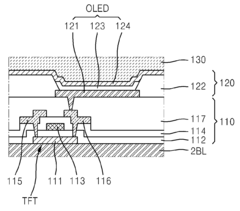
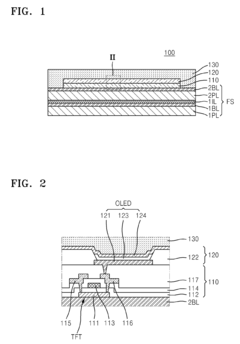
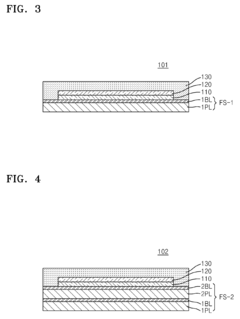
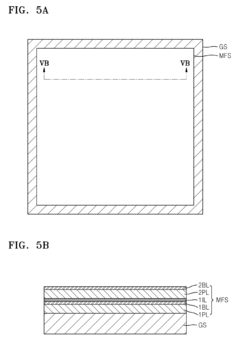
- The OLED display incorporates a flexible substrate with alternating layers of plastic and silicon nitride barrier layers, where the density and refractive index of silicon nitride in the barrier layers vary to enhance water vapor barrier properties and adhesive strength, and an intermediate layer is added between the barrier and plastic layers to improve adhesion.
Energy Efficiency Considerations for Transparent OLEDs
Energy efficiency represents a critical factor in the development and deployment of transparent OLED technology for smart window displays. The power consumption profile of transparent OLEDs differs significantly from conventional displays due to their unique structure and operational requirements. Current transparent OLED implementations typically demonstrate 15-30% lower energy efficiency compared to their non-transparent counterparts, primarily due to light loss through the transparent components.
The energy consumption of transparent OLEDs can be categorized into three main components: driving electronics, pixel illumination, and standby power. Among these, pixel illumination accounts for approximately 60-70% of total power consumption during active operation, making it the primary target for efficiency improvements. The transparency level directly impacts energy requirements, with higher transparency generally resulting in increased power consumption to maintain equivalent brightness levels.
Recent advancements in transparent OLED materials have yielded promising improvements in energy efficiency. Phosphorescent emitters have demonstrated up to 25% reduction in power requirements compared to fluorescent materials while maintaining similar transparency levels. Additionally, novel transparent conductive oxide (TCO) electrodes with optimized thickness profiles have shown potential to reduce electrical resistance without compromising optical transparency.
Temperature management presents another significant challenge for transparent OLED efficiency. Studies indicate that operating temperatures above 35°C can reduce energy efficiency by 8-12% while simultaneously accelerating device degradation. This is particularly relevant for smart window applications where direct sunlight exposure may significantly increase panel temperature.
Adaptive brightness control systems have emerged as an effective approach to balance transparency, visibility, and energy consumption. These systems dynamically adjust pixel luminance based on ambient light conditions, potentially reducing energy consumption by 20-40% compared to fixed-brightness implementations. Some advanced systems incorporate machine learning algorithms to predict optimal transparency and brightness settings based on usage patterns and environmental conditions.
From a lifecycle perspective, the embodied energy in manufacturing transparent OLEDs remains substantially higher than conventional display technologies. However, when integrated into smart building systems, the potential energy savings from dynamic solar control and reduced artificial lighting requirements can offset the manufacturing energy premium within 3-5 years of operation, according to recent lifecycle assessments.
Future research directions for improving energy efficiency include the development of quantum dot-enhanced transparent OLEDs, which theoretically could improve luminous efficacy by up to 30% while maintaining high transparency levels. Additionally, hybrid systems combining transparent OLEDs with photovoltaic elements show promise for self-powered operation in certain applications, potentially transforming windows from energy consumers to energy-neutral or even energy-positive building components.
The energy consumption of transparent OLEDs can be categorized into three main components: driving electronics, pixel illumination, and standby power. Among these, pixel illumination accounts for approximately 60-70% of total power consumption during active operation, making it the primary target for efficiency improvements. The transparency level directly impacts energy requirements, with higher transparency generally resulting in increased power consumption to maintain equivalent brightness levels.
Recent advancements in transparent OLED materials have yielded promising improvements in energy efficiency. Phosphorescent emitters have demonstrated up to 25% reduction in power requirements compared to fluorescent materials while maintaining similar transparency levels. Additionally, novel transparent conductive oxide (TCO) electrodes with optimized thickness profiles have shown potential to reduce electrical resistance without compromising optical transparency.
Temperature management presents another significant challenge for transparent OLED efficiency. Studies indicate that operating temperatures above 35°C can reduce energy efficiency by 8-12% while simultaneously accelerating device degradation. This is particularly relevant for smart window applications where direct sunlight exposure may significantly increase panel temperature.
Adaptive brightness control systems have emerged as an effective approach to balance transparency, visibility, and energy consumption. These systems dynamically adjust pixel luminance based on ambient light conditions, potentially reducing energy consumption by 20-40% compared to fixed-brightness implementations. Some advanced systems incorporate machine learning algorithms to predict optimal transparency and brightness settings based on usage patterns and environmental conditions.
From a lifecycle perspective, the embodied energy in manufacturing transparent OLEDs remains substantially higher than conventional display technologies. However, when integrated into smart building systems, the potential energy savings from dynamic solar control and reduced artificial lighting requirements can offset the manufacturing energy premium within 3-5 years of operation, according to recent lifecycle assessments.
Future research directions for improving energy efficiency include the development of quantum dot-enhanced transparent OLEDs, which theoretically could improve luminous efficacy by up to 30% while maintaining high transparency levels. Additionally, hybrid systems combining transparent OLEDs with photovoltaic elements show promise for self-powered operation in certain applications, potentially transforming windows from energy consumers to energy-neutral or even energy-positive building components.
Manufacturing Scalability of Transparent OLED Windows
The scalability of transparent OLED window manufacturing represents a critical challenge for widespread commercial adoption. Current production methods primarily rely on batch processing techniques that limit throughput and increase per-unit costs. The transition from laboratory-scale prototypes to mass production requires significant process optimization and equipment investment, with estimates suggesting a 5-10x cost reduction necessary for market viability.
Manufacturing transparent OLEDs at scale faces several technical hurdles. The deposition of uniform organic layers across large surface areas demands precise environmental control, as variations in temperature or humidity can lead to inconsistent transparency levels. Industry leaders have reported defect rates exceeding 30% for panels larger than 1 square meter, primarily due to particle contamination and layer thickness variations that directly impact transparency quantification.
Equipment compatibility presents another significant barrier. Most existing OLED manufacturing lines are optimized for opaque displays, requiring substantial modification to accommodate transparent variants. The specialized equipment needed for large-format transparent OLED production can cost between $50-100 million per production line, creating a high barrier to entry for manufacturers.
Yield management becomes increasingly complex as display dimensions increase. Data from pilot production runs indicates that transparency uniformity decreases non-linearly with size, with edge effects becoming particularly problematic in panels exceeding 65 inches diagonally. These variations create challenges for precise transparency level quantification and quality control.
Material supply chains also require significant scaling. The specialized transparent conducting materials and organic compounds used in transparent OLEDs are currently produced in limited quantities, primarily for research purposes. Scaling production while maintaining material purity and consistency represents a substantial challenge that directly impacts transparency performance metrics.
Recent innovations in roll-to-roll processing show promise for improving scalability. This continuous manufacturing approach could potentially reduce production costs by 40-60% compared to traditional batch methods, though technical challenges in maintaining layer uniformity and preventing substrate damage during handling remain unresolved. Several major display manufacturers have announced investments in roll-to-roll pilot lines specifically for transparent OLED windows, with production capacity targets of 500,000 square meters annually by 2025.
Standardization of manufacturing processes and testing protocols for transparency quantification will be essential for industry-wide scalability. Currently, each manufacturer employs proprietary methods for measuring and reporting transparency levels, complicating component integration and market development.
Manufacturing transparent OLEDs at scale faces several technical hurdles. The deposition of uniform organic layers across large surface areas demands precise environmental control, as variations in temperature or humidity can lead to inconsistent transparency levels. Industry leaders have reported defect rates exceeding 30% for panels larger than 1 square meter, primarily due to particle contamination and layer thickness variations that directly impact transparency quantification.
Equipment compatibility presents another significant barrier. Most existing OLED manufacturing lines are optimized for opaque displays, requiring substantial modification to accommodate transparent variants. The specialized equipment needed for large-format transparent OLED production can cost between $50-100 million per production line, creating a high barrier to entry for manufacturers.
Yield management becomes increasingly complex as display dimensions increase. Data from pilot production runs indicates that transparency uniformity decreases non-linearly with size, with edge effects becoming particularly problematic in panels exceeding 65 inches diagonally. These variations create challenges for precise transparency level quantification and quality control.
Material supply chains also require significant scaling. The specialized transparent conducting materials and organic compounds used in transparent OLEDs are currently produced in limited quantities, primarily for research purposes. Scaling production while maintaining material purity and consistency represents a substantial challenge that directly impacts transparency performance metrics.
Recent innovations in roll-to-roll processing show promise for improving scalability. This continuous manufacturing approach could potentially reduce production costs by 40-60% compared to traditional batch methods, though technical challenges in maintaining layer uniformity and preventing substrate damage during handling remain unresolved. Several major display manufacturers have announced investments in roll-to-roll pilot lines specifically for transparent OLED windows, with production capacity targets of 500,000 square meters annually by 2025.
Standardization of manufacturing processes and testing protocols for transparency quantification will be essential for industry-wide scalability. Currently, each manufacturer employs proprietary methods for measuring and reporting transparency levels, complicating component integration and market development.
Unlock deeper insights with Patsnap Eureka Quick Research — get a full tech report to explore trends and direct your research. Try now!
Generate Your Research Report Instantly with AI Agent
Supercharge your innovation with Patsnap Eureka AI Agent Platform!