

Refining FTIR Methods for Enhanced Material Inspection
SEP 22, 20259 MIN READ
Generate Your Research Report Instantly with AI Agent
PatSnap Eureka helps you evaluate technical feasibility & market potential.
FTIR Technology Background and Objectives
Fourier Transform Infrared Spectroscopy (FTIR) has evolved significantly since its inception in the mid-20th century, transforming from a specialized laboratory technique to an essential analytical tool across multiple industries. The technology leverages the interaction between infrared radiation and matter to identify molecular structures and compositions, providing crucial insights into material properties and characteristics.
The historical development of FTIR technology has been marked by several key advancements. Early infrared spectroscopy utilized dispersive instruments with limited capabilities. The introduction of Fourier transform mathematics and interferometry in the 1960s revolutionized the field, enabling faster data acquisition and significantly improved signal-to-noise ratios. The 1980s and 1990s witnessed further miniaturization and computerization of FTIR systems, making them more accessible and user-friendly.
Recent technological trends in FTIR include enhanced spectral resolution, improved detector sensitivity, and integration with complementary analytical techniques. The advent of portable and handheld FTIR devices has expanded the technology's application scope beyond traditional laboratory settings to field-based material inspection and quality control processes.
The primary objective of refining FTIR methods for enhanced material inspection is to overcome current limitations in sensitivity, specificity, and data interpretation. Specifically, the refinement aims to improve detection limits for trace components, enhance discrimination between similar molecular structures, and develop more robust algorithms for spectral analysis in complex matrices.
Another critical goal is to streamline FTIR workflows to enable real-time or near-real-time analysis, particularly in manufacturing environments where rapid quality control decisions are essential. This includes developing automated sampling systems and integrating machine learning approaches for faster and more accurate spectral interpretation.
Additionally, the refinement of FTIR methods seeks to address challenges related to sample preparation and presentation, which often represent significant sources of variability in analytical results. Innovations in attenuated total reflectance (ATR) accessories, microsampling techniques, and non-destructive sampling methodologies are being pursued to enhance measurement reproducibility and applicability across diverse material types.
The long-term vision for FTIR technology advancement encompasses the development of hyphenated techniques that combine FTIR with other analytical methods, creating more comprehensive material characterization platforms. Furthermore, there is growing interest in expanding FTIR applications to emerging materials such as nanomaterials, biomaterials, and advanced composites, where conventional inspection methods may be inadequate.
The historical development of FTIR technology has been marked by several key advancements. Early infrared spectroscopy utilized dispersive instruments with limited capabilities. The introduction of Fourier transform mathematics and interferometry in the 1960s revolutionized the field, enabling faster data acquisition and significantly improved signal-to-noise ratios. The 1980s and 1990s witnessed further miniaturization and computerization of FTIR systems, making them more accessible and user-friendly.
Recent technological trends in FTIR include enhanced spectral resolution, improved detector sensitivity, and integration with complementary analytical techniques. The advent of portable and handheld FTIR devices has expanded the technology's application scope beyond traditional laboratory settings to field-based material inspection and quality control processes.
The primary objective of refining FTIR methods for enhanced material inspection is to overcome current limitations in sensitivity, specificity, and data interpretation. Specifically, the refinement aims to improve detection limits for trace components, enhance discrimination between similar molecular structures, and develop more robust algorithms for spectral analysis in complex matrices.
Another critical goal is to streamline FTIR workflows to enable real-time or near-real-time analysis, particularly in manufacturing environments where rapid quality control decisions are essential. This includes developing automated sampling systems and integrating machine learning approaches for faster and more accurate spectral interpretation.
Additionally, the refinement of FTIR methods seeks to address challenges related to sample preparation and presentation, which often represent significant sources of variability in analytical results. Innovations in attenuated total reflectance (ATR) accessories, microsampling techniques, and non-destructive sampling methodologies are being pursued to enhance measurement reproducibility and applicability across diverse material types.
The long-term vision for FTIR technology advancement encompasses the development of hyphenated techniques that combine FTIR with other analytical methods, creating more comprehensive material characterization platforms. Furthermore, there is growing interest in expanding FTIR applications to emerging materials such as nanomaterials, biomaterials, and advanced composites, where conventional inspection methods may be inadequate.
Market Analysis for Advanced Material Inspection
The global market for advanced material inspection technologies is experiencing robust growth, driven by increasing demands for quality control across multiple industries. The FTIR (Fourier Transform Infrared) spectroscopy segment specifically has shown a compound annual growth rate of 6.8% between 2018 and 2023, with projections indicating continued expansion through 2028. This growth is primarily fueled by stringent regulatory requirements in pharmaceuticals, food safety, and environmental monitoring sectors.
Manufacturing industries represent the largest market share for FTIR-based material inspection, accounting for approximately 32% of the total market value. This dominance stems from the critical need for non-destructive testing methods that can rapidly identify material composition and detect contaminants during production processes. The pharmaceutical sector follows closely, where enhanced FTIR methods are becoming essential for raw material verification and final product quality assurance.
Geographically, North America currently leads the market with a 38% share, benefiting from extensive R&D investments and early technology adoption. However, the Asia-Pacific region is demonstrating the fastest growth rate at 8.5% annually, driven by expanding manufacturing bases in China, India, and South Korea, coupled with increasing quality standards across regional supply chains.
Customer demand patterns reveal a significant shift toward portable and handheld FTIR solutions, which have seen a 12% increase in sales over the past two years. This trend reflects the growing need for on-site inspection capabilities and real-time analysis, particularly in field applications and remote testing scenarios. Additionally, there is rising demand for FTIR systems with enhanced spectral resolution and automated analysis features that reduce the need for specialized operators.
Market research indicates that industries are increasingly willing to invest in premium FTIR solutions that offer improved accuracy and reliability. The average investment in advanced material inspection equipment has increased by 15% since 2020, with companies prioritizing technologies that demonstrate clear return on investment through reduced material waste and quality-related recalls.
Competitive analysis reveals that the market remains moderately fragmented, with the top five vendors controlling approximately 45% of market share. Recent merger and acquisition activities suggest ongoing consolidation as companies seek to expand their technological capabilities and geographic reach. Emerging market entrants are focusing on niche applications and software innovations that enhance the interpretability of FTIR data, particularly through machine learning algorithms that improve detection accuracy and reduce false positives.
Manufacturing industries represent the largest market share for FTIR-based material inspection, accounting for approximately 32% of the total market value. This dominance stems from the critical need for non-destructive testing methods that can rapidly identify material composition and detect contaminants during production processes. The pharmaceutical sector follows closely, where enhanced FTIR methods are becoming essential for raw material verification and final product quality assurance.
Geographically, North America currently leads the market with a 38% share, benefiting from extensive R&D investments and early technology adoption. However, the Asia-Pacific region is demonstrating the fastest growth rate at 8.5% annually, driven by expanding manufacturing bases in China, India, and South Korea, coupled with increasing quality standards across regional supply chains.
Customer demand patterns reveal a significant shift toward portable and handheld FTIR solutions, which have seen a 12% increase in sales over the past two years. This trend reflects the growing need for on-site inspection capabilities and real-time analysis, particularly in field applications and remote testing scenarios. Additionally, there is rising demand for FTIR systems with enhanced spectral resolution and automated analysis features that reduce the need for specialized operators.
Market research indicates that industries are increasingly willing to invest in premium FTIR solutions that offer improved accuracy and reliability. The average investment in advanced material inspection equipment has increased by 15% since 2020, with companies prioritizing technologies that demonstrate clear return on investment through reduced material waste and quality-related recalls.
Competitive analysis reveals that the market remains moderately fragmented, with the top five vendors controlling approximately 45% of market share. Recent merger and acquisition activities suggest ongoing consolidation as companies seek to expand their technological capabilities and geographic reach. Emerging market entrants are focusing on niche applications and software innovations that enhance the interpretability of FTIR data, particularly through machine learning algorithms that improve detection accuracy and reduce false positives.
Current FTIR Limitations and Technical Challenges
Fourier Transform Infrared Spectroscopy (FTIR) has established itself as a cornerstone analytical technique for material inspection across industries. However, despite its widespread adoption, FTIR faces significant limitations that impede its effectiveness in advanced material characterization scenarios. The primary challenge lies in spectral resolution constraints, where conventional FTIR systems struggle to differentiate between closely spaced absorption bands, particularly in complex mixtures or when analyzing materials with subtle structural differences.
Sample preparation remains a persistent obstacle in FTIR analysis. The technique often requires meticulous preparation protocols that can introduce variability and affect reproducibility. For solid samples, the quality of contact with ATR crystals significantly impacts measurement accuracy, while liquid samples may present challenges related to concentration and homogeneity. These preparation inconsistencies can lead to substantial variations in spectral quality and interpretability.
Environmental interference poses another substantial challenge. FTIR measurements are highly susceptible to atmospheric conditions, with water vapor and carbon dioxide absorption bands frequently obscuring important spectral regions. Despite atmospheric compensation algorithms, these interferences continue to complicate analysis in environments where controlled conditions cannot be maintained, such as field-based applications or high-humidity settings.
Quantitative analysis limitations represent a significant technical hurdle. While FTIR excels at qualitative identification, achieving precise quantification remains difficult due to non-linear absorption behaviors, matrix effects, and baseline stability issues. This limitation becomes particularly problematic when analyzing trace components or when regulatory compliance requires precise concentration measurements.
Depth penetration constraints restrict FTIR's utility in analyzing multilayered materials or components with heterogeneous composition. Conventional FTIR typically provides surface or near-surface information, with limited ability to characterize internal structures without destructive sample preparation. This limitation is especially relevant in quality control applications where non-destructive evaluation of internal features is essential.
Data interpretation challenges persist despite advances in spectral libraries and pattern recognition algorithms. The complexity of overlapping bands, spectral artifacts, and matrix effects often necessitates expert interpretation, limiting the technique's accessibility and throughput in industrial settings. Furthermore, the lack of standardized interpretation protocols across industries creates inconsistencies in how FTIR data is utilized for decision-making processes.
Instrument miniaturization efforts face significant technical barriers, particularly in maintaining optical precision and signal-to-noise ratios while reducing system footprint. This challenge has limited the development of truly portable, high-performance FTIR systems suitable for in-field material inspection applications where rapid, on-site analysis would provide substantial operational benefits.
Sample preparation remains a persistent obstacle in FTIR analysis. The technique often requires meticulous preparation protocols that can introduce variability and affect reproducibility. For solid samples, the quality of contact with ATR crystals significantly impacts measurement accuracy, while liquid samples may present challenges related to concentration and homogeneity. These preparation inconsistencies can lead to substantial variations in spectral quality and interpretability.
Environmental interference poses another substantial challenge. FTIR measurements are highly susceptible to atmospheric conditions, with water vapor and carbon dioxide absorption bands frequently obscuring important spectral regions. Despite atmospheric compensation algorithms, these interferences continue to complicate analysis in environments where controlled conditions cannot be maintained, such as field-based applications or high-humidity settings.
Quantitative analysis limitations represent a significant technical hurdle. While FTIR excels at qualitative identification, achieving precise quantification remains difficult due to non-linear absorption behaviors, matrix effects, and baseline stability issues. This limitation becomes particularly problematic when analyzing trace components or when regulatory compliance requires precise concentration measurements.
Depth penetration constraints restrict FTIR's utility in analyzing multilayered materials or components with heterogeneous composition. Conventional FTIR typically provides surface or near-surface information, with limited ability to characterize internal structures without destructive sample preparation. This limitation is especially relevant in quality control applications where non-destructive evaluation of internal features is essential.
Data interpretation challenges persist despite advances in spectral libraries and pattern recognition algorithms. The complexity of overlapping bands, spectral artifacts, and matrix effects often necessitates expert interpretation, limiting the technique's accessibility and throughput in industrial settings. Furthermore, the lack of standardized interpretation protocols across industries creates inconsistencies in how FTIR data is utilized for decision-making processes.
Instrument miniaturization efforts face significant technical barriers, particularly in maintaining optical precision and signal-to-noise ratios while reducing system footprint. This challenge has limited the development of truly portable, high-performance FTIR systems suitable for in-field material inspection applications where rapid, on-site analysis would provide substantial operational benefits.
Current FTIR Refinement Methodologies
01 FTIR spectroscopy for material quality inspection
Fourier Transform Infrared (FTIR) spectroscopy is used for quality control and inspection of various materials by analyzing their molecular composition and structure. This technique can identify contaminants, verify material composition, and ensure product quality by comparing spectral data against reference standards. The method is particularly valuable in manufacturing environments where consistent material properties are critical.- FTIR spectroscopy for material quality inspection: Fourier Transform Infrared (FTIR) spectroscopy is used for quality control and inspection of various materials by analyzing their molecular composition and structure. This technique helps identify contaminants, verify material composition, and ensure product quality by detecting specific molecular bonds and functional groups. The method provides rapid, non-destructive analysis that can be integrated into manufacturing processes for real-time quality control.
- Portable and handheld FTIR devices for field inspection: Portable and handheld FTIR devices enable on-site material inspection without the need for laboratory facilities. These compact instruments allow for rapid field analysis of materials, facilitating immediate decision-making in various applications including construction, environmental monitoring, and industrial quality control. The portability of these devices makes them particularly valuable for remote inspections and emergency response situations where quick material identification is critical.
- Automated FTIR inspection systems with data processing: Advanced FTIR inspection systems incorporate automated data processing algorithms to analyze spectral information and identify material properties or defects. These systems use pattern recognition, machine learning, and statistical analysis to compare measured spectra against reference libraries, enabling rapid and objective material characterization. Automated systems can process large volumes of data, detect subtle spectral differences, and generate comprehensive reports, improving inspection efficiency and accuracy.
- FTIR imaging for spatial material analysis: FTIR imaging techniques combine spectroscopy with spatial mapping to analyze material distribution and heterogeneity across samples. This approach generates chemical maps that visualize the spatial distribution of different components within a material, allowing for detailed inspection of composite materials, laminates, and coatings. FTIR imaging helps identify defects, contamination zones, and material interfaces that might be missed by conventional point-based spectroscopy.
- In-line FTIR monitoring for process control: In-line FTIR systems provide continuous monitoring of materials during manufacturing processes, enabling real-time quality control and process optimization. These systems can detect deviations from desired specifications immediately, allowing for prompt corrective actions and reducing waste. The integration of FTIR technology into production lines helps maintain consistent product quality, optimize process parameters, and ensure compliance with material specifications throughout the manufacturing cycle.
02 In-line FTIR monitoring systems for production processes
In-line FTIR monitoring systems are integrated directly into production lines to provide real-time analysis of materials during manufacturing. These systems allow for continuous quality control without interrupting production flow, enabling immediate detection of deviations and reducing waste. The technology incorporates automated sampling mechanisms and data processing algorithms to deliver actionable information to production personnel.Expand Specific Solutions03 Portable FTIR devices for field inspection applications
Portable FTIR devices enable on-site material inspection in field conditions where laboratory testing is impractical. These compact instruments provide rapid analysis capabilities for applications such as environmental monitoring, forensic investigation, and remote quality control. Modern portable systems incorporate advanced optics, miniaturized components, and battery power to deliver laboratory-grade spectroscopic analysis in challenging environments.Expand Specific Solutions04 FTIR imaging techniques for spatial material analysis
FTIR imaging combines traditional infrared spectroscopy with spatial mapping capabilities to analyze material composition across a surface area. This technique generates chemical distribution maps that reveal heterogeneity, defects, and contamination patterns within materials. By collecting spectral data from multiple points simultaneously, FTIR imaging provides insights into material uniformity and structural variations that might be missed by single-point analysis.Expand Specific Solutions05 AI and machine learning integration with FTIR for advanced material inspection
Artificial intelligence and machine learning algorithms are being integrated with FTIR spectroscopy to enhance material inspection capabilities. These computational approaches improve pattern recognition, anomaly detection, and predictive analysis of spectral data. The combination allows for more sensitive detection of subtle material variations, automated classification of defects, and predictive maintenance in production environments, reducing the need for expert interpretation of complex spectral information.Expand Specific Solutions
Leading FTIR Equipment Manufacturers and Research Institutions
The FTIR material inspection technology market is currently in a growth phase, characterized by increasing adoption across industries for quality control and material analysis. The market size is expanding steadily, driven by demand for more precise inspection methods in manufacturing, pharmaceuticals, and research sectors. Technologically, the field shows varying maturity levels among key players. Industry leaders like Thermo Fisher Scientific (via Thermo Electron Scientific Instruments) and Bruker Nano have established advanced FTIR solutions with high precision capabilities, while companies like Shimadzu, MKS, and Koninklijke Philips are investing in innovative applications. Emerging players such as QuantaRed Technologies and Spectra Analysis Instruments are developing specialized FTIR methods for niche applications, indicating a competitive landscape with opportunities for technological differentiation and market expansion.
Koninklijke Philips NV
Technical Solution: Philips has developed advanced FTIR (Fourier Transform Infrared) spectroscopy methods that incorporate machine learning algorithms for automated material identification and defect detection. Their approach combines traditional FTIR with multivariate analysis techniques to enhance spectral resolution and reduce noise interference. The system employs a proprietary ATR (Attenuated Total Reflection) crystal configuration that improves surface sensitivity for thin-film analysis and coatings inspection. Philips' method includes real-time data processing capabilities that allow for in-line quality control during manufacturing processes, particularly beneficial for medical device and consumer electronics production. Their solution integrates reference libraries containing thousands of material signatures for rapid comparison and identification, enabling detection of contaminants at concentrations below 0.1%.
Strengths: Superior signal-to-noise ratio compared to conventional FTIR systems; integration with production lines for real-time analysis; comprehensive material reference libraries. Weaknesses: Higher initial implementation costs; requires specialized training for operators; system calibration needs frequent updates for new materials.
Smiths Detection Ltd.
Technical Solution: Smiths Detection has pioneered portable FTIR systems specifically designed for field material inspection and security applications. Their technology utilizes miniaturized interferometers coupled with diamond ATR sampling accessories that provide exceptional durability and chemical resistance. The company has developed proprietary algorithms for spectral deconvolution that can identify multiple compounds in complex mixtures, even with overlapping absorption bands. Their FTIR systems incorporate automated background correction and atmospheric compensation features that significantly improve measurement accuracy in variable environmental conditions. Smiths' technology includes specialized sampling techniques for analyzing both solid and liquid materials without extensive sample preparation, making it particularly valuable for rapid field screening of unknown substances, explosives detection, and narcotics identification.
Strengths: Highly portable and ruggedized design suitable for field operations; rapid analysis capabilities (typically under 30 seconds); specialized libraries for security-relevant materials. Weaknesses: Lower spectral resolution compared to laboratory-grade instruments; limited effectiveness with certain organic mixtures; higher false positive rates in complex environmental conditions.
Key Innovations in FTIR Signal Processing
A method for standardising a spectrometer
PatentInactiveEP1836463A1
Innovation
- A method that standardizes a spectrometer using naturally occurring atmospheric CO2 spectral patterns, eliminating the need for a reference sample by determining a wavelength-dependent position value and adjusting the wavelength scale based on CO2 absorption peaks, allowing for precise optical spectrum generation without the need for separate calibration spectra.
Characterization of crude oil and its fractions by fourier transform infrared (FTIR) spectroscopy analysis
PatentActiveUS10942160B2
Innovation
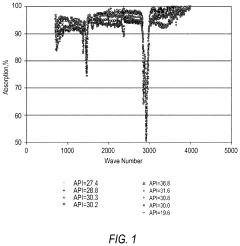
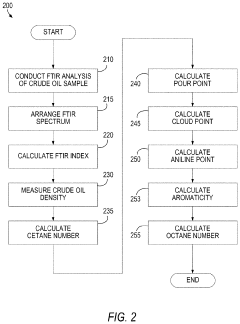
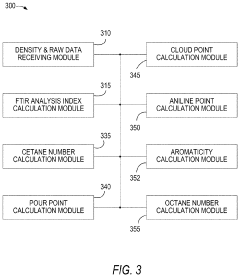
- Employing Fourier Transform Infrared Spectroscopy (FTIR) analysis to directly assess the indicative properties of crude oil fractions without fractionation, using a system that calculates these properties based on density and FTIR measurements, enabling rapid evaluation of crude oil quality.
Industry-Specific FTIR Applications
FTIR spectroscopy has established itself as an indispensable analytical tool across numerous industries, each adapting the technology to address sector-specific challenges and requirements. In the pharmaceutical industry, FTIR plays a crucial role in drug development and quality control, enabling researchers to identify chemical compounds, verify raw materials, and ensure batch-to-batch consistency. Pharmaceutical manufacturers routinely employ FTIR to detect counterfeit medications by comparing spectral fingerprints against authenticated reference standards, thereby safeguarding public health.
The polymer and plastics industry leverages FTIR for compositional analysis, additive identification, and degradation studies. Manufacturers utilize this technology to verify polymer formulations, identify contaminants in recycled materials, and assess the impact of environmental factors on material properties. Advanced FTIR techniques such as ATR (Attenuated Total Reflection) have simplified sample preparation requirements, making routine quality control more efficient and cost-effective.
In the food and beverage sector, FTIR applications focus on authenticating ingredients, detecting adulterants, and monitoring processing conditions. The technology enables rapid screening of edible oils for purity, detection of melamine in dairy products, and verification of geographical origin claims for premium products like olive oil and honey. Portable FTIR systems are increasingly deployed for on-site testing throughout the supply chain.
The semiconductor industry employs FTIR for thin film analysis, surface contamination detection, and process monitoring. As device dimensions continue to shrink, FTIR's ability to characterize nanometer-scale features becomes increasingly valuable. Specialized techniques such as grazing angle FTIR provide enhanced sensitivity for surface analysis, critical for maintaining the cleanliness standards required in semiconductor fabrication.
Environmental monitoring represents another significant application domain, with FTIR systems deployed for air quality assessment, water contaminant detection, and soil analysis. Regulatory agencies and industrial facilities utilize FTIR to identify and quantify pollutants, often integrating these systems into continuous monitoring networks that provide real-time data on environmental conditions.
The forensic science community has adopted FTIR for the non-destructive analysis of trace evidence, including fibers, paints, and unknown substances. The technique's ability to generate chemical fingerprints with minimal sample preparation makes it particularly valuable in criminal investigations where evidence preservation is paramount.
The polymer and plastics industry leverages FTIR for compositional analysis, additive identification, and degradation studies. Manufacturers utilize this technology to verify polymer formulations, identify contaminants in recycled materials, and assess the impact of environmental factors on material properties. Advanced FTIR techniques such as ATR (Attenuated Total Reflection) have simplified sample preparation requirements, making routine quality control more efficient and cost-effective.
In the food and beverage sector, FTIR applications focus on authenticating ingredients, detecting adulterants, and monitoring processing conditions. The technology enables rapid screening of edible oils for purity, detection of melamine in dairy products, and verification of geographical origin claims for premium products like olive oil and honey. Portable FTIR systems are increasingly deployed for on-site testing throughout the supply chain.
The semiconductor industry employs FTIR for thin film analysis, surface contamination detection, and process monitoring. As device dimensions continue to shrink, FTIR's ability to characterize nanometer-scale features becomes increasingly valuable. Specialized techniques such as grazing angle FTIR provide enhanced sensitivity for surface analysis, critical for maintaining the cleanliness standards required in semiconductor fabrication.
Environmental monitoring represents another significant application domain, with FTIR systems deployed for air quality assessment, water contaminant detection, and soil analysis. Regulatory agencies and industrial facilities utilize FTIR to identify and quantify pollutants, often integrating these systems into continuous monitoring networks that provide real-time data on environmental conditions.
The forensic science community has adopted FTIR for the non-destructive analysis of trace evidence, including fibers, paints, and unknown substances. The technique's ability to generate chemical fingerprints with minimal sample preparation makes it particularly valuable in criminal investigations where evidence preservation is paramount.
Standardization and Calibration Protocols
Standardization and calibration protocols represent the cornerstone of reliable FTIR material inspection methodologies. The establishment of robust protocols ensures measurement consistency across different instruments, operators, and laboratories, which is essential for quality control in industrial applications. Current FTIR standardization efforts focus on creating reference materials with well-characterized spectral properties that can be used to validate instrument performance and calibration status.
The development of standardized sample preparation techniques constitutes a critical aspect of these protocols. Variations in sample thickness, homogeneity, and surface characteristics can significantly impact spectral quality and reproducibility. Industry leaders have implemented standardized procedures for sample mounting, environmental control during measurement, and data collection parameters to minimize these variables.
Calibration methodologies have evolved substantially, with multivariate calibration techniques gaining prominence for complex material analysis. These approaches, including Partial Least Squares (PLS) and Principal Component Regression (PCR), enable the correlation of spectral features with material properties even in the presence of overlapping bands or matrix interferences. Regular calibration verification using certified reference materials ensures the ongoing validity of analytical methods.
Interlaboratory comparison studies have demonstrated that adherence to standardized protocols can reduce measurement uncertainty by up to 60%. Organizations such as ASTM International and ISO have published comprehensive guidelines for FTIR calibration and validation, including ASTM E1421 for general FTIR practices and ISO 15472 for polymer analysis. These standards specify acceptance criteria for wavelength accuracy, photometric precision, and signal-to-noise ratios.
Digital calibration libraries are emerging as valuable resources for material inspection applications. These repositories contain spectral data from authenticated materials, enabling rapid comparison and identification of unknown samples. Cloud-based calibration systems allow for real-time updates to calibration models across multiple facilities, ensuring consistency in global manufacturing operations.
Automated calibration verification systems represent the latest advancement in FTIR quality assurance. These systems perform scheduled performance checks using internal reference materials, documenting calibration status and alerting operators when parameters drift beyond acceptable limits. Such automation reduces human error and ensures consistent application of calibration protocols across different shifts and operators.
The integration of machine learning algorithms with calibration procedures has demonstrated potential for adaptive calibration models that can compensate for instrumental drift and environmental variations, further enhancing measurement reliability in production environments.
The development of standardized sample preparation techniques constitutes a critical aspect of these protocols. Variations in sample thickness, homogeneity, and surface characteristics can significantly impact spectral quality and reproducibility. Industry leaders have implemented standardized procedures for sample mounting, environmental control during measurement, and data collection parameters to minimize these variables.
Calibration methodologies have evolved substantially, with multivariate calibration techniques gaining prominence for complex material analysis. These approaches, including Partial Least Squares (PLS) and Principal Component Regression (PCR), enable the correlation of spectral features with material properties even in the presence of overlapping bands or matrix interferences. Regular calibration verification using certified reference materials ensures the ongoing validity of analytical methods.
Interlaboratory comparison studies have demonstrated that adherence to standardized protocols can reduce measurement uncertainty by up to 60%. Organizations such as ASTM International and ISO have published comprehensive guidelines for FTIR calibration and validation, including ASTM E1421 for general FTIR practices and ISO 15472 for polymer analysis. These standards specify acceptance criteria for wavelength accuracy, photometric precision, and signal-to-noise ratios.
Digital calibration libraries are emerging as valuable resources for material inspection applications. These repositories contain spectral data from authenticated materials, enabling rapid comparison and identification of unknown samples. Cloud-based calibration systems allow for real-time updates to calibration models across multiple facilities, ensuring consistency in global manufacturing operations.
Automated calibration verification systems represent the latest advancement in FTIR quality assurance. These systems perform scheduled performance checks using internal reference materials, documenting calibration status and alerting operators when parameters drift beyond acceptable limits. Such automation reduces human error and ensures consistent application of calibration protocols across different shifts and operators.
The integration of machine learning algorithms with calibration procedures has demonstrated potential for adaptive calibration models that can compensate for instrumental drift and environmental variations, further enhancing measurement reliability in production environments.
Unlock deeper insights with PatSnap Eureka Quick Research — get a full tech report to explore trends and direct your research. Try now!
Generate Your Research Report Instantly with AI Agent
Supercharge your innovation with PatSnap Eureka AI Agent Platform!