

Research on Hydrogen storage materials for high efficiency EV systems
SEP 24, 20259 MIN READ
Generate Your Research Report Instantly with AI Agent
PatSnap Eureka helps you evaluate technical feasibility & market potential.
Hydrogen Storage Materials Background and Objectives
Hydrogen storage materials have emerged as a critical component in the evolution of clean energy systems, particularly for electric vehicles (EVs). The development of these materials dates back to the 1970s when the potential of hydrogen as an energy carrier first gained significant attention during the oil crisis. Since then, research has progressed through various generations of storage technologies, from conventional compressed gas systems to advanced solid-state materials with enhanced storage capacities.
The technological trajectory has been marked by continuous improvements in volumetric and gravimetric hydrogen density, with recent breakthroughs in metal hydrides, complex hydrides, and nanoporous materials showing promising results. Current research is increasingly focused on materials that can operate under moderate temperature and pressure conditions while maintaining rapid hydrogen absorption and desorption kinetics, essential requirements for practical EV applications.
Market trends indicate a growing interest in hydrogen-powered vehicles as part of the broader transition to sustainable transportation. Major automotive manufacturers have begun investing in hydrogen fuel cell electric vehicles (FCEVs), creating a demand for efficient and safe hydrogen storage solutions. This shift is further supported by governmental policies worldwide that aim to reduce carbon emissions and promote clean energy technologies.
The primary technical objective of hydrogen storage materials research for EVs is to develop systems that meet the U.S. Department of Energy's targets: 6.5 wt% gravimetric capacity and 50 g/L volumetric capacity at near-ambient conditions. These benchmarks are considered essential for achieving driving ranges comparable to conventional vehicles while maintaining reasonable refueling times and safety standards.
Additional objectives include enhancing the cycle life of storage materials to match vehicle lifespans, reducing material costs to enable commercial viability, and improving system integration with fuel cells and other EV components. Research also aims to address safety concerns related to hydrogen storage, particularly in mobile applications where crash resistance and thermal management are critical considerations.
The evolution of hydrogen storage technologies is increasingly intertwined with advancements in computational materials science, allowing for more efficient screening and design of novel materials with optimized properties. This computational approach, combined with high-throughput experimental techniques, is accelerating the discovery process and enabling more targeted research efforts toward materials that can meet the demanding requirements of next-generation EV systems.
The technological trajectory has been marked by continuous improvements in volumetric and gravimetric hydrogen density, with recent breakthroughs in metal hydrides, complex hydrides, and nanoporous materials showing promising results. Current research is increasingly focused on materials that can operate under moderate temperature and pressure conditions while maintaining rapid hydrogen absorption and desorption kinetics, essential requirements for practical EV applications.
Market trends indicate a growing interest in hydrogen-powered vehicles as part of the broader transition to sustainable transportation. Major automotive manufacturers have begun investing in hydrogen fuel cell electric vehicles (FCEVs), creating a demand for efficient and safe hydrogen storage solutions. This shift is further supported by governmental policies worldwide that aim to reduce carbon emissions and promote clean energy technologies.
The primary technical objective of hydrogen storage materials research for EVs is to develop systems that meet the U.S. Department of Energy's targets: 6.5 wt% gravimetric capacity and 50 g/L volumetric capacity at near-ambient conditions. These benchmarks are considered essential for achieving driving ranges comparable to conventional vehicles while maintaining reasonable refueling times and safety standards.
Additional objectives include enhancing the cycle life of storage materials to match vehicle lifespans, reducing material costs to enable commercial viability, and improving system integration with fuel cells and other EV components. Research also aims to address safety concerns related to hydrogen storage, particularly in mobile applications where crash resistance and thermal management are critical considerations.
The evolution of hydrogen storage technologies is increasingly intertwined with advancements in computational materials science, allowing for more efficient screening and design of novel materials with optimized properties. This computational approach, combined with high-throughput experimental techniques, is accelerating the discovery process and enabling more targeted research efforts toward materials that can meet the demanding requirements of next-generation EV systems.
Market Analysis for Hydrogen-Powered EV Systems
The global hydrogen-powered electric vehicle market is experiencing significant growth, driven by increasing environmental concerns and the push for zero-emission transportation solutions. As of 2023, the market size for hydrogen fuel cell vehicles (FCEVs) reached approximately $5 billion, with projections indicating a compound annual growth rate of 38% through 2030, potentially reaching $45 billion by the end of the decade.
Asia-Pacific currently dominates the hydrogen mobility market, with Japan and South Korea leading in consumer adoption. Toyota's Mirai and Hyundai's Nexo have established themselves as flagship hydrogen vehicles, with combined global sales exceeding 20,000 units. China has positioned itself as a rapidly expanding market, with government initiatives supporting the deployment of over 5,000 hydrogen buses and commercial vehicles.
European markets show promising growth potential, particularly in Germany, France, and the Nordic countries, where hydrogen refueling infrastructure is expanding at an accelerated pace. The European Union's Green Deal has allocated €7 billion specifically for hydrogen mobility development, creating favorable conditions for market expansion.
Commercial applications represent the most immediate growth opportunity for hydrogen-powered systems. Heavy-duty transport, including buses, trucks, and industrial vehicles, accounts for approximately 65% of current hydrogen mobility investments. This segment benefits from centralized refueling requirements and predictable route planning, mitigating the infrastructure challenges that have limited passenger vehicle adoption.
The hydrogen storage materials market specifically is projected to grow at 12% annually, reaching $2.3 billion by 2028. Metal hydrides and complex hydrides are gaining significant market share due to their superior volumetric storage capacity compared to compressed gas systems, though cost remains a limiting factor.
Consumer adoption faces several market barriers, with vehicle cost premium (currently 30-40% higher than comparable battery EVs) and limited refueling infrastructure being the most significant. The global hydrogen refueling station network currently includes approximately 750 operational stations, with plans to expand to over 3,500 by 2030.
Fleet operators represent the most promising near-term market segment, with logistics companies, municipal transport authorities, and taxi services exploring hydrogen vehicle integration. These organizations can better absorb the higher initial costs through operational savings and can implement private refueling infrastructure to overcome public infrastructure limitations.
Asia-Pacific currently dominates the hydrogen mobility market, with Japan and South Korea leading in consumer adoption. Toyota's Mirai and Hyundai's Nexo have established themselves as flagship hydrogen vehicles, with combined global sales exceeding 20,000 units. China has positioned itself as a rapidly expanding market, with government initiatives supporting the deployment of over 5,000 hydrogen buses and commercial vehicles.
European markets show promising growth potential, particularly in Germany, France, and the Nordic countries, where hydrogen refueling infrastructure is expanding at an accelerated pace. The European Union's Green Deal has allocated €7 billion specifically for hydrogen mobility development, creating favorable conditions for market expansion.
Commercial applications represent the most immediate growth opportunity for hydrogen-powered systems. Heavy-duty transport, including buses, trucks, and industrial vehicles, accounts for approximately 65% of current hydrogen mobility investments. This segment benefits from centralized refueling requirements and predictable route planning, mitigating the infrastructure challenges that have limited passenger vehicle adoption.
The hydrogen storage materials market specifically is projected to grow at 12% annually, reaching $2.3 billion by 2028. Metal hydrides and complex hydrides are gaining significant market share due to their superior volumetric storage capacity compared to compressed gas systems, though cost remains a limiting factor.
Consumer adoption faces several market barriers, with vehicle cost premium (currently 30-40% higher than comparable battery EVs) and limited refueling infrastructure being the most significant. The global hydrogen refueling station network currently includes approximately 750 operational stations, with plans to expand to over 3,500 by 2030.
Fleet operators represent the most promising near-term market segment, with logistics companies, municipal transport authorities, and taxi services exploring hydrogen vehicle integration. These organizations can better absorb the higher initial costs through operational savings and can implement private refueling infrastructure to overcome public infrastructure limitations.
Current State and Challenges in Hydrogen Storage Technology
Hydrogen storage technology for electric vehicle (EV) applications currently faces significant technical and commercial challenges despite substantial research progress. Current hydrogen storage methods can be categorized into physical-based and material-based approaches. Physical storage includes compressed gas (350-700 bar) and cryogenic liquid hydrogen (-253°C), while material-based storage encompasses metal hydrides, complex hydrides, chemical hydrogen storage materials, and adsorption materials.
Compressed hydrogen gas storage, the most mature technology, achieves 5.5 wt% hydrogen content in Type IV carbon fiber composite tanks. However, these systems face safety concerns related to high pressure, limited volumetric capacity (approximately 40 g/L), and high manufacturing costs. Liquid hydrogen offers higher density but requires significant energy for liquefaction (30-40% of hydrogen's energy content) and suffers from boil-off losses during storage.
Metal hydrides present promising characteristics with high volumetric storage capacity (up to 150 g/L) and operational safety advantages. However, conventional metal hydrides typically demonstrate low gravimetric capacity (<2 wt%), slow kinetics, and often require high temperatures for hydrogen release. Advanced complex hydrides like alanates and borohydrides offer higher capacities (up to 10 wt%) but face challenges with reversibility and reaction kinetics.
Chemical hydrogen storage materials, including ammonia borane and formic acid, provide high theoretical hydrogen content but struggle with regeneration efficiency, requiring off-board processing that adds complexity to the hydrogen infrastructure. Meanwhile, adsorption materials (MOFs, carbon nanostructures) offer fast kinetics and reversibility but currently achieve limited capacity at ambient conditions.
The U.S. Department of Energy has established ambitious targets for automotive hydrogen storage systems: 6.5 wt% gravimetric capacity and 50 g/L volumetric capacity by 2025, with ultimate targets of 7.5 wt% and 70 g/L. Current technologies fall short of these benchmarks, particularly when considering system-level metrics that include tank weight, thermal management components, and auxiliary equipment.
Geographic distribution of hydrogen storage research shows concentration in North America, Europe, and East Asia, with the United States, Japan, Germany, China, and South Korea leading patent filings. Material availability presents another challenge, as some promising storage materials rely on rare or expensive elements, raising concerns about scalability and supply chain security.
Integration challenges with fuel cell systems include thermal management during hydrogen absorption/desorption processes, system response to dynamic load changes, and durability under real-world driving conditions. Additionally, manufacturing scalability and cost reduction remain significant hurdles for widespread adoption in the competitive EV market.
Compressed hydrogen gas storage, the most mature technology, achieves 5.5 wt% hydrogen content in Type IV carbon fiber composite tanks. However, these systems face safety concerns related to high pressure, limited volumetric capacity (approximately 40 g/L), and high manufacturing costs. Liquid hydrogen offers higher density but requires significant energy for liquefaction (30-40% of hydrogen's energy content) and suffers from boil-off losses during storage.
Metal hydrides present promising characteristics with high volumetric storage capacity (up to 150 g/L) and operational safety advantages. However, conventional metal hydrides typically demonstrate low gravimetric capacity (<2 wt%), slow kinetics, and often require high temperatures for hydrogen release. Advanced complex hydrides like alanates and borohydrides offer higher capacities (up to 10 wt%) but face challenges with reversibility and reaction kinetics.
Chemical hydrogen storage materials, including ammonia borane and formic acid, provide high theoretical hydrogen content but struggle with regeneration efficiency, requiring off-board processing that adds complexity to the hydrogen infrastructure. Meanwhile, adsorption materials (MOFs, carbon nanostructures) offer fast kinetics and reversibility but currently achieve limited capacity at ambient conditions.
The U.S. Department of Energy has established ambitious targets for automotive hydrogen storage systems: 6.5 wt% gravimetric capacity and 50 g/L volumetric capacity by 2025, with ultimate targets of 7.5 wt% and 70 g/L. Current technologies fall short of these benchmarks, particularly when considering system-level metrics that include tank weight, thermal management components, and auxiliary equipment.
Geographic distribution of hydrogen storage research shows concentration in North America, Europe, and East Asia, with the United States, Japan, Germany, China, and South Korea leading patent filings. Material availability presents another challenge, as some promising storage materials rely on rare or expensive elements, raising concerns about scalability and supply chain security.
Integration challenges with fuel cell systems include thermal management during hydrogen absorption/desorption processes, system response to dynamic load changes, and durability under real-world driving conditions. Additionally, manufacturing scalability and cost reduction remain significant hurdles for widespread adoption in the competitive EV market.
Current Hydrogen Storage Solutions for EVs
01 Metal hydrides for hydrogen storage
Metal hydrides are promising materials for hydrogen storage due to their high volumetric capacity and safety. These materials form chemical bonds with hydrogen, allowing for reversible storage under moderate temperature and pressure conditions. Advanced metal hydride compositions can achieve improved hydrogen storage efficiency through optimized absorption/desorption kinetics and thermodynamics, making them suitable for various applications including fuel cells and energy storage systems.- Metal hydride-based hydrogen storage materials: Metal hydrides are promising materials for hydrogen storage due to their high volumetric hydrogen density. These materials store hydrogen through chemical bonding with metals or alloys, forming metal hydrides. The efficiency of these materials can be improved by optimizing composition, structure, and catalysts to enhance hydrogen absorption/desorption kinetics and reduce operating temperatures. Various metal hydride systems including magnesium-based, aluminum-based, and transition metal-based compounds have been developed for high-efficiency hydrogen storage applications.
- Carbon-based hydrogen storage materials: Carbon-based materials such as activated carbon, carbon nanotubes, graphene, and carbon aerogels offer advantages for hydrogen storage due to their large surface area, lightweight nature, and tunable porosity. These materials store hydrogen primarily through physisorption mechanisms. Research focuses on increasing the specific surface area, optimizing pore size distribution, and functionalizing surfaces to enhance hydrogen binding energy. Carbon-based materials can operate at relatively mild conditions and offer fast kinetics for hydrogen uptake and release.
- Metal-organic frameworks (MOFs) for hydrogen storage: Metal-organic frameworks represent a class of crystalline porous materials composed of metal ions or clusters coordinated with organic ligands. Their exceptionally high surface areas, tunable pore sizes, and modifiable chemical functionalities make them promising candidates for hydrogen storage. MOFs can be designed with specific binding sites for hydrogen molecules, enhancing storage capacity and efficiency. Research focuses on improving their stability, hydrogen binding affinity, and volumetric storage capacity through rational design of metal centers and organic linkers.
- Composite hydrogen storage materials: Composite hydrogen storage materials combine different types of storage mechanisms or materials to overcome limitations of single-component systems. These may include metal hydride-carbon composites, polymer-metal hydride composites, or multi-component systems with catalysts. The synergistic effects between components can improve hydrogen storage capacity, kinetics, and thermal management. These materials often feature enhanced stability and cyclability compared to their individual components, making them suitable for practical hydrogen storage applications.
- Catalysts and additives for improved hydrogen storage efficiency: Various catalysts and additives are employed to enhance the performance of hydrogen storage materials. These include transition metals, metal oxides, and nanostructured catalysts that can significantly improve hydrogen absorption/desorption kinetics, lower operating temperatures, and enhance cycling stability. Dopants and additives can modify the electronic structure of storage materials, creating more favorable binding sites for hydrogen. The strategic incorporation of these components can substantially increase the practical efficiency of hydrogen storage systems for various applications.
02 Nanomaterials and nanostructured hydrogen storage systems
Nanomaterials offer enhanced hydrogen storage capabilities due to their high surface area and unique structural properties. Nanostructured materials such as carbon nanotubes, metal-organic frameworks, and nanocomposites can adsorb hydrogen more efficiently than bulk materials. The reduced particle size and engineered porosity facilitate faster hydrogen diffusion and improved storage capacity, leading to higher efficiency hydrogen storage systems suitable for mobile and stationary applications.Expand Specific Solutions03 Chemical hydrogen storage materials
Chemical hydrogen storage materials store hydrogen through chemical reactions rather than physical adsorption. These include complex hydrides, ammonia borane derivatives, and liquid organic hydrogen carriers that can release hydrogen through controlled chemical reactions. These materials often achieve higher gravimetric hydrogen densities compared to conventional storage methods, making them particularly valuable for applications requiring high energy density and efficiency.Expand Specific Solutions04 Composite and hybrid hydrogen storage systems
Composite and hybrid hydrogen storage systems combine multiple storage mechanisms or materials to overcome limitations of individual approaches. These systems often integrate metal hydrides with catalysts, supportive matrices, or other hydrogen storage materials to enhance performance. The synergistic effects between components can improve hydrogen absorption/desorption kinetics, cycling stability, and overall storage efficiency while operating under milder conditions.Expand Specific Solutions05 Catalysts and additives for enhanced hydrogen storage
Catalysts and additives play a crucial role in improving hydrogen storage efficiency by accelerating absorption and desorption processes. These materials can lower activation energy barriers, improve reaction kinetics, and enhance cycling stability of hydrogen storage systems. Strategic incorporation of catalysts such as transition metals, metal oxides, or novel nanomaterials can significantly boost the performance of hydrogen storage materials while reducing operating temperatures and pressures.Expand Specific Solutions
Key Industry Players in Hydrogen Storage Research
The hydrogen storage materials market for high-efficiency EV systems is currently in an early growth phase, with increasing momentum driven by global clean energy initiatives. The market size is projected to expand significantly as automotive manufacturers intensify their hydrogen technology investments. Technologically, the field remains in development with varying maturity levels across different storage approaches. Leading automotive companies including Toyota, Hyundai, Nissan, and Ford are making substantial R&D investments, while specialized research is conducted by academic institutions like Zhejiang University and California Institute of Technology. Energy companies such as GS Yuasa and JX Nippon are developing complementary technologies. The competitive landscape features collaboration between automotive manufacturers, research institutions, and energy companies to overcome technical challenges in hydrogen storage density, safety, and cost-effectiveness.
Hyundai Motor Co., Ltd.
Technical Solution: Hyundai has developed a comprehensive hydrogen storage platform for its NEXO fuel cell electric vehicle, featuring a three-tank system utilizing Type IV carbon fiber composite vessels capable of 700 bar storage pressure. Their proprietary storage architecture achieves 6.3% gravimetric capacity with innovative tank geometry that maximizes packaging efficiency within the vehicle structure. Hyundai's research extends beyond physical storage to chemical hydrogen carriers, particularly focusing on liquid organic hydrogen carriers (LOHCs) that can be integrated with conventional fueling infrastructure. Their advanced metal hydride research program explores multi-component alloys (primarily Ti-V-Cr systems with Zr and Ni modifiers) that demonstrate improved dehydrogenation kinetics at temperatures compatible with fuel cell waste heat. Hyundai has also pioneered integration of hydrogen storage systems with vehicle thermal management to optimize overall system efficiency.
Strengths: Superior system integration with vehicle architecture; demonstrated durability in commercial applications with over 5 million miles of fleet testing; innovative tank design achieving high volumetric efficiency. Weaknesses: Higher system weight compared to battery electric solutions; requires specialized manufacturing processes for high-pressure tanks; current generation systems still face cost challenges for mass market adoption.
Ford Global Technologies LLC
Technical Solution: Ford has developed a multi-faceted approach to hydrogen storage for EV applications, focusing on both physical and materials-based solutions. Their research includes advanced composite tank designs utilizing carbon fiber reinforcement with specialized polymer liners that minimize hydrogen permeation while maintaining structural integrity under high pressure (700 bar) conditions. Ford's materials research program has made significant progress in metal-organic frameworks (MOFs) for hydrogen adsorption, particularly Cu-based MOFs that demonstrate up to 8.6 wt% hydrogen capacity at moderate pressures and cryogenic temperatures. Their proprietary tank integration system optimizes packaging within existing vehicle platforms while maintaining crash safety standards. Ford has also explored chemical hydrogen storage through ammonia borane derivatives that can release hydrogen through controlled hydrolysis reactions triggered by waste heat from fuel cell operation. Recent patents indicate development of hybrid storage systems that combine high-pressure physical storage with materials-based absorption to optimize both volumetric and gravimetric efficiency.
Strengths: Innovative integration of storage systems within existing vehicle platforms; advanced composite materials expertise; comprehensive safety validation methodology for hydrogen systems. Weaknesses: Limited commercial deployment compared to competitors; current MOF systems require cryogenic temperatures for optimal performance; chemical storage approaches face challenges with regeneration efficiency.
Critical Patents and Innovations in Storage Materials
High-capacity complex hydrogen storage materials and a process of releasing hydrogen
PatentInactiveUS8961819B2
Innovation
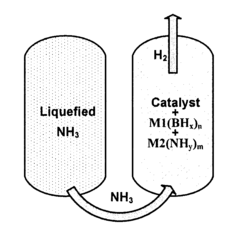
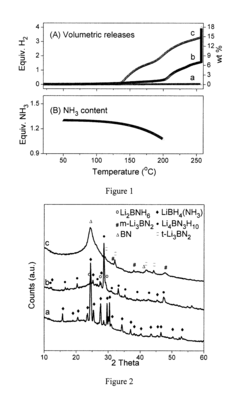
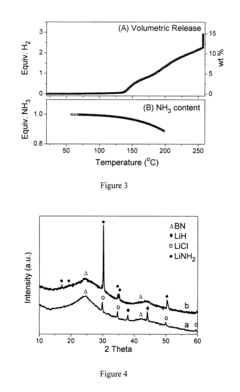
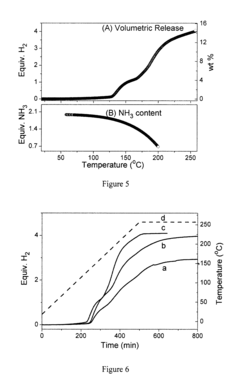
- A hydrogen storage system comprising borohydride and ammonia with a metal catalyst, where the molar ratio of ammonia to borohydride is optimized, and transition metal catalysts are introduced to improve dehydrogenation kinetics, allowing for hydrogen release in a closed system at mild conditions through equilibrium-vapor-pressure control.
High density hydrogen storage material
PatentInactiveUS20060292065A1
Innovation
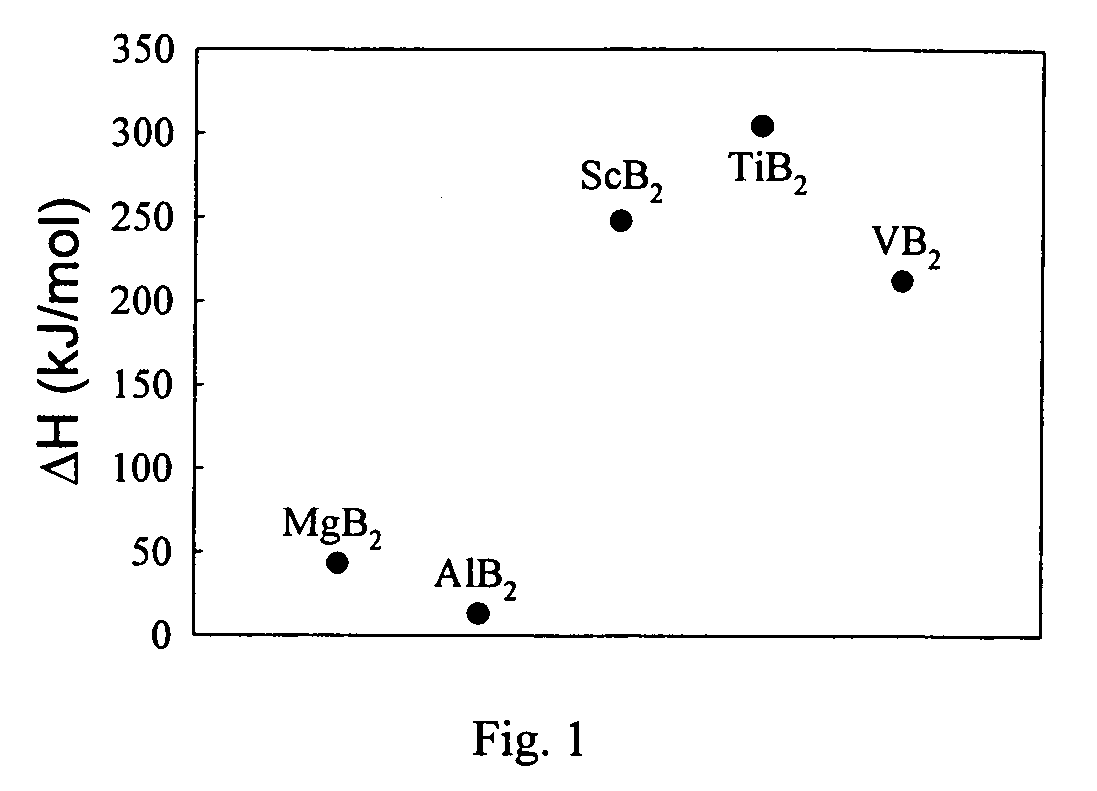
- A lightweight hydrogen storage material composed of LiBH4 combined with MHx, where greater than 50% of M comprises Al, which allows for reversible hydrogen storage and release at near-ambient temperatures, achieving an enthalpy of reaction in the range of 50 to 80 kJ/mol H2 and a single-crystal volumetric density 50% higher than liquid hydrogen.



Safety Standards and Risk Assessment
The safety aspects of hydrogen storage materials are paramount for the successful implementation of hydrogen-powered electric vehicle systems. Current international standards for hydrogen storage in automotive applications are primarily governed by regulations such as ISO 16111, which addresses portable hydrogen storage devices, and SAE J2579, which focuses on fuel systems in fuel cell vehicles. These standards establish critical parameters for material performance, including pressure tolerance, temperature stability, and cycle durability under various operating conditions.
Risk assessment methodologies for hydrogen storage materials must consider both the intrinsic and extrinsic safety factors. Intrinsic factors relate to the material properties themselves, such as thermal conductivity, hydrogen embrittlement resistance, and chemical stability. Extrinsic factors encompass system design elements, including containment strategies, pressure relief mechanisms, and thermal management systems. Comprehensive risk assessment frameworks typically employ Failure Mode and Effects Analysis (FMEA) and Hazard and Operability Studies (HAZOP) to identify potential failure points.
Material-specific safety considerations vary significantly across different hydrogen storage technologies. Metal hydrides present risks related to exothermic reactions during hydrogen absorption, which can cause rapid temperature increases if not properly managed. Complex hydrides and chemical hydrogen storage materials often involve reactive intermediates that require careful handling and containment. Carbon-based materials and MOFs (Metal-Organic Frameworks) generally present lower reactivity risks but may have issues with dust explosibility and thermal stability at high temperatures.
Testing protocols for hydrogen storage materials have evolved to include accelerated aging tests, extreme condition exposure, and abuse testing. These protocols evaluate material performance under scenarios such as rapid decompression, external fire exposure, and mechanical impact. Advanced computational modeling approaches are increasingly being integrated into safety assessments, allowing for simulation of material behavior under conditions that would be difficult or dangerous to replicate experimentally.
Regulatory compliance remains a moving target as standards continue to evolve with technological advancements. The development of hydrogen storage materials for EV applications must anticipate future regulatory requirements, particularly regarding lifecycle safety considerations. This includes end-of-life disposal or recycling processes, which are becoming increasingly important aspects of material selection and system design in the automotive sector.
Risk assessment methodologies for hydrogen storage materials must consider both the intrinsic and extrinsic safety factors. Intrinsic factors relate to the material properties themselves, such as thermal conductivity, hydrogen embrittlement resistance, and chemical stability. Extrinsic factors encompass system design elements, including containment strategies, pressure relief mechanisms, and thermal management systems. Comprehensive risk assessment frameworks typically employ Failure Mode and Effects Analysis (FMEA) and Hazard and Operability Studies (HAZOP) to identify potential failure points.
Material-specific safety considerations vary significantly across different hydrogen storage technologies. Metal hydrides present risks related to exothermic reactions during hydrogen absorption, which can cause rapid temperature increases if not properly managed. Complex hydrides and chemical hydrogen storage materials often involve reactive intermediates that require careful handling and containment. Carbon-based materials and MOFs (Metal-Organic Frameworks) generally present lower reactivity risks but may have issues with dust explosibility and thermal stability at high temperatures.
Testing protocols for hydrogen storage materials have evolved to include accelerated aging tests, extreme condition exposure, and abuse testing. These protocols evaluate material performance under scenarios such as rapid decompression, external fire exposure, and mechanical impact. Advanced computational modeling approaches are increasingly being integrated into safety assessments, allowing for simulation of material behavior under conditions that would be difficult or dangerous to replicate experimentally.
Regulatory compliance remains a moving target as standards continue to evolve with technological advancements. The development of hydrogen storage materials for EV applications must anticipate future regulatory requirements, particularly regarding lifecycle safety considerations. This includes end-of-life disposal or recycling processes, which are becoming increasingly important aspects of material selection and system design in the automotive sector.
Environmental Impact and Sustainability Analysis
The adoption of hydrogen storage materials in electric vehicle systems represents a significant step toward sustainable transportation solutions. Life cycle assessment (LCA) studies indicate that hydrogen-powered vehicles can reduce greenhouse gas emissions by 30-60% compared to conventional internal combustion engines, depending on the hydrogen production method. When hydrogen is produced through electrolysis powered by renewable energy sources, the carbon footprint approaches near-zero levels, offering a truly sustainable alternative to fossil fuel dependence.
Material selection for hydrogen storage significantly impacts environmental sustainability. Metal hydrides and complex hydrides, while effective for storage, often contain rare earth elements or precious metals that present mining and extraction challenges. The environmental degradation associated with extracting these materials must be weighed against their long-term environmental benefits. Alternatively, carbon-based materials like MOFs (Metal-Organic Frameworks) and activated carbon offer more environmentally benign options with lower ecological footprints during production.
Recycling and end-of-life management of hydrogen storage materials present both challenges and opportunities. Current recycling rates for advanced materials used in hydrogen storage systems remain below 25%, primarily due to complex material compositions and the absence of established recycling infrastructure. However, emerging technologies for selective material recovery show promise for improving these rates to potentially 60-70% within the next decade, significantly reducing waste and resource depletion.
Water consumption represents another critical environmental consideration. Hydrogen production via electrolysis requires approximately 9 kg of water per kg of hydrogen produced. While this figure may seem substantial, it compares favorably to water requirements for fossil fuel extraction and processing. Advanced catalyst materials being developed for hydrogen storage systems are also showing reduced dependence on water-intensive manufacturing processes.
From a circular economy perspective, hydrogen storage materials offer significant advantages. Many metal hydride systems can be regenerated multiple times without substantial performance degradation, extending their useful life beyond that of conventional battery technologies. Research indicates that properly engineered hydrogen storage systems can maintain 80% of their original capacity after 1,500 charge-discharge cycles, substantially reducing material replacement requirements and associated environmental impacts.
The integration of hydrogen storage materials into EV systems also contributes to noise pollution reduction and improved urban air quality, factors often overlooked in traditional environmental impact assessments but increasingly recognized as important sustainability metrics in densely populated areas.
Material selection for hydrogen storage significantly impacts environmental sustainability. Metal hydrides and complex hydrides, while effective for storage, often contain rare earth elements or precious metals that present mining and extraction challenges. The environmental degradation associated with extracting these materials must be weighed against their long-term environmental benefits. Alternatively, carbon-based materials like MOFs (Metal-Organic Frameworks) and activated carbon offer more environmentally benign options with lower ecological footprints during production.
Recycling and end-of-life management of hydrogen storage materials present both challenges and opportunities. Current recycling rates for advanced materials used in hydrogen storage systems remain below 25%, primarily due to complex material compositions and the absence of established recycling infrastructure. However, emerging technologies for selective material recovery show promise for improving these rates to potentially 60-70% within the next decade, significantly reducing waste and resource depletion.
Water consumption represents another critical environmental consideration. Hydrogen production via electrolysis requires approximately 9 kg of water per kg of hydrogen produced. While this figure may seem substantial, it compares favorably to water requirements for fossil fuel extraction and processing. Advanced catalyst materials being developed for hydrogen storage systems are also showing reduced dependence on water-intensive manufacturing processes.
From a circular economy perspective, hydrogen storage materials offer significant advantages. Many metal hydride systems can be regenerated multiple times without substantial performance degradation, extending their useful life beyond that of conventional battery technologies. Research indicates that properly engineered hydrogen storage systems can maintain 80% of their original capacity after 1,500 charge-discharge cycles, substantially reducing material replacement requirements and associated environmental impacts.
The integration of hydrogen storage materials into EV systems also contributes to noise pollution reduction and improved urban air quality, factors often overlooked in traditional environmental impact assessments but increasingly recognized as important sustainability metrics in densely populated areas.
Unlock deeper insights with PatSnap Eureka Quick Research — get a full tech report to explore trends and direct your research. Try now!
Generate Your Research Report Instantly with AI Agent
Supercharge your innovation with PatSnap Eureka AI Agent Platform!