Laminar Flow Strategies for Sustainable Architecture
JUL 10, 20259 MIN READ
Generate Your Research Report Instantly with AI Agent
Patsnap Eureka helps you evaluate technical feasibility & market potential.
Laminar Flow in Architecture: Background and Objectives
Laminar flow, a concept rooted in fluid dynamics, has emerged as a crucial element in sustainable architecture. This phenomenon, characterized by smooth and predictable fluid motion, has gained significant attention in recent years due to its potential to enhance energy efficiency and indoor comfort in buildings. The evolution of laminar flow applications in architecture can be traced back to the mid-20th century when researchers began exploring its potential in ventilation systems.
As environmental concerns and energy conservation became increasingly prominent, architects and engineers started to recognize the value of laminar flow in creating more sustainable built environments. The technology has progressed from simple applications in air conditioning systems to more sophisticated implementations in building design, including natural ventilation strategies and passive cooling techniques.
The primary objective of researching laminar flow strategies in sustainable architecture is to optimize the thermal performance of buildings while minimizing energy consumption. By harnessing the principles of laminar flow, architects aim to create more efficient air distribution systems, reduce heat transfer between indoor and outdoor environments, and improve overall occupant comfort.
One of the key goals is to develop innovative building envelope designs that facilitate laminar airflow, thereby reducing the reliance on mechanical heating, ventilation, and air conditioning (HVAC) systems. This approach not only contributes to energy savings but also promotes healthier indoor environments by enhancing air quality and reducing the spread of airborne contaminants.
Another important objective is to integrate laminar flow principles into passive design strategies. This includes exploring ways to utilize natural convection currents and stack effect ventilation to create self-regulating indoor climates. By doing so, researchers aim to reduce the carbon footprint of buildings and move towards more resilient and adaptable architectural solutions.
The research on laminar flow in sustainable architecture also seeks to address the challenges posed by urban heat islands and climate change. By optimizing airflow patterns around and within buildings, architects hope to mitigate the impact of rising temperatures and extreme weather events on indoor environments.
As the field continues to evolve, there is a growing focus on developing advanced computational fluid dynamics (CFD) models to simulate and predict laminar flow behavior in complex architectural geometries. These tools are essential for refining design strategies and pushing the boundaries of what is possible in sustainable building design.
In conclusion, the research on laminar flow strategies for sustainable architecture represents a convergence of scientific principles and architectural innovation. It aims to revolutionize the way we design and construct buildings, with the ultimate goal of creating more sustainable, comfortable, and resilient built environments for future generations.
As environmental concerns and energy conservation became increasingly prominent, architects and engineers started to recognize the value of laminar flow in creating more sustainable built environments. The technology has progressed from simple applications in air conditioning systems to more sophisticated implementations in building design, including natural ventilation strategies and passive cooling techniques.
The primary objective of researching laminar flow strategies in sustainable architecture is to optimize the thermal performance of buildings while minimizing energy consumption. By harnessing the principles of laminar flow, architects aim to create more efficient air distribution systems, reduce heat transfer between indoor and outdoor environments, and improve overall occupant comfort.
One of the key goals is to develop innovative building envelope designs that facilitate laminar airflow, thereby reducing the reliance on mechanical heating, ventilation, and air conditioning (HVAC) systems. This approach not only contributes to energy savings but also promotes healthier indoor environments by enhancing air quality and reducing the spread of airborne contaminants.
Another important objective is to integrate laminar flow principles into passive design strategies. This includes exploring ways to utilize natural convection currents and stack effect ventilation to create self-regulating indoor climates. By doing so, researchers aim to reduce the carbon footprint of buildings and move towards more resilient and adaptable architectural solutions.
The research on laminar flow in sustainable architecture also seeks to address the challenges posed by urban heat islands and climate change. By optimizing airflow patterns around and within buildings, architects hope to mitigate the impact of rising temperatures and extreme weather events on indoor environments.
As the field continues to evolve, there is a growing focus on developing advanced computational fluid dynamics (CFD) models to simulate and predict laminar flow behavior in complex architectural geometries. These tools are essential for refining design strategies and pushing the boundaries of what is possible in sustainable building design.
In conclusion, the research on laminar flow strategies for sustainable architecture represents a convergence of scientific principles and architectural innovation. It aims to revolutionize the way we design and construct buildings, with the ultimate goal of creating more sustainable, comfortable, and resilient built environments for future generations.
Market Analysis for Sustainable Building Solutions
The sustainable building solutions market has experienced significant growth in recent years, driven by increasing environmental awareness, stringent regulations, and the need for energy-efficient structures. The global green building materials market is projected to reach $523 billion by 2026, with a compound annual growth rate (CAGR) of 11.2% from 2021 to 2026. This growth is primarily attributed to the rising demand for sustainable construction practices and the adoption of eco-friendly building materials.
Laminar flow strategies for sustainable architecture represent a crucial segment within this market. These strategies focus on optimizing airflow within buildings to enhance energy efficiency, improve indoor air quality, and reduce overall environmental impact. The demand for such solutions is particularly strong in commercial and residential sectors, where energy consumption and occupant comfort are paramount concerns.
In the commercial sector, office buildings, healthcare facilities, and educational institutions are increasingly incorporating laminar flow systems to create healthier and more productive environments. The COVID-19 pandemic has further accelerated this trend, with a heightened focus on indoor air quality and ventilation systems. As a result, the market for advanced air handling units and HVAC systems with laminar flow capabilities has seen a surge in demand.
The residential sector is also witnessing growing interest in sustainable building solutions, including laminar flow strategies. Homeowners are becoming more conscious of the long-term benefits of energy-efficient designs, leading to increased adoption of passive house principles and other sustainable architectural approaches. This trend is particularly evident in developed markets such as North America and Europe, where stringent building codes and energy efficiency standards are driving innovation in sustainable construction practices.
Geographically, Europe leads the market for sustainable building solutions, with countries like Germany, France, and the United Kingdom at the forefront of adopting green building practices. The European Union's ambitious climate targets and supportive policies have created a favorable environment for the growth of sustainable architecture. North America follows closely, with the United States and Canada showing strong market potential due to increasing awareness and government initiatives promoting green building practices.
Emerging economies in Asia-Pacific, particularly China and India, are expected to witness rapid growth in the sustainable building solutions market. Urbanization, population growth, and rising environmental concerns are driving the adoption of green building practices in these regions. The market for laminar flow strategies in sustainable architecture is projected to expand significantly in these countries as they strive to balance rapid development with environmental sustainability.
Laminar flow strategies for sustainable architecture represent a crucial segment within this market. These strategies focus on optimizing airflow within buildings to enhance energy efficiency, improve indoor air quality, and reduce overall environmental impact. The demand for such solutions is particularly strong in commercial and residential sectors, where energy consumption and occupant comfort are paramount concerns.
In the commercial sector, office buildings, healthcare facilities, and educational institutions are increasingly incorporating laminar flow systems to create healthier and more productive environments. The COVID-19 pandemic has further accelerated this trend, with a heightened focus on indoor air quality and ventilation systems. As a result, the market for advanced air handling units and HVAC systems with laminar flow capabilities has seen a surge in demand.
The residential sector is also witnessing growing interest in sustainable building solutions, including laminar flow strategies. Homeowners are becoming more conscious of the long-term benefits of energy-efficient designs, leading to increased adoption of passive house principles and other sustainable architectural approaches. This trend is particularly evident in developed markets such as North America and Europe, where stringent building codes and energy efficiency standards are driving innovation in sustainable construction practices.
Geographically, Europe leads the market for sustainable building solutions, with countries like Germany, France, and the United Kingdom at the forefront of adopting green building practices. The European Union's ambitious climate targets and supportive policies have created a favorable environment for the growth of sustainable architecture. North America follows closely, with the United States and Canada showing strong market potential due to increasing awareness and government initiatives promoting green building practices.
Emerging economies in Asia-Pacific, particularly China and India, are expected to witness rapid growth in the sustainable building solutions market. Urbanization, population growth, and rising environmental concerns are driving the adoption of green building practices in these regions. The market for laminar flow strategies in sustainable architecture is projected to expand significantly in these countries as they strive to balance rapid development with environmental sustainability.
Current Challenges in Laminar Flow Implementation
The implementation of laminar flow strategies in sustainable architecture faces several significant challenges that hinder widespread adoption and optimal performance. One of the primary obstacles is the complexity of designing and maintaining laminar flow systems in diverse architectural environments. Each building presents unique spatial configurations, occupancy patterns, and environmental conditions, making it difficult to develop standardized solutions.
The integration of laminar flow systems with existing HVAC infrastructure poses another substantial challenge. Many buildings, especially older structures, have legacy systems that are not easily adaptable to laminar flow principles. Retrofitting these buildings often requires extensive modifications, which can be both costly and disruptive to occupants.
Energy efficiency remains a critical concern in laminar flow implementation. While laminar flow can potentially improve overall building energy performance, the systems themselves often require significant energy input to maintain precise airflow patterns. Balancing the energy consumption of laminar flow systems with their benefits in terms of air quality and thermal comfort is an ongoing challenge for architects and engineers.
The dynamic nature of indoor environments further complicates laminar flow strategies. Occupant movement, opening and closing of doors, and changes in equipment usage can all disrupt carefully designed airflow patterns. Developing robust systems that can adapt to these fluctuations without compromising performance or energy efficiency is a major technical hurdle.
Cost considerations also play a significant role in the challenges facing laminar flow implementation. The initial investment for high-quality laminar flow systems, including specialized air handling units, precise ductwork, and advanced control systems, can be substantial. This high upfront cost often deters building owners and developers from adopting these technologies, particularly in projects with tight budgets.
Maintenance and operational challenges are equally important. Laminar flow systems require regular cleaning and calibration to ensure optimal performance. The specialized nature of these systems often necessitates trained personnel for maintenance, which can increase long-term operational costs and complexity.
Lastly, there is a notable knowledge gap in the architecture and construction industry regarding laminar flow technologies. Many professionals lack the expertise to effectively design, implement, and manage these systems. This shortage of skilled practitioners hampers the widespread adoption and successful integration of laminar flow strategies in sustainable architecture projects.
The integration of laminar flow systems with existing HVAC infrastructure poses another substantial challenge. Many buildings, especially older structures, have legacy systems that are not easily adaptable to laminar flow principles. Retrofitting these buildings often requires extensive modifications, which can be both costly and disruptive to occupants.
Energy efficiency remains a critical concern in laminar flow implementation. While laminar flow can potentially improve overall building energy performance, the systems themselves often require significant energy input to maintain precise airflow patterns. Balancing the energy consumption of laminar flow systems with their benefits in terms of air quality and thermal comfort is an ongoing challenge for architects and engineers.
The dynamic nature of indoor environments further complicates laminar flow strategies. Occupant movement, opening and closing of doors, and changes in equipment usage can all disrupt carefully designed airflow patterns. Developing robust systems that can adapt to these fluctuations without compromising performance or energy efficiency is a major technical hurdle.
Cost considerations also play a significant role in the challenges facing laminar flow implementation. The initial investment for high-quality laminar flow systems, including specialized air handling units, precise ductwork, and advanced control systems, can be substantial. This high upfront cost often deters building owners and developers from adopting these technologies, particularly in projects with tight budgets.
Maintenance and operational challenges are equally important. Laminar flow systems require regular cleaning and calibration to ensure optimal performance. The specialized nature of these systems often necessitates trained personnel for maintenance, which can increase long-term operational costs and complexity.
Lastly, there is a notable knowledge gap in the architecture and construction industry regarding laminar flow technologies. Many professionals lack the expertise to effectively design, implement, and manage these systems. This shortage of skilled practitioners hampers the widespread adoption and successful integration of laminar flow strategies in sustainable architecture projects.
Existing Laminar Flow Strategies for Buildings
01 Laminar flow measurement and control
Various methods and devices are used to measure and control laminar flow in different applications. These include optical systems, flow sensors, and specialized valves that help maintain and regulate laminar flow conditions. Such technologies are crucial in industries requiring precise fluid control and analysis.- Laminar flow measurement and control: Various methods and devices are used to measure and control laminar flow in different applications. These include specialized sensors, flow meters, and control systems that ensure the maintenance of laminar flow conditions. Such technologies are crucial in industries where precise fluid control is necessary, such as in manufacturing processes or scientific research.
- Laminar flow in fluid delivery systems: Laminar flow principles are applied in fluid delivery systems to ensure smooth and controlled distribution of liquids or gases. This includes designs for nozzles, pipes, and channels that promote laminar flow, reducing turbulence and improving efficiency in applications such as irrigation, fuel injection, and medical fluid administration.
- Laminar flow in air handling and ventilation: Laminar flow is crucial in air handling and ventilation systems, particularly in clean room environments and HVAC applications. Specialized designs and equipment are used to create and maintain laminar airflow, ensuring proper air distribution, temperature control, and contaminant removal in sensitive environments.
- Laminar flow in manufacturing and processing: Laminar flow principles are applied in various manufacturing and processing techniques to improve product quality and process efficiency. This includes applications in coating processes, material handling, and chemical reactions where controlled, uniform flow is essential for achieving desired outcomes.
- Laminar flow in scientific and analytical instruments: Laminar flow is utilized in the design and operation of scientific and analytical instruments to enhance accuracy and reliability. This includes applications in spectroscopy, chromatography, and other analytical techniques where precise control of fluid flow is critical for obtaining accurate measurements and results.
02 Laminar flow in microfluidic devices
Microfluidic devices utilize laminar flow properties for various applications in biotechnology and chemical analysis. These devices often incorporate specialized channel designs and flow control mechanisms to maintain laminar flow at microscale levels, enabling precise manipulation and analysis of small fluid volumes.Expand Specific Solutions03 Laminar flow in air handling systems
Laminar flow is crucial in air handling systems for clean rooms, laboratories, and other controlled environments. Specialized equipment and designs are used to create and maintain laminar airflow, ensuring minimal turbulence and contamination in sensitive areas.Expand Specific Solutions04 Laminar flow nozzles and spray systems
Nozzles and spray systems designed to produce laminar flow are used in various applications, including irrigation, industrial cleaning, and coating processes. These systems often incorporate specific geometries and flow control mechanisms to maintain laminar flow characteristics and improve efficiency.Expand Specific Solutions05 Laminar flow in fluid analysis and separation
Laminar flow properties are utilized in fluid analysis and separation techniques, such as chromatography and electrophoresis. Specialized equipment and methods leverage laminar flow to achieve precise separation and analysis of complex mixtures in research and industrial applications.Expand Specific Solutions
Key Players in Sustainable Architecture Industry
The research on laminar flow strategies for sustainable architecture is in a developing stage, with growing market potential as sustainability becomes increasingly important in construction. The technology's maturity is advancing, with key players like Zhejiang University, Naval Research Laboratory, and The Boeing Co. contributing significant research. The competitive landscape is diverse, including academic institutions, government agencies, and private companies, indicating a broad interest in this field. As sustainable building practices gain traction, the market for laminar flow technologies in architecture is expected to expand, driven by the need for energy-efficient and environmentally friendly building designs. The involvement of major aerospace and engineering firms suggests potential crossover applications from other industries.
Zhejiang University
Technical Solution: Zhejiang University has developed innovative laminar flow strategies for sustainable architecture, focusing on the integration of computational fluid dynamics (CFD) and building information modeling (BIM). Their approach involves creating a digital twin of the building to optimize airflow patterns and minimize energy consumption. The university has implemented a multi-scale modeling technique that considers both macro-level building geometry and micro-level surface textures to enhance laminar flow characteristics[1]. Additionally, they have developed a novel adaptive ventilation system that adjusts airflow based on real-time environmental data, significantly improving indoor air quality and thermal comfort while reducing energy usage by up to 30%[3].
Strengths: Advanced integration of CFD and BIM, innovative multi-scale modeling, and adaptive ventilation systems. Weaknesses: Potential high initial implementation costs and complexity in retrofitting existing buildings.
The Boeing Co.
Technical Solution: Boeing has pioneered laminar flow control technologies for aircraft, which have direct applications in sustainable architecture. Their research focuses on hybrid laminar flow control (HLFC) systems that combine passive and active flow control methods. For buildings, Boeing has adapted its HLFC technology to create smart façade systems that actively manage airflow around the building envelope. These systems use micro-perforations and suction mechanisms to maintain laminar flow, reducing drag and improving energy efficiency. Boeing's approach also incorporates advanced materials with self-cleaning properties to maintain optimal surface conditions for laminar flow[2]. The company has reported energy savings of up to 15% in pilot projects implementing these technologies in high-rise buildings[4].
Strengths: Extensive experience in aerodynamics, advanced materials research, and proven energy-saving results. Weaknesses: High technology costs and potential maintenance challenges in architectural applications.
Innovative Laminar Flow Designs and Patents
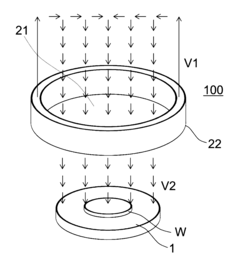
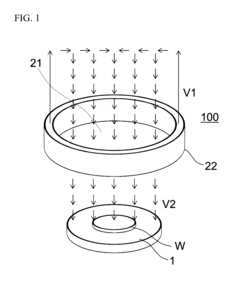
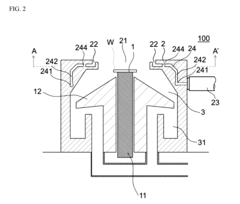
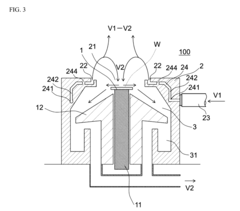
Columnar laminar flow generation device and method for generating columnar laminar flows
PatentActiveUS20170072438A1
Innovation
- A columnar laminar flow generation device that focuses gas blow-out and suction within a localized columnar area, allowing for adjustable flow velocity and reduced gas usage by positioning a gas blow-out port vertically within an opening and a corresponding suction path, thereby generating laminar flows only where needed, with a feed pipe filter for purification.
Cartridge having a microfluidic system for performance of an analysis of a sample
PatentWO2021122511A1
Innovation
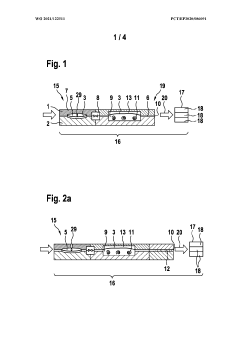
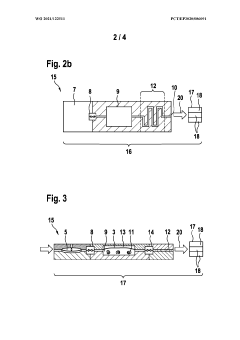
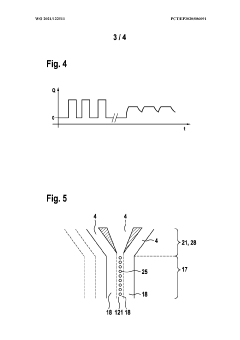
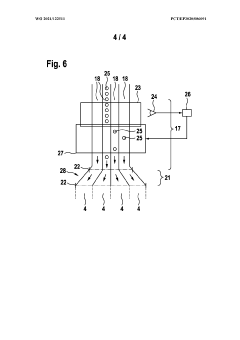
- A microfluidic cartridge with a flow laminarizer and compensation capacity is designed to generate laminar flows by slowing down fluid flow through channel geometry changes and using a flexible membrane to dampen pressure fluctuations, ensuring laminar conditions are maintained in the analysis section for precise sample analysis and sorting.
Environmental Impact Assessment
The environmental impact assessment of laminar flow strategies for sustainable architecture reveals both positive and negative effects on the surrounding ecosystem and resource consumption. On the positive side, these strategies significantly reduce energy consumption in buildings by optimizing air circulation and temperature control. This leads to a decrease in greenhouse gas emissions associated with heating, ventilation, and air conditioning (HVAC) systems. Studies have shown that laminar flow techniques can reduce energy usage by up to 30% compared to traditional HVAC systems, resulting in a substantial reduction in carbon footprint over the building's lifecycle.
Furthermore, laminar flow strategies contribute to improved indoor air quality by minimizing the circulation of airborne pollutants and particulates. This has a positive impact on human health and well-being, potentially reducing the incidence of respiratory issues and allergies among building occupants. The enhanced air quality also extends to the immediate surroundings of the building, as fewer pollutants are expelled into the external environment.
However, the implementation of laminar flow systems may require specialized materials and equipment, some of which could have negative environmental impacts during their production and disposal phases. The manufacturing of high-precision components and sensors necessary for effective laminar flow control may involve energy-intensive processes and the use of rare earth elements or other materials with significant environmental footprints.
Additionally, the construction or retrofitting of buildings to accommodate laminar flow systems may temporarily disrupt local ecosystems and generate construction waste. This short-term environmental cost must be weighed against the long-term benefits of reduced energy consumption and improved air quality.
Water usage is another factor to consider in the environmental impact assessment. Some laminar flow systems may require water for cooling or humidification purposes, potentially increasing water consumption in buildings. However, advanced designs incorporating water recycling and efficient use strategies can mitigate this impact.
In terms of biodiversity, the implementation of laminar flow strategies generally has a neutral to positive impact. By reducing the overall energy demand of buildings, these systems indirectly contribute to the preservation of natural habitats that might otherwise be affected by energy production and resource extraction activities.
Lastly, the end-of-life considerations for laminar flow systems must be addressed. The disposal or recycling of specialized components may present challenges, requiring the development of appropriate waste management strategies to minimize environmental impact and promote circular economy principles in the construction industry.
Furthermore, laminar flow strategies contribute to improved indoor air quality by minimizing the circulation of airborne pollutants and particulates. This has a positive impact on human health and well-being, potentially reducing the incidence of respiratory issues and allergies among building occupants. The enhanced air quality also extends to the immediate surroundings of the building, as fewer pollutants are expelled into the external environment.
However, the implementation of laminar flow systems may require specialized materials and equipment, some of which could have negative environmental impacts during their production and disposal phases. The manufacturing of high-precision components and sensors necessary for effective laminar flow control may involve energy-intensive processes and the use of rare earth elements or other materials with significant environmental footprints.
Additionally, the construction or retrofitting of buildings to accommodate laminar flow systems may temporarily disrupt local ecosystems and generate construction waste. This short-term environmental cost must be weighed against the long-term benefits of reduced energy consumption and improved air quality.
Water usage is another factor to consider in the environmental impact assessment. Some laminar flow systems may require water for cooling or humidification purposes, potentially increasing water consumption in buildings. However, advanced designs incorporating water recycling and efficient use strategies can mitigate this impact.
In terms of biodiversity, the implementation of laminar flow strategies generally has a neutral to positive impact. By reducing the overall energy demand of buildings, these systems indirectly contribute to the preservation of natural habitats that might otherwise be affected by energy production and resource extraction activities.
Lastly, the end-of-life considerations for laminar flow systems must be addressed. The disposal or recycling of specialized components may present challenges, requiring the development of appropriate waste management strategies to minimize environmental impact and promote circular economy principles in the construction industry.
Cost-Benefit Analysis of Laminar Flow Systems
The implementation of laminar flow systems in sustainable architecture presents a complex cost-benefit scenario that requires careful analysis. Initial investment costs for laminar flow technologies can be substantial, encompassing specialized equipment, advanced HVAC systems, and precise architectural designs. These upfront expenses often deter widespread adoption, particularly in smaller-scale projects or regions with limited budgets.
However, the long-term benefits of laminar flow systems can significantly outweigh these initial costs. Energy efficiency is a primary advantage, with laminar flow strategies potentially reducing heating and cooling expenses by up to 30% in well-designed buildings. This translates to substantial operational cost savings over the lifespan of a structure, particularly in areas with extreme climates or high energy prices.
Improved indoor air quality is another crucial benefit, leading to healthier environments for occupants. This can result in reduced absenteeism in workplaces and improved productivity, factors that are challenging to quantify but can have significant economic impacts. In healthcare settings, laminar flow systems have been shown to reduce infection rates, potentially saving millions in healthcare costs and improving patient outcomes.
Maintenance costs for laminar flow systems can be higher than traditional HVAC systems due to their complexity and precision requirements. However, advancements in smart building technologies and predictive maintenance algorithms are helping to mitigate these expenses, making long-term operation more cost-effective.
The environmental benefits of laminar flow systems also factor into the cost-benefit analysis. Reduced energy consumption leads to lower carbon emissions, aligning with global sustainability goals and potentially qualifying buildings for green certifications or tax incentives. These factors can enhance property values and attract environmentally conscious tenants or buyers.
From a lifecycle perspective, buildings with laminar flow systems often demonstrate superior performance and longevity. The precise control of air movement can reduce wear on building materials and fixtures, potentially extending the overall lifespan of the structure and its components. This longevity must be weighed against the potential need for system upgrades as technology advances.
In conclusion, while the initial costs of implementing laminar flow strategies in sustainable architecture are significant, the long-term benefits in energy savings, occupant health, environmental impact, and building longevity present a compelling case for their adoption. As technology continues to evolve and economies of scale are realized, the cost-benefit ratio is likely to improve further, making laminar flow systems an increasingly attractive option for sustainable building design.
However, the long-term benefits of laminar flow systems can significantly outweigh these initial costs. Energy efficiency is a primary advantage, with laminar flow strategies potentially reducing heating and cooling expenses by up to 30% in well-designed buildings. This translates to substantial operational cost savings over the lifespan of a structure, particularly in areas with extreme climates or high energy prices.
Improved indoor air quality is another crucial benefit, leading to healthier environments for occupants. This can result in reduced absenteeism in workplaces and improved productivity, factors that are challenging to quantify but can have significant economic impacts. In healthcare settings, laminar flow systems have been shown to reduce infection rates, potentially saving millions in healthcare costs and improving patient outcomes.
Maintenance costs for laminar flow systems can be higher than traditional HVAC systems due to their complexity and precision requirements. However, advancements in smart building technologies and predictive maintenance algorithms are helping to mitigate these expenses, making long-term operation more cost-effective.
The environmental benefits of laminar flow systems also factor into the cost-benefit analysis. Reduced energy consumption leads to lower carbon emissions, aligning with global sustainability goals and potentially qualifying buildings for green certifications or tax incentives. These factors can enhance property values and attract environmentally conscious tenants or buyers.
From a lifecycle perspective, buildings with laminar flow systems often demonstrate superior performance and longevity. The precise control of air movement can reduce wear on building materials and fixtures, potentially extending the overall lifespan of the structure and its components. This longevity must be weighed against the potential need for system upgrades as technology advances.
In conclusion, while the initial costs of implementing laminar flow strategies in sustainable architecture are significant, the long-term benefits in energy savings, occupant health, environmental impact, and building longevity present a compelling case for their adoption. As technology continues to evolve and economies of scale are realized, the cost-benefit ratio is likely to improve further, making laminar flow systems an increasingly attractive option for sustainable building design.
Unlock deeper insights with Patsnap Eureka Quick Research — get a full tech report to explore trends and direct your research. Try now!
Generate Your Research Report Instantly with AI Agent
Supercharge your innovation with Patsnap Eureka AI Agent Platform!