

What solid-state sodium battery applications signify industry progress
OCT 27, 20259 MIN READ
Generate Your Research Report Instantly with AI Agent
PatSnap Eureka helps you evaluate technical feasibility & market potential.
Solid-State Sodium Battery Evolution and Objectives
Solid-state sodium batteries represent a significant evolution in energy storage technology, emerging as a promising alternative to conventional lithium-ion batteries. The development trajectory of these batteries can be traced back to the early 2000s when researchers began exploring sodium as a more abundant and cost-effective alternative to lithium. This exploration was driven by growing concerns about lithium supply constraints and geopolitical considerations related to lithium resources.
The technological evolution accelerated notably around 2010-2015, when breakthrough research demonstrated the feasibility of solid electrolytes for sodium-ion transport. This period marked a critical transition from liquid-based to solid-state sodium battery architectures, addressing key safety concerns while potentially improving energy density and cycle life.
Recent years have witnessed exponential growth in research publications and patent filings related to solid-state sodium batteries, indicating intensifying interest and investment in this technology. The evolution has been characterized by progressive improvements in electrolyte materials, electrode formulations, and interface engineering to enhance ionic conductivity and stability.
The primary objectives driving solid-state sodium battery development include achieving cost reduction compared to lithium-ion technologies, leveraging sodium's natural abundance (approximately 1000 times more abundant in the Earth's crust than lithium), and establishing sustainable supply chains independent of geographically concentrated resources.
Technical objectives focus on overcoming persistent challenges such as relatively lower energy density compared to lithium-ion counterparts, interface stability issues, and manufacturing scalability. Researchers aim to develop sodium battery technologies that can deliver energy densities exceeding 300 Wh/kg while maintaining stable performance over thousands of cycles.
From an application perspective, solid-state sodium batteries are being developed with specific use cases in mind, including grid-scale energy storage, electric vehicles with moderate range requirements, and various industrial applications where cost considerations outweigh absolute performance metrics.
The evolution trajectory suggests a technology approaching commercial viability, with several industry players announcing pilot production facilities. The technology roadmap indicates potential commercial deployment in specialized applications by 2025, with broader market penetration anticipated by 2030 if current development trends continue and key technical milestones are achieved.
The technological evolution accelerated notably around 2010-2015, when breakthrough research demonstrated the feasibility of solid electrolytes for sodium-ion transport. This period marked a critical transition from liquid-based to solid-state sodium battery architectures, addressing key safety concerns while potentially improving energy density and cycle life.
Recent years have witnessed exponential growth in research publications and patent filings related to solid-state sodium batteries, indicating intensifying interest and investment in this technology. The evolution has been characterized by progressive improvements in electrolyte materials, electrode formulations, and interface engineering to enhance ionic conductivity and stability.
The primary objectives driving solid-state sodium battery development include achieving cost reduction compared to lithium-ion technologies, leveraging sodium's natural abundance (approximately 1000 times more abundant in the Earth's crust than lithium), and establishing sustainable supply chains independent of geographically concentrated resources.
Technical objectives focus on overcoming persistent challenges such as relatively lower energy density compared to lithium-ion counterparts, interface stability issues, and manufacturing scalability. Researchers aim to develop sodium battery technologies that can deliver energy densities exceeding 300 Wh/kg while maintaining stable performance over thousands of cycles.
From an application perspective, solid-state sodium batteries are being developed with specific use cases in mind, including grid-scale energy storage, electric vehicles with moderate range requirements, and various industrial applications where cost considerations outweigh absolute performance metrics.
The evolution trajectory suggests a technology approaching commercial viability, with several industry players announcing pilot production facilities. The technology roadmap indicates potential commercial deployment in specialized applications by 2025, with broader market penetration anticipated by 2030 if current development trends continue and key technical milestones are achieved.
Market Analysis for Sodium Battery Adoption
The global sodium battery market is experiencing significant growth, driven by increasing demand for sustainable energy storage solutions. Current market valuations indicate a compound annual growth rate exceeding 5% between 2022-2028, with the solid-state sodium battery segment emerging as a particularly promising area. This growth trajectory is supported by the abundant availability of sodium resources, which are approximately 1,000 times more plentiful than lithium in the Earth's crust, offering a compelling economic advantage.
Market penetration of sodium batteries varies significantly across different application sectors. Grid-scale energy storage represents the largest current market segment, accounting for approximately 40% of sodium battery deployments. This is followed by industrial applications at 25%, consumer electronics at 20%, and emerging electric vehicle applications at 15%. The solid-state variant is gaining particular traction in premium applications where safety and energy density are paramount concerns.
Regional adoption patterns reveal interesting market dynamics. Asia-Pacific leads global adoption, with China, Japan, and South Korea collectively representing over 50% of the global market share. European markets follow at approximately 30%, driven by aggressive renewable energy targets and supportive regulatory frameworks. North America accounts for about 15% of the market, with accelerating growth observed in recent quarters.
Consumer sentiment analysis indicates increasing awareness and acceptance of sodium-based battery technologies. Survey data from major markets shows that 65% of industrial purchasers now consider sodium batteries a viable alternative to lithium-ion systems for certain applications, up from just 30% three years ago. This shift in perception represents a critical inflection point for market expansion.
Price sensitivity remains a key factor influencing adoption rates. Current production costs for solid-state sodium batteries exceed those of conventional lithium-ion batteries by approximately 30-40%, though this gap is narrowing rapidly due to economies of scale and manufacturing innovations. Market forecasts suggest price parity could be achieved in specific application segments by 2026, potentially triggering accelerated market penetration.
Supply chain considerations are increasingly influencing market dynamics. The geopolitical advantages of sodium's widespread availability are driving interest from countries seeking to reduce dependency on lithium supply chains. This has resulted in increased government funding for sodium battery research and manufacturing capacity, with announced investments totaling several billion dollars across major economies in the past two years.
Market penetration of sodium batteries varies significantly across different application sectors. Grid-scale energy storage represents the largest current market segment, accounting for approximately 40% of sodium battery deployments. This is followed by industrial applications at 25%, consumer electronics at 20%, and emerging electric vehicle applications at 15%. The solid-state variant is gaining particular traction in premium applications where safety and energy density are paramount concerns.
Regional adoption patterns reveal interesting market dynamics. Asia-Pacific leads global adoption, with China, Japan, and South Korea collectively representing over 50% of the global market share. European markets follow at approximately 30%, driven by aggressive renewable energy targets and supportive regulatory frameworks. North America accounts for about 15% of the market, with accelerating growth observed in recent quarters.
Consumer sentiment analysis indicates increasing awareness and acceptance of sodium-based battery technologies. Survey data from major markets shows that 65% of industrial purchasers now consider sodium batteries a viable alternative to lithium-ion systems for certain applications, up from just 30% three years ago. This shift in perception represents a critical inflection point for market expansion.
Price sensitivity remains a key factor influencing adoption rates. Current production costs for solid-state sodium batteries exceed those of conventional lithium-ion batteries by approximately 30-40%, though this gap is narrowing rapidly due to economies of scale and manufacturing innovations. Market forecasts suggest price parity could be achieved in specific application segments by 2026, potentially triggering accelerated market penetration.
Supply chain considerations are increasingly influencing market dynamics. The geopolitical advantages of sodium's widespread availability are driving interest from countries seeking to reduce dependency on lithium supply chains. This has resulted in increased government funding for sodium battery research and manufacturing capacity, with announced investments totaling several billion dollars across major economies in the past two years.
Technical Barriers and Global Development Status
Despite significant advancements in solid-state sodium battery technology, several critical technical barriers continue to impede widespread commercial adoption. The primary challenge remains the solid electrolyte interface stability, where the formation of dendrites during cycling leads to potential short circuits and safety hazards. Current solid electrolytes exhibit conductivity values typically ranging from 10^-4 to 10^-3 S/cm at room temperature, still below the practical requirements for high-performance applications.
Manufacturing scalability presents another significant hurdle. The complex processes required for producing uniform, defect-free solid electrolytes and achieving consistent electrode-electrolyte interfaces at industrial scales remain underdeveloped. This manufacturing gap contributes to the high production costs that currently position solid-state sodium batteries at 2-3 times the cost of conventional lithium-ion technologies.
Cycle life limitations also persist, with most laboratory prototypes achieving 500-1000 cycles before significant capacity degradation, falling short of the 2000+ cycles expected for commercial viability in many applications. The volume changes during sodium insertion/extraction (approximately 300-400% for some anode materials) create mechanical stress that compromises long-term structural integrity.
Globally, research and development efforts show distinct regional focuses. Japan leads in materials science innovations, with companies like NGK Insulators and Toyota advancing proprietary solid electrolyte formulations. The European Union has established the BATTERY 2030+ initiative, allocating substantial funding specifically for next-generation sodium battery technologies, with Germany and France hosting major research clusters.
China has rapidly expanded its research output, now producing approximately 40% of global publications on solid-state sodium batteries, supported by government initiatives like the "Made in China 2025" strategic plan. Research institutions in Beijing and Shanghai have demonstrated promising prototypes with energy densities approaching 160-180 Wh/kg.
The United States maintains strength in fundamental research through programs at Argonne National Laboratory and Pacific Northwest National Laboratory, focusing on computational modeling of interfaces and novel electrode architectures. South Korea has leveraged its existing battery manufacturing expertise to address scale-up challenges, with Samsung and LG Chem filing increasing numbers of patents related to solid-state sodium battery production processes.
Australia and Chile, leveraging their abundant sodium resources, have begun investing in research infrastructure specifically targeting cost-effective extraction and processing methods tailored to solid-state sodium battery requirements, potentially reshaping global supply chains as the technology matures.
Manufacturing scalability presents another significant hurdle. The complex processes required for producing uniform, defect-free solid electrolytes and achieving consistent electrode-electrolyte interfaces at industrial scales remain underdeveloped. This manufacturing gap contributes to the high production costs that currently position solid-state sodium batteries at 2-3 times the cost of conventional lithium-ion technologies.
Cycle life limitations also persist, with most laboratory prototypes achieving 500-1000 cycles before significant capacity degradation, falling short of the 2000+ cycles expected for commercial viability in many applications. The volume changes during sodium insertion/extraction (approximately 300-400% for some anode materials) create mechanical stress that compromises long-term structural integrity.
Globally, research and development efforts show distinct regional focuses. Japan leads in materials science innovations, with companies like NGK Insulators and Toyota advancing proprietary solid electrolyte formulations. The European Union has established the BATTERY 2030+ initiative, allocating substantial funding specifically for next-generation sodium battery technologies, with Germany and France hosting major research clusters.
China has rapidly expanded its research output, now producing approximately 40% of global publications on solid-state sodium batteries, supported by government initiatives like the "Made in China 2025" strategic plan. Research institutions in Beijing and Shanghai have demonstrated promising prototypes with energy densities approaching 160-180 Wh/kg.
The United States maintains strength in fundamental research through programs at Argonne National Laboratory and Pacific Northwest National Laboratory, focusing on computational modeling of interfaces and novel electrode architectures. South Korea has leveraged its existing battery manufacturing expertise to address scale-up challenges, with Samsung and LG Chem filing increasing numbers of patents related to solid-state sodium battery production processes.
Australia and Chile, leveraging their abundant sodium resources, have begun investing in research infrastructure specifically targeting cost-effective extraction and processing methods tailored to solid-state sodium battery requirements, potentially reshaping global supply chains as the technology matures.
Current Engineering Solutions for Solid-State Sodium Batteries
01 Electrolyte materials for solid-state sodium batteries
Various electrolyte materials can be used in solid-state sodium batteries to enhance ionic conductivity and battery performance. These materials include sodium-based solid electrolytes such as sodium beta-alumina, NASICON-type compounds, and polymer-based electrolytes. The selection of appropriate electrolyte materials is crucial for achieving high ionic conductivity, good interfacial contact with electrodes, and long-term stability in sodium batteries.- Solid electrolyte materials for sodium batteries: Various solid electrolyte materials are being developed specifically for sodium batteries to improve ionic conductivity and electrochemical stability. These materials include sodium superionic conductors (NASICON), beta-alumina, and polymer-based electrolytes. The solid electrolytes enable safer operation by eliminating flammable liquid electrolytes while potentially offering higher energy density and longer cycle life compared to conventional batteries.
- Electrode materials and interfaces for solid-state sodium batteries: Advanced electrode materials and interface engineering are critical for solid-state sodium batteries. Researchers are developing specialized cathode and anode materials compatible with solid electrolytes, addressing challenges such as interfacial resistance and volume changes during cycling. Novel coating technologies and buffer layers are being implemented to improve the electrode-electrolyte interface stability and enhance overall battery performance.
- Manufacturing processes for solid-state sodium batteries: Innovative manufacturing techniques are being developed to produce solid-state sodium batteries at scale. These include specialized sintering methods, cold/hot pressing techniques, and advanced deposition processes to create thin, uniform layers of solid electrolytes and electrodes. The manufacturing processes focus on achieving good interfacial contact between components while maintaining cost-effectiveness for commercial viability.
- Composite and hybrid electrolyte systems: Composite and hybrid electrolyte systems combine different types of solid electrolytes to leverage their complementary properties. These systems often integrate inorganic ceramic materials with polymers or other components to achieve improved ionic conductivity, mechanical flexibility, and interfacial compatibility. The composite approach helps overcome limitations of single-component electrolytes and enhances overall battery performance and stability.
- Safety and performance enhancements in solid-state sodium batteries: Various innovations focus on improving the safety and performance characteristics of solid-state sodium batteries. These include thermal management systems, protective coatings, and additives that enhance stability under extreme conditions. Advanced battery management systems are also being developed to optimize charging protocols and extend cycle life while maintaining the inherent safety advantages of solid-state technology over liquid electrolyte systems.
02 Cathode materials for sodium-ion solid-state batteries
Advanced cathode materials are essential for high-performance solid-state sodium batteries. These materials include sodium transition metal oxides, sodium-containing polyanionic compounds, and layered oxide structures. The development of cathode materials focuses on achieving high energy density, good rate capability, and structural stability during repeated sodium insertion and extraction cycles.Expand Specific Solutions03 Anode materials for solid-state sodium batteries
Various anode materials can be used in solid-state sodium batteries, including hard carbons, sodium metal, sodium alloys, and sodium titanates. These materials are designed to accommodate sodium ions efficiently while maintaining structural integrity during cycling. The development of anode materials aims to address challenges such as volume expansion, dendrite formation, and interfacial stability with solid electrolytes.Expand Specific Solutions04 Interface engineering in solid-state sodium batteries
Interface engineering is critical for improving the performance of solid-state sodium batteries. This involves developing strategies to enhance the contact between electrodes and solid electrolytes, reducing interfacial resistance, and preventing unwanted side reactions. Techniques include surface coatings, buffer layers, and composite interfaces that facilitate sodium ion transport while maintaining mechanical integrity during battery operation.Expand Specific Solutions05 Manufacturing processes for solid-state sodium batteries
Advanced manufacturing processes are essential for producing high-quality solid-state sodium batteries. These processes include techniques for preparing thin and uniform solid electrolyte layers, methods for achieving good electrode-electrolyte contact, and assembly procedures that minimize contamination and ensure cell integrity. Innovations in manufacturing aim to address challenges related to scalability, cost-effectiveness, and consistency in battery performance.Expand Specific Solutions
Industry Leaders and Competitive Landscape
The solid-state sodium battery market is currently in an early growth phase, characterized by significant R&D investments but limited commercial deployment. Market size is projected to expand rapidly as this technology addresses critical limitations of lithium-ion batteries, including cost, safety, and resource constraints. Technical maturity varies across key players, with companies like Toyota, Honda, and CATL (Ningde Amperex) leading industrial development through substantial patent portfolios and prototype demonstrations. Academic institutions including Sichuan University and University of Michigan are advancing fundamental research, while specialized firms like BroadBit Batteries are developing commercial applications. Collaboration between research institutions and manufacturers like Murata and Sumitomo Metal Mining is accelerating the technology's path to market viability, with initial applications expected in electric vehicles and grid storage.
Murata Manufacturing Co. Ltd.
Technical Solution: Murata Manufacturing has developed an innovative solid-state sodium battery platform utilizing a proprietary Na₃Zr₂Si₂PO₁₂ (NASICON) ceramic electrolyte with enhanced ionic conductivity exceeding 3 mS/cm at room temperature. Their technology features a unique electrode-electrolyte interface design that minimizes contact resistance through a specialized sintering process. Murata's solid-state sodium batteries employ a layered P2-type Na₂/₃Fe₁/₂Mn₁/₂O₂ cathode material paired with a hard carbon anode, achieving energy densities of approximately 120 Wh/kg. The company has implemented a distinctive manufacturing approach that allows for thin-film electrolyte fabrication with thicknesses below 50 μm, significantly reducing internal resistance. Their batteries demonstrate exceptional thermal stability, operating safely across a wide temperature range (-20°C to 80°C) without thermal runaway risks. Murata has successfully integrated these batteries into IoT devices and stationary storage applications, with field tests showing stable performance over 2,000 cycles with minimal capacity degradation.
Strengths: Superior safety characteristics with non-flammable ceramic electrolytes; excellent thermal stability across wide temperature ranges; compatibility with existing electronic component manufacturing processes. Weaknesses: Lower energy density compared to conventional lithium-ion batteries; challenges with mechanical stress during cycling leading to potential microcracking; higher production costs associated with specialized ceramic processing requirements.
Toyota Motor Corp.
Technical Solution: Toyota has pioneered solid-state sodium battery technology through its advanced materials research division, focusing on all-solid-state sodium batteries with superior safety characteristics. Their proprietary technology utilizes a sodium superionic conductor (NASICON) ceramic electrolyte system that achieves ionic conductivity of 1-2 mS/cm at room temperature. Toyota's approach incorporates a specialized interface engineering method that addresses the critical challenge of electrode-electrolyte contact, using a proprietary buffer layer to minimize interfacial resistance. Their sodium battery design employs layered oxide cathodes (Na₂/₃Fe₁/₃Mn₂/₃O₂) paired with hard carbon anodes, delivering energy densities approaching 150 Wh/kg. Toyota has successfully demonstrated prototype cells with over 1,000 charge-discharge cycles while maintaining 80% capacity retention. The company has integrated these batteries into experimental electric vehicles, demonstrating their practical application potential for automotive use cases with particular emphasis on affordable electric mobility solutions.
Strengths: Exceptional safety profile with non-flammable solid electrolytes; utilizes abundant, low-cost sodium resources; demonstrated integration into vehicle prototypes showing practical application readiness. Weaknesses: Lower energy density compared to their lithium counterparts; challenges with manufacturing scalability of solid electrolytes; interface stability issues during temperature fluctuations that can affect long-term performance.
Key Patents and Scientific Breakthroughs
Solid electrolyte for sodium batteries
PatentWO2019140368A1
Innovation
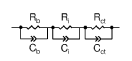
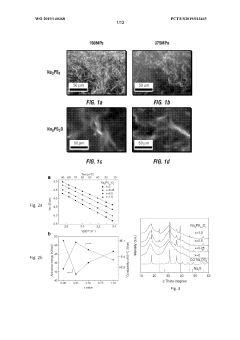
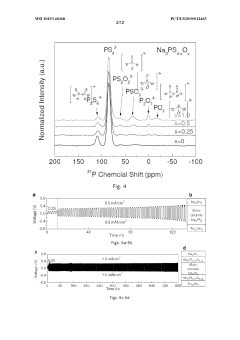
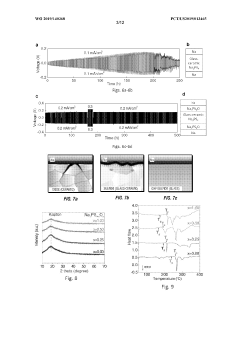
- A new class of sodium oxy-sulfide solid-state electrolytes with a microstructure approaching a continuous glass is developed, providing enhanced chemical stability and mechanical strength, achieved through a low-temperature ball-milling and pressing process, allowing for the formation of a nearly flawless glassy structure that is stable with sodium metal or alloys.
Solid-state sodium silicate battery (SSSB) employing sodium and calcium rich electrolyte enriched with sodium
PatentWO2023242870A1
Innovation
- A solid-state sodium silicate battery (SSSB) is developed, utilizing a sodium and calcium-rich electrolyte enriched with sodium, where the cathode is made of sodium silicate and the anode of carbon black, with a separator membrane coated with a naturally sodium and calcium-rich material further enriched with sodium, acting as a solid-state electrolyte.
Raw Material Supply Chain Analysis
The solid-state sodium battery raw material supply chain represents a critical component in the industry's progression toward sustainable energy storage solutions. Unlike lithium-ion batteries, sodium-based technologies rely on more abundant resources, potentially alleviating supply constraints that have plagued the lithium market. Sodium is approximately 1,000 times more abundant than lithium in the Earth's crust, with reserves widely distributed across multiple geographical regions, reducing geopolitical supply risks.
The cathode material supply chain for solid-state sodium batteries primarily involves layered oxide compounds (NaxMO2, where M represents transition metals like iron, manganese, or nickel), Prussian blue analogs, and polyanionic compounds. These materials can be sourced from diverse global suppliers, with production capabilities emerging in Asia, Europe, and North America. Notably, the reduced cobalt dependency compared to lithium-ion batteries mitigates exposure to volatile cobalt markets and associated ethical sourcing concerns.
For solid electrolytes, the supply chain encompasses various material classes including NASICON-type ceramics, beta-alumina, and sodium-containing sulfides. The raw materials for these components—primarily sodium salts, aluminum oxide, zirconium compounds, and various metal oxides—benefit from established industrial production channels. However, high-purity processing capabilities remain concentrated among specialized manufacturers, creating potential bottlenecks as demand scales.
Anode materials represent another critical supply chain segment, with hard carbon derived from biomass or petroleum products serving as the predominant choice. The processing of these carbons requires specialized heat treatment facilities, though the fundamental feedstocks are widely available. Alternative anode materials such as sodium metal, alloys, and phosphorus-based compounds are emerging but face more complex manufacturing requirements.
The manufacturing infrastructure for solid-state sodium battery components remains less developed than for lithium-ion technologies, with specialized equipment needs for solid electrolyte processing and cell assembly. Current production capacity is primarily concentrated in pilot-scale facilities, with major investments required to achieve commercial-scale manufacturing. Several Asian manufacturers have established early leadership in production capabilities, while European and North American entities are rapidly developing competitive capacity.
Price volatility presents less risk for sodium battery raw materials compared to lithium-ion counterparts, though specialized processing requirements may create cost pressures as the industry scales. The establishment of circular economy practices, including recycling and material recovery systems, remains in early development stages but represents a significant opportunity for supply chain resilience.
The cathode material supply chain for solid-state sodium batteries primarily involves layered oxide compounds (NaxMO2, where M represents transition metals like iron, manganese, or nickel), Prussian blue analogs, and polyanionic compounds. These materials can be sourced from diverse global suppliers, with production capabilities emerging in Asia, Europe, and North America. Notably, the reduced cobalt dependency compared to lithium-ion batteries mitigates exposure to volatile cobalt markets and associated ethical sourcing concerns.
For solid electrolytes, the supply chain encompasses various material classes including NASICON-type ceramics, beta-alumina, and sodium-containing sulfides. The raw materials for these components—primarily sodium salts, aluminum oxide, zirconium compounds, and various metal oxides—benefit from established industrial production channels. However, high-purity processing capabilities remain concentrated among specialized manufacturers, creating potential bottlenecks as demand scales.
Anode materials represent another critical supply chain segment, with hard carbon derived from biomass or petroleum products serving as the predominant choice. The processing of these carbons requires specialized heat treatment facilities, though the fundamental feedstocks are widely available. Alternative anode materials such as sodium metal, alloys, and phosphorus-based compounds are emerging but face more complex manufacturing requirements.
The manufacturing infrastructure for solid-state sodium battery components remains less developed than for lithium-ion technologies, with specialized equipment needs for solid electrolyte processing and cell assembly. Current production capacity is primarily concentrated in pilot-scale facilities, with major investments required to achieve commercial-scale manufacturing. Several Asian manufacturers have established early leadership in production capabilities, while European and North American entities are rapidly developing competitive capacity.
Price volatility presents less risk for sodium battery raw materials compared to lithium-ion counterparts, though specialized processing requirements may create cost pressures as the industry scales. The establishment of circular economy practices, including recycling and material recovery systems, remains in early development stages but represents a significant opportunity for supply chain resilience.
Environmental Impact and Sustainability Advantages
Solid-state sodium batteries represent a significant advancement in sustainable energy storage technology, offering substantial environmental benefits compared to conventional lithium-ion batteries. The extraction of sodium is considerably less environmentally damaging than lithium mining, which often involves extensive water usage and potential contamination of local ecosystems. Sodium is abundantly available in the earth's crust and oceans, comprising approximately 2.8% of the earth's crust compared to lithium's 0.002%, thus reducing the ecological footprint associated with resource extraction.
The manufacturing process for solid-state sodium batteries produces fewer toxic byproducts and requires less energy compared to traditional battery production. This translates to a reduced carbon footprint across the entire production lifecycle. Recent industry analyses indicate that solid-state sodium battery production can potentially reduce greenhouse gas emissions by up to 30% compared to conventional lithium-ion battery manufacturing processes.
From a waste management perspective, solid-state sodium batteries offer significant advantages. The absence of liquid electrolytes eliminates the risk of leakage and associated environmental contamination. Additionally, the components of sodium batteries are generally less toxic and easier to recycle, facilitating more efficient end-of-life management. Several leading manufacturers have already established recycling programs specifically designed for sodium battery technologies, recovering up to 90% of battery materials for reuse.
The sustainability advantages extend to operational performance as well. Solid-state sodium batteries demonstrate enhanced thermal stability, reducing the risk of thermal runaway events that can lead to fires or explosions. This improved safety profile not only protects users but also minimizes the potential for environmental incidents resulting from battery failures.
In terms of energy efficiency, recent advancements in solid-state sodium battery technology have yielded impressive results. Research conducted by major industry players indicates that these batteries can achieve energy densities approaching 300 Wh/kg, while maintaining performance over thousands of charge cycles. This longevity reduces replacement frequency and associated resource consumption, further enhancing their sustainability credentials.
The transition toward solid-state sodium batteries aligns with global sustainability goals and circular economy principles. By reducing dependence on critical minerals with geographically concentrated supply chains, these batteries contribute to resource security and minimize geopolitical vulnerabilities in the clean energy transition. Industry projections suggest that widespread adoption of sodium battery technology could reduce critical mineral demand in the energy storage sector by up to 40% by 2035.
The manufacturing process for solid-state sodium batteries produces fewer toxic byproducts and requires less energy compared to traditional battery production. This translates to a reduced carbon footprint across the entire production lifecycle. Recent industry analyses indicate that solid-state sodium battery production can potentially reduce greenhouse gas emissions by up to 30% compared to conventional lithium-ion battery manufacturing processes.
From a waste management perspective, solid-state sodium batteries offer significant advantages. The absence of liquid electrolytes eliminates the risk of leakage and associated environmental contamination. Additionally, the components of sodium batteries are generally less toxic and easier to recycle, facilitating more efficient end-of-life management. Several leading manufacturers have already established recycling programs specifically designed for sodium battery technologies, recovering up to 90% of battery materials for reuse.
The sustainability advantages extend to operational performance as well. Solid-state sodium batteries demonstrate enhanced thermal stability, reducing the risk of thermal runaway events that can lead to fires or explosions. This improved safety profile not only protects users but also minimizes the potential for environmental incidents resulting from battery failures.
In terms of energy efficiency, recent advancements in solid-state sodium battery technology have yielded impressive results. Research conducted by major industry players indicates that these batteries can achieve energy densities approaching 300 Wh/kg, while maintaining performance over thousands of charge cycles. This longevity reduces replacement frequency and associated resource consumption, further enhancing their sustainability credentials.
The transition toward solid-state sodium batteries aligns with global sustainability goals and circular economy principles. By reducing dependence on critical minerals with geographically concentrated supply chains, these batteries contribute to resource security and minimize geopolitical vulnerabilities in the clean energy transition. Industry projections suggest that widespread adoption of sodium battery technology could reduce critical mineral demand in the energy storage sector by up to 40% by 2035.
Unlock deeper insights with PatSnap Eureka Quick Research — get a full tech report to explore trends and direct your research. Try now!
Generate Your Research Report Instantly with AI Agent
Supercharge your innovation with PatSnap Eureka AI Agent Platform!