Scale FTIR for Large Sample Environmental Testing
SEP 22, 20259 MIN READ
Generate Your Research Report Instantly with AI Agent
Patsnap Eureka helps you evaluate technical feasibility & market potential.
FTIR Scaling Technology Background and Objectives
Fourier Transform Infrared Spectroscopy (FTIR) has evolved significantly since its inception in the 1950s, transitioning from simple laboratory instruments to sophisticated analytical tools capable of providing detailed molecular information. Traditional FTIR systems, while highly effective for small sample analysis, have historically been limited in their ability to analyze large environmental samples or perform in-situ testing of extensive surfaces. This technological gap has become increasingly problematic as environmental monitoring demands grow more complex and urgent.
The evolution of FTIR technology has been marked by several key advancements, including improved detector sensitivity, enhanced computational capabilities for data processing, and miniaturization of components. However, the scaling of FTIR systems to accommodate large environmental samples represents a relatively unexplored frontier with significant potential impact across multiple industries, including environmental monitoring, industrial quality control, and agricultural management.
Current technological trends indicate a convergence of spectroscopic techniques with portable and field-deployable systems, suggesting that scaled FTIR solutions are both timely and aligned with broader industry directions. The integration of artificial intelligence and machine learning algorithms with spectroscopic data analysis further enhances the potential value of scaled FTIR systems, enabling more sophisticated interpretation of complex environmental data sets.
The primary objective of scaling FTIR technology for large sample environmental testing is to develop systems capable of analyzing extensive environmental surfaces or volumes while maintaining the high sensitivity, specificity, and reliability characteristic of traditional FTIR. This includes overcoming challenges related to beam path length, sample heterogeneity, and signal-to-noise ratios when working with large or irregular environmental samples.
Secondary objectives include enhancing the portability of scaled FTIR systems to enable field deployment, developing robust calibration methods for diverse environmental matrices, and creating user-friendly interfaces that allow non-specialists to effectively utilize the technology. The ultimate goal is to transform FTIR from a primarily laboratory-based analytical technique to a versatile tool for real-time, in-situ environmental monitoring across large spatial scales.
The successful development of scaled FTIR technology would represent a significant advancement in environmental analytical capabilities, potentially enabling more comprehensive monitoring of pollutants, more efficient industrial process control, and more effective management of natural resources. As environmental challenges become increasingly complex and global in scale, the need for analytical technologies capable of operating at corresponding scales becomes increasingly critical.
The evolution of FTIR technology has been marked by several key advancements, including improved detector sensitivity, enhanced computational capabilities for data processing, and miniaturization of components. However, the scaling of FTIR systems to accommodate large environmental samples represents a relatively unexplored frontier with significant potential impact across multiple industries, including environmental monitoring, industrial quality control, and agricultural management.
Current technological trends indicate a convergence of spectroscopic techniques with portable and field-deployable systems, suggesting that scaled FTIR solutions are both timely and aligned with broader industry directions. The integration of artificial intelligence and machine learning algorithms with spectroscopic data analysis further enhances the potential value of scaled FTIR systems, enabling more sophisticated interpretation of complex environmental data sets.
The primary objective of scaling FTIR technology for large sample environmental testing is to develop systems capable of analyzing extensive environmental surfaces or volumes while maintaining the high sensitivity, specificity, and reliability characteristic of traditional FTIR. This includes overcoming challenges related to beam path length, sample heterogeneity, and signal-to-noise ratios when working with large or irregular environmental samples.
Secondary objectives include enhancing the portability of scaled FTIR systems to enable field deployment, developing robust calibration methods for diverse environmental matrices, and creating user-friendly interfaces that allow non-specialists to effectively utilize the technology. The ultimate goal is to transform FTIR from a primarily laboratory-based analytical technique to a versatile tool for real-time, in-situ environmental monitoring across large spatial scales.
The successful development of scaled FTIR technology would represent a significant advancement in environmental analytical capabilities, potentially enabling more comprehensive monitoring of pollutants, more efficient industrial process control, and more effective management of natural resources. As environmental challenges become increasingly complex and global in scale, the need for analytical technologies capable of operating at corresponding scales becomes increasingly critical.
Market Analysis for Large-Scale Environmental Testing Solutions
The global market for large-scale environmental testing solutions has experienced significant growth in recent years, driven by increasing regulatory requirements and growing awareness of environmental issues. The market for FTIR (Fourier Transform Infrared) spectroscopy equipment specifically for large sample environmental testing is projected to reach $1.2 billion by 2027, growing at a CAGR of 5.8% from 2022 to 2027.
Key market drivers include stricter environmental regulations across major economies, particularly in North America and Europe, which mandate regular testing of soil, water, and air quality. The industrial sector represents the largest end-user segment, accounting for approximately 42% of the market share, followed by government environmental agencies (28%) and research institutions (18%).
Geographically, North America currently dominates the market with a 35% share, followed closely by Europe at 30%. However, the Asia-Pacific region is expected to witness the fastest growth rate of 7.2% annually through 2027, primarily due to rapid industrialization in China and India coupled with strengthening environmental protection policies.
The demand for scaled-up FTIR solutions capable of handling large environmental samples has been particularly strong in sectors such as mining, agriculture, and urban development, where comprehensive soil and water analysis across large areas is required. Municipal authorities represent another significant market segment, with growing needs for monitoring air quality across urban centers.
Market challenges include the high initial investment cost for large-scale FTIR systems, which typically range from $150,000 to $500,000 depending on capabilities and sample handling capacity. This creates a significant barrier to entry for smaller organizations and developing regions.
Customer preferences are increasingly shifting toward integrated systems that combine FTIR technology with automated sampling mechanisms and data analytics platforms. The ability to process large sample volumes while maintaining accuracy and providing real-time data interpretation represents a key competitive advantage in this market.
Recent market trends indicate growing demand for portable large-scale FTIR solutions that can be deployed in field conditions, reducing the need for sample transportation to laboratories. This trend is particularly prominent in emergency response scenarios and remote monitoring applications, where immediate analysis of environmental conditions is critical.
The competitive landscape features established analytical instrument manufacturers expanding their environmental testing portfolios alongside specialized environmental technology firms developing purpose-built solutions for large-scale testing needs. Strategic partnerships between technology providers and environmental service companies are becoming increasingly common to deliver comprehensive testing solutions.
Key market drivers include stricter environmental regulations across major economies, particularly in North America and Europe, which mandate regular testing of soil, water, and air quality. The industrial sector represents the largest end-user segment, accounting for approximately 42% of the market share, followed by government environmental agencies (28%) and research institutions (18%).
Geographically, North America currently dominates the market with a 35% share, followed closely by Europe at 30%. However, the Asia-Pacific region is expected to witness the fastest growth rate of 7.2% annually through 2027, primarily due to rapid industrialization in China and India coupled with strengthening environmental protection policies.
The demand for scaled-up FTIR solutions capable of handling large environmental samples has been particularly strong in sectors such as mining, agriculture, and urban development, where comprehensive soil and water analysis across large areas is required. Municipal authorities represent another significant market segment, with growing needs for monitoring air quality across urban centers.
Market challenges include the high initial investment cost for large-scale FTIR systems, which typically range from $150,000 to $500,000 depending on capabilities and sample handling capacity. This creates a significant barrier to entry for smaller organizations and developing regions.
Customer preferences are increasingly shifting toward integrated systems that combine FTIR technology with automated sampling mechanisms and data analytics platforms. The ability to process large sample volumes while maintaining accuracy and providing real-time data interpretation represents a key competitive advantage in this market.
Recent market trends indicate growing demand for portable large-scale FTIR solutions that can be deployed in field conditions, reducing the need for sample transportation to laboratories. This trend is particularly prominent in emergency response scenarios and remote monitoring applications, where immediate analysis of environmental conditions is critical.
The competitive landscape features established analytical instrument manufacturers expanding their environmental testing portfolios alongside specialized environmental technology firms developing purpose-built solutions for large-scale testing needs. Strategic partnerships between technology providers and environmental service companies are becoming increasingly common to deliver comprehensive testing solutions.
Current FTIR Technology Limitations for Large Samples
Fourier Transform Infrared Spectroscopy (FTIR) has become an essential analytical tool in environmental testing, yet significant limitations emerge when scaling this technology for large sample analysis. Conventional FTIR systems are primarily designed for small sample sizes, typically in the range of a few millimeters to centimeters, creating substantial challenges when attempting to analyze larger environmental samples such as soil sections, vegetation areas, or industrial waste materials.
The primary limitation stems from the optical configuration of traditional FTIR instruments. The infrared beam in standard systems has a limited diameter and focal length, restricting the sampling area to relatively small dimensions. When attempting to analyze larger samples, multiple measurements must be taken and stitched together, introducing potential inconsistencies and increasing analysis time exponentially with sample size.
Sample preparation presents another significant barrier. Large environmental samples often require extensive processing before analysis, including grinding, homogenization, and extraction procedures. These preparatory steps can alter the chemical composition of the sample, potentially leading to data that does not accurately represent the original environmental conditions. Additionally, the heterogeneity inherent in large environmental samples makes representative sampling extremely difficult.
Beam attenuation becomes increasingly problematic with larger sample paths. As the infrared beam traverses greater distances through a sample or requires wider dispersion to cover larger areas, signal strength diminishes significantly. This attenuation results in reduced signal-to-noise ratios, compromising the detection of trace compounds that may be environmentally significant.
Current FTIR systems also face resolution limitations when scaled to larger samples. The spatial resolution decreases as the sampling area increases, making it difficult to identify localized contaminants or variations within a large environmental sample. This limitation is particularly problematic for environmental monitoring where understanding the distribution of contaminants is often as important as identifying their presence.
The mechanical systems of conventional FTIR instruments present additional scaling challenges. Sample stages, positioning mechanisms, and environmental control chambers are typically designed for small samples and cannot accommodate larger environmental specimens without significant modifications. These modifications often require custom engineering solutions that are expensive and may compromise instrument performance.
Data processing capabilities also become strained when handling large sample analyses. The volume of spectral data generated from large-area scans can overwhelm standard FTIR software and processing algorithms, leading to extended analysis times and potential computational bottlenecks. This limitation becomes particularly acute when real-time or rapid environmental assessment is required.
The primary limitation stems from the optical configuration of traditional FTIR instruments. The infrared beam in standard systems has a limited diameter and focal length, restricting the sampling area to relatively small dimensions. When attempting to analyze larger samples, multiple measurements must be taken and stitched together, introducing potential inconsistencies and increasing analysis time exponentially with sample size.
Sample preparation presents another significant barrier. Large environmental samples often require extensive processing before analysis, including grinding, homogenization, and extraction procedures. These preparatory steps can alter the chemical composition of the sample, potentially leading to data that does not accurately represent the original environmental conditions. Additionally, the heterogeneity inherent in large environmental samples makes representative sampling extremely difficult.
Beam attenuation becomes increasingly problematic with larger sample paths. As the infrared beam traverses greater distances through a sample or requires wider dispersion to cover larger areas, signal strength diminishes significantly. This attenuation results in reduced signal-to-noise ratios, compromising the detection of trace compounds that may be environmentally significant.
Current FTIR systems also face resolution limitations when scaled to larger samples. The spatial resolution decreases as the sampling area increases, making it difficult to identify localized contaminants or variations within a large environmental sample. This limitation is particularly problematic for environmental monitoring where understanding the distribution of contaminants is often as important as identifying their presence.
The mechanical systems of conventional FTIR instruments present additional scaling challenges. Sample stages, positioning mechanisms, and environmental control chambers are typically designed for small samples and cannot accommodate larger environmental specimens without significant modifications. These modifications often require custom engineering solutions that are expensive and may compromise instrument performance.
Data processing capabilities also become strained when handling large sample analyses. The volume of spectral data generated from large-area scans can overwhelm standard FTIR software and processing algorithms, leading to extended analysis times and potential computational bottlenecks. This limitation becomes particularly acute when real-time or rapid environmental assessment is required.
Existing Large-Scale FTIR Implementation Approaches
01 FTIR calibration and scaling techniques
Various methods for calibrating and scaling FTIR spectroscopy measurements to ensure accuracy and reliability. These techniques include reference standards, mathematical algorithms, and automated calibration processes that compensate for instrumental drift and environmental factors. Proper scaling of FTIR data is essential for quantitative analysis and comparison of spectra across different instruments or measurement conditions.- FTIR calibration and scaling techniques: Various methods for calibrating and scaling FTIR spectroscopy measurements to ensure accuracy and reliability. These techniques include reference standards, mathematical algorithms, and automated calibration procedures that compensate for instrumental drift and environmental factors. Proper scaling allows for consistent quantitative analysis across different samples and instruments.
- Portable and miniaturized FTIR systems: Development of compact, portable FTIR spectroscopy systems that maintain analytical capabilities while allowing for field measurements. These systems incorporate scaled-down optical components, specialized detectors, and integrated data processing capabilities. Miniaturization enables on-site analysis in various applications including environmental monitoring, quality control, and forensic investigations.
- FTIR data processing and analysis algorithms: Advanced algorithms for processing and analyzing FTIR spectral data, including scaling methods to normalize spectra across different measurement conditions. These computational approaches enhance spectral resolution, remove artifacts, and improve signal-to-noise ratios. Machine learning and artificial intelligence techniques are increasingly applied to interpret complex spectral patterns and automate analysis.
- Multi-scale FTIR imaging and mapping: Techniques for FTIR imaging across multiple spatial scales, from macro to micro levels, enabling comprehensive material characterization. These methods combine traditional FTIR spectroscopy with advanced imaging capabilities to create detailed chemical maps of heterogeneous samples. Applications include pharmaceutical quality control, biological tissue analysis, and materials science research.
- FTIR integration with other analytical techniques: Integration of FTIR spectroscopy with complementary analytical methods to provide multi-dimensional characterization of samples. These hybrid approaches combine the molecular specificity of FTIR with other techniques such as Raman spectroscopy, mass spectrometry, or thermal analysis. Scaling and correlation of data between different analytical platforms enhances overall analytical capabilities and provides more comprehensive material insights.
02 Portable and miniaturized FTIR systems
Development of compact, portable FTIR spectroscopy systems that maintain measurement accuracy while allowing for field applications. These systems incorporate specialized scaling algorithms to compensate for their reduced optical path lengths and detector sensitivities. Miniaturized FTIR devices enable on-site analysis in various industries including environmental monitoring, pharmaceutical quality control, and material identification.Expand Specific Solutions03 FTIR data processing and analysis methods
Advanced computational methods for processing and analyzing FTIR spectral data, including scaling algorithms that enhance signal quality and extract meaningful information. These methods involve baseline correction, noise reduction, spectral normalization, and multivariate statistical analysis techniques. Proper data scaling is crucial for pattern recognition, component identification, and quantitative determination in complex samples.Expand Specific Solutions04 Integration of FTIR with other analytical techniques
Systems and methods for integrating FTIR spectroscopy with complementary analytical techniques such as Raman spectroscopy, mass spectrometry, or chromatography. These integrated approaches require specialized scaling procedures to harmonize data from different measurement principles. Combined analytical platforms provide more comprehensive characterization of complex materials and enable cross-validation of results.Expand Specific Solutions05 Industry-specific FTIR scaling applications
Specialized FTIR scaling methods developed for specific industrial applications such as pharmaceutical quality control, environmental monitoring, food safety, and material science. These applications require tailored scaling approaches to address industry-specific challenges like matrix effects, sample preparation variations, and regulatory compliance requirements. Custom calibration models and scaling factors are developed to optimize FTIR performance for particular sample types and analytical targets.Expand Specific Solutions
Leading Manufacturers and Research Institutions in FTIR Technology
The FTIR for large sample environmental testing market is in a growth phase, characterized by increasing demand for advanced analytical solutions in environmental monitoring. The market size is expanding due to stricter environmental regulations and growing industrial applications, with projections indicating significant growth over the next decade. Technologically, the field is moderately mature but evolving rapidly with innovations in sample handling and data processing. Key players include established analytical instrument manufacturers like Thermo Electron Scientific Instruments and Smiths Detection, alongside specialized entities such as Spectra Analysis Instruments and Dxcover. Academic institutions (Heriot-Watt University, University of Strathclyde) and research organizations (Hefei Institutes of Physical Science) are driving innovation, while industrial giants (Saudi Arabian Oil Co., China Petroleum & Chemical Corp.) are investing in application-specific developments.
Thermo Electron Scientific Instruments LLC
Technical Solution: Thermo Electron has developed advanced FTIR systems specifically designed for large sample environmental testing applications. Their technology incorporates multi-bounce attenuated total reflection (ATR) accessories that allow for analysis of larger environmental samples without extensive preparation. The company's Nicolet™ series FTIR spectrometers feature expanded sample chambers that accommodate custom environmental testing cells capable of simulating various temperature, humidity, and pressure conditions while performing real-time spectroscopic analysis. Their systems employ diamond ATR crystals with extended pathlengths to enhance sensitivity for trace contaminant detection in environmental matrices. Thermo's technology also includes automated sampling systems that can process multiple large environmental samples in sequence, with specialized software algorithms for environmental contaminant identification against comprehensive spectral libraries. Their FTIR systems achieve detection limits in the parts-per-billion range for many environmental pollutants through advanced signal processing techniques.
Strengths: Superior detection sensitivity for environmental contaminants; robust sample handling capabilities for diverse environmental matrices; comprehensive spectral libraries specifically for environmental applications. Weaknesses: Higher cost compared to conventional FTIR systems; requires specialized training for optimal operation; sample preparation can still be challenging for certain complex environmental matrices.
Smiths Detection Ltd.
Technical Solution: Smiths Detection has developed portable and scalable FTIR systems specifically designed for environmental field testing of large samples. Their technology employs ruggedized, field-deployable FTIR spectrometers with extended sample interfaces that can analyze surfaces up to 10 times larger than conventional systems. The company's HazMatID™ platform incorporates specialized optics that maintain beam coherence across larger sampling areas while preserving spectral resolution critical for environmental contaminant identification. Smiths' systems feature proprietary algorithms that compensate for sample heterogeneity common in environmental specimens, allowing for accurate analysis even with uneven sample surfaces. Their technology includes automated background correction that accounts for atmospheric variations in field settings, essential for reliable outdoor environmental testing. Smiths Detection has also developed specialized sampling accessories that can collect and concentrate trace contaminants from large environmental samples, enhancing detection sensitivity. Their systems include GPS integration for spatial mapping of environmental contamination across large areas, with data synchronization capabilities for comprehensive environmental assessment programs.
Strengths: Exceptional field portability for in-situ environmental testing; rapid analysis capabilities for emergency response scenarios; robust design for harsh environmental conditions. Weaknesses: Lower spectral resolution compared to laboratory-based systems; limited sample preparation options in field settings; battery life constraints for extended field operations.
Key Innovations in Scaled FTIR Optical Systems
Fourier transform infrared spectroscopy instrument
PatentWO2024175879A1
Innovation
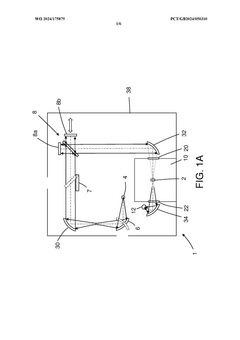
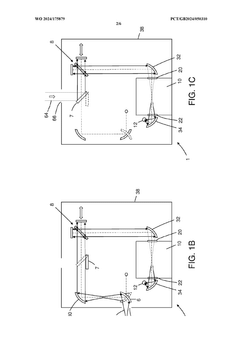
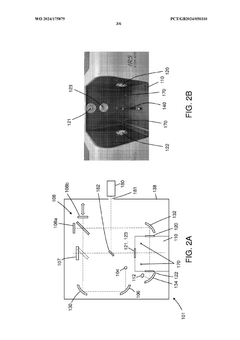
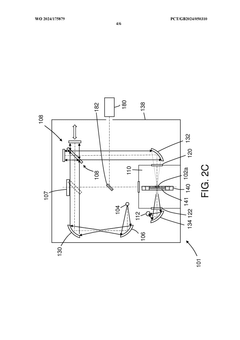
- A reconfigurable FTIR spectroscopy instrument with a sample chamber that can accommodate different sample holder accessories for conventional and luminescence spectroscopy configurations, utilizing a rotatable mirror as an optical switch to seamlessly switch between configurations, allowing for easy transition between transmission, reflection, ATR, PL, and Raman spectroscopy measurements.
FTIR System and Method for Compositional Analysis of Matter
PatentInactiveUS20170059411A1
Innovation
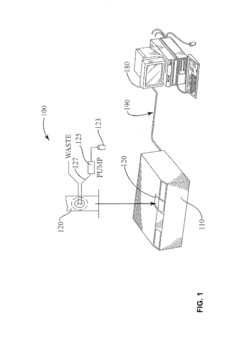
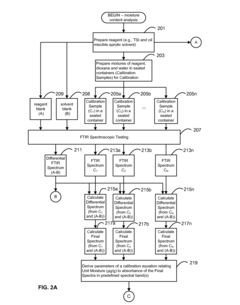
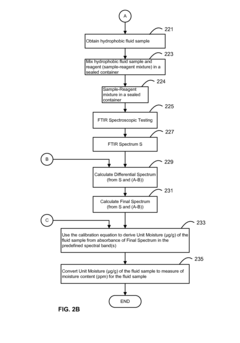
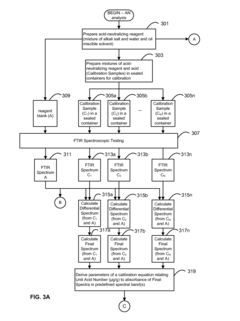
- A system and method using FTIR spectroscopy that involves preparing reagents reacting with the sample to produce carbon dioxide gas, allowing for calibration equations to be derived from standard mixtures, enabling precise measurement of moisture, acidity, or basicity by analyzing absorbance in specific spectral bands, which can be applied to various hydrophobic fluids and solid matrices.
Environmental Compliance Standards and Regulatory Requirements
Environmental compliance standards and regulatory requirements have become increasingly stringent for industries utilizing large-scale manufacturing processes. The implementation of Scale FTIR (Fourier Transform Infrared) spectroscopy for large sample environmental testing must align with these evolving regulatory frameworks. Currently, major environmental protection agencies worldwide, including the EPA in the United States, the European Environment Agency, and China's Ministry of Ecology and Environment, have established specific protocols for emissions monitoring and material analysis.
The Clean Air Act Amendments and subsequent regulations require continuous emissions monitoring systems (CEMS) with specific accuracy and reliability standards that Scale FTIR systems must meet. These regulations typically mandate detection limits in the parts per billion (ppb) range for certain volatile organic compounds (VOCs) and greenhouse gases. Scale FTIR systems designed for large sample testing must demonstrate compliance with these sensitivity requirements through rigorous validation protocols.
ISO 14000 series standards, particularly ISO 14001 for environmental management systems, provide frameworks that industries must follow when implementing environmental testing technologies. Scale FTIR systems need to be integrated into these management systems with appropriate documentation, calibration procedures, and quality assurance protocols to maintain certification compliance.
The Registration, Evaluation, Authorization and Restriction of Chemicals (REACH) regulation in Europe and similar chemical management regulations globally require detailed analysis of chemical substances in products. Scale FTIR technology must be capable of identifying and quantifying regulated substances at threshold levels specified in these regulations, which often range from 0.1% to 0.01% concentration by weight.
Waste management regulations, including the Resource Conservation and Recovery Act (RCRA) in the US, establish testing requirements for waste characterization. Scale FTIR systems used for large sample testing must be capable of identifying hazardous constituents according to standardized methods such as EPA Method 320 or European EN standards, with documented precision and accuracy metrics.
Industry-specific regulations, such as those for pharmaceutical manufacturing (GMP guidelines), automotive production (End-of-Life Vehicle Directive), and electronics manufacturing (RoHS Directive), impose additional requirements on environmental testing methodologies. Scale FTIR systems must be validated for these specific applications, with appropriate reference materials and calibration standards traceable to national metrology institutes.
Emerging regulations addressing microplastics, nanomaterials, and other novel environmental contaminants are creating new compliance challenges. Scale FTIR technology must demonstrate adaptability to these evolving requirements through software updates, sampling modifications, and analytical method development capabilities that can be validated against regulatory standards as they emerge.
The Clean Air Act Amendments and subsequent regulations require continuous emissions monitoring systems (CEMS) with specific accuracy and reliability standards that Scale FTIR systems must meet. These regulations typically mandate detection limits in the parts per billion (ppb) range for certain volatile organic compounds (VOCs) and greenhouse gases. Scale FTIR systems designed for large sample testing must demonstrate compliance with these sensitivity requirements through rigorous validation protocols.
ISO 14000 series standards, particularly ISO 14001 for environmental management systems, provide frameworks that industries must follow when implementing environmental testing technologies. Scale FTIR systems need to be integrated into these management systems with appropriate documentation, calibration procedures, and quality assurance protocols to maintain certification compliance.
The Registration, Evaluation, Authorization and Restriction of Chemicals (REACH) regulation in Europe and similar chemical management regulations globally require detailed analysis of chemical substances in products. Scale FTIR technology must be capable of identifying and quantifying regulated substances at threshold levels specified in these regulations, which often range from 0.1% to 0.01% concentration by weight.
Waste management regulations, including the Resource Conservation and Recovery Act (RCRA) in the US, establish testing requirements for waste characterization. Scale FTIR systems used for large sample testing must be capable of identifying hazardous constituents according to standardized methods such as EPA Method 320 or European EN standards, with documented precision and accuracy metrics.
Industry-specific regulations, such as those for pharmaceutical manufacturing (GMP guidelines), automotive production (End-of-Life Vehicle Directive), and electronics manufacturing (RoHS Directive), impose additional requirements on environmental testing methodologies. Scale FTIR systems must be validated for these specific applications, with appropriate reference materials and calibration standards traceable to national metrology institutes.
Emerging regulations addressing microplastics, nanomaterials, and other novel environmental contaminants are creating new compliance challenges. Scale FTIR technology must demonstrate adaptability to these evolving requirements through software updates, sampling modifications, and analytical method development capabilities that can be validated against regulatory standards as they emerge.
Cost-Benefit Analysis of Scaled FTIR Systems
The implementation of scaled FTIR systems for large sample environmental testing requires careful financial consideration to justify the substantial initial investment. When evaluating the cost-benefit ratio, organizations must account for both direct acquisition expenses and long-term operational implications. The initial capital expenditure for scaled FTIR systems typically ranges from $150,000 to $500,000, depending on resolution capabilities, sample chamber dimensions, and automation features.
Operating costs present another significant consideration, including maintenance contracts (approximately 10-15% of purchase price annually), specialized training for technical staff, and facility modifications to accommodate larger equipment footprints. Energy consumption increases proportionally with system size, potentially adding $5,000-$10,000 annually to utility expenses for industrial-scale implementations.
These costs must be weighed against quantifiable benefits that scaled FTIR systems deliver. Primary among these is the dramatic increase in throughput capacity, with large-chamber systems capable of processing 300-500% more samples daily compared to standard units. This efficiency translates directly to reduced per-sample analysis costs, typically decreasing from $45-60 per sample to $15-25 for high-volume operations.
Quality improvements represent another significant benefit, as scaled systems enable whole-sample analysis rather than extrapolation from smaller portions. Studies indicate this approach reduces error rates by 30-40% in environmental contamination assessments, potentially avoiding costly remediation mistakes that can exceed millions in liability. The ability to analyze heterogeneous samples in their entirety particularly benefits soil, sediment, and industrial waste testing applications.
Regulatory compliance benefits must also factor into the analysis. Scaled FTIR systems often meet more stringent documentation and chain-of-custody requirements, reducing compliance risks that carry potential penalties ranging from $10,000 to $100,000 per violation in many jurisdictions. The enhanced data quality also strengthens defensibility in litigation scenarios.
Return on investment timelines typically range from 2-4 years for organizations processing more than 1,000 environmental samples monthly. However, smaller operations may struggle to achieve favorable economics unless they can leverage the equipment through service offerings to external clients or through collaborative arrangements with partner organizations to maximize utilization rates.
Operating costs present another significant consideration, including maintenance contracts (approximately 10-15% of purchase price annually), specialized training for technical staff, and facility modifications to accommodate larger equipment footprints. Energy consumption increases proportionally with system size, potentially adding $5,000-$10,000 annually to utility expenses for industrial-scale implementations.
These costs must be weighed against quantifiable benefits that scaled FTIR systems deliver. Primary among these is the dramatic increase in throughput capacity, with large-chamber systems capable of processing 300-500% more samples daily compared to standard units. This efficiency translates directly to reduced per-sample analysis costs, typically decreasing from $45-60 per sample to $15-25 for high-volume operations.
Quality improvements represent another significant benefit, as scaled systems enable whole-sample analysis rather than extrapolation from smaller portions. Studies indicate this approach reduces error rates by 30-40% in environmental contamination assessments, potentially avoiding costly remediation mistakes that can exceed millions in liability. The ability to analyze heterogeneous samples in their entirety particularly benefits soil, sediment, and industrial waste testing applications.
Regulatory compliance benefits must also factor into the analysis. Scaled FTIR systems often meet more stringent documentation and chain-of-custody requirements, reducing compliance risks that carry potential penalties ranging from $10,000 to $100,000 per violation in many jurisdictions. The enhanced data quality also strengthens defensibility in litigation scenarios.
Return on investment timelines typically range from 2-4 years for organizations processing more than 1,000 environmental samples monthly. However, smaller operations may struggle to achieve favorable economics unless they can leverage the equipment through service offerings to external clients or through collaborative arrangements with partner organizations to maximize utilization rates.
Unlock deeper insights with Patsnap Eureka Quick Research — get a full tech report to explore trends and direct your research. Try now!
Generate Your Research Report Instantly with AI Agent
Supercharge your innovation with Patsnap Eureka AI Agent Platform!