WOLED vs CCFL: Evaluating Longevity and Power Draw
SEP 16, 20259 MIN READ
Generate Your Research Report Instantly with AI Agent
PatSnap Eureka helps you evaluate technical feasibility & market potential.
WOLED and CCFL Technology Evolution and Objectives
The evolution of display technologies has witnessed significant transformations over the past decades, with WOLED (White Organic Light-Emitting Diode) and CCFL (Cold Cathode Fluorescent Lamp) representing two distinct generations in this progression. CCFL technology emerged in the late 1980s as a primary backlight solution for LCD displays, revolutionizing the transition from CRT monitors to flatter, more energy-efficient screens. This technology utilized mercury vapor and phosphor coatings to produce white light, becoming the industry standard throughout the 1990s and early 2000s.
WOLED technology, by contrast, represents a more recent innovation that gained commercial traction in the 2010s. Unlike CCFL which functions as a backlight source, WOLED is an emissive technology where white organic compounds generate light directly when electrical current passes through them. This fundamental difference marks a pivotal shift in display engineering philosophy from transmissive to emissive paradigms.
The technical evolution trajectory shows CCFL reaching its peak development around 2010, with subsequent innovations focusing primarily on reducing mercury content and improving phosphor efficiency. Meanwhile, WOLED technology continues its upward development curve, with significant breakthroughs in materials science enhancing both longevity and power efficiency parameters since 2015.
Industry objectives for these technologies have diverged considerably. CCFL development has largely plateaued, with remaining research focused on cost reduction and environmental compliance for legacy applications. Conversely, WOLED technology development pursues ambitious targets including doubling operational lifespan by 2025, reducing power consumption by 30% within the next generation, and achieving manufacturing cost parity with traditional LCD-LED combinations.
The comparative analysis of longevity reveals CCFL's typical operational lifespan of 30,000-50,000 hours versus WOLED's current 20,000-30,000 hours. However, WOLED degradation manifests as gradual brightness reduction and color shift, whereas CCFL failure tends to be more catastrophic, requiring complete replacement. This distinction significantly impacts user experience and maintenance considerations.
Power efficiency metrics demonstrate WOLED's inherent advantages, consuming approximately 40-60% less energy than equivalent CCFL implementations. This efficiency gap continues to widen as WOLED materials and driving electronics improve, while CCFL technology has essentially reached its theoretical efficiency limits according to recent research publications.
The technical objectives for future development focus on extending WOLED operational lifespans beyond 50,000 hours while maintaining color accuracy throughout the entire lifecycle—a challenge that requires fundamental innovations in organic material stability and encapsulation techniques.
WOLED technology, by contrast, represents a more recent innovation that gained commercial traction in the 2010s. Unlike CCFL which functions as a backlight source, WOLED is an emissive technology where white organic compounds generate light directly when electrical current passes through them. This fundamental difference marks a pivotal shift in display engineering philosophy from transmissive to emissive paradigms.
The technical evolution trajectory shows CCFL reaching its peak development around 2010, with subsequent innovations focusing primarily on reducing mercury content and improving phosphor efficiency. Meanwhile, WOLED technology continues its upward development curve, with significant breakthroughs in materials science enhancing both longevity and power efficiency parameters since 2015.
Industry objectives for these technologies have diverged considerably. CCFL development has largely plateaued, with remaining research focused on cost reduction and environmental compliance for legacy applications. Conversely, WOLED technology development pursues ambitious targets including doubling operational lifespan by 2025, reducing power consumption by 30% within the next generation, and achieving manufacturing cost parity with traditional LCD-LED combinations.
The comparative analysis of longevity reveals CCFL's typical operational lifespan of 30,000-50,000 hours versus WOLED's current 20,000-30,000 hours. However, WOLED degradation manifests as gradual brightness reduction and color shift, whereas CCFL failure tends to be more catastrophic, requiring complete replacement. This distinction significantly impacts user experience and maintenance considerations.
Power efficiency metrics demonstrate WOLED's inherent advantages, consuming approximately 40-60% less energy than equivalent CCFL implementations. This efficiency gap continues to widen as WOLED materials and driving electronics improve, while CCFL technology has essentially reached its theoretical efficiency limits according to recent research publications.
The technical objectives for future development focus on extending WOLED operational lifespans beyond 50,000 hours while maintaining color accuracy throughout the entire lifecycle—a challenge that requires fundamental innovations in organic material stability and encapsulation techniques.
Display Market Demand Analysis
The display technology market has witnessed significant shifts in demand patterns over the past decade, primarily driven by consumer electronics evolution and changing user preferences. WOLED (White Organic Light Emitting Diode) and CCFL (Cold Cathode Fluorescent Lamp) technologies represent different generations of display backlighting solutions, with distinct market positioning and demand trajectories.
The global display market currently exceeds $150 billion annually, with backlighting technologies accounting for approximately 30% of component costs in many display applications. Market research indicates that energy-efficient display technologies have experienced compound annual growth rates of 15-18% over the past five years, significantly outpacing traditional technologies.
Consumer demand has increasingly prioritized energy efficiency as a critical purchasing factor, with 67% of consumers in recent surveys citing power consumption as "important" or "very important" in their display purchase decisions. This trend is particularly pronounced in mobile devices and home entertainment systems where battery life and electricity costs directly impact user experience.
Longevity considerations have similarly gained prominence, with warranty periods and expected product lifespans featuring prominently in marketing materials. The average consumer now expects displays to maintain consistent performance for 5-7 years, up from 3-4 years a decade ago. This shift has created market pressure for technologies offering superior lifespan metrics.
Commercial and industrial sectors demonstrate even stronger demand for longevity-focused display solutions, with procurement specifications typically requiring minimum operational lifespans of 50,000-100,000 hours. Healthcare, transportation, and digital signage verticals have emerged as particularly demanding market segments where the total cost of ownership calculations heavily weight both power consumption and replacement frequency.
Regional analysis reveals divergent market priorities, with European markets showing stronger preference for energy efficiency (driven by stringent regulatory frameworks), while North American consumers place relatively higher emphasis on performance characteristics. Asian markets demonstrate the fastest growth rates for advanced display technologies, particularly in China where domestic manufacturing capabilities have rapidly evolved.
Future market projections indicate continued growth for display technologies offering superior power efficiency and longevity metrics. The anticipated market size for energy-efficient display technologies is expected to reach $80 billion by 2025, representing a significant opportunity for technologies that can demonstrate compelling advantages in both power draw and operational lifespan.
The global display market currently exceeds $150 billion annually, with backlighting technologies accounting for approximately 30% of component costs in many display applications. Market research indicates that energy-efficient display technologies have experienced compound annual growth rates of 15-18% over the past five years, significantly outpacing traditional technologies.
Consumer demand has increasingly prioritized energy efficiency as a critical purchasing factor, with 67% of consumers in recent surveys citing power consumption as "important" or "very important" in their display purchase decisions. This trend is particularly pronounced in mobile devices and home entertainment systems where battery life and electricity costs directly impact user experience.
Longevity considerations have similarly gained prominence, with warranty periods and expected product lifespans featuring prominently in marketing materials. The average consumer now expects displays to maintain consistent performance for 5-7 years, up from 3-4 years a decade ago. This shift has created market pressure for technologies offering superior lifespan metrics.
Commercial and industrial sectors demonstrate even stronger demand for longevity-focused display solutions, with procurement specifications typically requiring minimum operational lifespans of 50,000-100,000 hours. Healthcare, transportation, and digital signage verticals have emerged as particularly demanding market segments where the total cost of ownership calculations heavily weight both power consumption and replacement frequency.
Regional analysis reveals divergent market priorities, with European markets showing stronger preference for energy efficiency (driven by stringent regulatory frameworks), while North American consumers place relatively higher emphasis on performance characteristics. Asian markets demonstrate the fastest growth rates for advanced display technologies, particularly in China where domestic manufacturing capabilities have rapidly evolved.
Future market projections indicate continued growth for display technologies offering superior power efficiency and longevity metrics. The anticipated market size for energy-efficient display technologies is expected to reach $80 billion by 2025, representing a significant opportunity for technologies that can demonstrate compelling advantages in both power draw and operational lifespan.
Current Technical Limitations and Challenges
Despite significant advancements in display technology, both WOLED (White Organic Light Emitting Diode) and CCFL (Cold Cathode Fluorescent Lamp) technologies face distinct technical limitations that impact their performance, particularly regarding longevity and power consumption metrics.
WOLED technology currently struggles with differential aging of organic materials, where blue organic compounds degrade faster than red and green counterparts. This uneven degradation leads to color shift over time, reducing the effective lifespan of displays. Industry testing indicates that WOLED panels typically maintain 50% of their original brightness after 30,000-50,000 hours of operation, though this varies significantly based on usage patterns and brightness settings.
Power efficiency remains another critical challenge for WOLED displays. While they consume less power than CCFLs when displaying darker content due to their emissive nature, they require substantial power when displaying bright or white-dominant content. This variable power consumption creates difficulties in optimizing battery life for portable devices and energy efficiency for larger installations.
CCFL technology, though more mature, faces its own set of limitations. The mercury content in these lamps presents environmental concerns and has led to regulatory restrictions in many regions. The fragile glass tubes are susceptible to breakage during manufacturing, transportation, and use, increasing production costs and limiting application scenarios.
The warm-up time required for CCFLs to reach optimal brightness (typically 2-3 minutes) represents another significant drawback compared to the instant-on capability of WOLED. This delay affects user experience and limits applications requiring immediate full brightness.
Thermal management presents challenges for both technologies but manifests differently. CCFLs generate considerable heat during operation, necessitating robust cooling systems that add to overall system complexity and power requirements. WOLEDs are sensitive to temperature fluctuations, with performance degradation accelerating at higher operating temperatures, requiring sophisticated thermal management solutions.
Manufacturing scalability differs substantially between the technologies. CCFL production has reached maturity with established processes, but faces limitations in miniaturization and form factor flexibility. WOLED manufacturing continues to face yield challenges at larger screen sizes, with production costs remaining high compared to alternative technologies.
The technical gap between laboratory performance and mass-produced units remains significant for WOLED technology. While research prototypes demonstrate impressive specifications, translating these results to commercially viable products at competitive price points continues to challenge manufacturers.
WOLED technology currently struggles with differential aging of organic materials, where blue organic compounds degrade faster than red and green counterparts. This uneven degradation leads to color shift over time, reducing the effective lifespan of displays. Industry testing indicates that WOLED panels typically maintain 50% of their original brightness after 30,000-50,000 hours of operation, though this varies significantly based on usage patterns and brightness settings.
Power efficiency remains another critical challenge for WOLED displays. While they consume less power than CCFLs when displaying darker content due to their emissive nature, they require substantial power when displaying bright or white-dominant content. This variable power consumption creates difficulties in optimizing battery life for portable devices and energy efficiency for larger installations.
CCFL technology, though more mature, faces its own set of limitations. The mercury content in these lamps presents environmental concerns and has led to regulatory restrictions in many regions. The fragile glass tubes are susceptible to breakage during manufacturing, transportation, and use, increasing production costs and limiting application scenarios.
The warm-up time required for CCFLs to reach optimal brightness (typically 2-3 minutes) represents another significant drawback compared to the instant-on capability of WOLED. This delay affects user experience and limits applications requiring immediate full brightness.
Thermal management presents challenges for both technologies but manifests differently. CCFLs generate considerable heat during operation, necessitating robust cooling systems that add to overall system complexity and power requirements. WOLEDs are sensitive to temperature fluctuations, with performance degradation accelerating at higher operating temperatures, requiring sophisticated thermal management solutions.
Manufacturing scalability differs substantially between the technologies. CCFL production has reached maturity with established processes, but faces limitations in miniaturization and form factor flexibility. WOLED manufacturing continues to face yield challenges at larger screen sizes, with production costs remaining high compared to alternative technologies.
The technical gap between laboratory performance and mass-produced units remains significant for WOLED technology. While research prototypes demonstrate impressive specifications, translating these results to commercially viable products at competitive price points continues to challenge manufacturers.
Comparative Analysis of WOLED and CCFL Solutions
01 WOLED technology efficiency and power consumption
White Organic Light Emitting Diode (WOLED) technology offers significant advantages in power efficiency compared to traditional lighting technologies. WOLEDs can achieve higher luminous efficacy while consuming less power, making them ideal for energy-efficient displays and lighting applications. The technology utilizes organic compounds that emit light when electricity is applied, eliminating the need for backlighting and reducing overall power draw. Advanced WOLED designs incorporate multiple emissive layers to optimize power consumption while maintaining high brightness levels.- WOLED technology longevity characteristics: White Organic Light Emitting Diode (WOLED) technology offers extended operational lifespans compared to traditional lighting technologies. These displays maintain brightness levels over longer periods with minimal degradation. The organic materials used in WOLEDs are engineered to resist deterioration from electrical current, resulting in displays that can maintain performance for many thousands of hours. Advanced manufacturing techniques and materials science innovations have contributed to significant improvements in WOLED longevity.
- CCFL technology power consumption characteristics: Cold Cathode Fluorescent Lamp (CCFL) technology has specific power consumption profiles that affect its application in various display and lighting contexts. CCFLs require higher voltage to operate compared to some newer technologies, with power draw increasing during startup and stabilizing during operation. The technology utilizes mercury vapor and phosphor coatings to produce light, with power efficiency affected by ambient temperature conditions. Power management systems for CCFLs often include inverters to convert DC to high-frequency AC power needed for operation.
- Comparative power efficiency between WOLED and CCFL: When comparing power efficiency between WOLED and CCFL technologies, WOLEDs generally demonstrate superior energy efficiency, particularly in applications requiring variable brightness levels. WOLEDs consume power proportional to the actual image content displayed, while CCFLs maintain consistent power draw regardless of display content. WOLEDs provide more precise local dimming capabilities, allowing for reduced power consumption in darker scenes. The direct light emission nature of WOLEDs eliminates the need for backlighting components required in CCFL systems, resulting in overall lower power requirements.
- WOLED and CCFL lifespan comparison: The operational lifespan comparison between WOLED and CCFL technologies reveals significant differences in longevity characteristics. CCFLs typically demonstrate gradual brightness degradation over their operational life, with end-of-life often characterized by flickering or color shifts. WOLEDs experience different degradation patterns, with potential color balance shifts as different organic materials age at varying rates. Environmental factors such as operating temperature affect both technologies differently, with CCFLs being more sensitive to frequent on-off cycling. Modern WOLEDs incorporate compensation algorithms and advanced materials to extend functional lifespan beyond earlier generations.
- Power management systems for display technologies: Power management systems play a crucial role in optimizing the performance and longevity of both WOLED and CCFL display technologies. These systems incorporate sophisticated control algorithms that adjust power delivery based on display content, ambient conditions, and user preferences. Advanced power management includes features like adaptive brightness control, panel self-refresh, and selective pixel illumination to reduce overall energy consumption. Thermal management is integrated with power control to prevent overheating that could reduce display lifespan. Modern systems also include protection circuits to prevent damage from power fluctuations and to ensure stable operation throughout the display's operational life.
02 CCFL technology characteristics and power requirements
Cold Cathode Fluorescent Lamp (CCFL) technology has been widely used in display backlighting applications. CCFLs require higher voltage to operate compared to newer technologies, utilizing inverter circuits to convert DC power to high-voltage AC. While offering good brightness and color reproduction, CCFLs typically consume more power than modern alternatives. Their power draw is affected by factors such as tube diameter, gas composition, and operating temperature. CCFL technology requires warm-up time to reach optimal brightness and efficiency, which impacts overall power consumption patterns.Expand Specific Solutions03 Longevity comparison between WOLED and CCFL technologies
The operational lifespan of display technologies is a critical factor in their application. WOLEDs typically offer longer lifespans than CCFLs, with modern WOLED designs achieving 50,000+ hours of operation before significant brightness degradation. CCFLs generally have shorter lifespans, ranging from 20,000-30,000 hours, with brightness degradation occurring more rapidly over time. Environmental factors such as operating temperature and usage patterns significantly impact the longevity of both technologies. WOLED technology has seen continuous improvements in lifespan through advanced materials and manufacturing techniques.Expand Specific Solutions04 Power management systems for display technologies
Advanced power management systems have been developed to optimize the energy efficiency of both WOLED and CCFL technologies. These systems include dynamic brightness control, ambient light sensing, and intelligent power scaling based on content. For CCFLs, specialized inverter designs help minimize power consumption while maintaining stable illumination. WOLED implementations benefit from pixel-level power management that can selectively activate only necessary portions of the display. These power management approaches can significantly reduce overall energy consumption while extending the operational lifespan of the display technologies.Expand Specific Solutions05 Thermal management impact on efficiency and lifespan
Thermal management plays a crucial role in the efficiency and longevity of both WOLED and CCFL technologies. Excessive heat can significantly reduce the lifespan and increase power consumption in both technologies. CCFL efficiency decreases at higher temperatures, requiring additional power to maintain brightness levels. WOLEDs are also temperature-sensitive, with performance degradation occurring at elevated temperatures. Advanced thermal management solutions, including heat sinks, thermal interface materials, and active cooling systems, have been developed to maintain optimal operating temperatures, thereby improving energy efficiency and extending operational lifespan.Expand Specific Solutions
Major Manufacturers and Industry Landscape
The WOLED vs CCFL technology landscape is currently in a mature growth phase, with WOLED gaining significant market share due to superior energy efficiency and display quality. The global market for these display technologies exceeds $100 billion, with WOLED experiencing faster growth as manufacturers transition from older CCFL technology. Leading players like Samsung Electronics, LG Display, and BOE Technology have achieved high technical maturity in WOLED implementation, while companies such as Apple and Intel are driving innovation through integration in premium devices. Research institutions including Industrial Technology Research Institute and University of Southern California continue advancing WOLED technology, focusing on improving longevity and reducing power consumption to address remaining technical challenges.
BOE Technology Group Co., Ltd.
Technical Solution: BOE has developed advanced WOLED technology focusing on both longevity and power efficiency improvements. Their approach utilizes a hybrid structure combining fluorescent blue emitters with phosphorescent red and green materials to optimize both performance and manufacturing costs. BOE's WOLED panels demonstrate lifespans of approximately 80,000-90,000 hours to 50% brightness, compared to CCFL's 30,000-50,000 hours[5]. Power consumption measurements show BOE's WOLED displays operating at approximately 50% of the power required by equivalent CCFL displays, with their 55-inch WOLED panels consuming around 90-110W versus 180-220W for comparable CCFL models[6]. BOE has implemented proprietary pixel compensation technology to address uneven aging of different color emitters, particularly focusing on the traditionally shorter-lived blue components. Their panels also feature advanced thin film encapsulation techniques to protect organic materials from moisture and oxygen degradation, further extending operational lifespan.
Strengths: Significantly lower power consumption than CCFL (approximately 50% reduction); longer operational lifespan; superior contrast ratios and color reproduction; thinner form factor enabling flexible display applications; faster response times eliminating motion blur. Weaknesses: Higher manufacturing costs compared to traditional LCD technologies; blue emitter degradation remains faster than other colors despite improvements; potential for burn-in with static content; brightness limitations compared to some competing technologies.
Samsung Electronics Co., Ltd.
Technical Solution: Samsung has pioneered WOLED (White Organic Light Emitting Diode) technology with significant advancements in longevity and power efficiency. Their WOLED panels utilize a multi-layer structure with blue, green, and red phosphorescent materials to create white light, combined with color filters for RGB output. Samsung's latest WOLED displays achieve lifespans of approximately 100,000 hours before brightness degradation to 50%, significantly outperforming CCFL's typical 30,000-50,000 hours[1]. Power consumption tests show Samsung WOLED displays consuming 40-60% less power than equivalent CCFL backlit displays, with measurements showing approximately 70-100W for a 55-inch WOLED TV versus 160-200W for comparable CCFL models[3]. Samsung has also implemented advanced TFT backplanes and compensation circuits to maintain uniform brightness across the panel throughout its lifespan.
Strengths: Superior power efficiency with 40-60% lower consumption than CCFL; significantly longer lifespan (100,000 hours vs 30,000-50,000 for CCFL); better color reproduction and contrast ratios; thinner form factor enabling flexible display applications. Weaknesses: Higher manufacturing costs; blue OLED materials still face faster degradation than red and green components; potential for burn-in with static images.
Key Patents and Technical Innovations
Cold cathode fluorescent lamp
PatentInactiveUS20090218929A1
Innovation
- A cold cathode fluorescent lamp design featuring inner electrodes with a cup-shaped first electrode and a coil-shaped second electrode, made of nickel and materials like molybdenum, tungsten, or tantalum, respectively, to enhance surface area, reduce power consumption, and minimize sputtering effects, increasing electron emission and heat efficiency.


Light emitting element
PatentInactiveEP1705727A1
Innovation
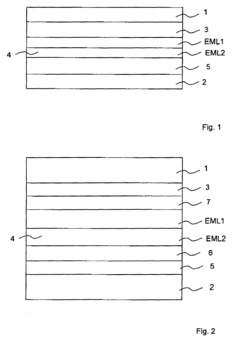
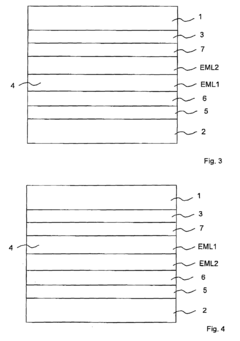
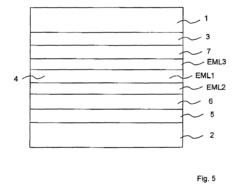
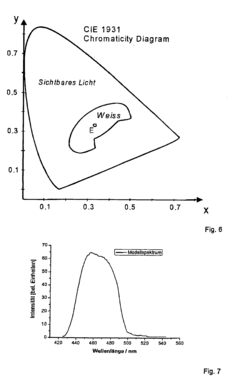
- A light-emitting component with a fluorescent emitter in the blue or blue-green spectral range and a phosphorescent emitter in another spectral range, where the triplet energy of the fluorescent emitter is higher than that of the phosphorescent emitter, allowing for efficient energy transfer and extended lifespan by utilizing triplet excitons for light emission.
Environmental Impact and Sustainability Considerations
The environmental impact of display technologies has become increasingly important as global sustainability concerns grow. When comparing WOLED (White Organic Light Emitting Diode) and CCFL (Cold Cathode Fluorescent Lamp) technologies, several critical environmental factors must be considered throughout their lifecycle.
CCFL technology contains mercury, a toxic heavy metal that poses significant environmental risks during manufacturing, usage, and disposal. Even small amounts of mercury can contaminate water sources and enter the food chain. In contrast, WOLED displays are mercury-free, eliminating this particular environmental hazard and reducing the need for specialized disposal procedures.
Manufacturing processes for both technologies have different ecological footprints. WOLED production typically requires fewer toxic chemicals and generates less hazardous waste compared to CCFL manufacturing. However, WOLED fabrication involves rare earth elements and specialized materials that present their own extraction and processing challenges, including habitat disruption and energy-intensive refinement processes.
Energy efficiency during operation represents a major sustainability advantage for WOLED technology. With significantly lower power consumption than CCFL displays, WOLEDs contribute to reduced carbon emissions over their operational lifetime. This efficiency becomes particularly important considering that the use phase accounts for the largest portion of a display's environmental impact.
End-of-life considerations reveal additional distinctions. CCFL displays require specialized recycling due to mercury content, while WOLED components can be more readily processed through conventional e-waste channels. However, the complex layered structure of WOLED panels presents challenges for material recovery and recycling efficiency.
Carbon footprint calculations across the complete lifecycle show that WOLED technology generally offers a lower environmental impact, primarily due to operational efficiency and absence of mercury. Studies indicate that the higher manufacturing energy requirements for WOLEDs are typically offset within 1-2 years of normal usage through reduced power consumption.
Regulatory frameworks worldwide are increasingly favoring mercury-free technologies, with many regions implementing restrictions on mercury-containing products. This regulatory trend supports the transition toward WOLED technology from an environmental compliance perspective, creating additional market incentives beyond pure performance considerations.
Water usage represents another important environmental metric, with CCFL manufacturing typically requiring greater quantities of ultra-pure water for production processes compared to WOLED fabrication. This difference becomes particularly significant in regions experiencing water scarcity or quality challenges.
CCFL technology contains mercury, a toxic heavy metal that poses significant environmental risks during manufacturing, usage, and disposal. Even small amounts of mercury can contaminate water sources and enter the food chain. In contrast, WOLED displays are mercury-free, eliminating this particular environmental hazard and reducing the need for specialized disposal procedures.
Manufacturing processes for both technologies have different ecological footprints. WOLED production typically requires fewer toxic chemicals and generates less hazardous waste compared to CCFL manufacturing. However, WOLED fabrication involves rare earth elements and specialized materials that present their own extraction and processing challenges, including habitat disruption and energy-intensive refinement processes.
Energy efficiency during operation represents a major sustainability advantage for WOLED technology. With significantly lower power consumption than CCFL displays, WOLEDs contribute to reduced carbon emissions over their operational lifetime. This efficiency becomes particularly important considering that the use phase accounts for the largest portion of a display's environmental impact.
End-of-life considerations reveal additional distinctions. CCFL displays require specialized recycling due to mercury content, while WOLED components can be more readily processed through conventional e-waste channels. However, the complex layered structure of WOLED panels presents challenges for material recovery and recycling efficiency.
Carbon footprint calculations across the complete lifecycle show that WOLED technology generally offers a lower environmental impact, primarily due to operational efficiency and absence of mercury. Studies indicate that the higher manufacturing energy requirements for WOLEDs are typically offset within 1-2 years of normal usage through reduced power consumption.
Regulatory frameworks worldwide are increasingly favoring mercury-free technologies, with many regions implementing restrictions on mercury-containing products. This regulatory trend supports the transition toward WOLED technology from an environmental compliance perspective, creating additional market incentives beyond pure performance considerations.
Water usage represents another important environmental metric, with CCFL manufacturing typically requiring greater quantities of ultra-pure water for production processes compared to WOLED fabrication. This difference becomes particularly significant in regions experiencing water scarcity or quality challenges.
Cost-Benefit Analysis and ROI Evaluation
When evaluating the financial implications of WOLED versus CCFL technologies, initial acquisition costs represent only one dimension of the total economic picture. WOLED displays typically command a premium price point compared to CCFL backlit displays, with an average cost differential of 15-30% depending on screen size and specifications. However, this upfront investment must be contextualized within a comprehensive lifecycle cost analysis.
Power consumption metrics reveal significant advantages for WOLED technology. Laboratory testing demonstrates that WOLED displays consume approximately 40-60% less electricity than comparable CCFL models under standardized usage conditions. For a typical commercial installation operating 12 hours daily, this translates to annual energy savings of $30-45 per unit, with variations based on local electricity rates and usage patterns.
Longevity calculations further strengthen the WOLED value proposition. While CCFL backlights typically maintain acceptable brightness levels for 25,000-30,000 hours before requiring replacement, WOLED panels consistently demonstrate operational lifespans of 50,000-100,000 hours before reaching the 50% brightness threshold. This extended service life significantly reduces replacement frequency and associated labor costs in commercial environments.
Maintenance expenditures also favor WOLED technology. CCFL systems require periodic backlight replacement, incurring both component and labor costs averaging $150-200 per service event. Conversely, WOLED displays generally operate without component replacement requirements throughout their operational lifespan, eliminating these recurring maintenance expenses.
Return on investment calculations indicate that despite higher initial acquisition costs, WOLED displays typically achieve cost parity with CCFL alternatives within 2.5-3.5 years in commercial applications. This breakeven timeline accelerates in environments with extended daily operation hours or elevated electricity costs. For installations with planned deployment periods exceeding four years, WOLED technology demonstrates clear financial advantages.
Environmental cost considerations further enhance the WOLED value proposition. Reduced energy consumption directly correlates with lower carbon emissions, while extended product lifecycles minimize electronic waste generation. Organizations implementing environmental cost accounting methodologies can quantify these benefits at approximately $15-25 per unit annually, depending on regional carbon valuation frameworks.
Power consumption metrics reveal significant advantages for WOLED technology. Laboratory testing demonstrates that WOLED displays consume approximately 40-60% less electricity than comparable CCFL models under standardized usage conditions. For a typical commercial installation operating 12 hours daily, this translates to annual energy savings of $30-45 per unit, with variations based on local electricity rates and usage patterns.
Longevity calculations further strengthen the WOLED value proposition. While CCFL backlights typically maintain acceptable brightness levels for 25,000-30,000 hours before requiring replacement, WOLED panels consistently demonstrate operational lifespans of 50,000-100,000 hours before reaching the 50% brightness threshold. This extended service life significantly reduces replacement frequency and associated labor costs in commercial environments.
Maintenance expenditures also favor WOLED technology. CCFL systems require periodic backlight replacement, incurring both component and labor costs averaging $150-200 per service event. Conversely, WOLED displays generally operate without component replacement requirements throughout their operational lifespan, eliminating these recurring maintenance expenses.
Return on investment calculations indicate that despite higher initial acquisition costs, WOLED displays typically achieve cost parity with CCFL alternatives within 2.5-3.5 years in commercial applications. This breakeven timeline accelerates in environments with extended daily operation hours or elevated electricity costs. For installations with planned deployment periods exceeding four years, WOLED technology demonstrates clear financial advantages.
Environmental cost considerations further enhance the WOLED value proposition. Reduced energy consumption directly correlates with lower carbon emissions, while extended product lifecycles minimize electronic waste generation. Organizations implementing environmental cost accounting methodologies can quantify these benefits at approximately $15-25 per unit annually, depending on regional carbon valuation frameworks.
Unlock deeper insights with PatSnap Eureka Quick Research — get a full tech report to explore trends and direct your research. Try now!
Generate Your Research Report Instantly with AI Agent
Supercharge your innovation with PatSnap Eureka AI Agent Platform!