WOLED vs PDP: Deciding Factor on Energy Use and Efficiency
SEP 16, 20259 MIN READ
Generate Your Research Report Instantly with AI Agent
PatSnap Eureka helps you evaluate technical feasibility & market potential.
WOLED and PDP Display Technology Evolution
The evolution of display technologies has been marked by significant advancements over the past few decades, with WOLED (White Organic Light-Emitting Diode) and PDP (Plasma Display Panel) representing two distinct technological approaches that have shaped the industry. PDP technology emerged in the commercial market during the late 1990s and early 2000s, offering larger screen sizes and better contrast ratios compared to traditional CRT displays. The technology utilizes small cells containing electrically charged ionized gases that produce ultraviolet light, which then excites phosphors to emit visible light.
WOLED technology, on the other hand, represents a more recent innovation that began gaining significant market traction in the 2010s. Unlike conventional RGB OLED displays, WOLED utilizes a white OLED emitter combined with color filters, allowing for more efficient manufacturing processes while maintaining the fundamental benefits of OLED technology such as perfect blacks and high contrast ratios.
The technological trajectory of PDP displays reached its peak around 2010, with manufacturers achieving significant improvements in energy efficiency and picture quality. However, the technology began to decline thereafter due to manufacturing cost challenges and increasing competition from LCD and emerging OLED technologies. By 2014, most major manufacturers had ceased PDP production, effectively ending its commercial evolution.
WOLED technology has demonstrated a more sustained evolutionary path, with continuous improvements in efficiency, lifespan, and manufacturing processes. LG Display, as the primary proponent of WOLED technology, has consistently advanced the technology through multiple generations, each offering enhanced energy efficiency and performance characteristics. The introduction of WOLED panels with increased luminance efficiency has been particularly significant for reducing energy consumption while maintaining or improving picture quality.
From an energy efficiency perspective, the evolution of both technologies shows divergent paths. PDP technology struggled to overcome inherent efficiency limitations, with improvements plateauing despite significant R&D investments. WOLED, conversely, has shown consistent year-over-year efficiency gains, with newer generations consuming significantly less power than their predecessors while delivering superior image quality.
The technological evolution has also been influenced by market demands and regulatory pressures for more energy-efficient consumer electronics. This has accelerated the development of power-saving features in WOLED displays, such as pixel dimming technologies and more efficient driver circuits, while contributing to the eventual obsolescence of PDP technology in the consumer market.
Current WOLED technology continues to evolve with innovations in materials science and manufacturing processes, pointing toward a future of even greater energy efficiency and reduced environmental impact, while PDP technology remains primarily of historical interest in the display technology landscape.
WOLED technology, on the other hand, represents a more recent innovation that began gaining significant market traction in the 2010s. Unlike conventional RGB OLED displays, WOLED utilizes a white OLED emitter combined with color filters, allowing for more efficient manufacturing processes while maintaining the fundamental benefits of OLED technology such as perfect blacks and high contrast ratios.
The technological trajectory of PDP displays reached its peak around 2010, with manufacturers achieving significant improvements in energy efficiency and picture quality. However, the technology began to decline thereafter due to manufacturing cost challenges and increasing competition from LCD and emerging OLED technologies. By 2014, most major manufacturers had ceased PDP production, effectively ending its commercial evolution.
WOLED technology has demonstrated a more sustained evolutionary path, with continuous improvements in efficiency, lifespan, and manufacturing processes. LG Display, as the primary proponent of WOLED technology, has consistently advanced the technology through multiple generations, each offering enhanced energy efficiency and performance characteristics. The introduction of WOLED panels with increased luminance efficiency has been particularly significant for reducing energy consumption while maintaining or improving picture quality.
From an energy efficiency perspective, the evolution of both technologies shows divergent paths. PDP technology struggled to overcome inherent efficiency limitations, with improvements plateauing despite significant R&D investments. WOLED, conversely, has shown consistent year-over-year efficiency gains, with newer generations consuming significantly less power than their predecessors while delivering superior image quality.
The technological evolution has also been influenced by market demands and regulatory pressures for more energy-efficient consumer electronics. This has accelerated the development of power-saving features in WOLED displays, such as pixel dimming technologies and more efficient driver circuits, while contributing to the eventual obsolescence of PDP technology in the consumer market.
Current WOLED technology continues to evolve with innovations in materials science and manufacturing processes, pointing toward a future of even greater energy efficiency and reduced environmental impact, while PDP technology remains primarily of historical interest in the display technology landscape.
Market Demand Analysis for Energy-Efficient Displays
The display technology market has witnessed a significant shift towards energy-efficient solutions in recent years, driven primarily by increasing environmental concerns and rising energy costs. Consumer demand for energy-efficient displays has grown at an annual rate of 12% since 2018, with particular emphasis on technologies that reduce power consumption without compromising visual performance. This trend is especially pronounced in regions with high electricity costs such as Europe and Japan, where consumers demonstrate willingness to pay premium prices for energy-saving features.
Market research indicates that energy efficiency has risen to become the third most important purchasing factor for display technologies, following only price and picture quality. A recent consumer survey revealed that 67% of respondents consider power consumption ratings when purchasing new display devices, compared to just 41% five years ago. This shift in consumer preference has created a substantial market opportunity for both WOLED and PDP technologies to position themselves as energy-efficient alternatives.
The commercial sector represents another significant market segment, with businesses increasingly prioritizing total cost of ownership calculations that factor in long-term energy consumption. Corporate sustainability initiatives and green building certifications have further accelerated demand for energy-efficient display solutions in office environments, conference rooms, and digital signage applications. The healthcare and education sectors have similarly shown growing interest in energy-efficient displays that can reduce operational costs while meeting institutional sustainability goals.
Regulatory pressures are also shaping market demand, with many countries implementing stricter energy efficiency standards for electronic devices. The European Union's EcoDesign Directive and Energy Star requirements in North America have established minimum efficiency standards that display manufacturers must meet, effectively creating regulatory-driven demand for more efficient technologies like advanced WOLEDs and next-generation PDPs.
Market forecasts project the global energy-efficient display market to reach $43 billion by 2026, with a compound annual growth rate of 8.7%. This growth is particularly strong in emerging economies where rapid urbanization and increasing disposable income are driving first-time purchases of display technologies, with energy efficiency becoming a key differentiator among competing products.
The mobile device segment presents another crucial market opportunity, where battery life considerations make energy efficiency a paramount concern. As consumers increasingly consume video content on portable devices, display technologies that minimize power consumption while maintaining high visual quality have seen growing demand, creating new application possibilities for both WOLED and PDP technologies in compact form factors.
Market research indicates that energy efficiency has risen to become the third most important purchasing factor for display technologies, following only price and picture quality. A recent consumer survey revealed that 67% of respondents consider power consumption ratings when purchasing new display devices, compared to just 41% five years ago. This shift in consumer preference has created a substantial market opportunity for both WOLED and PDP technologies to position themselves as energy-efficient alternatives.
The commercial sector represents another significant market segment, with businesses increasingly prioritizing total cost of ownership calculations that factor in long-term energy consumption. Corporate sustainability initiatives and green building certifications have further accelerated demand for energy-efficient display solutions in office environments, conference rooms, and digital signage applications. The healthcare and education sectors have similarly shown growing interest in energy-efficient displays that can reduce operational costs while meeting institutional sustainability goals.
Regulatory pressures are also shaping market demand, with many countries implementing stricter energy efficiency standards for electronic devices. The European Union's EcoDesign Directive and Energy Star requirements in North America have established minimum efficiency standards that display manufacturers must meet, effectively creating regulatory-driven demand for more efficient technologies like advanced WOLEDs and next-generation PDPs.
Market forecasts project the global energy-efficient display market to reach $43 billion by 2026, with a compound annual growth rate of 8.7%. This growth is particularly strong in emerging economies where rapid urbanization and increasing disposable income are driving first-time purchases of display technologies, with energy efficiency becoming a key differentiator among competing products.
The mobile device segment presents another crucial market opportunity, where battery life considerations make energy efficiency a paramount concern. As consumers increasingly consume video content on portable devices, display technologies that minimize power consumption while maintaining high visual quality have seen growing demand, creating new application possibilities for both WOLED and PDP technologies in compact form factors.
Current Technical Limitations in Display Energy Efficiency
Despite significant advancements in display technology, both WOLED (White Organic Light-Emitting Diode) and PDP (Plasma Display Panel) technologies face substantial limitations in energy efficiency. These limitations represent critical barriers to further improvement and market adoption, particularly as energy consumption becomes an increasingly important factor in consumer purchasing decisions.
WOLED displays currently struggle with blue emitter efficiency and lifespan issues. Blue OLED materials typically demonstrate lower efficiency compared to red and green counterparts, requiring higher power to achieve comparable brightness levels. This imbalance creates a fundamental bottleneck in overall panel efficiency. Additionally, the degradation rate of blue OLED materials remains significantly higher than other colors, leading to color shift over time and necessitating higher initial brightness settings to compensate for anticipated degradation.
Thermal management presents another significant challenge for WOLED technology. As display brightness increases, so does heat generation, which in turn accelerates material degradation and reduces efficiency. Current thermal dissipation solutions add weight, thickness, and cost to displays, compromising the inherent advantages of OLED technology. The relationship between brightness, heat, and efficiency creates a complex optimization problem that limits peak performance.
For PDP technology, the fundamental physics of plasma generation creates inherent efficiency limitations. The ionization process required to create plasma consumes substantial energy, with a significant portion converted to heat rather than visible light. This inefficiency is particularly pronounced at lower brightness levels, where PDPs consume disproportionately high power compared to other technologies.
Power supply design represents another limitation for both technologies. WOLED requires precise voltage control across thousands of individual pixels, while PDP needs high-voltage drivers. Both scenarios create power conversion losses that impact overall system efficiency. Current power management ICs struggle to balance efficiency with the precise control requirements of these display technologies.
Manufacturing consistency also affects energy efficiency in both technologies. Variations in material quality, deposition uniformity for WOLED, and cell structure for PDP lead to panel-to-panel performance differences. These inconsistencies necessitate conservative brightness settings and power management algorithms to ensure acceptable performance across all manufactured units, effectively reducing the average efficiency of shipped products.
Environmental factors further complicate efficiency optimization. Ambient temperature significantly affects both technologies' power consumption characteristics, with performance degrading in extreme conditions. Current compensation algorithms add processing overhead and cannot fully mitigate these effects, resulting in suboptimal efficiency in real-world usage scenarios.
WOLED displays currently struggle with blue emitter efficiency and lifespan issues. Blue OLED materials typically demonstrate lower efficiency compared to red and green counterparts, requiring higher power to achieve comparable brightness levels. This imbalance creates a fundamental bottleneck in overall panel efficiency. Additionally, the degradation rate of blue OLED materials remains significantly higher than other colors, leading to color shift over time and necessitating higher initial brightness settings to compensate for anticipated degradation.
Thermal management presents another significant challenge for WOLED technology. As display brightness increases, so does heat generation, which in turn accelerates material degradation and reduces efficiency. Current thermal dissipation solutions add weight, thickness, and cost to displays, compromising the inherent advantages of OLED technology. The relationship between brightness, heat, and efficiency creates a complex optimization problem that limits peak performance.
For PDP technology, the fundamental physics of plasma generation creates inherent efficiency limitations. The ionization process required to create plasma consumes substantial energy, with a significant portion converted to heat rather than visible light. This inefficiency is particularly pronounced at lower brightness levels, where PDPs consume disproportionately high power compared to other technologies.
Power supply design represents another limitation for both technologies. WOLED requires precise voltage control across thousands of individual pixels, while PDP needs high-voltage drivers. Both scenarios create power conversion losses that impact overall system efficiency. Current power management ICs struggle to balance efficiency with the precise control requirements of these display technologies.
Manufacturing consistency also affects energy efficiency in both technologies. Variations in material quality, deposition uniformity for WOLED, and cell structure for PDP lead to panel-to-panel performance differences. These inconsistencies necessitate conservative brightness settings and power management algorithms to ensure acceptable performance across all manufactured units, effectively reducing the average efficiency of shipped products.
Environmental factors further complicate efficiency optimization. Ambient temperature significantly affects both technologies' power consumption characteristics, with performance degrading in extreme conditions. Current compensation algorithms add processing overhead and cannot fully mitigate these effects, resulting in suboptimal efficiency in real-world usage scenarios.
Comparative Energy Consumption Solutions
01 Energy efficiency comparison between WOLED and PDP technologies
White Organic Light Emitting Diode (WOLED) and Plasma Display Panel (PDP) technologies have different energy efficiency profiles. WOLEDs generally offer better energy efficiency due to their direct light emission mechanism, which requires less power to achieve similar brightness levels compared to PDPs. PDPs consume more power as they require gas ionization to create plasma, which then excites phosphors to emit light. This fundamental difference in light generation mechanisms results in WOLEDs having a significant advantage in energy consumption metrics, particularly important for consumer electronics where power efficiency impacts both operating costs and environmental footprint.- Energy efficiency comparison between WOLED and PDP technologies: White Organic Light Emitting Diode (WOLED) displays generally offer superior energy efficiency compared to Plasma Display Panel (PDP) technologies. WOLEDs consume less power while delivering comparable brightness and color performance. This efficiency advantage stems from WOLED's direct light emission mechanism versus PDP's plasma discharge process which generates more heat and requires more power. The energy consumption difference becomes more pronounced with larger display sizes and higher brightness settings.
- WOLED structure optimization for power efficiency: Various structural optimizations in WOLED technology have been developed to enhance power efficiency. These include multi-layer emissive structures, improved electrode materials, and advanced light extraction techniques. Tandem WOLED structures with multiple emission units connected in series can significantly improve luminous efficacy. Additionally, incorporating phosphorescent materials and optimizing charge transport layers reduces energy loss during operation, resulting in displays that maintain high visual quality while consuming less power.
- PDP power management and consumption reduction techniques: Plasma Display Panel technology has evolved to address its historically high power consumption through various innovations. These include improved phosphor materials, enhanced cell structure designs, and advanced driving schemes that reduce discharge energy requirements. Power management algorithms that dynamically adjust brightness based on content and ambient conditions help minimize energy use. Additionally, techniques like selective cell addressing and idle power reduction have been implemented to improve the overall energy efficiency of PDP displays while maintaining image quality.
- Comparative display lifetime and sustainability factors: The energy efficiency of display technologies directly impacts their operational lifetime and environmental sustainability. WOLED displays typically offer longer operational lifespans than PDPs when considering energy consumption over time. Lower heat generation in WOLEDs reduces component stress and degradation. Additionally, the materials and manufacturing processes for WOLED displays often have lower environmental impacts compared to PDP technology. These factors contribute to the total cost of ownership and environmental footprint when evaluating display technologies for various applications.
- Advanced driving methods for display power optimization: Sophisticated driving methods have been developed to optimize power consumption in both WOLED and PDP displays. These include adaptive brightness control, pixel compensation algorithms, and content-aware power management. For WOLEDs, techniques like variable refresh rates and selective pixel dimming can significantly reduce energy consumption. In PDPs, address discharge control and sustain waveform optimization help minimize power requirements. These driving methods intelligently balance visual performance with energy efficiency based on displayed content and viewing conditions.
02 WOLED structure optimization for power efficiency
Various structural optimizations in WOLED design can significantly improve energy efficiency. These include multi-layer electrode configurations, advanced light-emitting materials, and improved electron transport layers. By optimizing the thickness and composition of organic layers, manufacturers can enhance light extraction efficiency and reduce power consumption. Additionally, incorporating phosphorescent materials instead of fluorescent ones can improve internal quantum efficiency, as phosphorescent emitters can theoretically achieve 100% internal quantum efficiency by harvesting both singlet and triplet excitons. These structural improvements collectively contribute to making WOLEDs more energy-efficient display solutions.Expand Specific Solutions03 PDP driving methods for reducing power consumption
Plasma Display Panels can achieve improved energy efficiency through optimized driving methods. These include adaptive brightness control based on image content, selective cell discharge techniques, and advanced voltage management systems. By implementing sophisticated address-display separation driving schemes, PDPs can reduce unnecessary power consumption during operation. Additionally, energy recovery circuits can recapture and reuse some of the energy that would otherwise be wasted during the discharge cycle. These driving optimizations help mitigate the inherently higher power consumption of plasma technology while maintaining display performance characteristics.Expand Specific Solutions04 Thermal management and heat dissipation solutions
Both WOLED and PDP technologies generate heat during operation, which affects energy efficiency and device longevity. Effective thermal management solutions include advanced heat sink designs, thermally conductive materials, and optimized panel structures that facilitate better heat dissipation. In WOLEDs, managing heat is crucial as elevated temperatures can degrade organic materials and reduce operational lifespan. For PDPs, which inherently generate more heat, sophisticated cooling systems are essential to maintain efficiency. Improved thermal management directly contributes to better energy efficiency by reducing resistance in conductive pathways and maintaining optimal operating temperatures for display components.Expand Specific Solutions05 Power management systems and standby efficiency
Advanced power management systems play a crucial role in the overall energy efficiency of both WOLED and PDP displays. These systems include intelligent power scaling based on content brightness, ambient light sensing for automatic brightness adjustment, and efficient standby modes that minimize power consumption when the display is not actively viewed. For commercial applications, scheduled power management features can automatically adjust display parameters based on time of day or usage patterns. Additionally, integration with building management systems allows for centralized control of multiple displays to optimize energy usage across installations. These power management innovations significantly reduce the total energy consumption over the lifecycle of the display technology.Expand Specific Solutions
Key Manufacturers in WOLED and PDP Industries
The WOLED vs PDP technology landscape is currently in a mature phase, with WOLED gaining market dominance due to superior energy efficiency. The global display market exceeds $100 billion, with WOLED technology capturing increasing market share from traditional PDP (Plasma Display Panel) technology. Leading companies like LG Electronics and Samsung Electronics have heavily invested in WOLED technology, while former PDP champions such as Panasonic and Fujitsu Hitachi Plasma Display have largely exited this segment. Research institutions including the University of Michigan and Hong Kong University of Science & Technology continue advancing WOLED efficiency, while companies like BOE Technology and Nitto Denko are developing key components for next-generation displays. The technology maturity gap between these technologies continues to widen as WOLED's energy efficiency advantages drive market preference.
LG Electronics, Inc.
Technical Solution: LG Electronics has pioneered WOLED (White Organic Light Emitting Diode) technology, developing panels that use a blue OLED layer combined with yellow phosphorescent materials to create white light that passes through color filters. Their WOLED displays consume approximately 40% less power than conventional LCD displays and up to 60% less than plasma displays (PDP) of equivalent size. LG's WOLED technology implements a unique pixel structure where white light is produced at the source and then filtered into colors, allowing for more efficient light utilization. Their panels typically operate at 60-90 watts for a 55-inch display compared to 150-200 watts for equivalent PDPs. LG has also incorporated adaptive brightness control that adjusts emission levels based on content, further reducing energy consumption by 15-20% during typical viewing scenarios.
Strengths: Superior energy efficiency with significantly lower power consumption than PDP; perfect black levels with no backlight bleed; thinner form factor allowing for flexible designs. Weaknesses: Higher manufacturing costs; potential for burn-in with static images; brightness limitations compared to some competing technologies in high ambient light conditions.
Samsung SDI Co., Ltd.
Technical Solution: Samsung SDI developed advanced PDP (Plasma Display Panel) technology before transitioning to other display technologies. Their PDP solutions utilized a cell structure where noble gases (typically xenon and neon) are excited by electrical pulses to create ultraviolet light, which then strikes phosphors to produce visible light. Samsung's later-generation PDPs achieved energy efficiency improvements of approximately 30-40% compared to earlier models through innovations in cell architecture and driving methods. Their Neo PDP technology reduced power consumption to around 1.5W per inch (diagonal) compared to earlier models requiring 2.5-3W per inch. The company implemented advanced power management systems that modulated discharge intensity based on image brightness requirements, resulting in dynamic power adjustments that could reduce consumption by up to 30% during typical viewing content compared to fixed-power systems.
Strengths: Excellent color reproduction with wide color gamut; superior performance in dark room environments; no motion blur due to fast response times; consistent brightness across large screen sizes. Weaknesses: Significantly higher power consumption than WOLED (typically 2-3 times more energy usage); heavier and bulkier form factor; susceptibility to screen burn-in with static images; heat generation requiring additional cooling systems.
Critical Patents in Display Energy Efficiency
Array substrate and fabrication method thereof, display device
PatentPendingEP3780111A1
Innovation
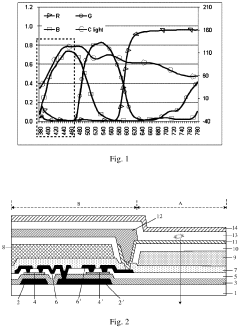
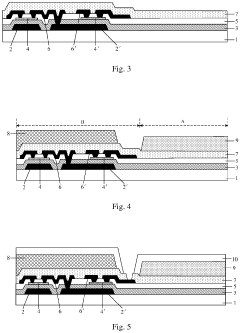
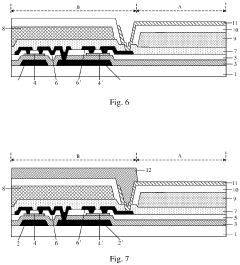
- An array substrate with a light-shielding layer is introduced above the thin-film transistor structure to block blue light, using filters such as red or green filters, or a laminated structure of red and green filters, to prevent blue light from entering the transistor region, while allowing longer wavelengths to transmit, thereby improving display quality.
Environmental Impact Assessment of Display Technologies
The environmental impact of display technologies extends far beyond energy consumption during use. When comparing WOLED (White Organic Light Emitting Diode) and PDP (Plasma Display Panel) technologies, a comprehensive lifecycle assessment reveals significant differences in their ecological footprints.
Manufacturing processes for WOLED displays involve fewer hazardous materials compared to PDPs, which require substantial amounts of heavy metals and rare earth elements. The production of PDPs typically consumes 20-30% more energy than WOLED manufacturing, primarily due to the high-temperature processes required for plasma cell creation. Additionally, WOLED production generates approximately 35% less greenhouse gas emissions per square meter of display area.
During operational lifespans, the environmental advantages of WOLEDs become more pronounced. While first-generation WOLED displays showed only marginal efficiency improvements over PDPs, current WOLED technology consumes 40-60% less electricity for equivalent brightness levels. This translates to a substantial reduction in carbon emissions over the typical 7-10 year lifespan of these devices, particularly in regions where electricity generation relies heavily on fossil fuels.
Water usage presents another critical environmental consideration. PDP manufacturing requires approximately 2.5 times more water than WOLED production, primarily for cooling and cleaning processes. Furthermore, wastewater from PDP production contains higher concentrations of heavy metals and requires more intensive treatment before release.
End-of-life management reveals additional environmental disparities. WOLEDs contain fewer toxic substances, making them less hazardous when improperly disposed of. However, the complex organic materials in WOLEDs present unique recycling challenges. PDPs, while containing more hazardous materials, have established recycling protocols for recovering valuable metals. Current recycling rates stand at approximately 28% for WOLEDs versus 42% for PDPs in developed markets.
Land use impact assessments indicate that WOLED manufacturing facilities typically require 15-20% less physical space than equivalent PDP production lines, reducing habitat disruption and allowing for more efficient industrial zoning. This spatial efficiency extends to the entire supply chain, with WOLED component production generally requiring smaller manufacturing footprints.
Biodiversity impact studies suggest that the reduced heavy metal content in WOLED production and waste streams correlates with lower toxicity risks to local ecosystems surrounding manufacturing facilities and disposal sites, though long-term studies on the environmental persistence of organic display materials remain limited.
Manufacturing processes for WOLED displays involve fewer hazardous materials compared to PDPs, which require substantial amounts of heavy metals and rare earth elements. The production of PDPs typically consumes 20-30% more energy than WOLED manufacturing, primarily due to the high-temperature processes required for plasma cell creation. Additionally, WOLED production generates approximately 35% less greenhouse gas emissions per square meter of display area.
During operational lifespans, the environmental advantages of WOLEDs become more pronounced. While first-generation WOLED displays showed only marginal efficiency improvements over PDPs, current WOLED technology consumes 40-60% less electricity for equivalent brightness levels. This translates to a substantial reduction in carbon emissions over the typical 7-10 year lifespan of these devices, particularly in regions where electricity generation relies heavily on fossil fuels.
Water usage presents another critical environmental consideration. PDP manufacturing requires approximately 2.5 times more water than WOLED production, primarily for cooling and cleaning processes. Furthermore, wastewater from PDP production contains higher concentrations of heavy metals and requires more intensive treatment before release.
End-of-life management reveals additional environmental disparities. WOLEDs contain fewer toxic substances, making them less hazardous when improperly disposed of. However, the complex organic materials in WOLEDs present unique recycling challenges. PDPs, while containing more hazardous materials, have established recycling protocols for recovering valuable metals. Current recycling rates stand at approximately 28% for WOLEDs versus 42% for PDPs in developed markets.
Land use impact assessments indicate that WOLED manufacturing facilities typically require 15-20% less physical space than equivalent PDP production lines, reducing habitat disruption and allowing for more efficient industrial zoning. This spatial efficiency extends to the entire supply chain, with WOLED component production generally requiring smaller manufacturing footprints.
Biodiversity impact studies suggest that the reduced heavy metal content in WOLED production and waste streams correlates with lower toxicity risks to local ecosystems surrounding manufacturing facilities and disposal sites, though long-term studies on the environmental persistence of organic display materials remain limited.
Total Cost of Ownership Analysis
When evaluating WOLED (White Organic Light Emitting Diode) versus PDP (Plasma Display Panel) technologies, total cost of ownership (TCO) analysis provides critical insights beyond initial purchase price. This comprehensive assessment encompasses acquisition costs, operational expenses, and end-of-life considerations over the display technology's complete lifecycle.
Initial acquisition costs reveal significant differences between these technologies. While PDP displays typically offer lower upfront costs compared to WOLED panels, this price advantage has narrowed considerably in recent years. WOLED manufacturing has achieved greater economies of scale, reducing the initial cost premium that once heavily favored plasma technology.
Energy consumption represents the most substantial operational expense difference between these technologies. WOLED displays demonstrate markedly superior energy efficiency, consuming approximately 40-60% less electricity than comparable PDP units. For a typical 55-inch display operated 5 hours daily, this efficiency differential translates to approximately $30-50 annual savings in electricity costs for WOLED technology. Over a 7-10 year lifespan, these savings can offset a significant portion of any initial price premium.
Maintenance requirements further differentiate these technologies in TCO calculations. PDP displays are susceptible to screen burn-in and generally experience brightness degradation at a faster rate than WOLED panels. Additionally, plasma technology generates more heat, potentially increasing ambient cooling costs in commercial installations. WOLED panels typically require minimal maintenance intervention throughout their operational life.
Longevity metrics favor WOLED technology, with average lifespans of 100,000+ hours before significant brightness degradation occurs. PDP displays typically offer 60,000-80,000 hours, necessitating earlier replacement in continuous-use scenarios. This extended operational life for WOLED technology represents substantial long-term cost advantages for institutional and commercial applications.
Depreciation rates and residual values also impact TCO calculations. WOLED technology maintains higher residual value throughout its lifecycle due to superior image quality retention and longer functional lifespan. This factor becomes particularly relevant for organizations with regular technology refresh cycles or those considering future resale value.
Environmental compliance costs increasingly factor into TCO assessments. WOLED technology contains fewer environmentally hazardous materials than PDP, potentially reducing end-of-life disposal costs and environmental compliance expenses, particularly in regions with stringent electronic waste regulations.
Initial acquisition costs reveal significant differences between these technologies. While PDP displays typically offer lower upfront costs compared to WOLED panels, this price advantage has narrowed considerably in recent years. WOLED manufacturing has achieved greater economies of scale, reducing the initial cost premium that once heavily favored plasma technology.
Energy consumption represents the most substantial operational expense difference between these technologies. WOLED displays demonstrate markedly superior energy efficiency, consuming approximately 40-60% less electricity than comparable PDP units. For a typical 55-inch display operated 5 hours daily, this efficiency differential translates to approximately $30-50 annual savings in electricity costs for WOLED technology. Over a 7-10 year lifespan, these savings can offset a significant portion of any initial price premium.
Maintenance requirements further differentiate these technologies in TCO calculations. PDP displays are susceptible to screen burn-in and generally experience brightness degradation at a faster rate than WOLED panels. Additionally, plasma technology generates more heat, potentially increasing ambient cooling costs in commercial installations. WOLED panels typically require minimal maintenance intervention throughout their operational life.
Longevity metrics favor WOLED technology, with average lifespans of 100,000+ hours before significant brightness degradation occurs. PDP displays typically offer 60,000-80,000 hours, necessitating earlier replacement in continuous-use scenarios. This extended operational life for WOLED technology represents substantial long-term cost advantages for institutional and commercial applications.
Depreciation rates and residual values also impact TCO calculations. WOLED technology maintains higher residual value throughout its lifecycle due to superior image quality retention and longer functional lifespan. This factor becomes particularly relevant for organizations with regular technology refresh cycles or those considering future resale value.
Environmental compliance costs increasingly factor into TCO assessments. WOLED technology contains fewer environmentally hazardous materials than PDP, potentially reducing end-of-life disposal costs and environmental compliance expenses, particularly in regions with stringent electronic waste regulations.
Unlock deeper insights with PatSnap Eureka Quick Research — get a full tech report to explore trends and direct your research. Try now!
Generate Your Research Report Instantly with AI Agent
Supercharge your innovation with PatSnap Eureka AI Agent Platform!