A Tanggut white thorns NTCIPK9 gene and its expression protein and application
What is AI technical title?
AI technical title is built by Patsnap AI team. It summarizes the technical point description of the patent document.
A gene and Nitraria technology applied in the field of plant genetic engineering to increase resources and improve salt tolerance
Active Publication Date: 2017-03-01
NANJING FORESTRY UNIV
View PDF2 Cites 0 Cited by
Summary
Abstract
Description
Claims
Application Information
AI Technical Summary
This helps you quickly interpret patents by identifying the three key elements:
Problems solved by technology
Method used
Benefits of technology
Problems solved by technology
In addition, so far, no similar genes have been found in species other than plants, so CIPK Gene is unique to plants for Ca 2+ Ser / Thr-like phosphoprotein kinase genes in signal pathway
Method used
the structure of the environmentally friendly knitted fabric provided by the present invention; figure 2 Flow chart of the yarn wrapping machine for environmentally friendly knitted fabrics and storage devices; image 3 Is the parameter map of the yarn covering machine
View more
Image
Smart Image Click on the blue labels to locate them in the text.
Viewing Examples
Smart Image
Click on the blue label to locate the original text in one second.
Reading with bidirectional positioning of images and text.
Smart Image
Examples
Experimental program
Comparison scheme
Effect test
Embodiment 1
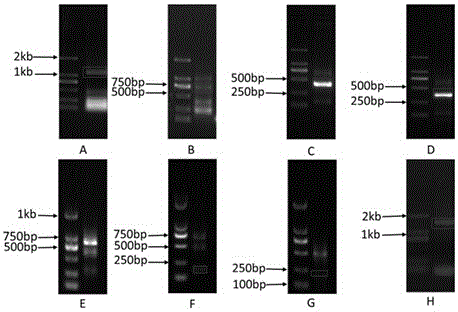
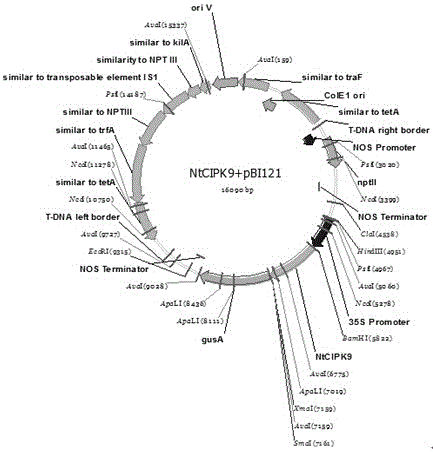
[0027] Using the leaves of Nitraria tangutica as material, total RNA was extracted and reversed into cDNA, and corresponding primers were designed for PCR. After agarose gel electrophoresis, the target band was recovered, connected with pMD19-T vector, and transformed into E. coli. Sequence and analyze. After determining the target sequence, design RACE primers based on the sequence, obtain 5' and 3' sequences by PCR, and after sequencing analysis, splicing to obtain NtCIPK9 full-length sequence. Primers were designed based on the full-length sequence, the full-length fragment was obtained by PCR, connected to the pMD19-T vector, transformed into E. coli, sequenced and analyzed again, and after the full-length fragment was confirmed, positive clones were picked for plasmid extraction, and enzyme cutting sites were added After spotting, it was simultaneously double-digested with the vector pBI121, ligated under the action of T4 ligase, and then transformed into Agrobacterium E...
Embodiment 2
[0063] Example 2 Gene function verification
[0064] Build 35S: CIPK9 Expression vector, transformed into wild-type Arabidopsis thaliana, to observe Nitraria tangutica NtCIPK9 Whether the gene can enhance the salt tolerance of Arabidopsis, compare the phenotypic differences between transgenic Arabidopsis and wild-type Arabidopsis, and speculate that Nitraria tangutata CIPK9 The function of the gene.
[0065] 1) Construction of the carrier
[0066] The Escherichia coli strain used in the present invention is E. coli JM109 (purchased from Biovector (Dalian) Co., Ltd.); the expression vector is pBI 121 (purchased from Biovector Co., LTD).
[0067] The specific process is as follows:
[0068] 1. By PCR to CIPK9 BamH I and SmaI restriction sites are added to the upstream and downstream of the gene fragment respectively. The PCR system and reaction conditions are the same as the full-length amplification. The primers are:
the structure of the environmentally friendly knitted fabric provided by the present invention; figure 2 Flow chart of the yarn wrapping machine for environmentally friendly knitted fabrics and storage devices; image 3 Is the parameter map of the yarn covering machine
Login to View More
PUM
Login to View More
Abstract
The invention discloses a nitraria tangutorum CBL-interacting protein kinase 9 (NtCIPK9) gene, expressed protein of the NtCIPK9 gene and application of the NtCIPK9 gene. The nucleotide sequence of the NtCIPK9 gene is shown as the SEQ ID NO.1, and the amino acid sequence of the NtCIPK9 gene is shown as the SEQ ID NO.2. According to the NtCIPK9 gene, a full-length gene related to stress resistance of nitraria tangutorum is cloned in a homological mode by using leaf blade tissue of the nitraria tangutorum on the basis of a part of existing transcriptome data according to the stress resistance characteristic of the nitraria tangutorum, and is named NtCIPK9 according to a homologous gene in arabidopsis. The function of plant salt tolerance of the NtCIPK9 gene is proved through analysis of salt tolerance of an NtCIPK9 gene homozygous arabidopsis plant, and resources are increased for a plant stress resistance gene pool.
Description
technical field [0001] The invention belongs to the technical field of plant genetic engineering, in particular to a Nitraria tangutata NtCIPK9 Genes and their expressed proteins and applications. Background technique [0002] Nitraria tangutica ( Nitraria tangutorum ) belongs to the genus Nitraria (Zygophyllaceae) of the family Zygophyllaceae ( Nitraria ), a strong xerophytic deciduous shrub, is a unique Nitraria species in my country, mainly distributed in the northwestern region of China. Nitraria tangut is resistant to drought, salt and alkali, wind and sand, and barrenness. It can improve saline-alkali soil, increase soil fertility, prevent wind and sand, maintain oasis, and protect ecological balance. Its berry-shaped drupe is rich in vitamin C, flavonoids, protein, 19 kinds of amino acids and 21 kinds of trace elements, and has edible value. In addition, its fruit also has medicinal value such as invigorating the spleen and stomach, lowering blood fat, lowering ...
Claims
the structure of the environmentally friendly knitted fabric provided by the present invention; figure 2 Flow chart of the yarn wrapping machine for environmentally friendly knitted fabrics and storage devices; image 3 Is the parameter map of the yarn covering machine
Login to View More
Application Information
Patent Timeline
Application Date:The date an application was filed.
Publication Date:The date a patent or application was officially published.
First Publication Date:The earliest publication date of a patent with the same application number.
Issue Date:Publication date of the patent grant document.
PCT Entry Date:The Entry date of PCT National Phase.
Estimated Expiry Date:The statutory expiry date of a patent right according to the Patent Law, and it is the longest term of protection that the patent right can achieve without the termination of the patent right due to other reasons(Term extension factor has been taken into account ).
Invalid Date:Actual expiry date is based on effective date or publication date of legal transaction data of invalid patent.


 Login to View More
  Login to View More