Calculation method of electromechanical oscillation mode of time-delay power system based on sod‑ps‑r algorithm

A technology of SOD-PS-R and power system, which is applied in the field of electromechanical oscillation mode calculation of time-delay power system, and can solve problems such as not considering the influence of time-delay

CN105468909BActive Publication Date: 2018-01-30SHANDONG UNIV
6 Cites 0 Cited by

Patent Information

Authority / Receiving Office
CN · China
Patent Type
Patents(China)
Current Assignee / Owner
Publication Date
2018-01-30

Smart Images

  • Figure 1
    Figure 1
  • Figure 2
    Figure 2
  • Figure 3
    Figure 3
Patent Text Reader

Abstract

The invention discloses a method for calculating the electromechanical oscillation mode of a time-delayed power system based on the SOD-PS-R algorithm. According to the relationship between the eigenvalue of the time-delayed power system model and the eigenvalue of the solution operator of the time-delayed power system model, the calculated The eigenvalue of the time-delay power system model is converted into the eigenvalue of the calculation solution operator; thus the problem of calculating the electromechanical oscillation mode of the time-delay power system is transformed into the eigenvalue problem of the calculation solution operator; it is used for large-scale time-delay power systems Electromechanical oscillation mode. The SOD‑PS‑R algorithm only needs to calculate the maximum set number of eigenvalues ​​of the modulus of the discretization approximation matrix of the solution operator, and through one calculation, the electromechanical oscillation mode of the large-scale time-delay power system can be obtained.
Need to check novelty before this filing date? Find Prior Art

Description

technical field

[0001] The invention relates to an electromechanical oscillation mode calculation method of a time-delay power system based on a SOD-PS-R (Solution Operator Discretization-PesudoSpectrum and Rotation) algorithm. Background technique

[0002] With the rise of the Global Energy Internet, the scale of the interconnected power system is gradually increasing, and the problem of interval low-frequency oscillation is more significant. The traditional solution is to install a power system stabilizer (Power System Stabilizer, PSS), but because its feedback control signal comes from the local area, it cannot effectively damp the interval oscillation of the interconnected power system.

[0003] The emergence of Wide-Area Measurement System (WAMS) has brought new opportunities for the development of stability analysis and control of large-scale interconnected power systems. The low-frequency oscillation control of the interconnected grid based on the wide-area informati...

Examples

Embodiment Construction

[0097] The present invention will be further described below in conjunction with the accompanying drawings and embodiments.

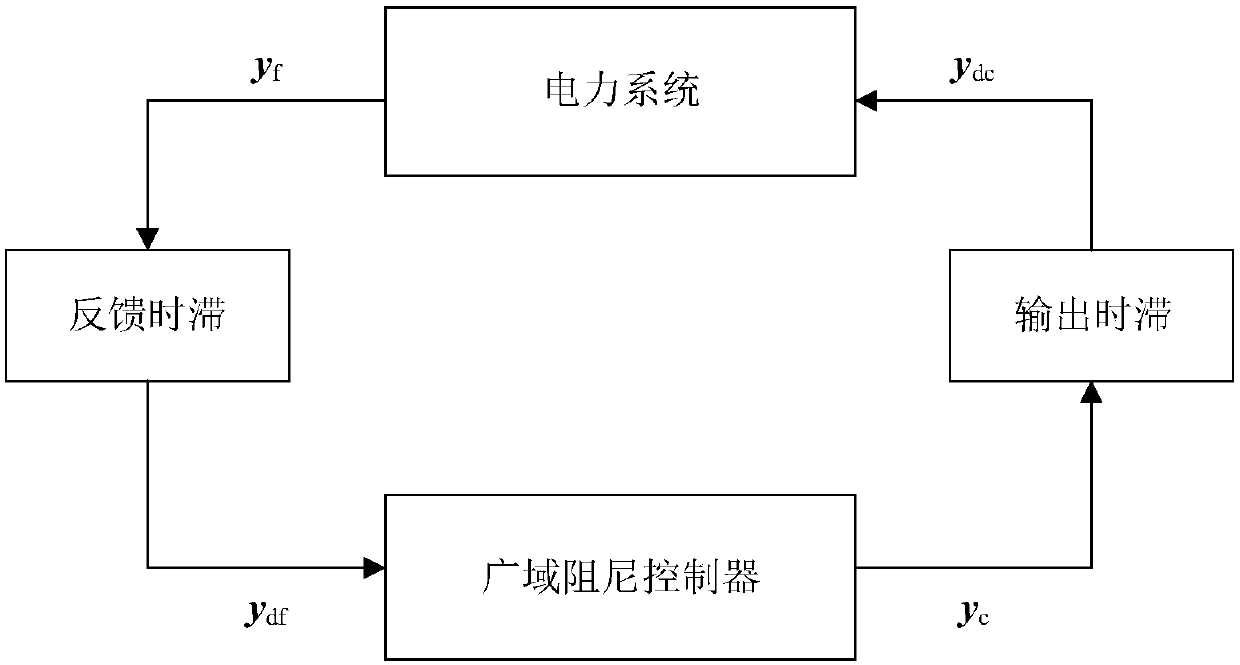
[0098] Such as figure 1 Shown: Introducing communication time-lags during the modeling of real large-scale power systems. The time-delay power system includes four parts: time-delay-free power system, wide-area feedback time-delay, wide-area damping controller and wide-area output time-delay. The connection relationship between each part is shown in the figure. figure 1 In , the output of the time-delay-free power system is y f ,y df is the wide-area feedback signal taking time lag into account and used as the input of the damping controller, y c is the output of the wide-area damping controller, y dc It is the control input of the time-delay-free power system.

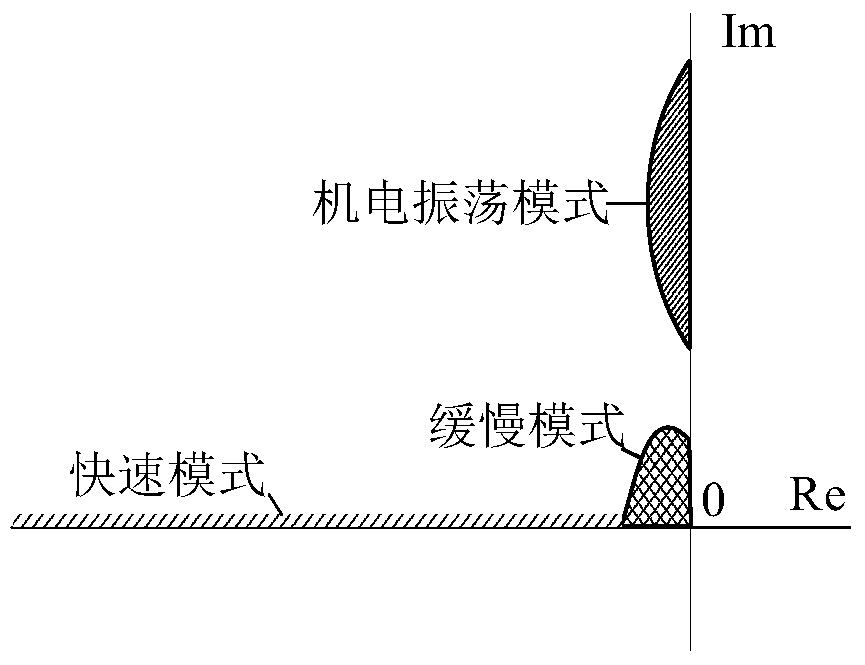
[0099] Such as figure 2 Shown: The operating modes corresponding to the eigenvalues ​​of the time-delay power system can be mainly divided into three categories, electromechanical oscillat...