Set of teeth

a technology of pre-manufactured teeth and teeth, applied in the field of pre-manufactured teeth, can solve the problem that natural teeth only function in a very limited way

US7267549B2Inactive Publication Date: 2007-09-11ZAHN SPEKTRUM ENTWICKLUNGSGES FUR DENTALPROD
6 Cites 21 Cited by

Patent Information

Authority / Receiving Office
US · United States
Patent Type
Patents(United States)
Current Assignee / Owner
Publication Date
2007-09-11
Estimated Expiration
Not applicable · inactive patent

Smart Images

  • Figure 1
    Figure 1
  • Figure 2
    Figure 2
  • Figure 3
    Figure 3
Patent Text Reader

Abstract

A set of pre-manufactured teeth are provided and include, at least one of a first molar or premolar selected from a group of molars or premolars provided for one jaw, and at least one of a second premolar or molar selected from a group of antagonists provided for the other jaw, wherein at least three centric contact points being provided in each case of a fossa of a premolar or a molar, a stamp cusp of the antagonist coming to rest on the contact points in the position of intercuspation, the contact points being disposed on a compensation curve defined by the movement of the jaw condyles, the centric contact points each lying on a spherical sector, and abrasions being disposed in at least one movement track without breaking up the punctiform contacts.
Need to check novelty before this filing date? Find Prior Art

Description

CROSS REFERENCE TO RELATED APPLICATIONS

[0001] This application is a filing under 35 U.S.C. 371 of PCT / E02 / 14429 filed Dec. 17, 2002, which claims the benefit of German Application DE 101 63 105.7, filed Dec. 23, 2001.BACKGROUND OF THE INVENTION

[0002] The invention relates to a set of pre-manufactured teeth.

[0003] In dentistry, occlusion is the usual term for the contact between teeth of the upper jaw and teeth of the lower jaw. In reconstruction of an occlusion and thus of a masticatory surface, the aim is to ensure that the tooth contacts occur uniformly and simultaneously in all four support zones and that, upon functional movements (primarily protrusion, laterotrusion and mediotrusion movements) of the lower jaw relative to the upper jaw, uninterrupted sliding is obtained between all antagonist posterior teeth. This applies nowadays to individual rehabilitation.

[0004] The various occlusion concepts are named for their characteristics in respect of centric contact (point-centric, long...

Examples

Embodiment Construction

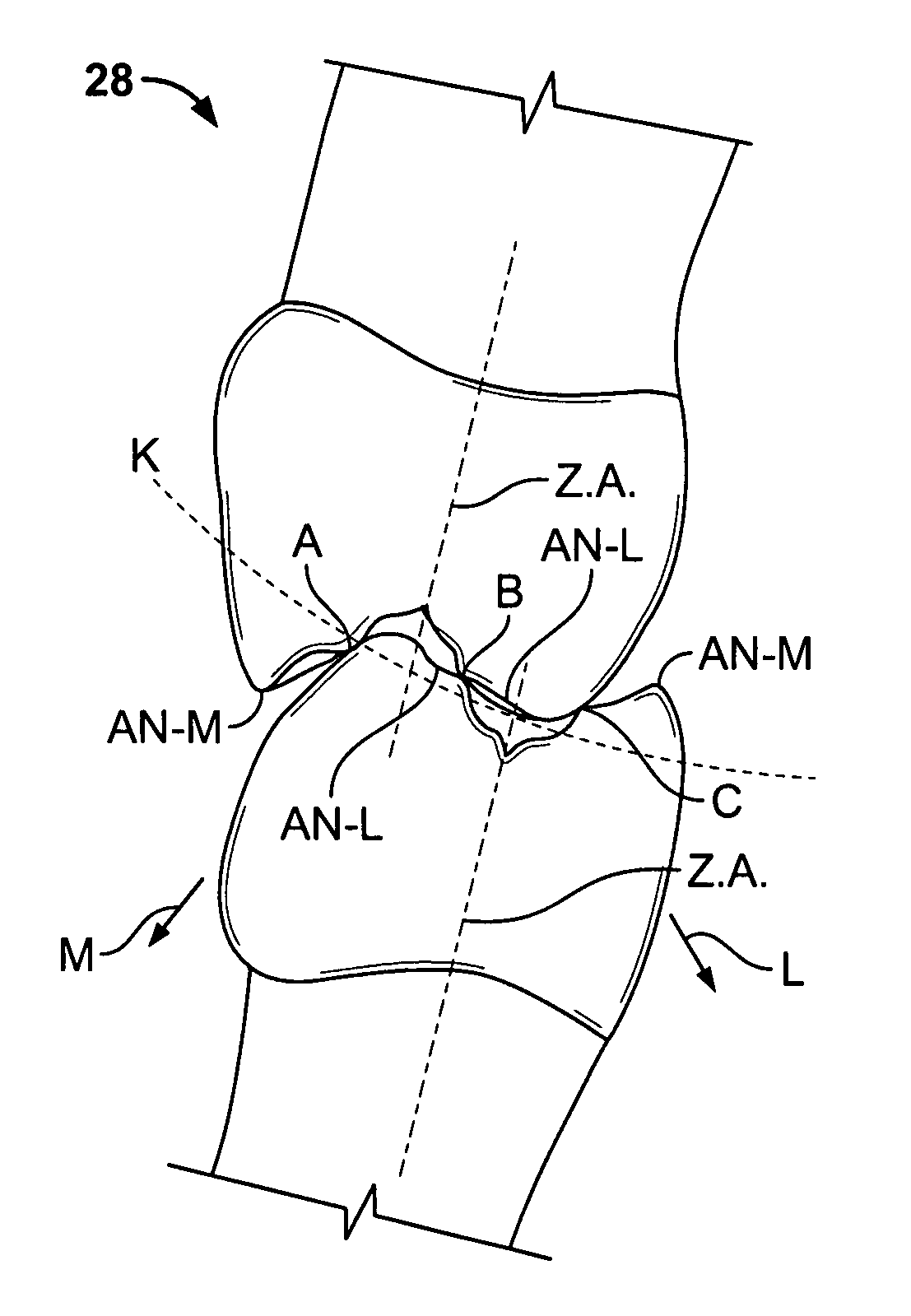
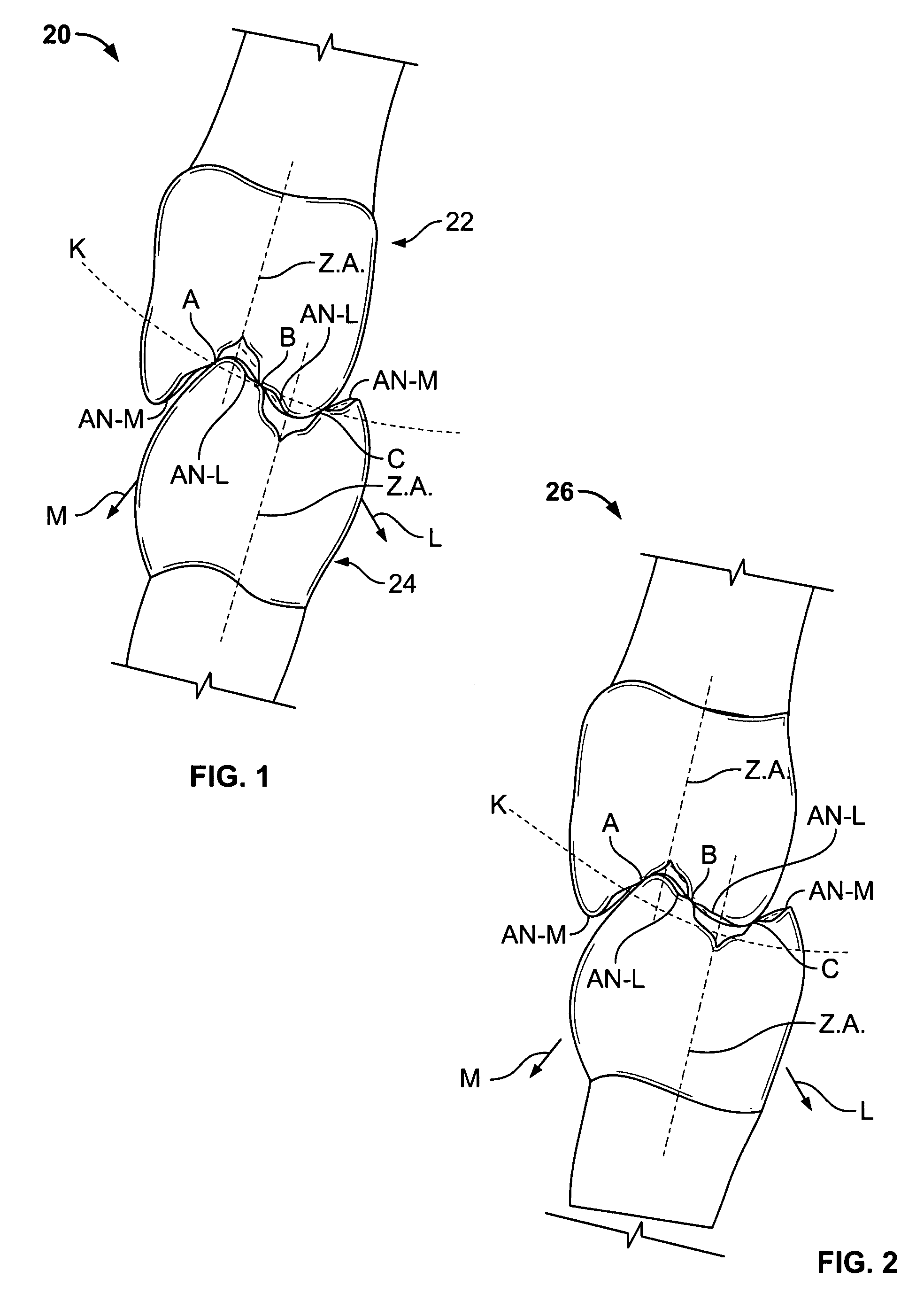
[0042]A set of teeth 20 consisting of the premolars 4 of the upper jaw and lower jaw 22 and 24, respectively, is shown in FIG. 1, where K designates the transverse compensation curve, Z.A. designates the tooth axis, the arrow M indicates the mediotrusion movement, and the arrow L indicates the laterotrusion movement.

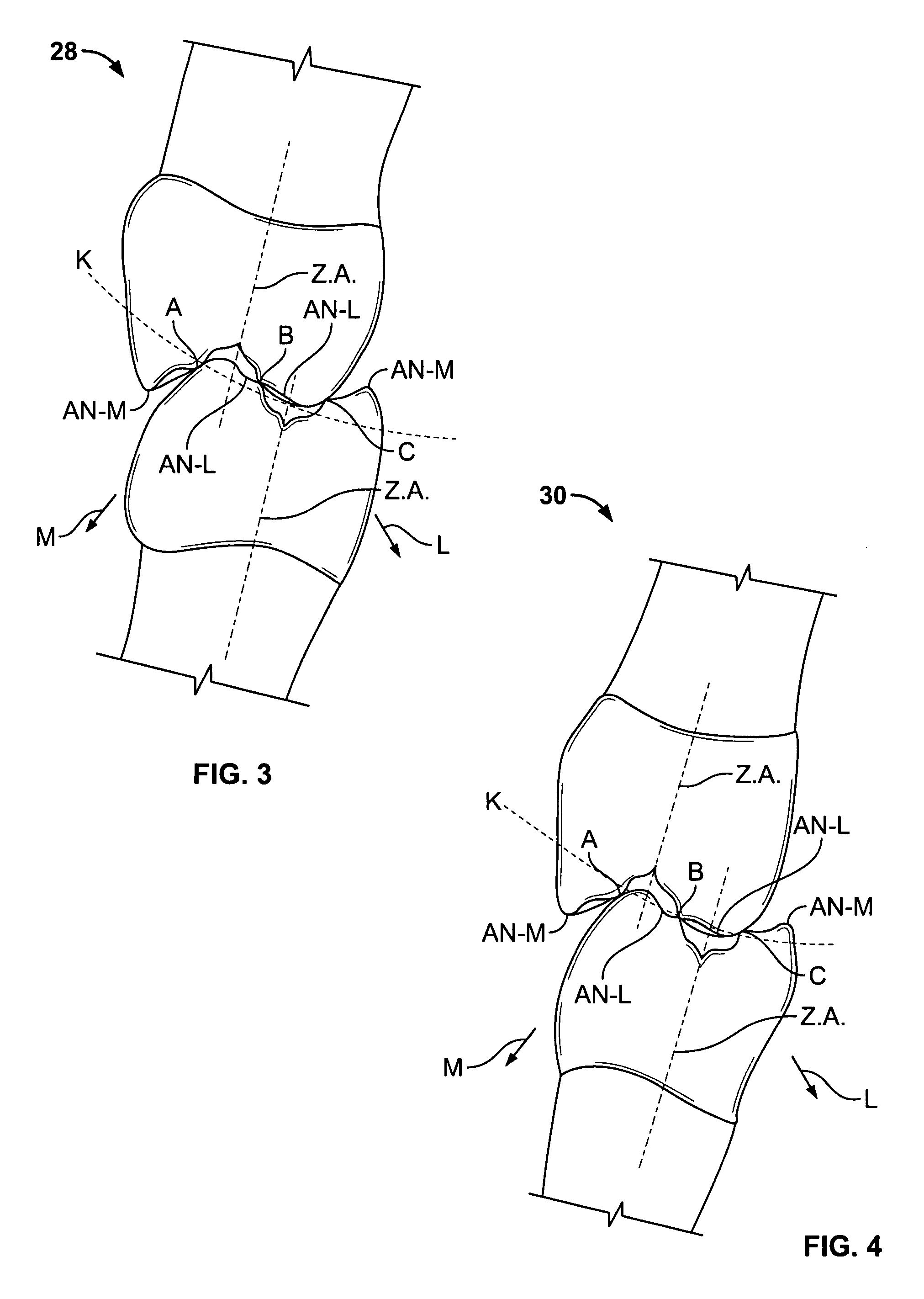
[0043]Each tooth has, in the fossa of its respective antagonist, at least three contact points on which its stamp cusps come to rest in the position of intercuspation. The contact points come to rest on spherical sectors and are disposed on the compensation curves defined by the movement of the jaw condyles and are designated by A, B and C. The inclination of the abrasion surfaces is 45° on the laterotrusion side (AN-L) and 40° on the mediotrusion side (AN-M).

[0044]FIG. 2 shows the antagonist pair 26 adjacent to the antagonist pair from FIG. 1, namely the premolars 5. The inclination of the abrasion surfaces of this pair of teeth, lying posterior to the premolars 4, decr...