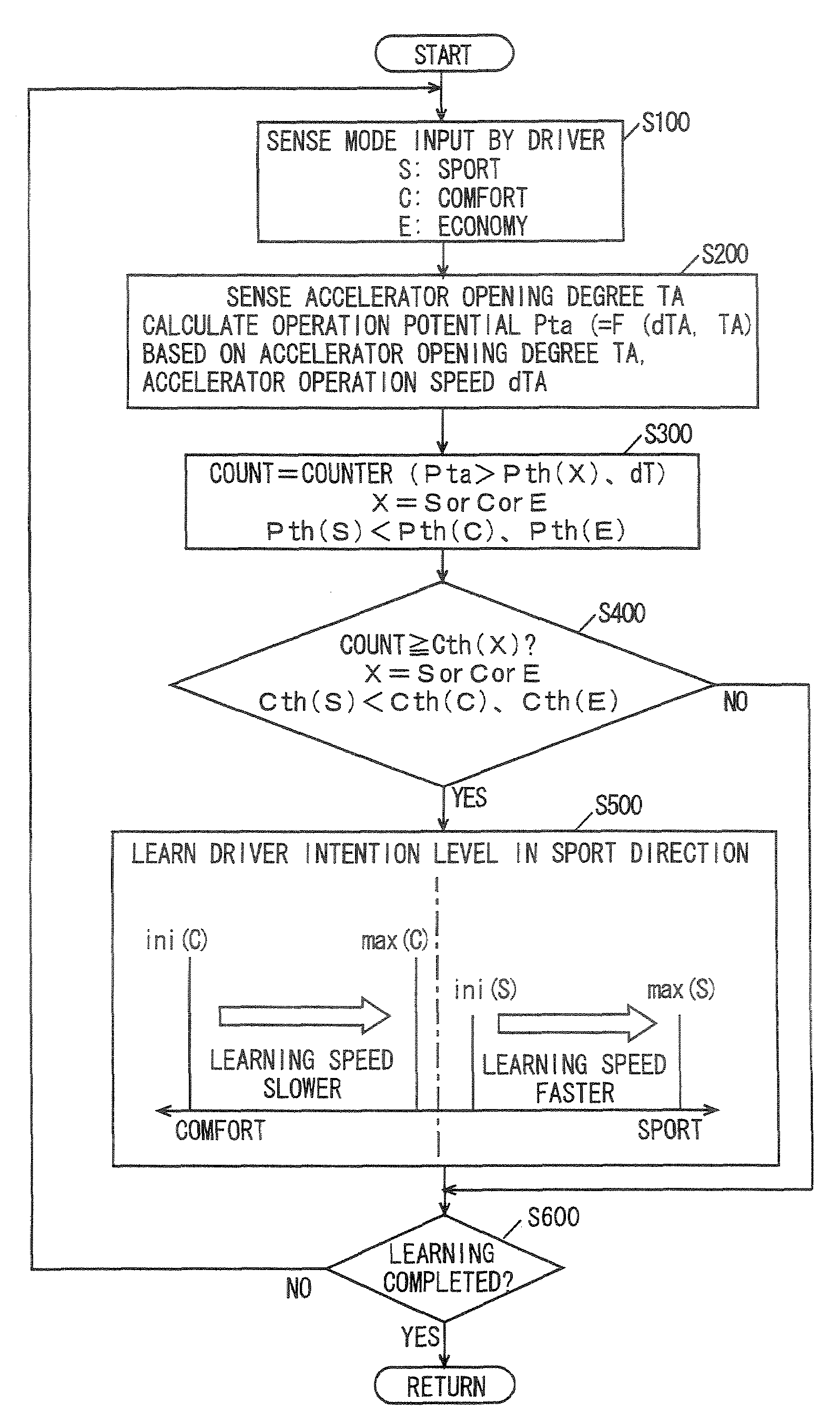
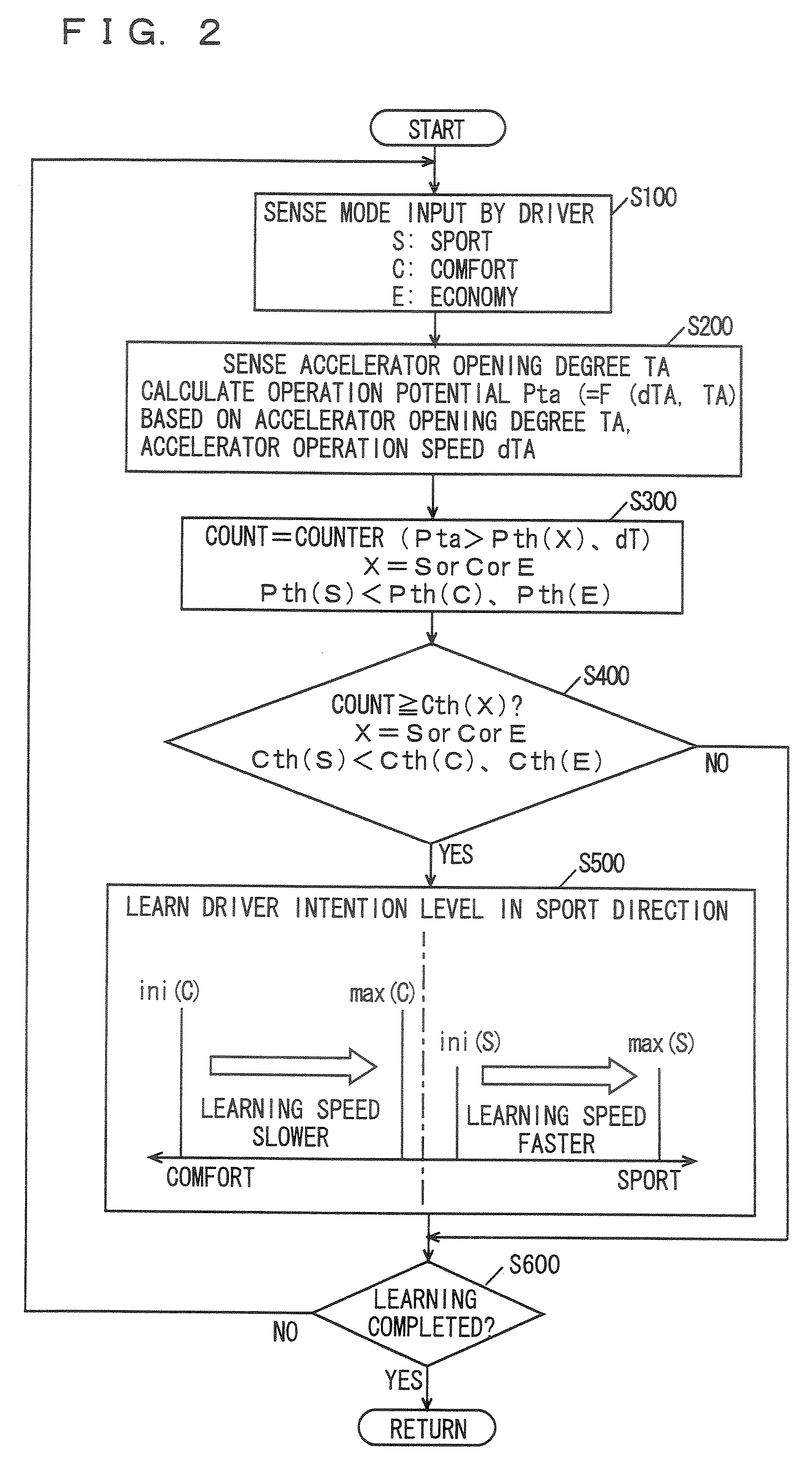
[0011]In accordance with the present invention, a driver inputs his own control preference, and the input control preference is detected by the detection unit. The control preference includes, for example, a sport preference in which mobility of the vehicle is emphasized, a comfort preference in which comfortableness of the vehicle is emphasized, an economy preference in which cost efficiency of the vehicle is emphasized, and the like. The detection unit detects, for example, one of a sport mode, a comfort mode and an economy mode selected by a mode selection switch. For example, when detecting an operation by the driver of depressing an accelerator pedal hard and fast, the control unit estimates that the driver's driving preference is highly sportive where the mobility is emphasized. If such an operation is repeatedly detected, it is learned that the driving preference is highly sportiveness. Here, the control unit changes the degree of learning, for example, sportiveness depending on the selected control preference (sport, comfort and economy). More specifically, if not in the sport mode, learning is performed such that sportiveness is not increased so actively, and if in the sport mode, learning is performed such that sportiveness is increased actively. In this way, if the sport preference is not selected as a control preference, it is not learned that the driving preference is highly sportive even when the driver depresses the accelerator pedal heavily and hard. Therefore, the driving preference can be learned appropriately. As a result, it is possible to provide a control device for a vehicle capable of realizing vehicular traveling performance that matches the driver's preference.
[0013]In accordance with the present invention, when an operation amount of a member operated by a driver (accelerator opening degree) or the rate of change of the operation amount (accelerator operation speed) exceeds a predetermined threshold value, it is estimated that the driving preference is highly sportive. In this case, when the first control preference in which the vehicle traveling performance is emphasized is selected, the threshold value is set lower than when it is not selected, and thus it is likely to be estimated that the driving preference is sportive. By contrast, when the first control preference in which the vehicle traveling performance is emphasized is not selected, the threshold value is set higher than when it is selected, and thus it is less likely to be estimated that the driving preference is sportive. In this way, when the sport preference is not selected as a control preference, it is not learned that the driving preference is so sportive even when the driver depresses the accelerator pedal heavily and hard. Therefore, the driving preference can be learned appropriately.
[0015]In accordance with the present invention, when the number of times an operation amount of a member operated by a driver (accelerator opening degree) or the rate of change of the operation amount (accelerator operation speed) exceeds a predetermined threshold value exceeds a predetermined number of times, it is estimated that the driving preference is highly sportive. In this case, when the first control preference in which the vehicle traveling performance is emphasized is selected, the threshold value is set low and the number of times is set low as compared with when it is not selected, and thus it is more likely to be estimated that the driving preference is sportive. By contrast, when the first control preference in which the vehicle traveling performance is emphasized is not selected, the threshold value is set high and the number of times is also set high as compared with when it is selected, and thus it is less likely to be estimated that the driving preference is sportive. In this way, when the sport preference is not selected as a control preference, it is not learned that the driving preference is so sportive even when the driver depresses the accelerator pedal heavily and hard for a short time. Therefore, the driving preference can be learned appropriately even for a short time.


 Login to View More
  Login to View More