Gaming machine bonus system

a bonus system and machine technology, applied in the field of games or gambling, can solve the problems of low probability of being achieved, reduced physical size of symbols, and difficulty in achieving giant jackpots in one machine, so as to improve the entertainment value of games, increase the level of player excitement, and increase the expectation of winning

US8206209B1Active Publication Date: 2012-06-26FOX JOHN
13 Cites 5 Cited by

Patent Information

Authority / Receiving Office
US · United States
Current Assignee / Owner
Publication Date
2012-06-26

Smart Images

  • Figure 1
    Figure 1
  • Figure 2
    Figure 2
  • Figure 3
    Figure 3
Patent Text Reader

Abstract

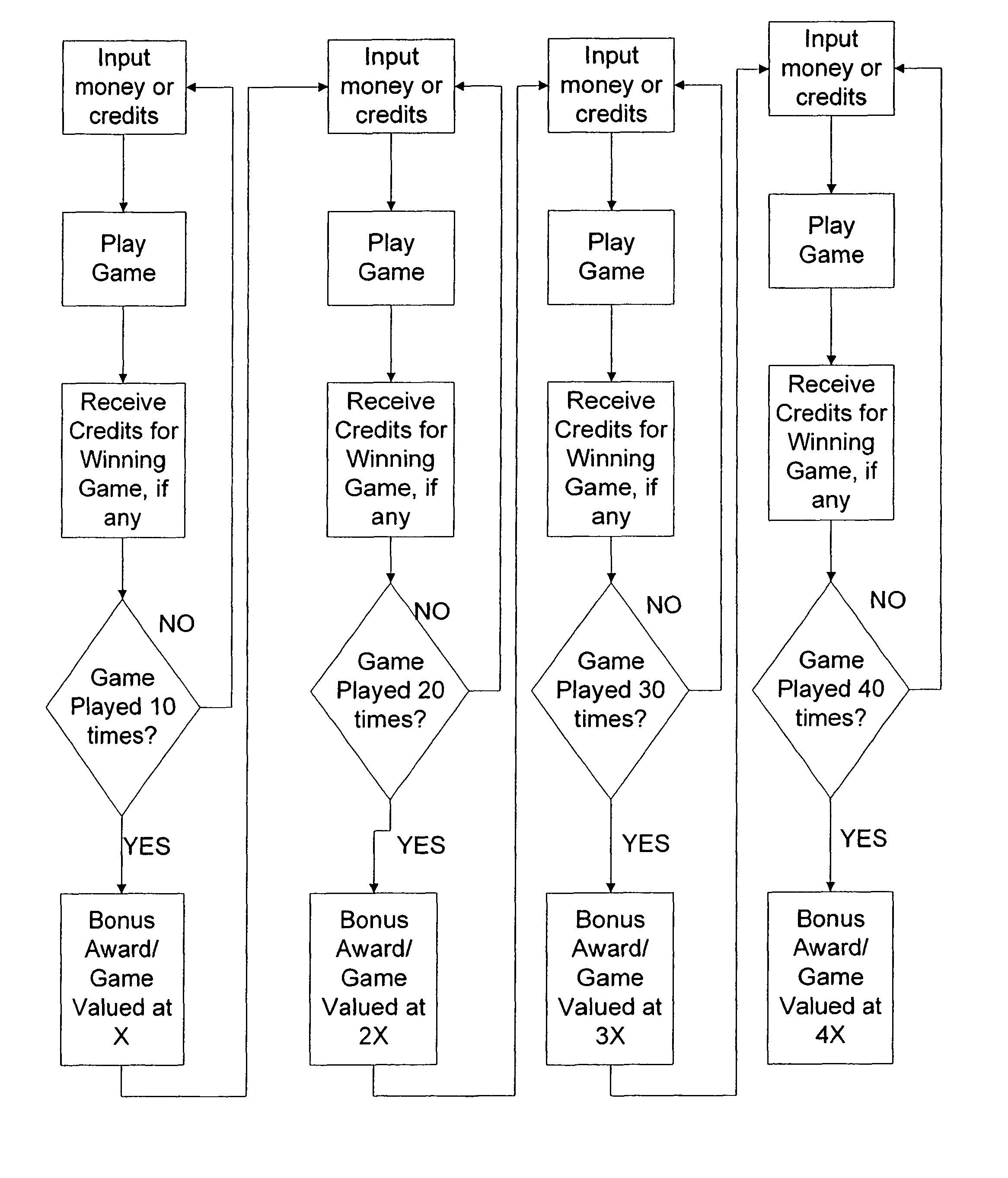
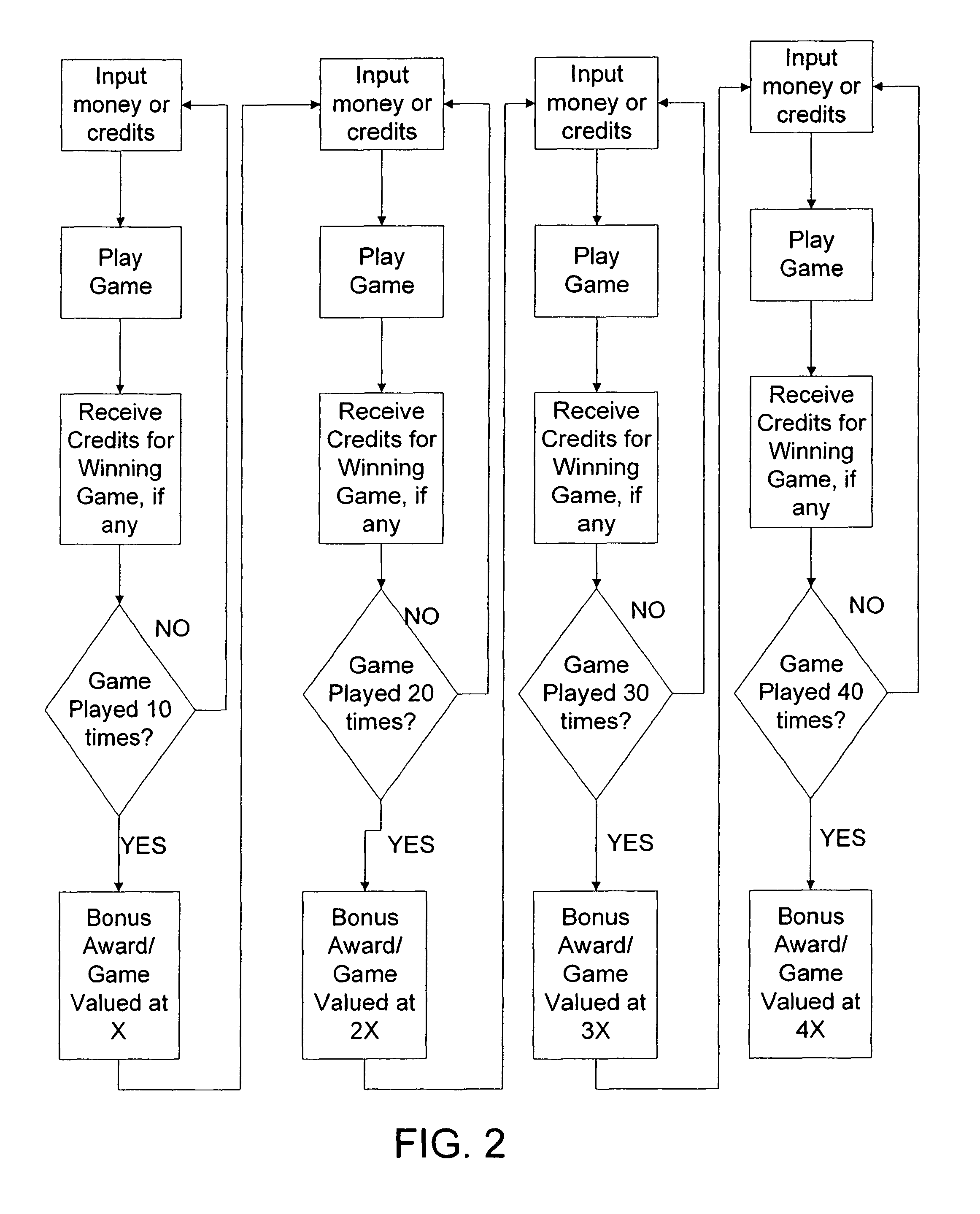
A method of conducting a wagering game includes indicating a random outcome by displaying selected game symbols, initiating a first bonus at a preselected number of plays, providing a first award of a first desired number of credits, initiating a second bonus at a first multiple of the preselected number of plays, wherein the first multiple is a number greater than 1, providing a second award of a second desired number of credits, wherein the second desired number of credits is the product of the first desired number of credits times the first multiple, initiating a third bonus at a second multiple of the preselected number of plays, wherein the second multiple is a number greater than 1, and providing a third award of a third desired number of credits, wherein the third desired number of credits is the product of the first desired number of credits times the second multiple.
Need to check novelty before this filing date? Find Prior Art

Description

BACKGROUND OF THE INVENTION

[0001] This invention relates to the field of gaming or gambling, and, in particular, to gaming devices.

[0002] Gambling or gaming devices have been in use for decades and were originally introduced in the 19th century. A major advancement in technology of gaming devices occurred when microprocessors were introduced in the gaming or gambling field. They were divided into two major segments in their development. One being the mechanical spinning reels and the other being the use of “CRT” displays or animated displays of reels, cards, keno boards, and “21” games. The emergence of such microprocessor devices has opened a vast set of possibilities to gambling device designers. In U.S. Pat. No. 4,095,795, the first microprocessor slot machine is described.

[0003] Another major advancement used microprocessors and a software program to adjust the odds of achieving any particular combination or game outcome. For example, U.S. Pat. No. 4,448,419 describes a mechanical ...

Examples

Embodiment Construction

[0030]The present invention is directed to increasing the Plays Per Hour, as described above, of a gaming device, and thereby significantly increase the revenue to the owner of the gaming device. Players typically do not consider the number of games played on a machine, but instead attempt to find a gaming device with a low House Edge, as described above, that is easy to play. Additionally, players often are not specifically aware of the passage of time when playing on a gaming machine, so long as the player perceives that he or she is successful. Accordingly, a gaming device that is played where a bonus round occurs with less frequency as time moves forward, but with greater awards the longer a player plays will typically not discourage players, and can thus generate more revenue by providing an incentive to play faster and for longer periods of time. Such a gaming device may be played for more games so that more revenue will be generated than, for example, a higher payout percenta...