System and methods of transferring tasks from a first mobile device to a second mobile device

a mobile device and task technology, applied in the field of transferring tasks between mobile devices, can solve the problems of user being forced to power off the mobile device, affecting the performance of the mobile device,

Active Publication Date: 2016-04-12
QUALCOMM INC
View PDF9 Cites 1 Cited by
  • Summary
  • Abstract
  • Description
  • Claims
  • Application Information

AI Technical Summary

Benefits of technology

[0004]When a mobile device is low on battery power and no electrical outlet is readily available for recharge or when the mobile device runs out of battery power, a user performing tasks on the mobile device may be forced to power off the mobile device. The user discontinues performing tasks until the mobile device is recharged. Thus, the user experiences a time delay and interruption in performing the tasks. Systems and methods described herein may advantageously enable a first mobile device to transfer tasks on the first mobile device to a second mobile device when the first mobile device experiences a low battery condition. Transferring the tasks from the first mobile device to the second mobile device may enable the user to continue performing the tasks on the second mobile device.
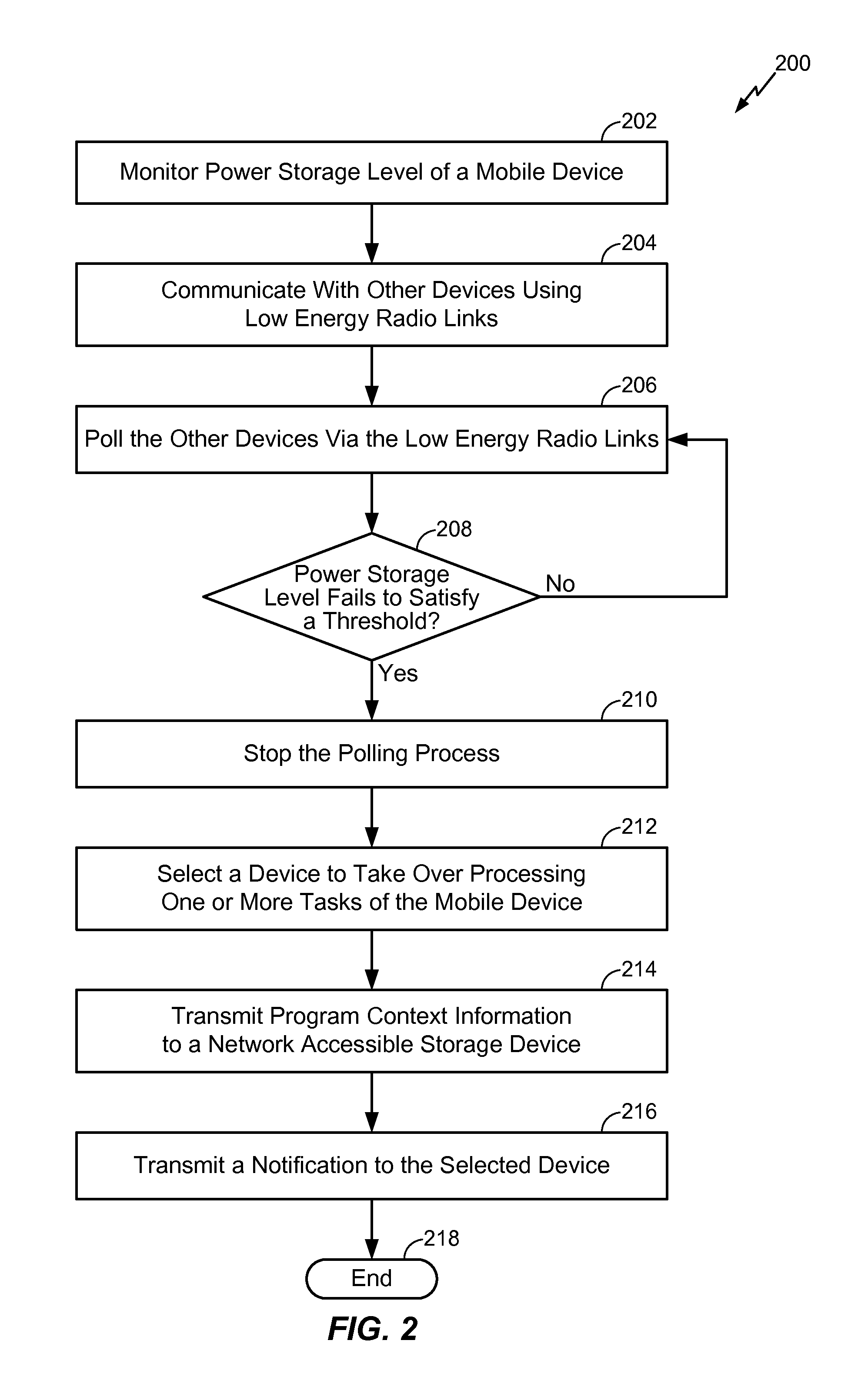
[0005]For example, a user may be in possession of a plurality of mobile devices (e.g., a mobile phone, a tablet computer, a laptop computer). The user may be performing one or more tasks (e.g., web browsing, phone calls, streaming music, etc.) on a first mobile device (e.g., the user's mobile phone) while the other mobile devices are in a sleep state. When the first mobile device detects that the battery power storage level of the first mobile device fails to satisfy a first threshold, such as the battery power storage level is less than or equal to a first threshold (e.g., 10% battery power remaining), the first mobile device may identify a second mobile device to take over processing / executing of one or more tasks. The first mobile device may select the second mobile device based on information regarding battery power storage levels and processing capabilities of the second mobile device. The first mobile device may communicate with the second mobile device to receive the information (e.g., via polling or periodic notifications from the other mobile devices). The first mobile device may communicate with the second mobile device via a low energy data link, such as a Bluetooth low energy (BLE) connection, an ANT connection, a near field communication (NFC) connection, etc. The use of the low energy data link may enable the first mobile device or the second mobile device to reduce power consumption associated with communication between the first mobile device and the second mobile device.
[0007]For example, when browsing a particular website in a web browser program, the second mobile device may automatically execute a web browser program and load the particular website in the web browser program so that the user does not have to open the web browser program and reload the particular website. As another example, when the user is participating in a voice call on the first mobile device, the second mobile device may automatically (i.e., without user action) send a conference call request to the first mobile device to establish a conference call. The first mobile device may add the voice call to the conference call such that the voice call is handed over to the second mobile device via the conference call.

Problems solved by technology

However, when the mobile device is low on battery power and no charging device is readily available, the user may be forced to power off the mobile device to preserve the battery.
Completely draining the power stored in the battery may damage a power storing capability of the battery.
The user may interrupt tasks being performed on the mobile device by powering off the mobile device.
The user may also lose state information of an application (e.g., a number of tabs open in a web browser program) running on the mobile device.
While the user may resume performing the tasks and / or may manually restore the state of the application after the battery is charged and after the mobile device is again powered on, the user experiences time delay and inconvenience due to the interruption.
When a mobile device is low on battery power and no electrical outlet is readily available for recharge or when the mobile device runs out of battery power, a user performing tasks on the mobile device may be forced to power off the mobile device.
Thus, the user experiences a time delay and interruption in performing the tasks.

Method used

the structure of the environmentally friendly knitted fabric provided by the present invention; figure 2 Flow chart of the yarn wrapping machine for environmentally friendly knitted fabrics and storage devices; image 3 Is the parameter map of the yarn covering machine
View more

Image

Smart Image Click on the blue labels to locate them in the text.
Viewing Examples
Smart Image
  • System and methods of transferring tasks from a first mobile device to a second mobile device
  • System and methods of transferring tasks from a first mobile device to a second mobile device
  • System and methods of transferring tasks from a first mobile device to a second mobile device

Examples

Experimental program
Comparison scheme
Effect test

Embodiment Construction

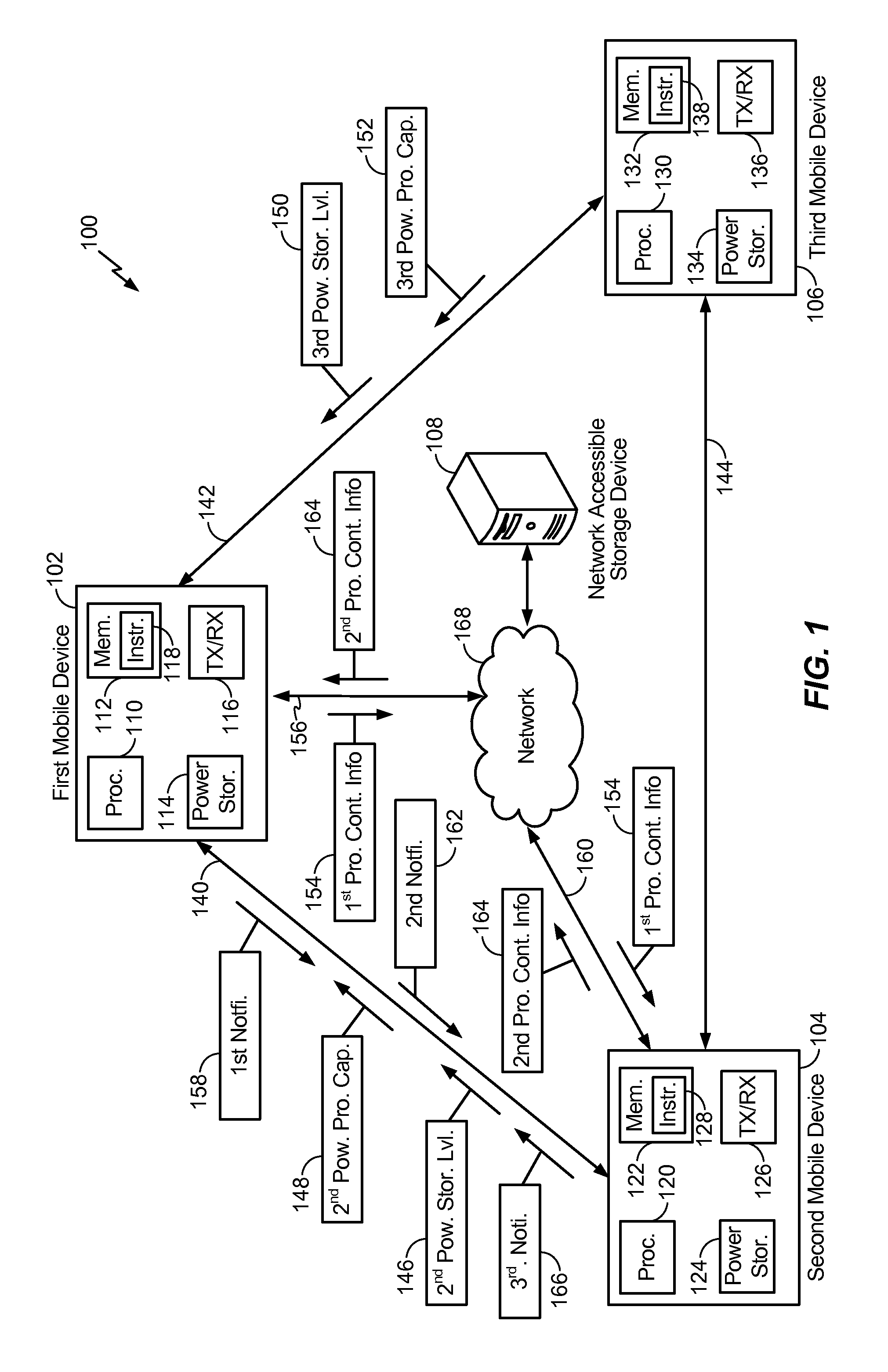
[0020]FIG. 1 illustrates a particular embodiment of a system 100 that is operable to enable a first mobile device to transfer a task of the first mobile device to a second mobile device. The system 100 may include a first mobile device 102, a second mobile device 104, a third mobile device 106, and a network accessible storage device 108. The first mobile device 102, the second mobile device 104, and / or the third mobile device 106 may be a mobile telephone, a portable computing device (e.g., a laptop computer), a tablet computing device, a personal digital assistant (PDA), a portable media player, or any combination thereof. In a particular embodiment, the first mobile device 102, the second mobile device 104, the third mobile device 106, or any combination thereof may be integrated in (or coupled to a component of) a vehicle (e.g., an automobile). The network accessible storage device 108 may be a cloud storage device, a storage area network, a network accessible server, a network ...

the structure of the environmentally friendly knitted fabric provided by the present invention; figure 2 Flow chart of the yarn wrapping machine for environmentally friendly knitted fabrics and storage devices; image 3 Is the parameter map of the yarn covering machine
Login to View More

PUM

No PUM Login to View More

Abstract

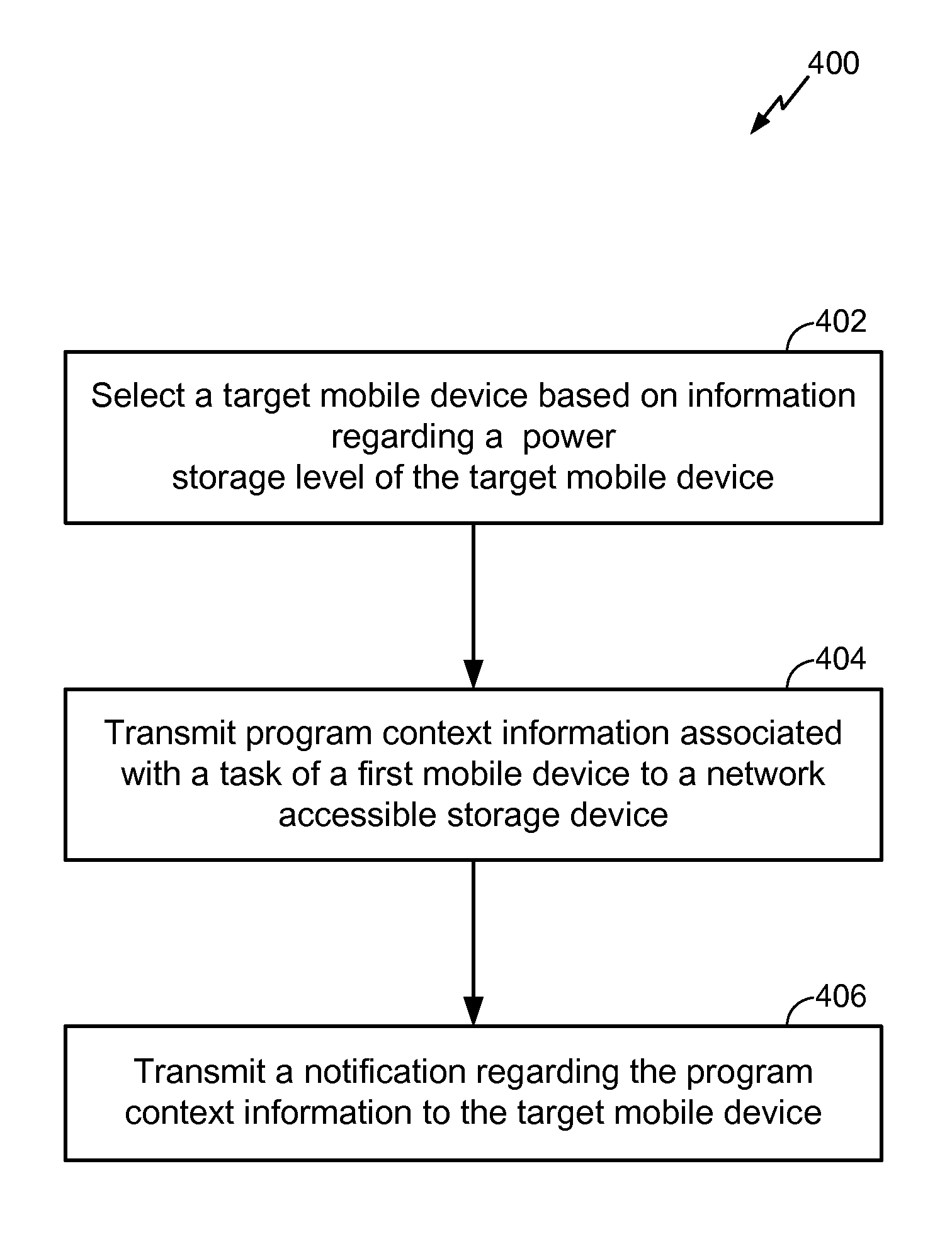
A method includes selecting a target mobile device based on information regarding a power storage level of the particular mobile device. The method further includes transmitting program context information associated with a task of the first mobile device to a network accessible storage device. The method further includes transmitting a notification regarding the program context information to the target mobile device. The present disclosure describes a power and task (data and / or voice) handover system that enables a user to transfer task(s) from one mobile device to another mobile device using a network (wired or wireless) based handover scheme.

Description

I. FIELD[0001]The present disclosure relates to transferring tasks between mobile devices.II. DESCRIPTION OF RELATED ART[0002]Advances in technology have resulted in smaller and more powerful computing devices. For example, there currently exist a variety of portable personal computing devices, including wireless computing devices, such as portable wireless telephones, personal digital assistants (PDAs), and paging devices that are small, lightweight, and easily carried by users. More specifically, portable wireless telephones, such as cellular telephones and Internet Protocol (IP) telephones, can communicate voice and data packets over wireless networks. Many such wireless telephones incorporate additional devices to provide enhanced functionality for end users. For example, a wireless telephone can also include a digital still camera, a digital video camera, a digital recorder, and an audio file player. Also, such wireless telephones can execute software applications, such as a we...

Claims

the structure of the environmentally friendly knitted fabric provided by the present invention; figure 2 Flow chart of the yarn wrapping machine for environmentally friendly knitted fabrics and storage devices; image 3 Is the parameter map of the yarn covering machine
Login to View More

Application Information

Patent Timeline
no application Login to View More
Patent Type & AuthorityPatents(United States)
IPC IPC(8): G06F15/16H04W4/00G06F9/50G06F9/48H04L29/08G08C17/00H04M1/00H04L12/66H04W4/60
CPCH04L67/10G06F9/4856H04L67/34H04W4/003G06F9/5094Y02B60/142Y02B60/144Y02B60/162H04W4/60Y02D10/00
InventorSINGH, BALVINDER P.SHIVPURE, NITIN KUMAR
OwnerQUALCOMM INC