
Portable light source position automatic calibration system and calibration method
A light source position, automatic calibration technology, applied in key distribution, can solve the problems of poor repeatability, complex operation, large workload, etc., to achieve the effect of convenient movement and operation, simple and flexible operation, and high work efficiency
Patent Information
- Authority / Receiving Office
- CN · China
- Patent Type
- Patents(China)
- Current Assignee / Owner
- Publication Date
- 2016-02-10
Smart Images
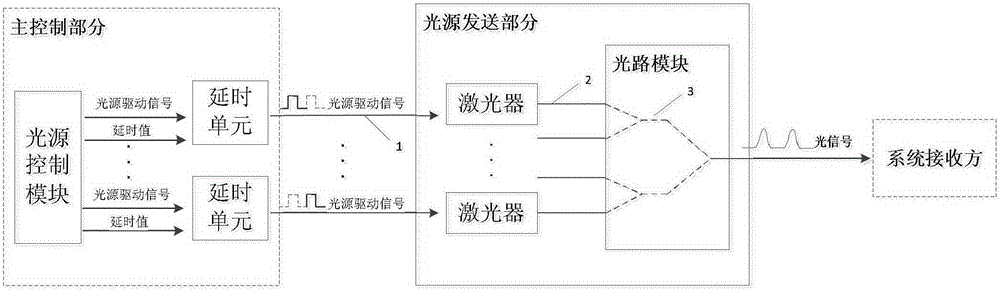
Figure 1 
Figure 2 
Figure 3
Abstract
Description
technical field
[0001] The invention relates to the field of quantum secure communication, in particular to a system and method for calibrating the position of a light source in quantum key distribution (QKD), which has the practicability of quantum key distribution equipment in terms of industrialization and productization. Background technique
[0002] The fundamental difference between Quantum Key Distribution (QKD) and the classical key system is that it uses different quantum states of photons as the carrier of the key, and the basic principles of quantum mechanics guarantee that the process cannot be eavesdropped or deciphered. Therefore, a more secure key system is provided.
[0003] In the current practical QKD system, the design of the sender generally includes the main control part and the light source sending part, such as figure 1 shown. The main control part controls the generation of the driving signal of the light source, and the signal is output to the lase...
Examples
Embodiment 1
[0054] This embodiment adopts a QKD system based on polarization coding, BB84 protocol, and decoy light source. The QKD sender needs to send photons of four different polarization states, and each polarization state of photons includes two kinds of signal (signal) state and decoy (decoy) state, that is, a total of 8 kinds of light need to be sent, corresponding to 8 optical pulses, which can be Respectively denoted as h_s, v_s, p_s, n_s, h_d, v_d, p_d, n_d. Among them, the light intensity of the decoy state is weaker than that of the signal state. The QKD sender selects one of the eight light pulses at each light-emitting time according to a fixed period, so from the perspective of the time axis, all the light pulses transmitted on the optical fiber should be synthesized into one beam with a fixed Periodic optical pulse signal; if the relative positions of the optical pulses finally transmitted on the optical fiber are unstable, the positions of the eight optical pulses need ...
Embodiment 2
[0083] This embodiment adopts a QKD system based on polarization coding, B92 protocol, and non-decoy light source. The QKD sender needs to send photons of two different polarization states (H, +), corresponding to two optical pulses, and the positions of the two optical pulses need to be calibrated.
[0084] Step 1: first set the key parameters of the light source drive signal used for calibration of the QKD sender device, including frequency and code pattern. The code pattern of each light source driving signal is as follows:
[0085] The code pattern of the first channel is: 11000,
[0086] The code pattern of the second channel is: 00111;
[0087] Step 2: Perform simple logic settings on the position offset calculation module, such as start signal frequency, stop signal frequency, expected delay value, calibration accuracy, calibration times threshold and other parameters; among them, the stop signal frequency is generally set to the QKD sender The frequency of the light...