
Preparation process of ashitaba fermented tea
A production process and technology for fermenting tea, applied in the field of beverages, can solve the problems of incompletely exerted nutritional and health care functions, difficult leaching of macromolecular nutrients, lack of fragrance of ordinary tea leaves, etc. thick effect
Patent Information
- Authority / Receiving Office
- CN · China
- Current Assignee / Owner
- Publication Date
- 2014-12-03
- Estimated Expiration
- Not applicable · inactive patent
Smart Images
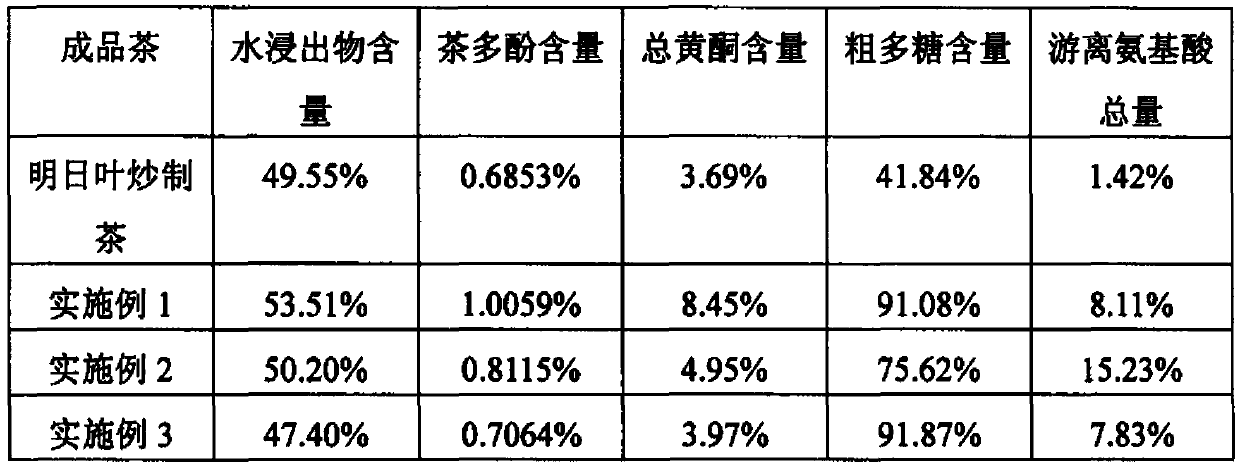
Figure 1
Abstract
Description
technical field
[0001] The invention relates to beverages, in particular to a preparation process of ashitaba fermented tea. Background technique
[0002] Ashitaba is a perennial herb belonging to the Umbelliferae family Angelica, which has the functions of enhancing human immunity, anti-ulcer, anti-thrombosis, lowering cholesterol, lowering blood fat, and preventing cancer. In recent years, studies have found that Ashitaba contains very rare chalcones, which have good antibacterial, anti-tumor, anti-thrombotic, blood pressure-lowering, anti-allergic, anti-cancer, anti-AIDS, anti-dementia, anti-diabetes and many other effects. Do diuretic laxatives, stimulants, lactogens. Ashitaba is a plant containing multiple functional components, and the development of its related products has been frequently reported in recent years. In addition to being directly eaten as fresh vegetables, it can also be used as feed and functional drinks. In addition, making tea with ashitaba as raw...
Examples
Embodiment 1
[0031] Cleaning: pick the fresh leaves of Ashitaba after 30 days of growth, remove the stalks, wash with water and remove the water;
[0032] Spreading and withering: spread the washed and dehydrated Ashitaba for 8 hours, turn the pile 4 times, and turn the pile once every 2 hours;
[0033] Temperature drift: water temperature 60 ℃, time 30 seconds;
[0034] Water shake: time 3 minutes;
[0035] Cutting: Cut Ashitaba into small pieces of about 8cm×4cm;
[0036] Baking (withering in hot air): drying with hot air at low temperature, the temperature at the air outlet is 60°C, the time is 15 minutes, and the pile is turned 8 times during the baking;
[0037] Kneading: Spray cellulase with an enzyme activity of 190 units during the rolling process, and the amount of cellulase added is 0.15g / 100g fresh leaves;
[0038] Fermentation: Put the kneaded ashitaba into the fermentation room for fermentation. The fermentation temperature is 37° C., the relative humidity is 97%, and the ...
Embodiment 2
[0044] Cleaning: pick the fresh leaves of Ashitaba after 30 days of growth, remove the stalks, wash with water and remove the water;
[0045] Spreading and withering: spread the washed and dehydrated Ashitaba for 8 hours, turn the pile 4 times, and turn the pile once every 2 hours;
[0046] Temperature drift: water temperature 60 ℃, time 30 seconds;
[0047] Water shake: time 3 minutes;
[0048] Cutting: Cut Ashitaba into small pieces of about 8cm×4cm;
[0049] Baking (withering in hot air): drying with hot air at low temperature, the temperature at the air outlet is 60°C, the time is 15 minutes, and the pile is turned 8 times during the baking;
[0050] Kneading: Spray a medium-temperature amylase with an enzyme activity of 9816 units during the rolling process, and the amount of the medium-temperature amylase added is 0.015g / 100g of fresh leaves;
[0051] Fermentation: Put the kneaded ashitaba fermented tea into the fermentation room for fermentation. The fermentation te...
Embodiment 3
[0057] Cleaning: pick the fresh leaves of Ashitaba after 30 days of growth, remove the stalks, wash with water and remove the water;
[0058] Spreading and withering: spread the washed and dehydrated Ashitaba for 8 hours, turn the pile 4 times, and turn the pile once every 2 hours;
[0059] Temperature drift: water temperature 60 ℃, time 30 seconds;
[0060] Water shake: time 3 minutes;
[0061] Cutting: Cut Ashitaba into small pieces of about 8cm×4cm;
[0062] Baking (withering in hot air): drying with hot air at low temperature, the temperature at the air outlet is 60°C, the time is 15 minutes, and the pile is turned 8 times during the baking;
[0063] Kneading: Spray pectinase with an enzyme activity of 5718 units during the rolling process, and the amount of pectinase added is 0.015g / 100g fresh leaves;
[0064] Fermentation: Put the kneaded ashitaba fermented tea into the fermentation room for fermentation. The fermentation temperature is 37° C., the relative humidity ...