
A lithium-air battery based on graphene oxide-carbon paper gas catalytic electrode
A gas catalytic electrode and air battery technology, which is applied to battery electrodes, fuel cell half-cells, secondary battery-type half-cells, circuits, etc., can solve the problem of electrode conductivity damage, oxygen transmission channel blockage, and charging failure. and other problems, to achieve the effect of large discharge capacity, improved stability, and reduced ohmic voltage drop
Patent Information
- Authority / Receiving Office
- CN · China
- Patent Type
- Patents(China)
- Current Assignee / Owner
- Publication Date
- 2016-08-17
- Estimated Expiration
- Not applicable · inactive patent
Smart Images
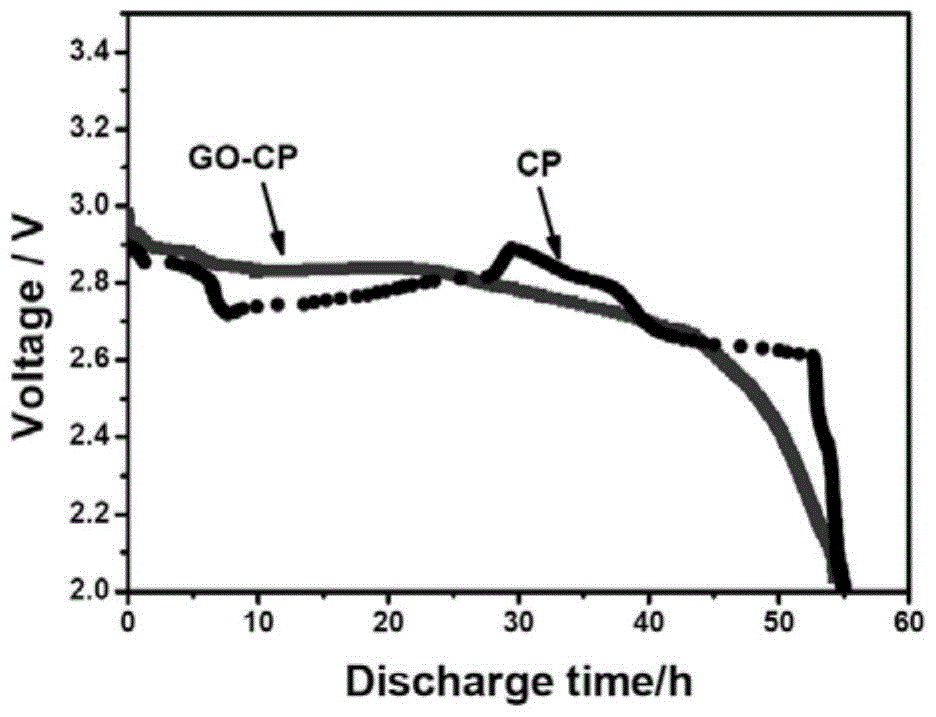
Figure 1 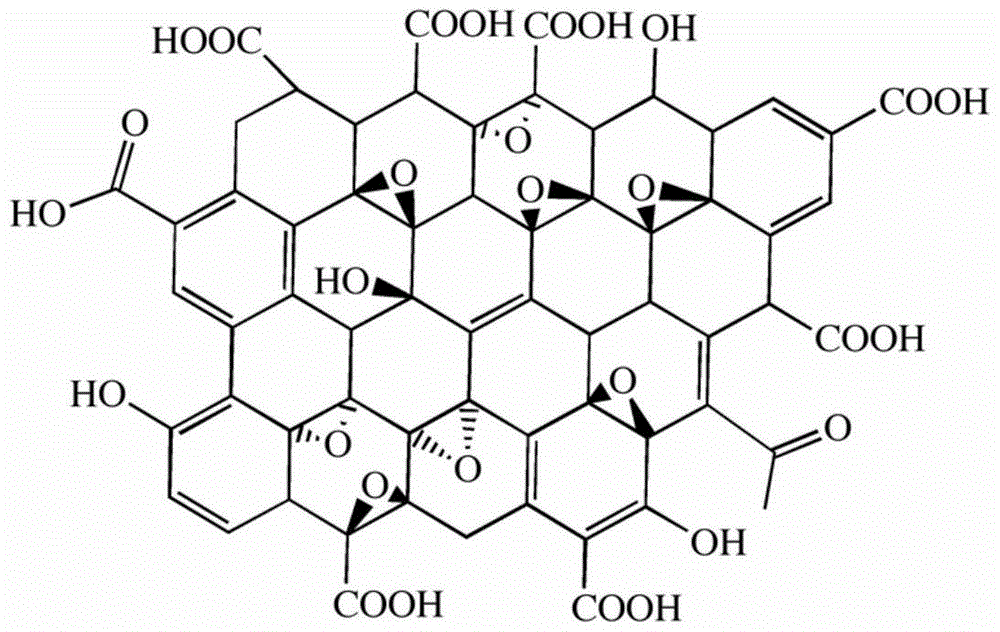
Figure 2 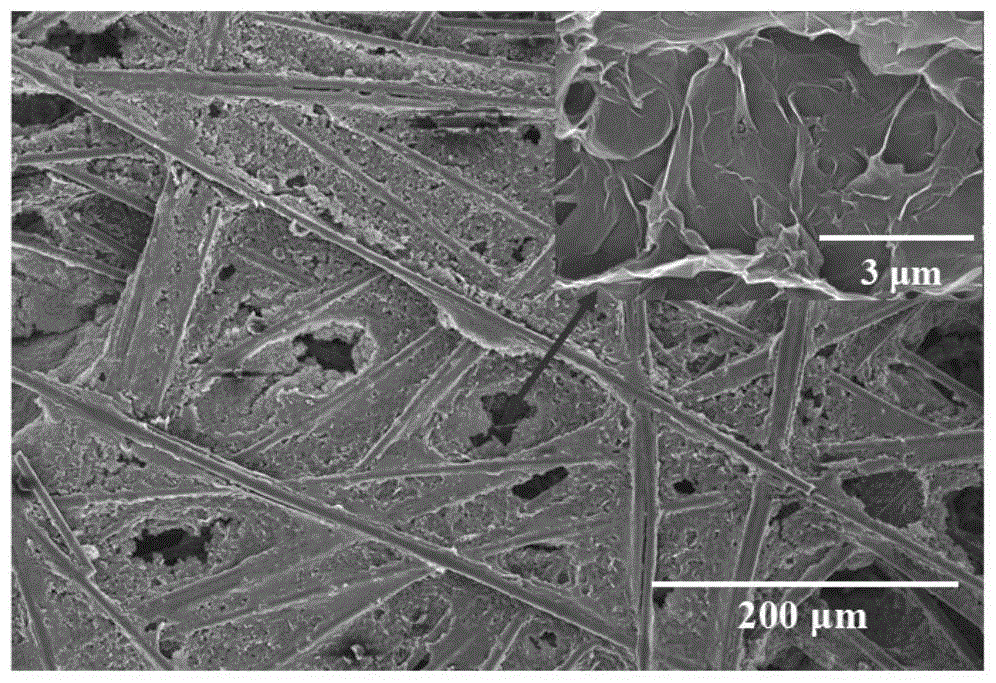
Figure 3
Abstract
Description
technical field
[0001] The invention provides a lithium-air battery, in particular to a lithium-air battery based on a graphene oxide-carbon paper gas catalytic electrode, which belongs to the lithium-air battery and its preparation technology. Background technique
[0002] A lithium-air battery is a secondary battery that uses metallic lithium as the negative electrode and air as the positive electrode. It has a completely different design from lithium-ion batteries, and its theoretical specific energy is 11140Wh / kg (excluding oxygen mass), which is close to the theoretical specific energy value of gasoline of 13000Wh / kg. Even considering the quality of oxygen, its specific energy is ten times that of ordinary lithium-ion batteries (5210Wh / kg). In 1996, Dr. Abraham of EIC Laboratory in Massachusetts reported for the first time the lithium-air battery of this new polymer electrolyte system, which obtained a discharge specific capacity of 1400Ah / kg, which is close to the act...
Examples
Embodiment 1
[0033] Graphene oxide at 1.0mg / cm 3 The concentration of ultrasonic dispersion in double distilled water, adding KH 2 PO 4 and K 2 HPO 4 , prepared into a phosphate buffer solution with pH 9.0, and continued to ultrasonically disperse for 6 hours to make it into a uniformly dispersed suspension. The electrophoresis-electrolytic cell is assembled with a platinum electrode as the negative electrode and carbon paper as the positive electrode. The voltage of the electrolytic cell is controlled at 20V by the stabilized power supply, and the temperature of the electrolyte is controlled at 45°C. The surface is evenly attached and deposited, using a uniform stirring device, the stirring rate is 2000r / min, and the electrolysis reaction time is 5min. The carbon paper electrode loaded with graphene oxide was cleaned with twice distilled water, and its Raman spectrum is shown in the attached Figure 6 . The cleaned carbon paper electrodes loaded with graphene oxide were baked in a v...
Embodiment 2
[0035] Graphene oxide at 2.0mg / cm 3 The concentration of ultrasonic dispersion in double distilled water, adding KH 2 PO 4 and K 2 HPO 4 , prepared into a phosphate buffer solution with a pH of 8.0, and continued ultrasonic dispersion for 6 hours to form a uniformly dispersed suspension. The electrophoresis-electrolytic cell is assembled with a platinum electrode as the negative electrode and carbon paper as the positive electrode. The voltage of the electrolytic cell is controlled at 15V by the stabilized power supply, and the temperature of the electrolyte is controlled at 35°C. During the electrolysis process, in order to make the graphene oxide on the carbon paper The surface is uniformly attached and deposited, using a uniform stirring device, the stirring rate is 3000r / min, and the electrolysis reaction time is 15min. The carbon paper electrode loaded with graphene oxide was cleaned with double distilled water, and the cleaned carbon paper electrode loaded with graph...
Embodiment 3
[0038] Graphene oxide at 3.0mg / cm 3 The concentration of ultrasonic dispersion in double distilled water, adding KH 2 PO 4 and K 2 HPO 4 , prepared into a phosphate buffer solution with pH 7.0, and continued to ultrasonically disperse for 6 hours to make it into a uniformly dispersed suspension. The electrophoresis-electrolytic cell is assembled with a platinum electrode as the negative electrode and carbon paper as the positive electrode. The voltage of the electrolytic cell is controlled at 8V by the stabilized power supply, and the temperature of the electrolyte is controlled at 25°C. During the electrolysis process, in order to make the graphene oxide on the carbon paper The surface is uniformly attached and deposited, using a uniform stirring device, the stirring rate is 4000r / min, and the electrolysis reaction time is 25min. The carbon paper electrode loaded with graphene oxide was cleaned with double distilled water, and the cleaned carbon paper electrode loaded wit...