
Preparation method and application of BiOI-reduced graphene oxide composite photocatalyst
A catalyst and graphene technology, applied in chemical instruments and methods, botanical equipment and methods, physical/chemical process catalysts, etc., can solve the problems of unfavorable close combination, achieve excellent antibacterial activity, good stability, and simple preparation method Feasible effect
Patent Information
- Authority / Receiving Office
- CN · China
- Patent Type
- Applications(China)
- Current Assignee / Owner
- Publication Date
- 2016-10-26
Smart Images
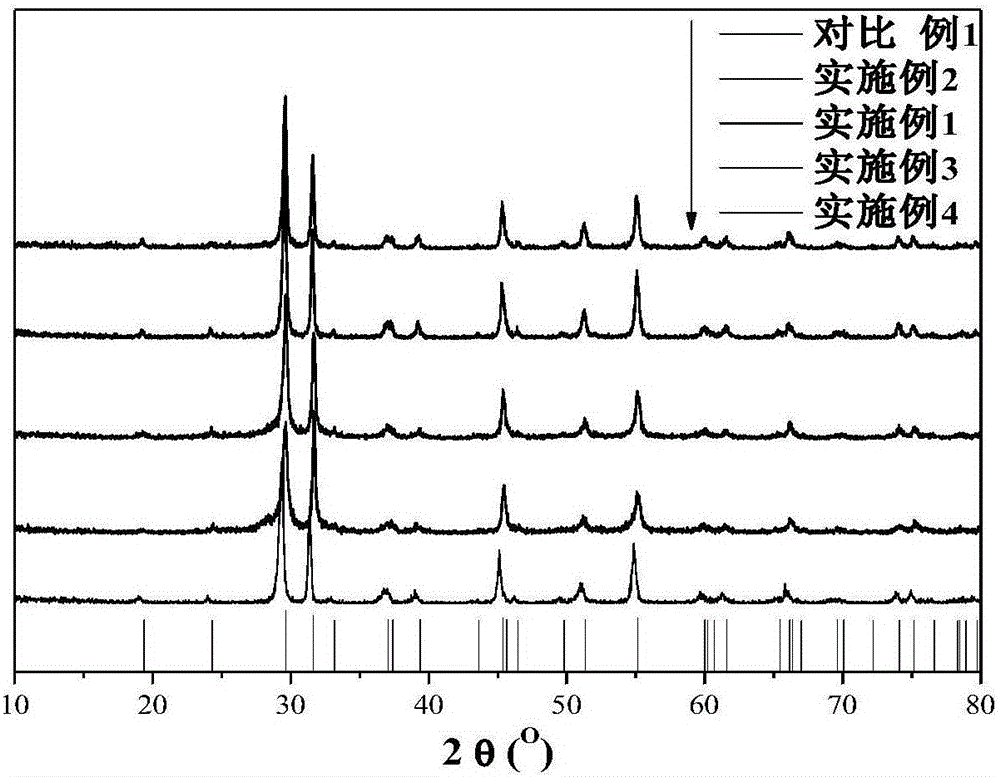
Figure 1 
Figure 2 
Figure 3
Abstract
Description
technical field
[0001] The invention relates to the field of semiconductor photocatalytic materials, in particular to a method for preparing a sheet-like BiOI-reduced graphene (BiOI-RGO) composite visible light catalyst synthesized by alcohol thermal reduction technology and its application. Background technique
[0002] Using semiconductor photocatalysts such as TiO 2 The application of environmental pollution control has attracted more and more attention. However, TiO 2 The wide bandgap allows it to be excited only by ultraviolet light, which only accounts for a small part of the solar spectrum (less than 5%), and the rapid recombination of photogenerated carriers also makes its quantum efficiency very low. How to obtain visible photocatalysts that can make full use of sunlight, be excited in the visible spectral range, and photoinduced carrier separation has become an important research field.
[0003] Oxyhalides BiOX (X=Cl, Br, I) belong to the main group of multimeta...
Examples
Embodiment 1
[0046] Mix 1 g of commercially available graphene with 1 g of NaNO 3 Dissolve in 40mL H 2 SO 4 , stirred for one hour under ice bath, then added 5g KMnO 4 Stir for 48 hours. Add 100mL 5wt% H 2 SO 4 The solution was then stirred at 60 °C for 2 hours and 10 mL of 30 wt% H was added 2 o 2 and 1.0L deionized water. The precipitate was first washed with 5mol / L HCl, and then washed to neutrality with ultrapure water (the supernatant taken out was mixed with BaCl 2 reaction without precipitation), then put into the refrigerator to freeze for 24 hours, and then vacuum freeze-dry to obtain oxidized graphene. Weigh 0.12g Bi(NO 3 ) 3 ·5H 2 O was dissolved in 5.0mL ethylene glycol and 35mL isopropanol mixed solution, 0.146g ionic liquid C 10 h 19 IN 2 Dissolve in the above system and stir vigorously for 1.5 hours. At the same time, 20 mg of the above graphene was added to 20 mL of ethanol and sonicated for 1 hour to obtain a homogeneous solution of graphene flakes, which wa...
Embodiment 2
[0051] Change the amount of GO to 10 mg, and the rest of the content is the same as that described in Example 1 to obtain the visible light catalyst of this example. figure 1 The XRD spectrum of this example shows that the obtained BiOI is a pure tetragonal BiOI crystal (JCPDS 10-0445), and no impurities are formed. The specific surface area of the present embodiment is 42m 2 / g. Figure 8-Figure 9 This example has a certain catalytic activity in the catalytic degradation of methyl orange under visible light. Figure 10 In this example, under visible light, it has a certain photocatalytic killing performance on Acinetobacter baumannii.
Embodiment 3
[0053] Change the amount of GO to 30 mg, and the rest of the content is the same as that described in Example 1 to obtain the visible light catalyst of this example. figure 1 The XRD spectrum of this example shows that the obtained BiOI is a pure tetragonal BiOI crystal (JCPDS 10-0445), and no impurities are formed. The specific surface area of the present embodiment is 139m 2 / g. Figure 8-Figure 9 This example has a certain catalytic activity in the catalytic degradation of methyl orange under visible light. Figure 10 In this example, under visible light, it has a certain photocatalytic killing performance on Acinetobacter baumannii.