

Preparation method of vonoprazan fumarate intermediate namely 5-(2-fluorophenyl)-1H-pyrrole-3-methanal
A technology for vornorazan fumarate and an intermediate is applied in the field of preparation of vornorazan fumarate intermediate 5--1H-pyrrole-3-formaldehyde, and can solve harsh reaction conditions, damage and equipment corrosion Environmental problems, etc., to achieve the effect of reducing the post-reaction processing burden, reducing the difficulty of operation, and low equipment requirements
Patent Information
- Authority / Receiving Office
- CN · China
- Patent Type
- Applications(China)
- Current Assignee / Owner
- Publication Date
- 2016-12-21
Smart Images
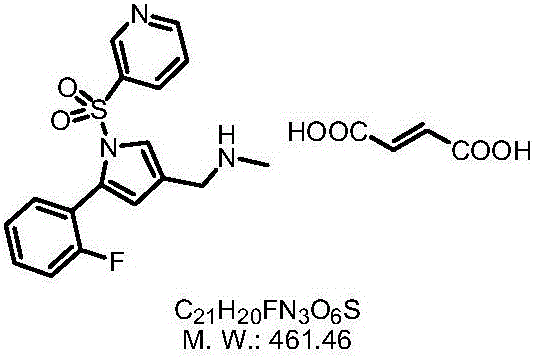
Figure 1 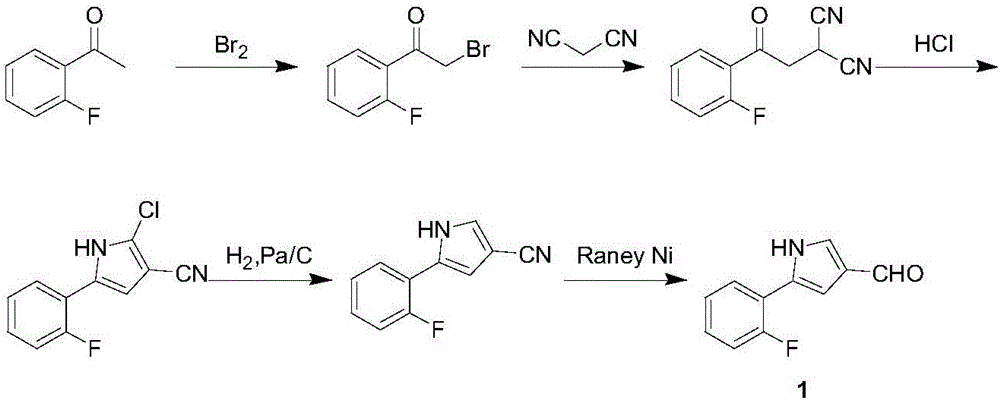
Figure 2 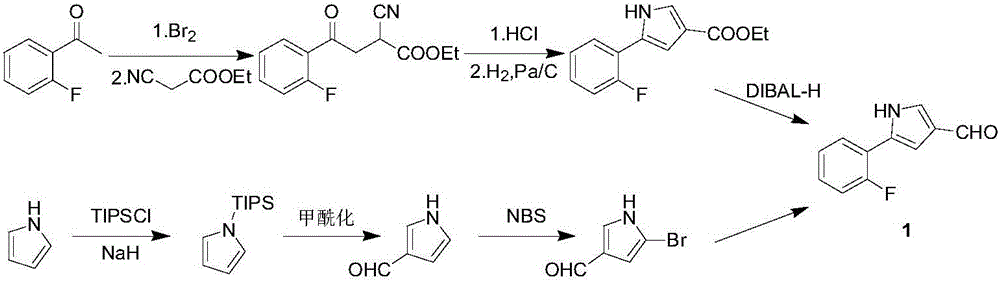
Figure 3
Abstract
Description
technical field
[0001] The invention relates to a preparation method of 5-(2-fluorophenyl)-1H-pyrrole-3-carbaldehyde, an intermediate of vonoprazan fumarate, and belongs to the technical field of medicine and chemical industry. Background technique
[0002] Vonoprazan Fumarate, the chemical name is 1-[5-(2-fluorophenyl)-1-(pyridin-3-ylsulfonyl)-1H-pyrrol-3-yl]-N - Methylmethylamine fumarate, once code-named TAK-438, is a new type of gastric acid secretion inhibitor developed by Takeda Pharmaceutical Company of Japan. It was launched in Japan on December 26, 2014. The trade name is Takecab. For the treatment of non-erosive gastroesophageal reflux disease, duodenal ulcer, gastric ulcer, erosive esophagitis, etc., it has not yet been marketed in China. The chemical structure of vonorazan fumarate is as follows:
[0003]
[0004] 5-(2-Fluorophenyl)-1H-pyrrole-3-carboxaldehyde (1) is the key intermediate of fumaric acid vonoprazan, and the patent CN102421753B applied by Japa...
Examples
Embodiment 1
[0030] Preparation of Compound IV:
[0031] In a 2000ml reaction bottle, add 138g of 2-fluoroacetophenone, 114g of allylamine, 966ml of absolute ethanol, and 10ml of glacial acetic acid, heat the reaction system to 50°C, keep it warm for 6h, and cool to At room temperature, a large amount of solids precipitated, stirred for 1 hour, then cooled to 0-10°C, kept warm for 1 hour, filtered with suction, rinsed the filter cake with cold ethanol, and dried to obtain 165 g of white solid, compound IV, with a yield of 93%.
Embodiment 2
[0033] Preparation method 1 of compound V:
[0034] In a 3000ml reaction flask, add 160g of compound IV, 8.5g of cuprous iodide, 285g of triphenylphosphine, and 640ml of dioxane. Under nitrogen protection, stir at 40°C for 16h. TLC detects the progress of the reaction. After the reaction is completed, cool to room temperature, add 1280ml of water, then add 320ml of ethyl acetate to extract three times, combine the organic phase, add 240ml of 1% dilute hydrochloric acid to the organic phase, stir for 15min, separate the liquids, concentrate the organic phase to dryness to obtain a dark brown oil, add ethanol 240ml was dissolved, and 800ml of water was added dropwise under stirring at room temperature, and a solid precipitated out. The temperature was lowered to 5-10°C, kept for 1 hour, and filtered with suction to obtain 135g of a light yellow solid, namely compound V, with a yield of 85.4%.
Embodiment 3
[0036] Preparation method 2 of compound V:
[0037] In a 3000ml reaction flask, add 160g of compound IV, 1.7g of cuprous iodide, 474g of triphenylphosphine, and 1600ml of dioxane, under the protection of nitrogen, stir at 60°C for 24h, check the progress of the reaction by TLC, after the completion of the reaction, cool to room temperature, add 1280ml of water, then add 320ml of ethyl acetate to extract three times, combine the organic phase, add 240ml of 1% dilute hydrochloric acid to the organic phase, stir for 15min, separate the liquids, concentrate the organic phase to dryness to obtain a dark brown oil, add ethanol 240ml was dissolved, and 800ml of water was added dropwise under stirring at room temperature, and a solid precipitated out. The temperature was lowered to 5-10°C, kept for 1 hour, and filtered with suction to obtain 127g of a light yellow solid, namely compound V, with a yield of 80.3%.