
Process for separating lead and bismuth from high bismuth lead alloy
A bismuth-lead alloy and a technology for separating lead, which can be applied in photography technology, photography auxiliary technology, improvement of process efficiency, etc., can solve the problems of easy dispersion of gold and silver, difficulty in separation, complicated process, etc.
Patent Information
- Authority / Receiving Office
- CN · China
- Patent Type
- Applications(China)
- Current Assignee / Owner
- Publication Date
- 2017-09-19
Smart Images
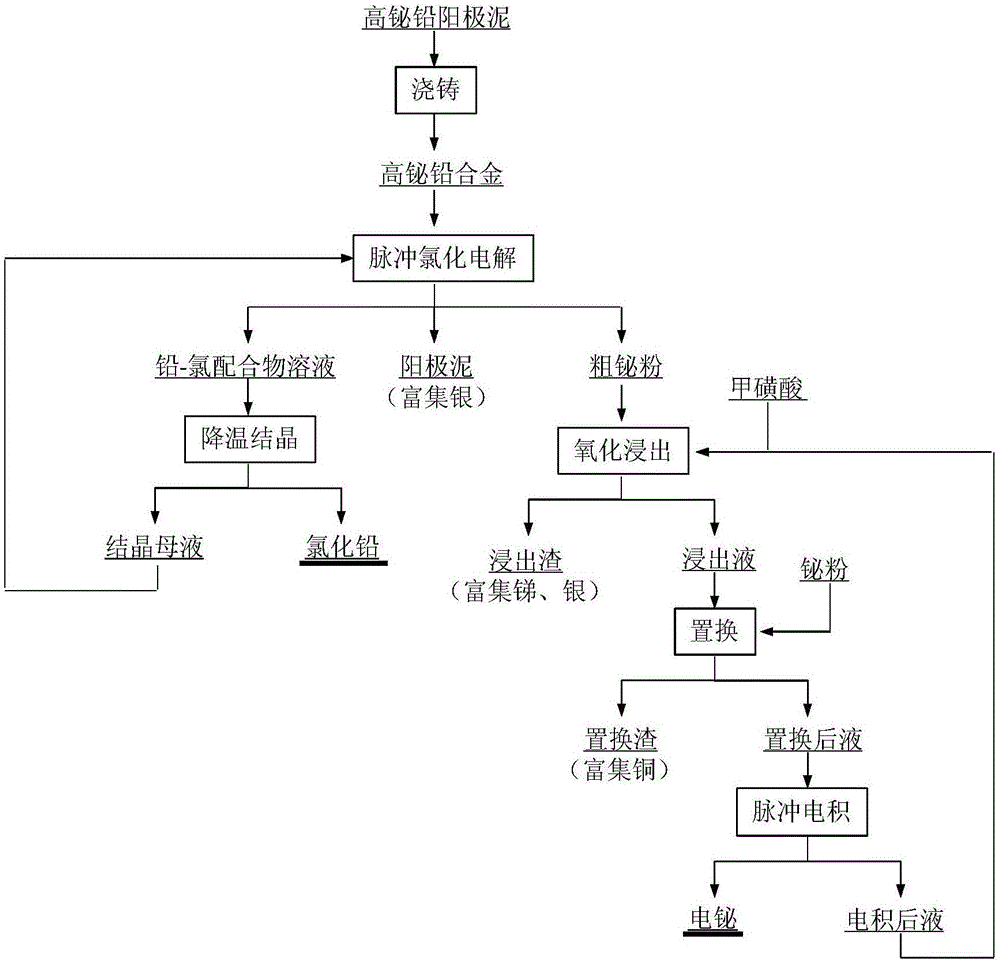
Figure 1
Abstract
Description
technical field
[0001] The invention belongs to the field of hydrometallurgy, and in particular relates to a process for separating lead and bismuth from a high-bismuth-lead alloy. Background technique
[0002] During the electrolytic refining of crude lead, because the standard electrode potential of Sb, As, Bi, Cu, Ag, Au and other metals is more positive than that of Pb, these metals are rarely dissolved into the electrolyte but adhere to the surface of the anode in solid form or fall off the electrolytic tank Anode slime is formed in the anode slime, because it is enriched with 5-30% bismuth, 5-45% antimony, 1-10% copper, 1-20% bismuth, 10-1500g / t gold, 1-20% Silver and 5-30% lead, 0.1-30% arsenic and other elements, so it is of great significance to realize its clean treatment and efficient recycling. Especially in recent years, the proportion of high-bismuth lead raw materials has gradually increased, and the bismuth content in the anode slime obtained during the elec...
Examples
Embodiment 1
[0031] The composition of the high-bismuth-lead anode alloy cast from high-bismuth-lead anode slime provided by a company in Hunan is: Bi40.1%, Cu 1.9%, Pb 51.4%, Sb 4.5%, Ag 1.9%.
[0032]The high bismuth-lead alloy was used as the anode (length 12cm×width 8cm×thickness 2cm), graphite was used as the cathode for pulse chlorination electrolysis in the HCl-NaCl system, and the anode was placed in a canvas anode bag. The pulse frequency of the pulsed electric field during electrolysis is 500Hz, the duty cycle is 60%, and the pulse average current density is 700A / m 2 , the temperature is 60°C, the distance between cathode and anode is 6cm, the volume of electrolyte is 1L, the concentration of HCl in the electrolyte is 3mol / L, and the concentration of NaCl is 100g / L. Under these conditions, the reaction was stopped after 10 hours of electrolysis, the liquid and solid were separated, the cathode sponge bismuth powder was rinsed twice with 50 ml of hot water and then dried, and the ...
Embodiment 2
[0035] The composition of the high-bismuth-lead anode alloy cast from high-bismuth-lead anode slime provided by a company in Yunnan is: Bi38.3%, Cu 2.3%, Pb 52.7%, Sb 5.1%, Ag 1.3%.
[0036] This high bismuth lead alloy is used as the anode (length 18cm×width 10cm×thickness 2cm), and the titanium plate is used as the cathode in HCl-NH 4 Pulse chlorination electrolysis was carried out in the Cl system, and the anode was placed in a canvas anode bag. The pulse frequency of the pulse electric field is 1200Hz, the duty cycle is 70%, and the pulse average current density is 600A / m 2 , the temperature is 70°C, the distance between cathode and anode is 7cm, the volume of electrolyte is 1.5L, the concentration of HCl in the electrolyte is 4mol / L, NH 4 Cl concentration is 80g / L. Under these conditions, the reaction was terminated after 18 hours of electrolysis, and the liquid and solid were separated. The cathode sponge bismuth powder was washed twice with 100 ml of hydrochloric acid...