
A diblock copolymer with dual responsiveness to light and pH and its preparation method
A block copolymer, responsive technology, used in non-active ingredients medical preparations, pharmaceutical formulations, emulsion delivery, etc., can solve problems such as protein adhesion, low cell uptake of carriers, etc.
Patent Information
- Authority / Receiving Office
- CN · China
- Patent Type
- Patents(China)
- Current Assignee / Owner
- Publication Date
- 2020-06-16
Smart Images
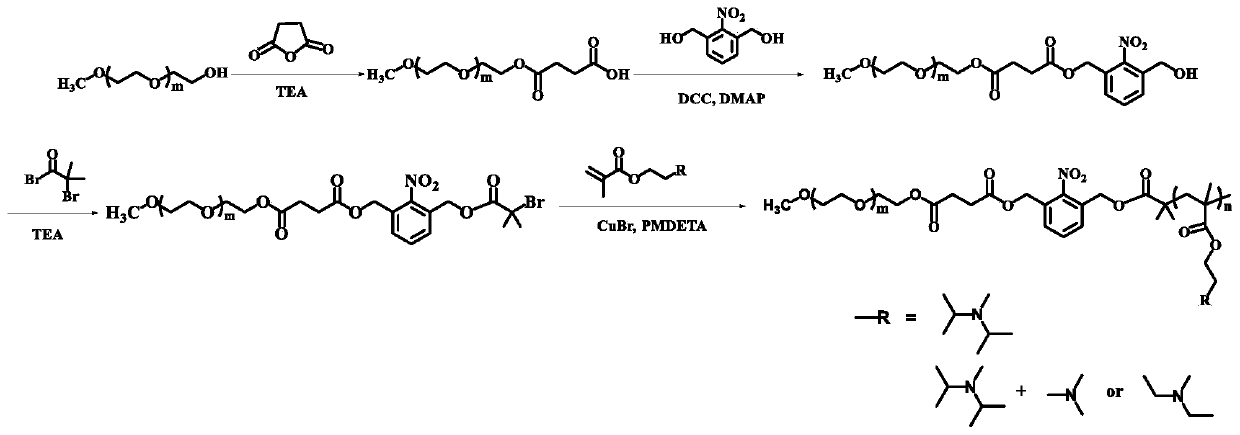
Figure 1 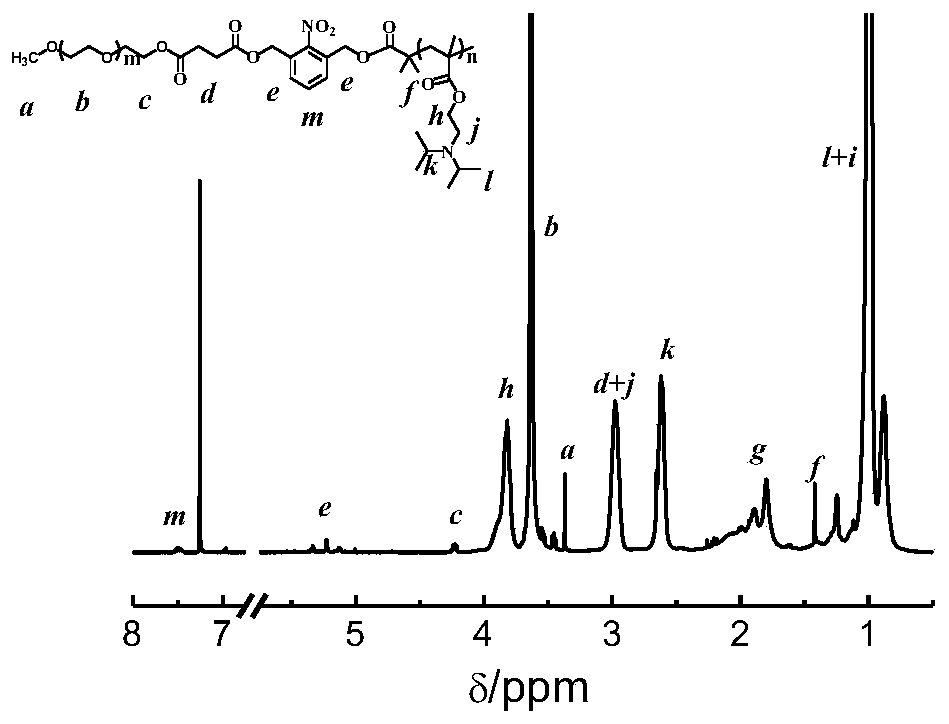
Figure 2 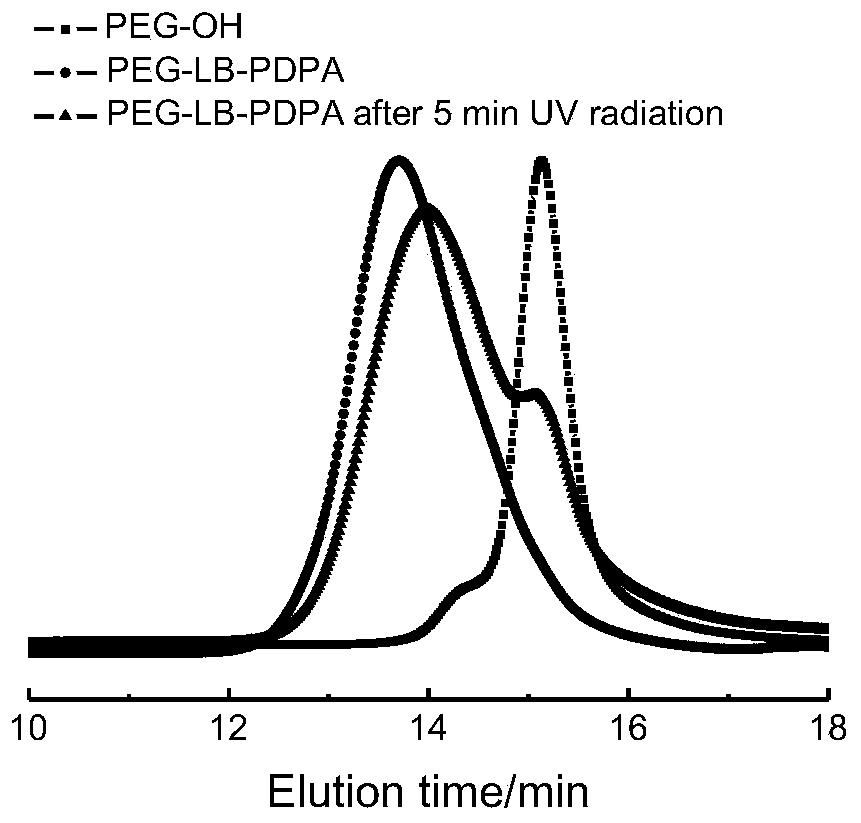
Figure 3
Abstract
Description
technical field
[0001] The invention relates to a two-block copolymer with dual responsiveness to light and pH and a preparation method thereof, belonging to the field of organic polymers. Background technique
[0002] Targeted delivery of drugs to tumor sites to achieve drug targeting and controlled release to reduce drug damage to normal tissues is an important issue in the treatment of tumors. Due to the EPR effect in tumor tissue, the targeted delivery of drugs can be achieved by using nanoparticles to load drugs. Macromolecular self-assembly refers to the process of spontaneous and regular assembly of amphiphilic copolymers under the induction of hydrophilic and hydrophobic interactions, which is a clean way to construct nanoparticles. The nanoparticles have a hydrophobic core and can be loaded with hydrophobic drugs. Moreover, the polymer structure itself is very designable, and stimuli-responsive motifs are introduced into the polymer main chain to construct stimuli...
Examples
Embodiment example 1
[0022] Example 1: Preparation of light and pH dual-responsive diblock copolymer PEG-LB-PDPA
[0023] Preparation of carboxyl-terminated polyethylene glycol: Weigh 10 g of polyethylene glycol monomethyl ether and dissolve it in 50 mL of dichloromethane, add 0.4 g of succinic anhydride and 0.25 mL of triethylamine in sequence, react at room temperature for 24 hours, and remove by rotary evaporation Excess solvent was precipitated three times in diethyl ether, and vacuum-dried to constant weight to obtain carboxyl-terminated polyethylene glycol;
[0024] Preparation of o-nitrobenzyl ester-terminated polyethylene glycol: Dissolve 3 g of carboxy-terminated polyethylene glycol in 15 mL of dichloromethane, add 0.2 g of 2-nitro-1,3-benzyl glycol, 0.48g N,N-dicyclohexylimine, and 0.15g 4-dimethylaminopyridine, reacted at room temperature for 24h, rotary evaporated to remove excess solvent, precipitated in ether three times, dried in vacuum to constant weight, and obtained o-nitro Benz...
Embodiment example 2
[0028] Example 2: Preparation of light and pH dual-responsive diblock copolymer PEG-LB-P (DMA-co-DPA)
[0029] Take by weighing the ATRP macroinitiator prepared in 0.5g embodiment case 1, 1.02g 2-(diisopropylamino) ethyl methacrylate, 0.54g 2-(dimethylamino) ethyl methacrylate, 21 μ L N,N,N',N,'N"-pentamethyldiethylenetriamine and 14mg cuprous bromide, then add 1mL isopropanol and 1mL N,N-dimethylformamide to dissolve the monomer and initiate reagent, and reacted overnight at 50°C in the absence of oxygen. After the reaction was completed, 10 mL of THF was added to quench the reaction, and the copper salt was removed through a neutral alumina column, dialyzed in deionized water for 3 days, and freeze-dried to obtain light and pH dual responsiveness. Block copolymer PEG-LB-P (DMA-co-DPA).
Embodiment example 3
[0030] Example 3: Preparation of light and pH dual-responsive diblock copolymer PEG-LB-P (DEA-co-DPA)
[0031] Take by weighing the ATRP macroinitiator prepared in 0.5g embodiment case 1, 1.02g 2-(diisopropylamino) ethyl methacrylate, 0.67g 2-(diethylamino) ethyl methacrylate, 21 μ L N,N,N',N,'N"-pentamethyldiethylenetriamine and 14mg cuprous bromide, then add 1mL isopropanol and 1mL N,N-dimethylformamide to dissolve the monomer and initiate reagent, and reacted overnight at 50°C in the absence of oxygen. After the reaction was completed, 10 mL of THF was added to quench the reaction, and the copper salt was removed through a neutral alumina column, dialyzed in deionized water for 3 days, and freeze-dried to obtain light and pH dual responsiveness. Block copolymer PEG-LB-P (DEA-co-DPA).