
Heterotrophic nitrification-aerobic denitrification compound bacterial agent for low-temperature high ammonia-nitrogen removal and application
A compound bacterial agent and heterotrophic nitrification technology, applied in the field of microorganisms, can solve the problems of poor wastewater treatment quality, high treatment cost, and low treatment efficiency, and achieve the effects of strong tolerance, high treatment efficiency and low treatment cost
Patent Information
- Authority / Receiving Office
- CN · China
- Patent Type
- Applications(China)
- Current Assignee / Owner
- Publication Date
- 2018-12-25
Smart Images
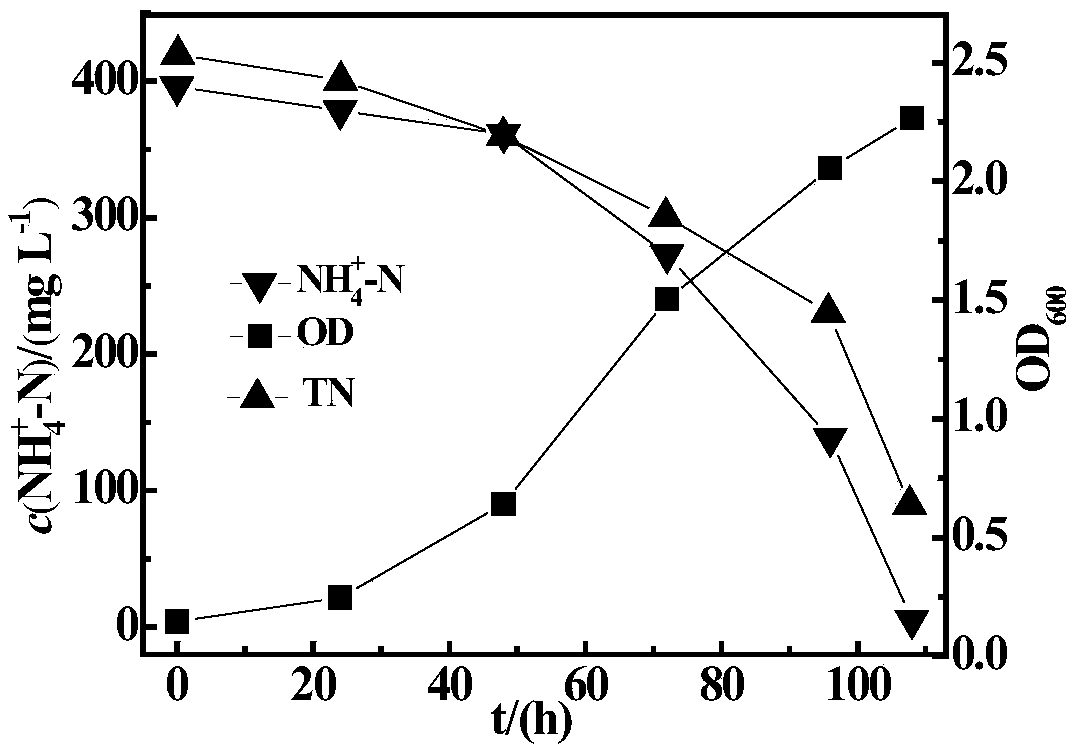
Figure 1 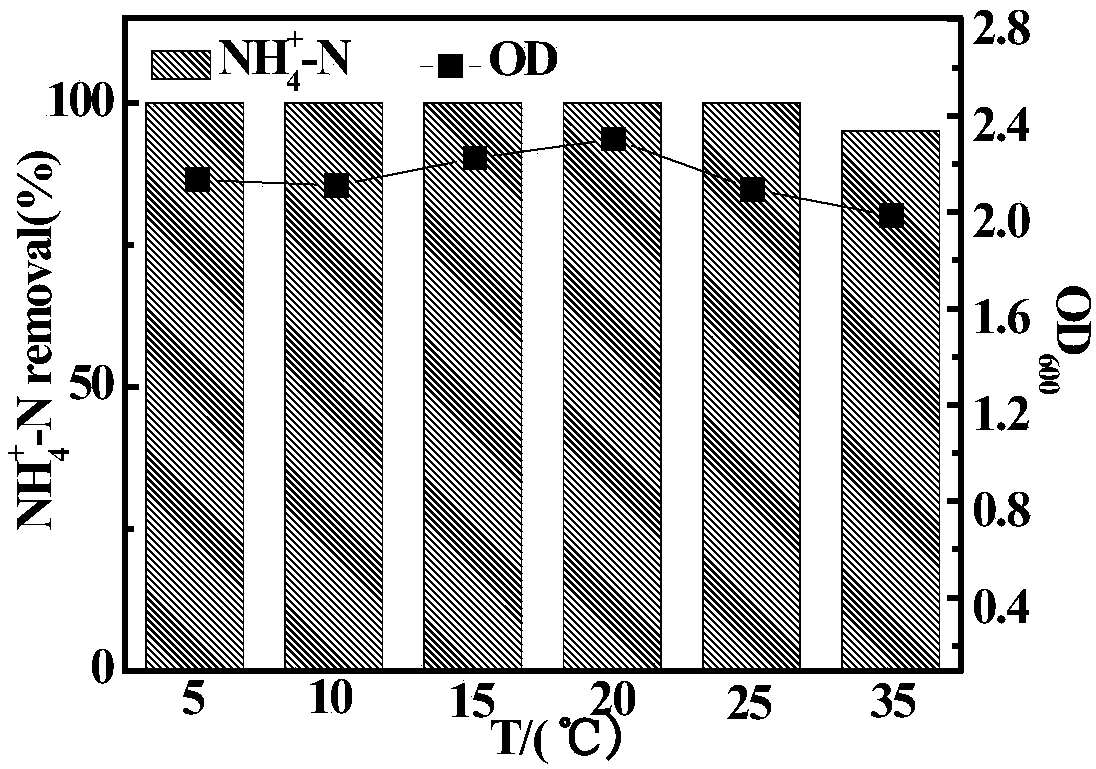
Figure 2 
Figure 3
Abstract
Description
technical field
[0001] The invention belongs to the technical field of microorganisms, and in particular relates to a heterotrophic nitrification-aerobic denitrification composite microbial agent capable of removing high ammonia nitrogen at low temperature and its application. Background technique
[0002] In recent years, the discharge of high ammonia nitrogen wastewater (ammonia nitrogen concentration > 200mg / L) has been increasing. Improper treatment of high ammonia nitrogen wastewater and direct discharge into water bodies will lead to increasingly serious phenomena such as eutrophication of water bodies, resulting in deterioration of water body quality. In order to control ammonia nitrogen pollution in water bodies, my country has promulgated strict new standards for pollutant control, among which the primary standard for ammonia nitrogen is 5.0mg / L. The new standard puts forward new requirements for the effective control of ammonia nitrogen, especially the effectiv...
Examples
Embodiment 1
[0051] Step 1) acclimatization of bacterial classification
[0052] Acclimatization of Cupriavidus sp.SWA1 with low temperature and high ammonia nitrogen tolerance: Inoculate 2mL of the bacterial liquid into a 250mL Erlenmeyer flask containing 100mL of sterilized heterotrophic nitrification medium, shake well, 5°C, 150 r· min -1 Cultured under the same conditions for 2 days. Under the above-mentioned same conditions, the continuous subculture was carried out for 5 times, and the corresponding ammonia nitrogen concentration was 200mg / L, 300mg / L, 400mg / L, 500mg / L, 600mg / L respectively.
[0053] Acclimatization of Alcaligenes faecalis (CICC 22642) with low temperature and high ammonia nitrogen tolerance: Inoculate 2mL of the bacteria liquid into a 250mL Erlenmeyer flask containing 100mL of sterilized heterotrophic nitrification medium, shake well, and store at 5°C. 150r·min -1 Cultured under the same conditions for 2 days. Under the same conditions as above, the strains were ...
Embodiment 2
[0068] Example 2: Experiment of removal of high ammonia nitrogen by compound bacterial agent at 5°C
[0069] Configure a heterotrophic nitrification medium with an ammonia nitrogen concentration of 400mg / L, take 100mL of heterotrophic nitrification culture based on a 250mL Erlenmeyer flask, add 2mL of complex bacterial agent bacterial solution (OD600 is 1-2) to the bottle with a micropipette, Seal it with parafilm, put it into a shaker and set it at 5°C, 150r min -1 Cultivate under condition, measure the OD600 value of bacterial liquid every 24h then determine the thalline growth situation, measure the content of ammonia nitrogen and total nitrogen in the culture medium simultaneously, determine the removal effect of ammonia nitrogen and total nitrogen, by figure 1 It can be seen that the ammonia nitrogen removal rate of the composite bacterial agent can reach 100% and the total nitrogen removal rate can reach 79.05% at 5°C.
Embodiment 3
[0070] Example 3: The experiment of removing high ammonia nitrogen by compound bacterial agent at different temperatures
[0071] Configure a heterotrophic nitrification medium with an ammonia nitrogen concentration of 400mg / L, take 100mL of heterotrophic nitrification culture based on a 250mL Erlenmeyer flask, add 2mL of complex bacterial agent bacterial solution (OD600 is 1-2) to the bottle with a micropipette, Sealed with parafilm, put different Erlenmeyer flasks into different shakers (temperature settings were 5°C, 10°C, 15°C, 20°C, 25°C, 35°C, speed setting 150r min -1 ), then measure the OD600 value of the bacterial solution every 24 hours to determine the growth of the bacteria, and measure the content of ammonia nitrogen in the medium at the same time to determine the removal effect of ammonia nitrogen. Depend on figure 2 It can be seen that the composite microbial agent can achieve efficient removal of ammonia nitrogen in the range of 5-35 °C.