
Method for preparing prucalopride
A technology of methylacetanilide and reaction, which is applied in the field of preparation of prucalopride, can solve problems such as inconvenient operation, and achieve the effects of less by-products, improved purity and yield, and mild reaction conditions
Patent Information
- Authority / Receiving Office
- CN · China
- Current Assignee / Owner
- Publication Date
- 2019-01-18
Smart Images
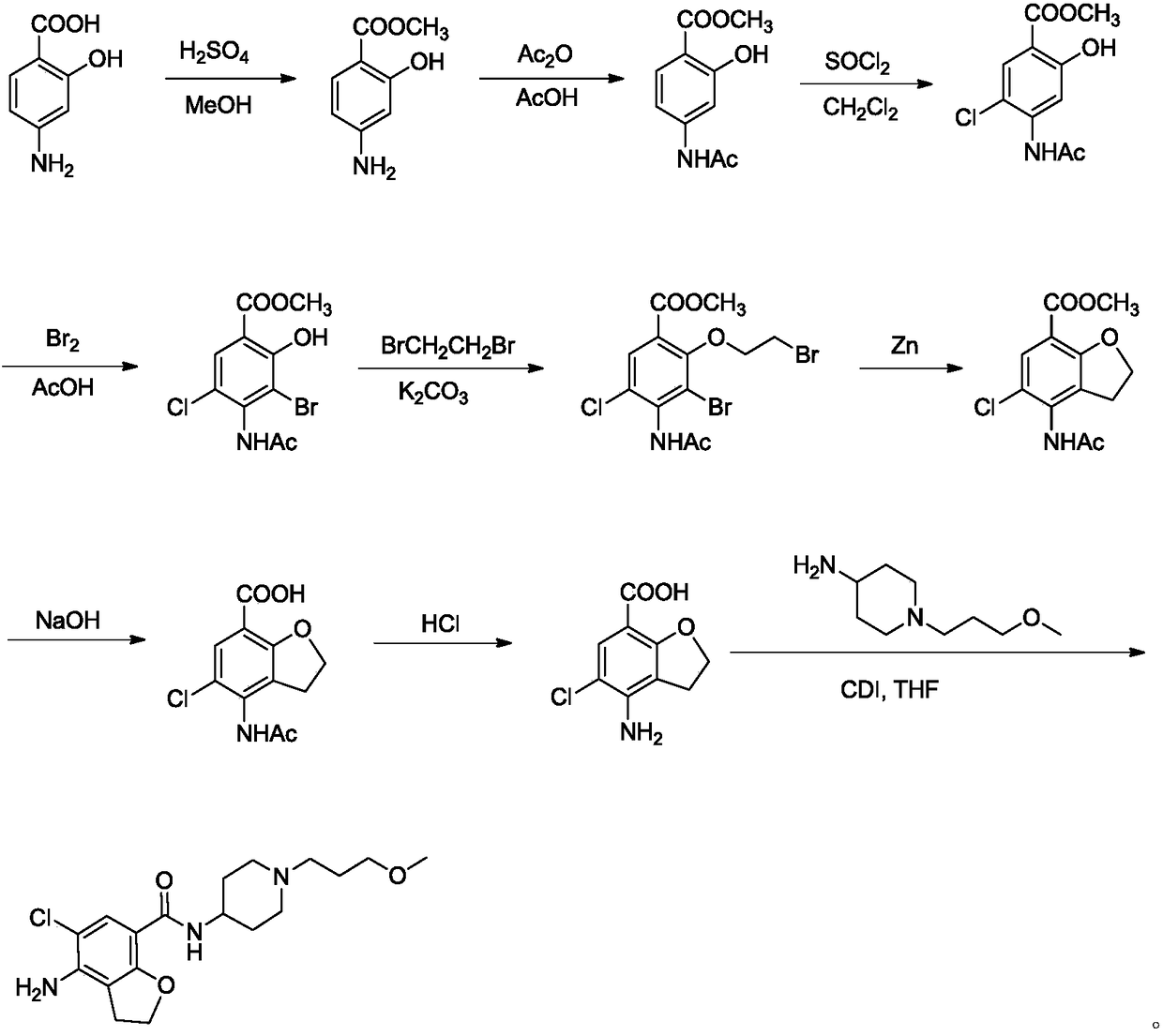
Figure 1 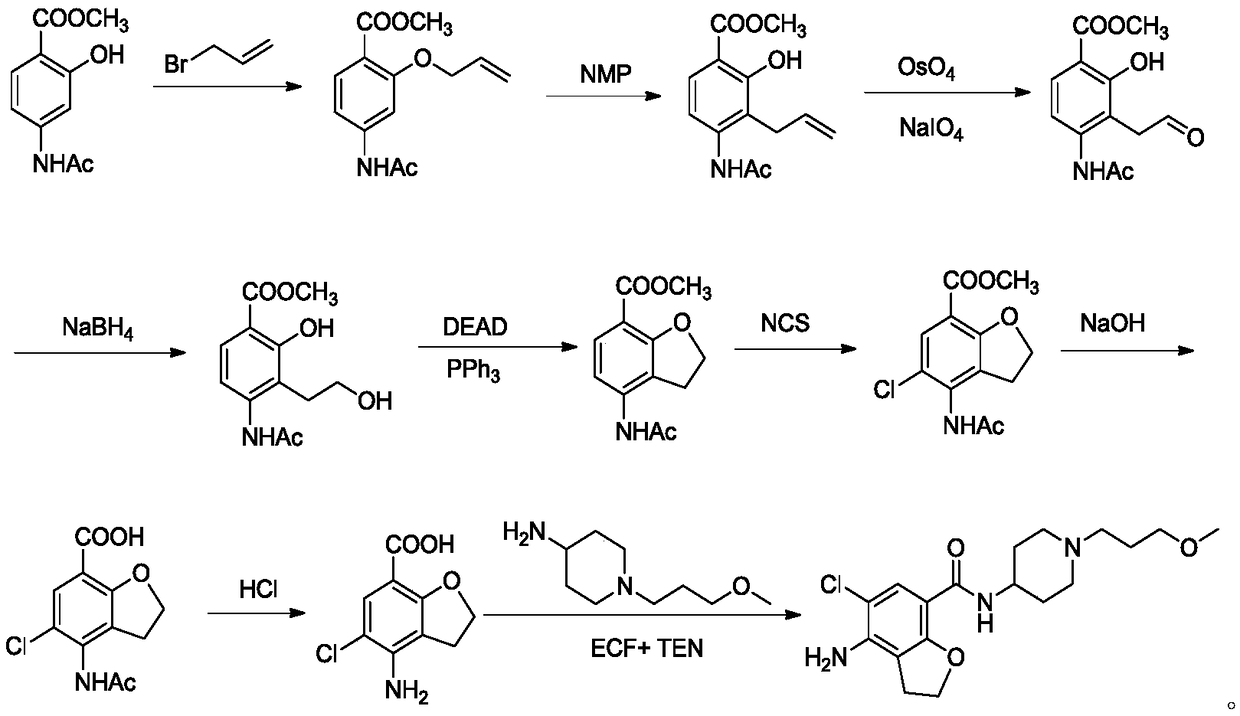
Figure 2 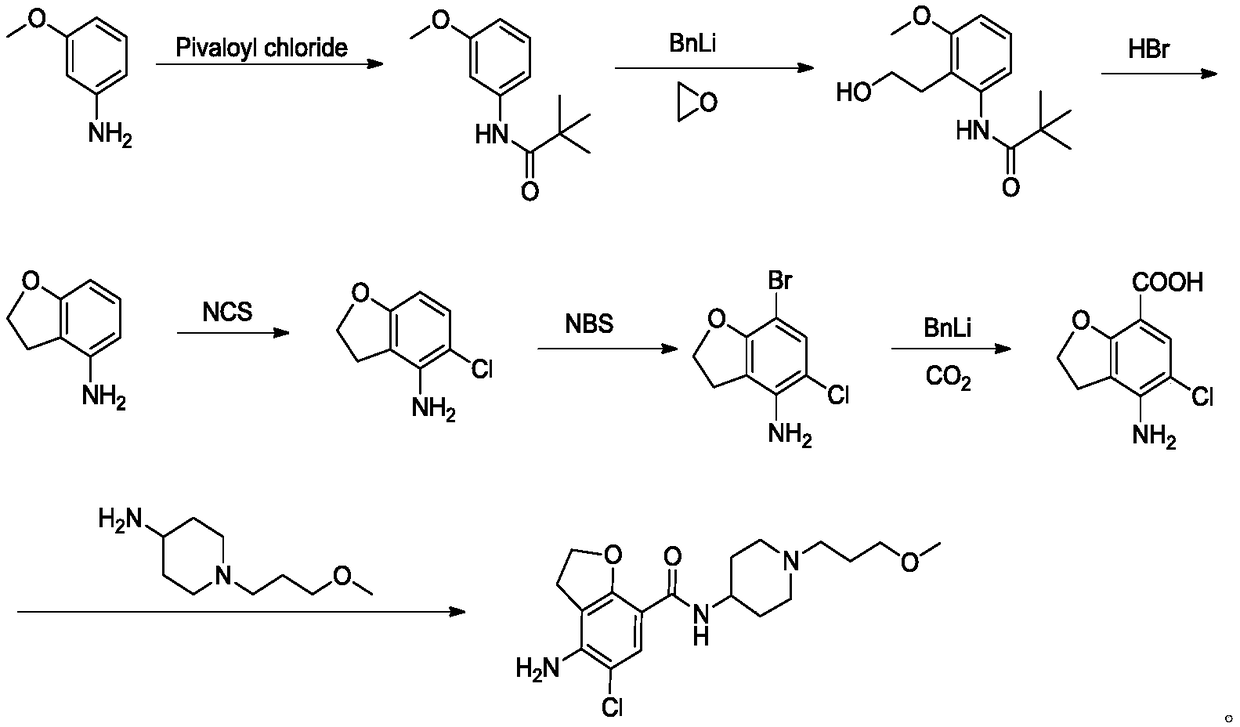
Figure 3
Abstract
Description
technical field
[0001] The invention belongs to the field of medicinal chemistry, and in particular relates to a preparation method of prucalopride. Background technique
[0002] Prucalopride, the chemical name is 4-amino-5-chloro-2,3-dihydro-N-[1-(3-methoxypropyl)-4-piperidinyl]-7- Benzofuran carboxamide is a selective 5-HT developed by Belgium Movetis NV company 4 Receptor agonist. In October 2009, the European Medicines Agency approved its monosuccinate for marketing. It is clinically used to treat female constipation that cannot be relieved by laxatives. The trade name is Resolor. This product is the first new type of dihydrobenzofuran carboxylic acid derivatives to promote intestinal motility agent, which can efficiently and selectively stimulate 5-HT 4a and 5-HT 4b Receptors, increase gastrointestinal motility, improve constipation symptoms.
[0003] The synthetic scheme of prucalopride mainly contains following three kinds:
[0004] Scheme 1, Yuan Youzhi and othe...
Examples
Embodiment 1
[0047] Step 1, the preparation of 3-chloro-4-methylacetanilide: Take 141g of 3-chloro-4-methylaniline, dissolve it in 200mL ethyl acetate, add 102g of acetic anhydride dropwise under ice bath, after the dropwise addition, The temperature was raised to room temperature, and the reaction was continued for 12 hours. After the reaction, the reaction solution was washed with water until neutral, dried and filtered, and the filtrate was distilled under reduced pressure to obtain 175 g of a white solid.
[0048] Step 2, the preparation of 3-(2-hydroxyethoxy)-4-methylacetanilide: take 183g of 3-chloro-4-methylacetanilide, dissolve it in 400mL dimethyl carbonate, add ethylene glycol 62g , potassium hydroxide 100g, heated to reflux for 12h, after the reaction, filtered to remove the solid, the filtrate was washed with water, the organic layer was dried and filtered, the filtrate was decompressed to recover the solvent, and the residual solid petroleum ether:ethyl acetate=2:1 was recrysta...
Embodiment 2
[0057] Step 1, the preparation of 3-chloro-4-methylacetanilide: take 141g of 3-chloro-4-methylaniline, dissolve it in 200mL ethyl acetate, add 110g of acetic anhydride dropwise under ice bath, after the dropwise addition, The temperature was raised to room temperature, and the reaction was continued for 12 hours. After the reaction, the reaction solution was washed with water until neutral, dried and filtered, and the filtrate was distilled under reduced pressure to obtain 181 g of a white solid.
[0058] Step 2, the preparation of 3-(2-hydroxyethoxy)-4-methylacetanilide: take 183g of 3-chloro-4-methylacetanilide, dissolve it in 400mL dimethyl carbonate, add ethylene glycol 70g , potassium hydroxide 100g, heated to reflux for 12h, after the reaction, filtered to remove the solid, the filtrate was washed with water, the organic layer was dried and filtered, the filtrate was decompressed to recover the solvent, and the residual solid petroleum ether:ethyl acetate=2:1 was recrysta...
Embodiment 3
[0067] Step 1, the preparation of 3-chloro-4-methylacetanilide: Take 141g of 3-chloro-4-methylaniline, dissolve it in 200mL ethyl acetate, add 120g of acetic anhydride dropwise under ice bath, after the dropwise addition, The temperature was raised to room temperature, and the reaction was continued for 12 hours. After the reaction, the reaction solution was washed with water until neutral, dried and filtered, and the filtrate was distilled under reduced pressure to obtain 185 g of a white solid.
[0068] Step 2, the preparation of 3-(2-hydroxyethoxy)-4-methylacetanilide: Take 183g of 3-chloro-4-methylacetanilide, dissolve it in 400mL dimethyl carbonate, add ethylene glycol 76g , potassium hydroxide 100g, heated to reflux for 12h, after the reaction, filtered to remove the solid, the filtrate was washed with water, the organic layer was dried and filtered, the filtrate was decompressed to recover the solvent, and the residual solid petroleum ether:ethyl acetate=2:1 was recrysta...