
A kind of ceramic product with self-cleaning glaze and preparation method thereof
A technology of ceramic products and production methods, which is applied in the field of ceramics and can solve problems such as unsatisfactory smoothness of glazed surfaces, easy staining and cleaning of glazed surfaces, and yellowing of glazed surfaces, so as to reduce scratches on glazed surfaces and improve glazed surfaces. The effect of improving quality and wear resistance
Patent Information
- Authority / Receiving Office
- CN · China
- Patent Type
- Patents(China)
- Current Assignee / Owner
- Publication Date
- 2021-07-16
Smart Images
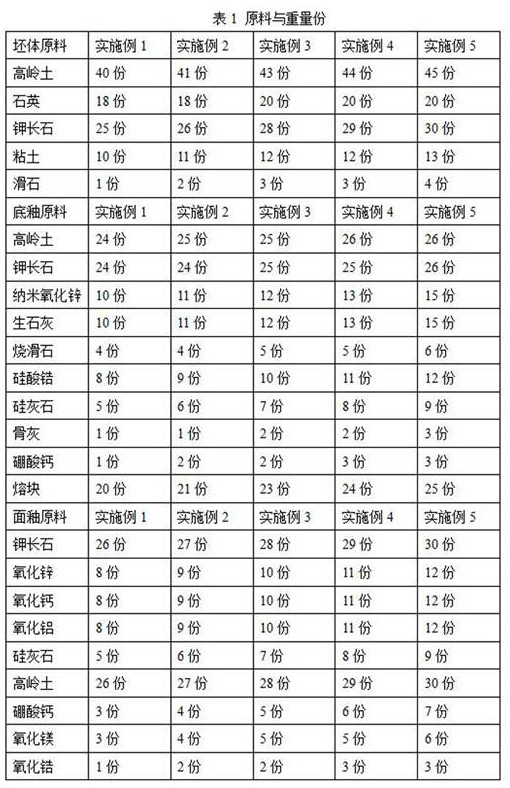
Figure 1 
Figure 2
Abstract
Description
technical field
[0001] The invention belongs to the technical field of ceramics, and in particular relates to a ceramic product with self-cleaning glaze and a manufacturing method thereof. Background technique
[0002] The development history of ceramics is an important part of the history of Chinese civilization. As one of the four ancient civilizations, China has made outstanding contributions to the progress and development of human society. Among them, the invention and development of ceramics has unique significance. Ceramics from all dynasties and dynasties in Chinese history have different artistic styles and technical characteristics. "china" in English means both China and ceramics, which clearly shows that China is the "hometown of ceramics". As early as more than a thousand years before the Europeans mastered the porcelain manufacturing technology, the Han people had already produced very exquisite ceramics. China is one of the first countries in the world to us...
Examples
Embodiment 1
[0032] This embodiment provides a ceramic product with a self-cleaning glaze, including a base material and a glaze, and the base material includes the following raw materials in parts by weight: 40 parts of kaolin, 18 parts of quartz, 25 parts of potassium feldspar, 10 parts of clay, talc 1 part; the glaze includes a bottom glaze and a top glaze, and the bottom glaze includes the following raw materials in parts by weight: 24 parts of potassium feldspar, 10 parts of nano-zinc oxide, 10 parts of quicklime, 4 parts of burnt talc, 24 parts of kaolin, zirconium silicate 8 parts, 5 parts of wollastonite, 1 part of bone ash, 1 part of calcium borate, 20 parts of frit; the surface glaze includes the following raw materials in parts by weight: 26 parts of potassium feldspar, 8 parts of zinc oxide, 8 parts of calcium oxide, and 8 parts of aluminum oxide , 3 parts of magnesium oxide, 26 parts of kaolin, 5 parts of wollastonite, 1 part of zirconia, and 3 parts of calcium borate.
[0033...
Embodiment 2
[0042]This embodiment provides a ceramic product with a self-cleaning glaze, including a base material and a glaze, and the base material includes the following raw materials in parts by weight: 41 parts of kaolin, 18 parts of quartz, 26 parts of potassium feldspar, 11 parts of clay, and talc 2 parts; the glaze includes a bottom glaze and a top glaze, and the bottom glaze includes the following raw materials in parts by weight: 24 parts of potassium feldspar, 11 parts of nano-zinc oxide, 11 parts of quicklime, 4 parts of burnt talc, 25 parts of kaolin, zirconium silicate 9 parts, 6 parts of wollastonite, 1 part of bone ash, 2 parts of calcium borate, 21 parts of frit; the surface glaze includes the following raw materials in parts by weight: 27 parts of potassium feldspar, 9 parts of zinc oxide, 9 parts of calcium oxide, and 9 parts of aluminum oxide 4 parts, magnesium oxide 4 parts, kaolin 27 parts, wollastonite 6 parts, zirconia 2 parts, calcium borate 4 parts.
[0043] This...
Embodiment 3
[0052] This embodiment provides a ceramic product with a self-cleaning glaze, including a tire material and a glaze material, and the tire material includes the following raw materials in parts by weight: 43 parts of kaolin, 20 parts of quartz, 28 parts of potassium feldspar, 12 parts of clay, 3 parts of talc;
[0053] The glaze includes a bottom glaze and a surface glaze, and the bottom glaze includes the following raw materials in parts by weight: 25 parts of potassium feldspar, 12 parts of nano-zinc oxide, 12 parts of quicklime, 5 parts of burnt talc, 25 parts of kaolin, 10 parts of zirconium silicate, 7 parts of wollastonite, 2 parts of bone ash, 2 parts of calcium borate, 23 parts of frit; the surface glaze includes the following raw materials in parts by weight: 28 parts of potassium feldspar, 10 parts of zinc oxide, 10 parts of calcium oxide, 10 parts of aluminum oxide, 5 parts of magnesium, 28 parts of kaolin, 7 parts of wollastonite, 2 parts of zirconia, and 5 parts o...