
Preparation method of 2, 6-dichloromethylpyridine hydrochloride
A technology of dichloropicoline hydrochloride and lutidine, applied in the field of preparation of 2,6-dichloropicoline hydrochloride, can solve the problems of short cost route, high toxicity of raw materials, high cost, etc. Achieve the effect of low cost, few reaction steps and low toxicity
Patent Information
- Authority / Receiving Office
- CN · China
- Patent Type
- Applications(China)
- Current Assignee / Owner
- Publication Date
- 2019-05-14
- Estimated Expiration
- Not applicable · inactive patent
Smart Images
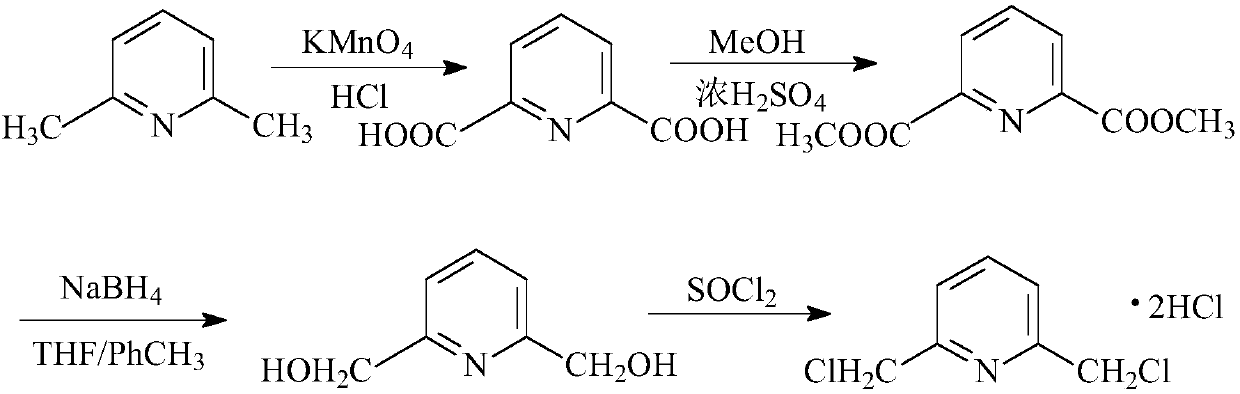
Figure 1
Abstract
Description
technical field
[0001] The invention belongs to the field of organic synthesis, and in particular relates to a preparation method of 2,6-dichloromethylpyridine hydrochloride. Background technique
[0002] Pyridine and its derivatives are widely distributed in nature. Many plant components such as alkaloids contain pyridine ring compounds in their structures, which are the basis for the production of many important compounds, such as medicines, pesticides, dyes, surfactants, rubber additives, feed additives, food additives, adhesives, etc. Indispensable raw material in production.
[0003] 2,6-Dichloromethylpyridine hydrochloride is an important pharmaceutical and pesticide intermediate. The method usually used at present is to methylate pyridine, and then use expensive precious metal chemical raw materials such as methyl lithium and methyl iodide to process reaction; or direct ring synthesis with a methyl group on the 2,6-position, and then chlorine gas for chlorination. ...
Examples
Embodiment 1
[0022] (1) Add 2,6-lutidine (21.4g, 0.2mol) and 150ml of water into a 250ml flask, heat to 80°C, add potassium permanganate (126.4g, 0.8mol) in batches, and maintain the temperature Heating and stirring at 75-80°C for 35 minutes, followed by thin-layer chromatography analysis, after the reaction is complete, use 2mol / l hydrochloric acid to adjust the pH value of the reaction solution to 3, and cool the temperature of the reaction solution to 20°C to obtain 2,6-pyridinedicarboxylic acid .
[0023] (2) 2,6-pyridinedicarboxylic acid and methanol (16g, 0.5mol) were reacted with concentrated sulfuric acid to generate 2,6-pyridinedicarboxylic acid dimethyl ester.
[0024] (3) Dimethyl 2,6-pyridinedicarboxylate was dissolved in a solvent mixed with 75mlTHF and 75ml toluene, and sodium borohydride (45.4g, 1.2mol) and aluminum trichloride were added in batches at 0-5°C, and The reaction was continued for 3-4 hours, followed by thin-layer chromatography analysis until the reaction was ...
Embodiment 2
[0027] (1) Add 2,6-lutidine (21.4g, 0.2mol) and 150ml of water into a 250ml flask, heat to 80°C, add potassium permanganate (142.2g, 0.9mol) in batches, and maintain the temperature Heating and stirring at 75-80°C for 35min, followed by thin-layer chromatography analysis, after the reaction is complete, use 2mol / l hydrochloric acid to adjust the pH value of the reaction solution to 4, and cool the temperature of the reaction solution to 25°C to obtain 2,6-pyridinedicarboxylic acid .
[0028] (2) 2,6-pyridinedicarboxylic acid and methanol (17.9g, 0.56mol) were reacted with concentrated sulfuric acid to generate 2,6-pyridinedicarboxylic acid dimethyl ester.
[0029] (3) Dimethyl 2,6-pyridinedicarboxylate was dissolved in a solvent mixed with 75mlTHF and 75ml toluene, and sodium borohydride (53g, 1.4mol) and aluminum trichloride were added in batches at 0-5°C, and the addition was completed The reaction was continued for 3-4h, followed by thin-layer chromatography analysis until...
Embodiment 3
[0032] (1) Add 2,6-lutidine (21.4g, 0.2mol) and 150ml of water into a 250ml flask, heat to 80°C, add potassium permanganate (15.8g, 1.0mol) in batches, and maintain the temperature Heating and stirring at 75-80°C for 35 minutes, followed by thin-layer chromatography analysis, after the reaction is complete, use 2mol / l hydrochloric acid to adjust the pH value of the reaction solution to 3, and cool the temperature of the reaction solution to 25°C to obtain 2,6-pyridinedicarboxylic acid .
[0033] (2) 2,6-pyridinedicarboxylic acid and methanol (19.2g, 0.6mol) were reacted with concentrated sulfuric acid to generate 2,6-pyridinedicarboxylic acid dimethyl ester.
[0034] (3) Dimethyl 2,6-pyridinedicarboxylate was dissolved in a solvent mixed with 75mlTHF and 75ml toluene, and sodium borohydride (68.1g, 1.8mol) and aluminum trichloride were added in batches at 0-5°C, and The reaction was continued for 3-4 hours, followed by thin-layer chromatography analysis until the reaction was...