
Clean in-phase layer selection in-core selective coherence spectrum method
A technology of nuclear selectivity and selectivity, which is applied in the field of nuclear magnetic resonance of layer-selective homonuclear selective coherent spectrum, can solve the problems of consuming experiment time and difficulty in spectrum analysis, achieve clear spectrum, reduce experiment time, and avoid signal self-cancelling effect
Patent Information
- Authority / Receiving Office
- CN · China
- Patent Type
- Applications(China)
- Current Assignee / Owner
- Publication Date
- 2021-03-30
Smart Images

Figure 1 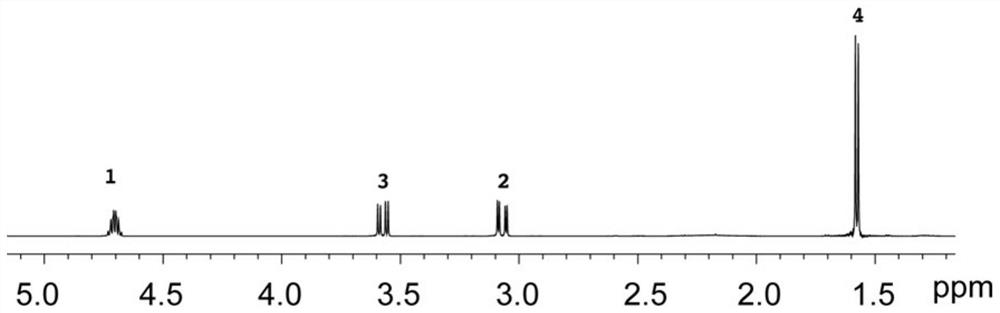
Figure 2 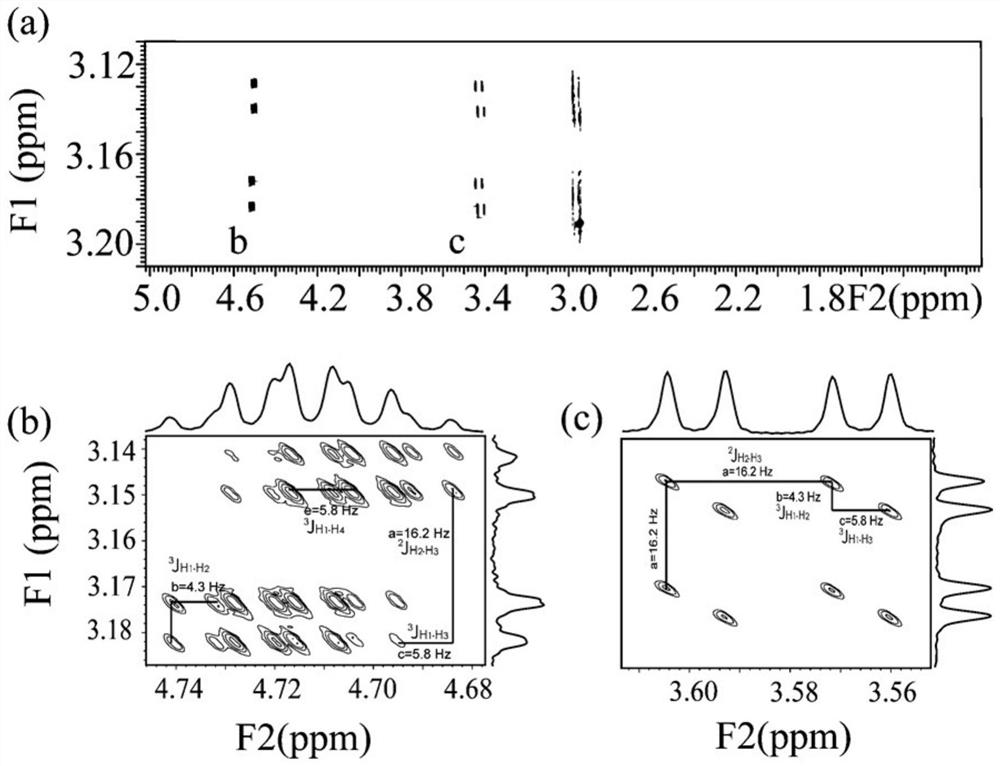
Figure 3
Abstract
Description
technical field
[0001] The invention relates to a nuclear magnetic resonance method, in particular to a nuclear magnetic resonance method with clean and homogeneous layer-selective homonuclear selective coherence spectrum. Background technique
[0002] NMR spectroscopy is a powerful analytical tool with a wide range of applications. J-coupling is an important parameter in NMR spectroscopy, which can provide valuable information about molecular structure and conformation. Among them, two-dimensional correlation spectroscopy (“COSY”) experiments that provide molecular J-coupling relationships play an indispensable role in molecular resolution, but their numerical resolution has been low due to the limited number of sampling points in the indirect dimension. Numerical resolution can be improved by a selective ("soft") COZY method, which facilitates the analysis of the coupling constant between a given proton and its coupled pair. However, since the final signal is composed of...
Examples
Embodiment Construction
[0022] Below in conjunction with accompanying drawing and embodiment, the present invention will be further described:
[0023] The invention provides a clean and homogeneous layer-selected homonuclear selective coherence spectrum method, which is characterized in that it comprises the following steps:
[0024] 1) collecting the NMR one-dimensional spectrum of the sample;
[0025] 2) Measure the pulse width of the 180-degree hard pulse of the sample;
[0026] 3) Measure the pulse width and time of the sample's excitation nuclear 90-degree selective pulse, observation nuclear 90-degree selective pulse, and inversion 90-degree selective pulse;
[0027] 4) Set dephasing gradient G 1 , G 2 and G 3 the intensity and duration of
[0028] 5) Set the central position of the excited hydrogen nucleus to be studied as the center frequency of the selective 90-degree selective pulse of the excited nucleus, and set the central position of the observed hydrogen nucleus to be studied as ...