
Eyeball-motion-positioning-based proton-heavy ion beam current gate control method for eyeball tumor radiotherapy
An eye movement, heavy ion beam technology, applied in the field of radiological medicine, can solve the problems of affecting placement, affecting the proton heavy ion beam current range, affecting the proton heavy ion radiotherapy accuracy, etc., so as to reduce the impact, improve the treatment efficiency, reduce the The effect of the probability of operating errors
Patent Information
- Authority / Receiving Office
- CN · China
- Patent Type
- Applications(China)
- Current Assignee / Owner
- Publication Date
- 2021-04-23
Smart Images
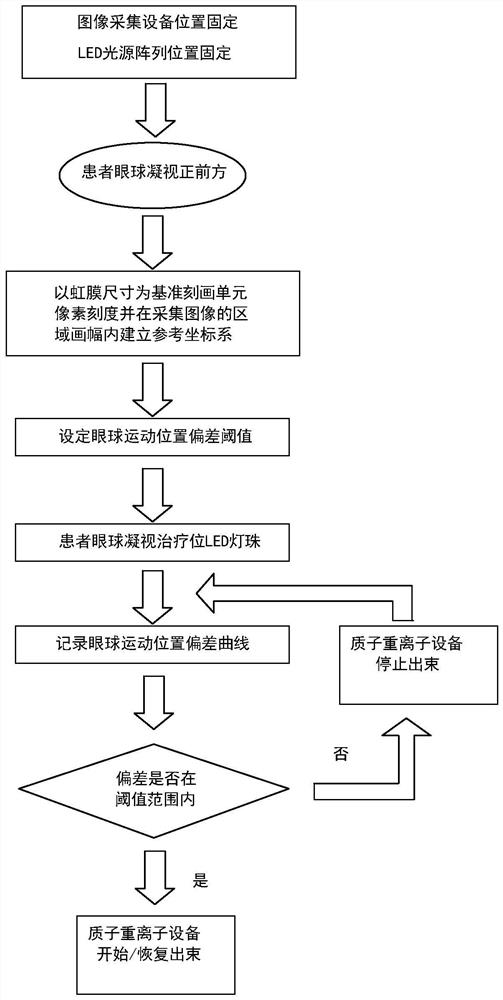
Figure 1 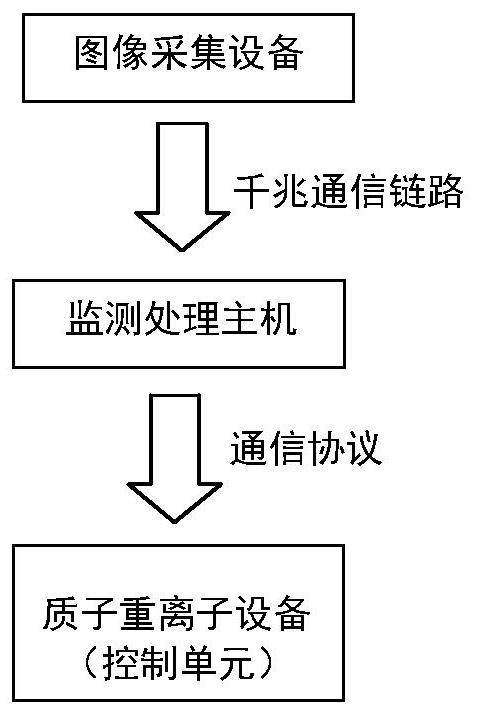
Figure 2 
Figure 3
Abstract
Description
technical field
[0001] The invention relates to the field of radiation medicine, in particular to a proton heavy ion beam gating method based on eyeball movement positioning in eyeball tumor radiotherapy. Background technique
[0002] Uveal malignant melanoma is a rare ocular malignancy, including choroidal melanoma, ciliary body melanoma, and iris melanoma. The incidence rate in Europe is 5-7 cases / year per million people, and the incidence rate in Asia is 0.4-0.6 cases / year per million people. The main treatment methods include enucleation, local excision, thermotherapy, photon radiotherapy, particle brachytherapy, and ion radiotherapy. Radiation therapy has become the main treatment for ocular malignant tumors. It has been reported in the literature that proton and heavy ion radiotherapy can provide better results in terms of tumor control, eye protection, vision and the incidence of adverse events.
[0003] During ion radiation therapy for malignant tumors of the eyeb...
Examples
Embodiment Construction
[0035] The present invention will be further described in detail below in conjunction with the accompanying drawings and examples. The following examples are explanations of the present invention and the present invention is not limited to the following examples.
[0036] see Figure 1-Figure 2 , the present embodiment relates to a proton heavy ion beam gating method based on eye movement positioning in eyeball tumor radiotherapy, comprising the following steps:
[0037] (1) Position the patient's head on the treatment bed with a jig. An LED point light source array is arranged above the eyeball. An image acquisition device is set on the top to continuously collect real-time images of eye movement, and the relative position between the image acquisition device and the patient's head remains fixed;
[0038] (2) Light up the LED lamp beads directly above the patient's eyeball for treatment, and the patient stares at the LED light directly above the eyeball, and the light source...