
Resource management device
a resource management and resource technology, applied in the field of resource management devices, can solve the problems of uneven time-based access requests and decrease in access efficiency, and achieve the effect of minimising bandwidth
Patent Information
- Authority / Receiving Office
- US · United States
- Patent Type
- Applications(United States)
- Current Assignee / Owner
- Publication Date
- 2006-07-13
Smart Images
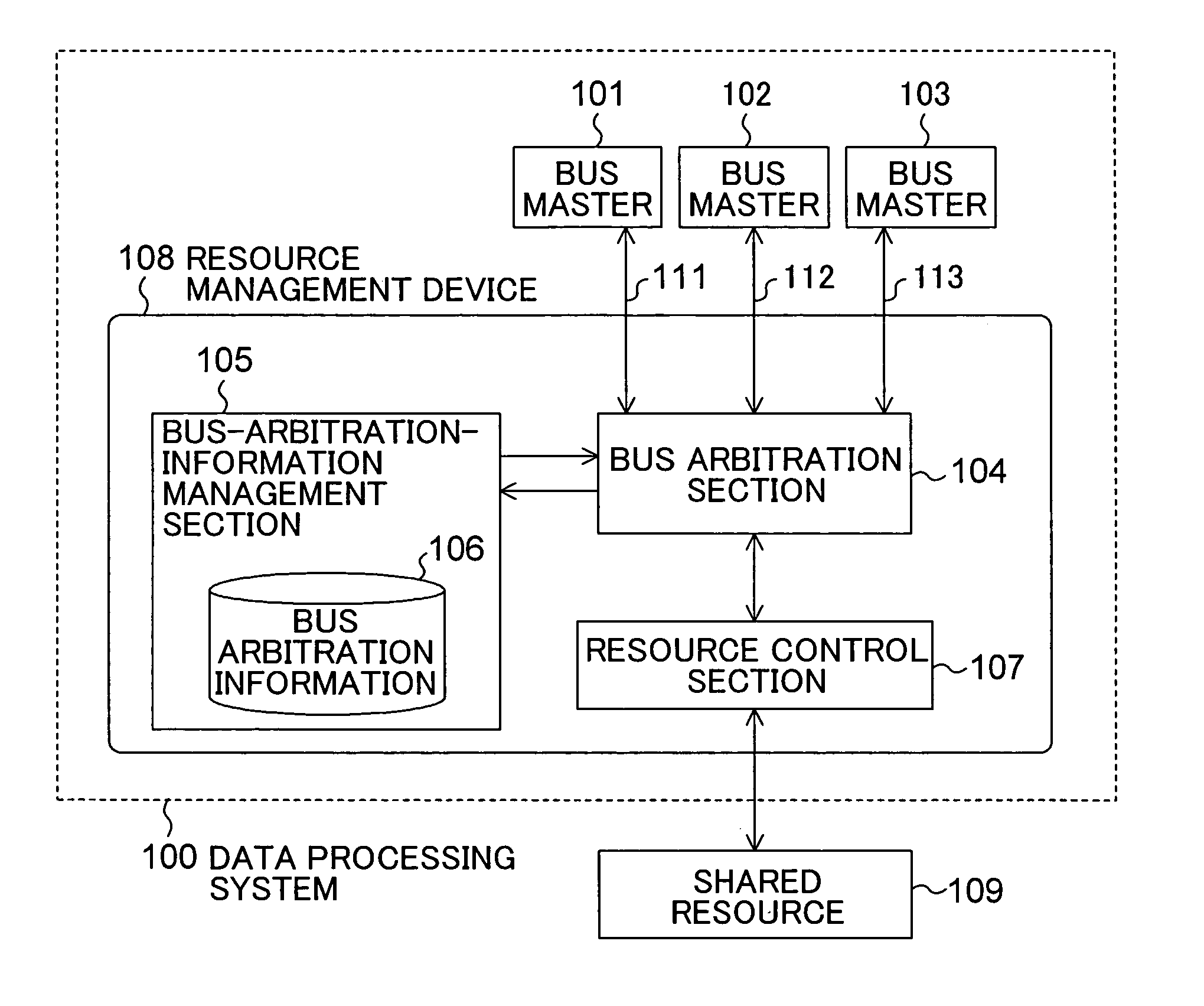
Figure 1 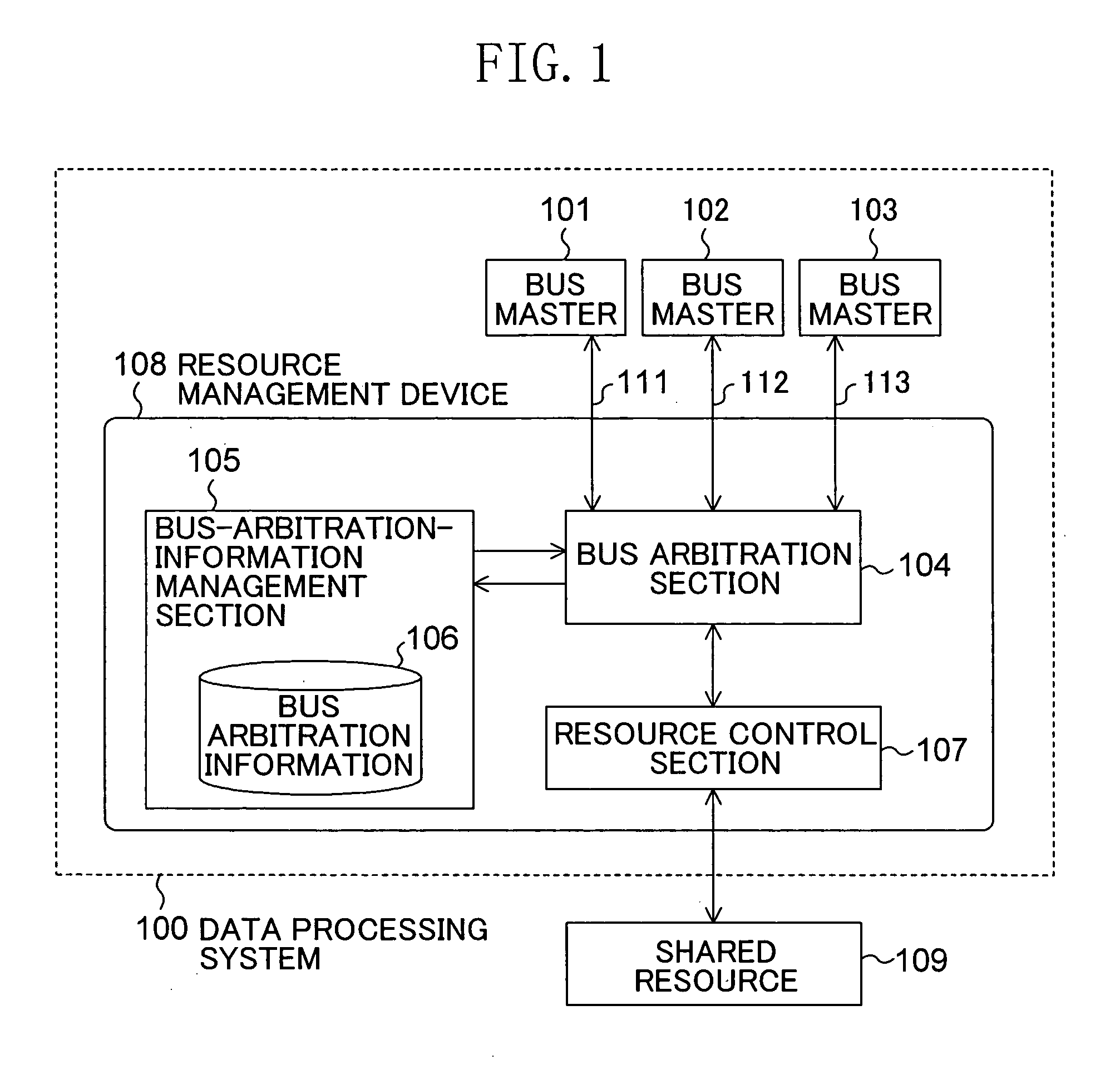
Figure 2 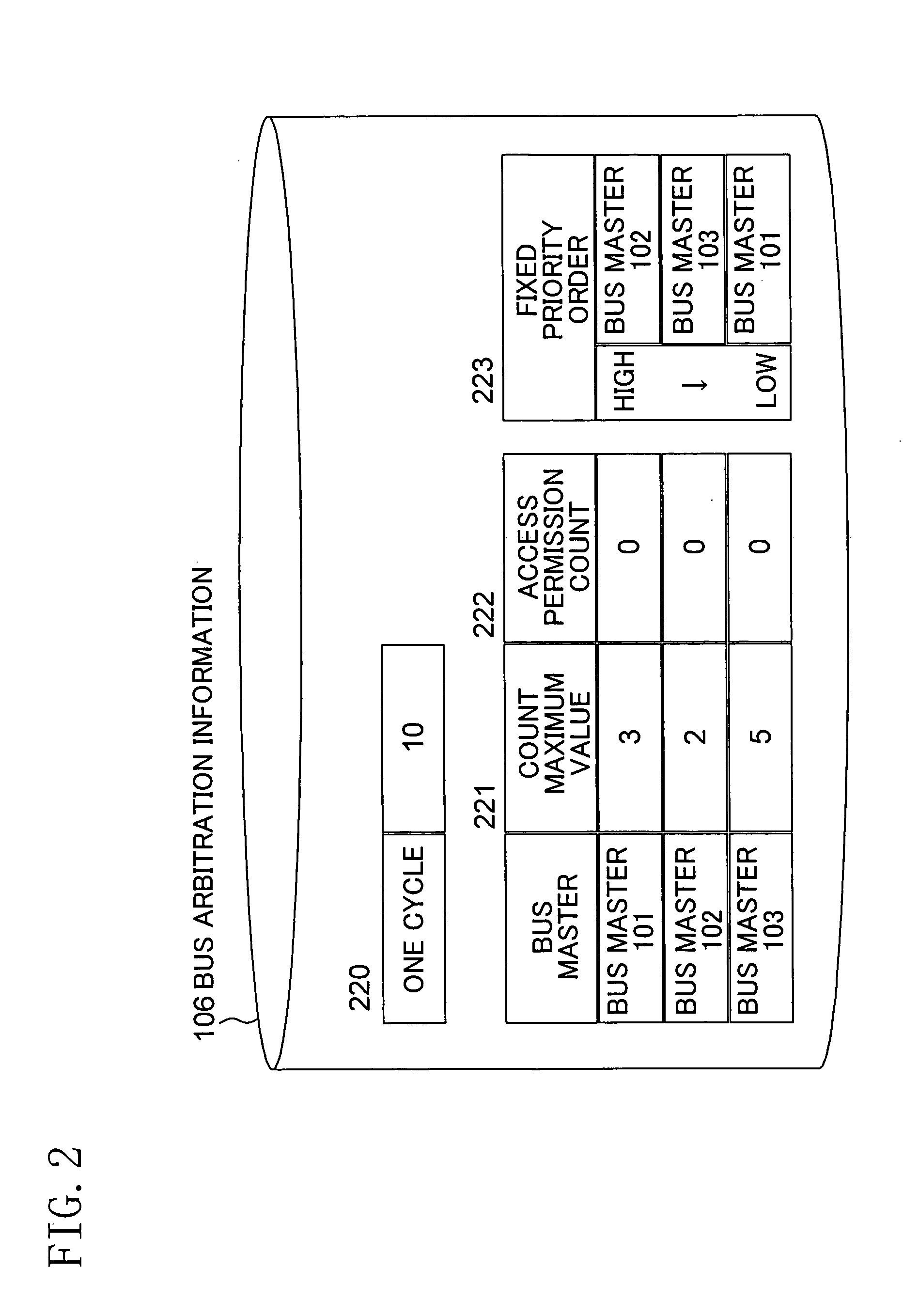
Figure 3
Abstract
Description
BACKGROUND OF THE INVENTION
[0001] The present invention relates to a resource management device for arbitrating access requests issued from respective masters to at least one shared resource in a system.
[0002] In system LSI, a plurality of masters, such as a microprocessor, a DSP (Digital Signal Processor) and a DMA (Direct Memory Access) controller, access a shared resource such as a memory or a peripheral I / O (input / output) controller. This configuration needs a resource management device for efficiently arbitrating access requests from the respective masters to the shared resource.
[0003] According to a conventional technique, based on priority order information on the maters held in the form of a table, the resource management device arbitrates access requests at regular timings. A plurality of patterns of priority order information are stored in this table so that the patterns are sequentially switched from one to another at regular timings of arbitration. Each of the masters...
Examples
embodiment 1
[0036]FIG. 2 shows a first example of the bus arbitration information 106 shown in FIG. 1. Reference numeral 220 denotes arbitration cycle information, reference numeral 221 denotes a count maximum value set for each of the bus masters, reference numeral 222 denotes access permission counts for the respective bus masters, and reference numeral 223 denotes priority order information. The arbitration cycle information 220 indicates the number of arbitrations performed by the bus arbitration section 104 in one cycle. In this case, “10” is set as the arbitration cycle information 220 and, therefore, 10 arbitration intervals correspond to one arbitration cycle. Each of the count maximum values 221 indicates the minimum number of times each of the first through third bus masters 101 through 103 is allowed to gain access permission within one arbitration cycle and is previously set such that the sum of the count maximum values 221 is equal to a set value in the arbitration cycle informatio...
embodiment 2
[0052]FIG. 7 shows a second example of the bus arbitration information 106 in FIG. 1. Priority order information 223 shown in FIG. 7 indicates that the priority of bus masters decreases toward the bottom of the list. It is also indicated that management with round robin scheduling is performed in such a manner that the bus-arbitration-information management section 105 rotates the priority order information 223 at every arbitration timing, and the bus master having the highest priority is sequentially switched to the first bus master 101, the second bus master 102 and then the third bus master 103 at respective arbitration timings.
[0053]FIG. 8 shows an example of arbitration based on bus arbitration information 106 in FIG. 7. The bottom part of FIG. 8 shows a change in the priority order information 223.
[0054] In the example of FIG. 8, at arbitration timing 1, all the first through third bus masters 101 through 103 issue access requests. At this arbitration timing 1, access permis...
embodiment 3
[0057]FIG. 9 shows a third example of the bus arbitration information 106 in FIG. 1. Priority order information 223 shown in FIG. 9 indicates that the larger a remaining priority permission count determined from the count maximum value 221 and the access permission count 222 is, the higher the priority is. If the remaining priority permission counts are the same, priorities are assigned to the first bus master 101, the second bus master 102 and the third bus master 103 in this order (i.e., a fixed priority order).
[0058]FIG. 10 shows a first example of arbitration based on the bus arbitration information 106 in FIG. 9. In the example of FIG. 10, at arbitration timing 1, all the first through third bus masters 101 through 103 issue access requests. At this arbitration timing 1, the access permission counts 222 associated with all the bus masters are zero and less than the respective count maximum values 221, so that arbitration is performed on all the bus masters based on the priorit...