
Geopolymer composites and structures formed therefrom
Patent Information
- Authority / Receiving Office
- US · United States
- Current Assignee / Owner
- Publication Date
- 2006-11-09
- Estimated Expiration
- Not applicable · inactive patent
Smart Images
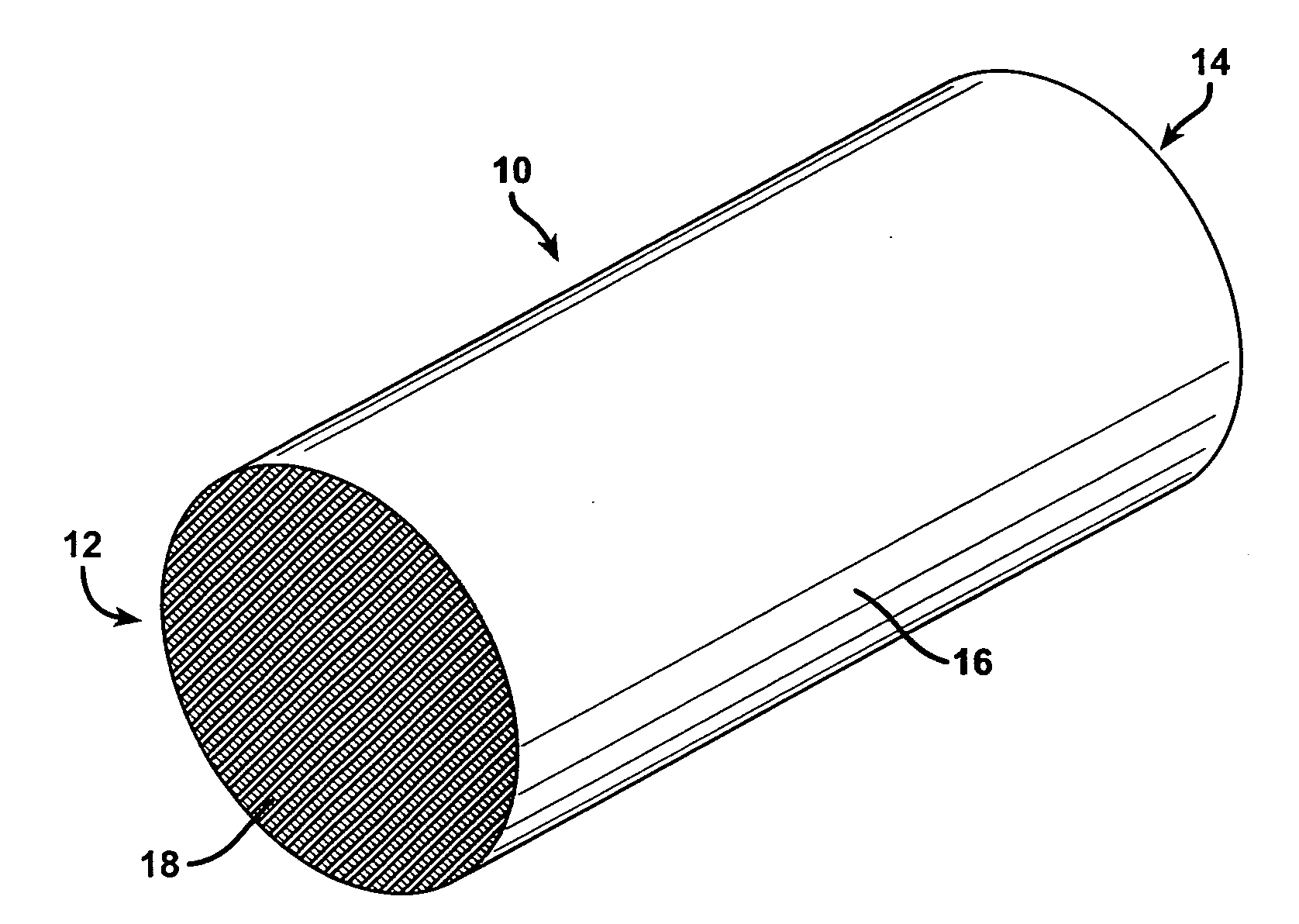
Figure 1 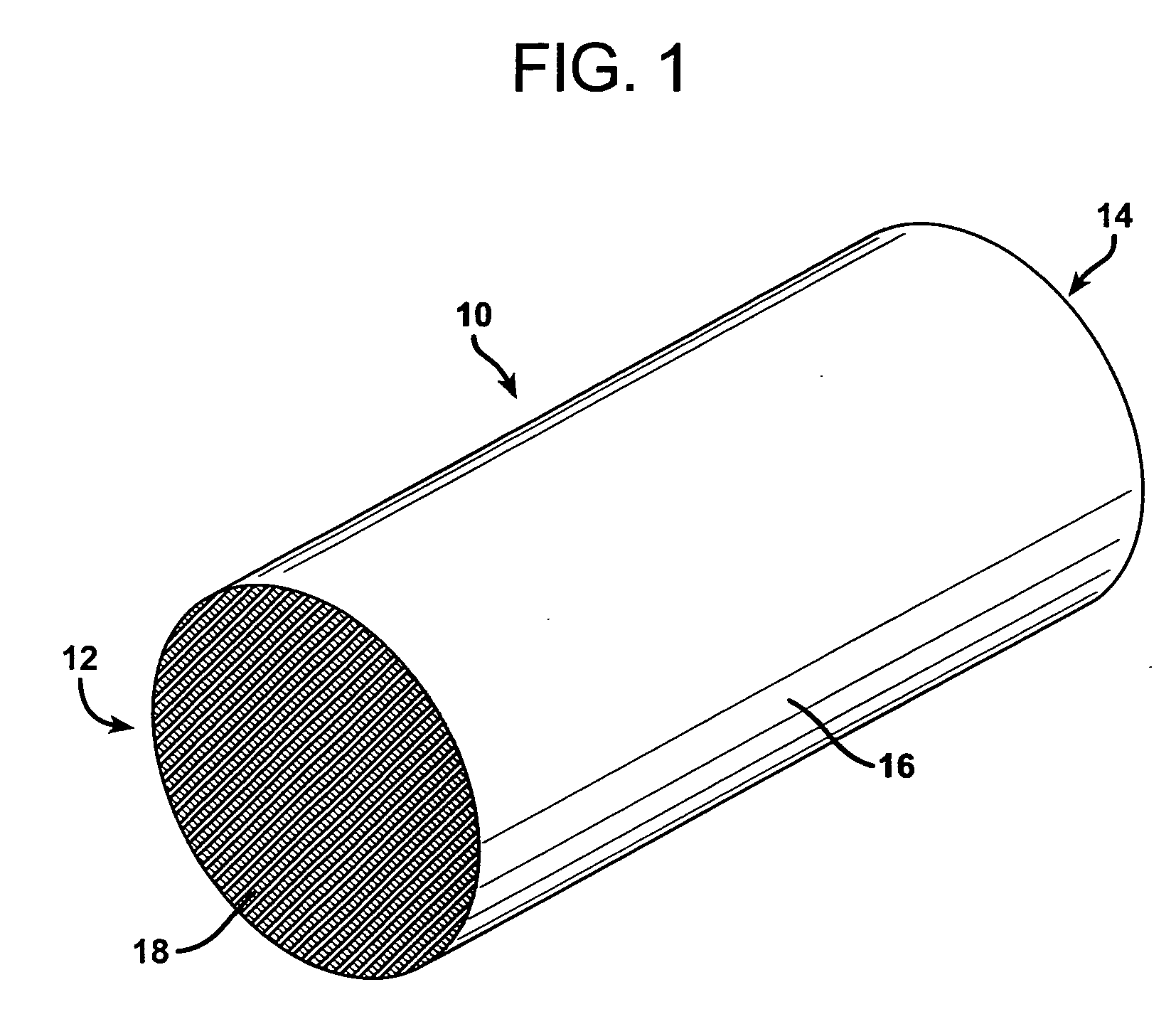
Figure 2
Abstract
Description
FIELD OF THE INVENTION
[0001] The present invention relates to low coefficient of thermal expansion geopolymer composite materials and articles formed therefrom. The materials of the present invention are useful in the manufacture of high temperature bodies such as diesel particulate filters, catalytic converters, NOx adsorbers, catalyst substrates, honeycomb monoliths and flow filter bodies for high temperature fluids and in other high temperature applications. Specifically, a composite material of ground low coefficient of thermal expansion (CTE) material particulate such as cordierite, silica, other low CTE materials or a combination thereof with a geopolymer is disclosed. The geopolymer, typically formed by the reaction of activated clay such as metakaolin with alkali silicate aqueous solutions, may be modified by the addition of boric oxide to provide a low CTE material having high green and fired strength and reduced cracking upon firing. The material of the present invention ...
Examples
example 1
[0026] Composition 4, 90 wt. % cordierite 10 wt. % potassium aluminosilicate geopolymer bonded ceramic, modified by an addition of 5 wt. % B2O3 (of the total batch) was prepared as follows: 2.07 g Glomax LL 186.4 g cordierite and 1 g CMC (AqualonR Cellulose Gum) binder were mixed for 3 minutes; 8.27 g Ludox and 10.36 g boric oxide (B2O3) were added to 100 g water and heated until the boric oxide dissolves and added to the dry mix and was added; 10.34 g of Kasil-1 was added to the mixed batch and completely mixed to formed a solution. The solution was then added to the dry batch and fully mixed to form a geopolymer bonded wet mix. The batch yielded a dry composition of approximately 94.7% cordierite and 5.3% potassium boroaluminosilicate glass on drying and firing to 800° C. (assuming no dissolution of cordierite). The CTE of Example 1 was about 17.5×10⁻⁷ / ° C. (25° to 800° C.).
example 2
[0027] Composition 10, 90 wt. % vitreous silica and 10 wt. % potassium aluminosilicate geopolymer-bonded ceramic, modified by a B2O3 addition of 3 excess wt. % was prepared as follows: 559.2 g crushed vitreous silica, 31 g of Kasil-1, 6.28 g Glomax LL, 24.8 g Ludox and 18.66 g boric oxide were prepared, mixed and fired as described in Example 1. The batch yields a dry composition of approximately 92.8 wt. % silica and 7.2 wt. % potassium boroaluminosilicate glass on drying and firing to 800° C., assuming no dissolution of the silica particulate on firing. The CTE of Example 2 was about 11×10−7 / ° C. (25° to 800° C.).
example 3
[0028] Composition 9, 80 wt. % vitreous silica, 10 wt. % cordierite and 10 wt. % potassium aluminosilicate geopolymer-bonded ceramic, modified by a B2O3 addition of 3 excess wt. % was prepared as follows: 31 g of Kasil-1, 6.28 g Glomax LL, 24.8 g Ludox, 18.66 g boric oxide, 503.24 g fused silica, and 55.92 g ground cordierite are prepared, mixed and fired as described in Example 1. The batch yields a dry composition of approximately 83.6 wt. % silica, 9.2 wt. % cordierite (assuming no dissolution of cordierite) and 7.2 wt. % potassium boroaluminosilicate geopolymer glass on drying and firing to 800° C. assuming no dissolution of silica or cordierite particulate. The CTE of Example 3 was about 10.0×10⁻⁷ / ° C. (25° to 800° C.).