
Elastin protective polyphenolics and methods of using the same
Patent Information
- Authority / Receiving Office
- US · United States
- Current Assignee / Owner
- Publication Date
- 2006-11-23
Smart Images
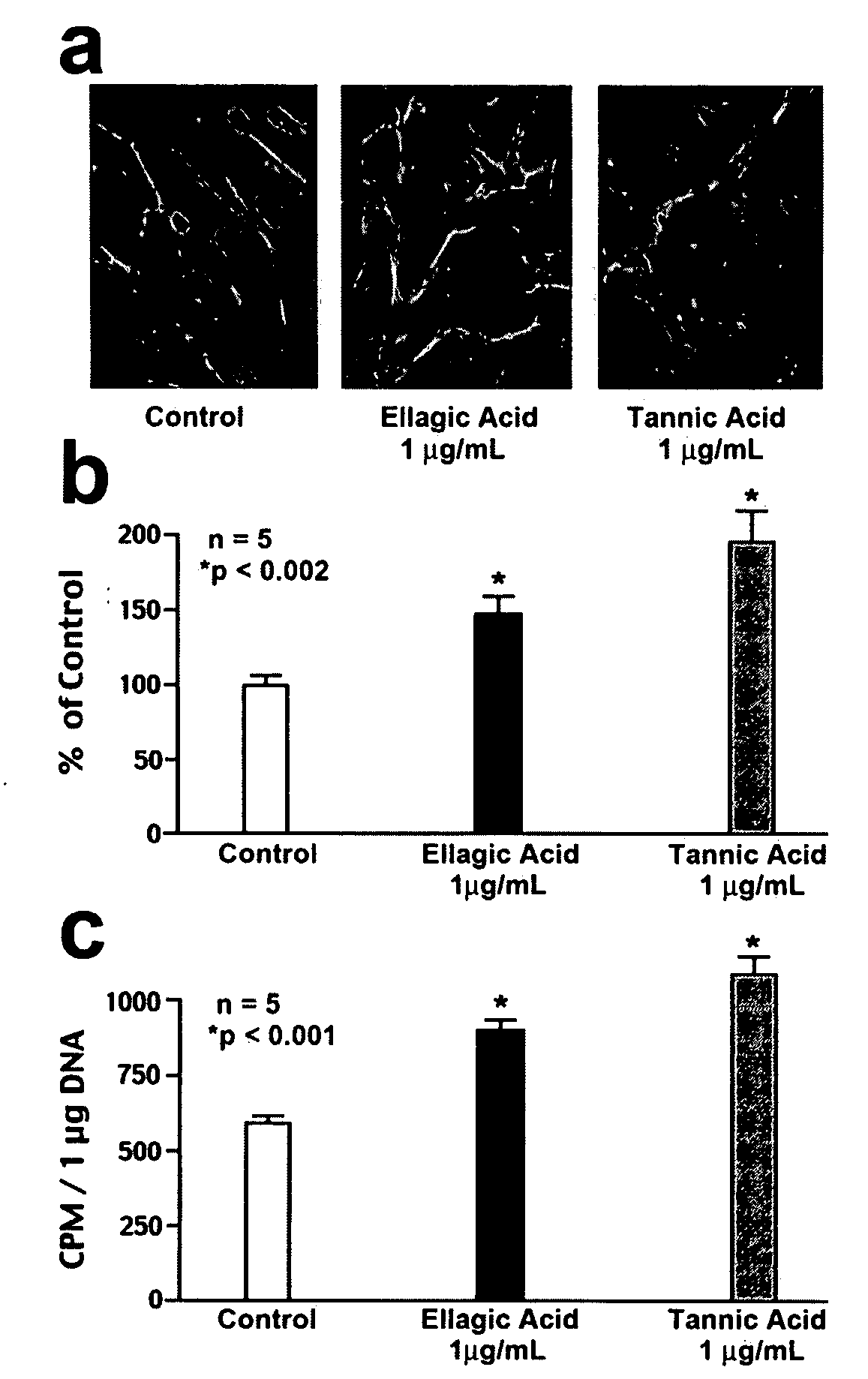
Figure 1 
Figure 2 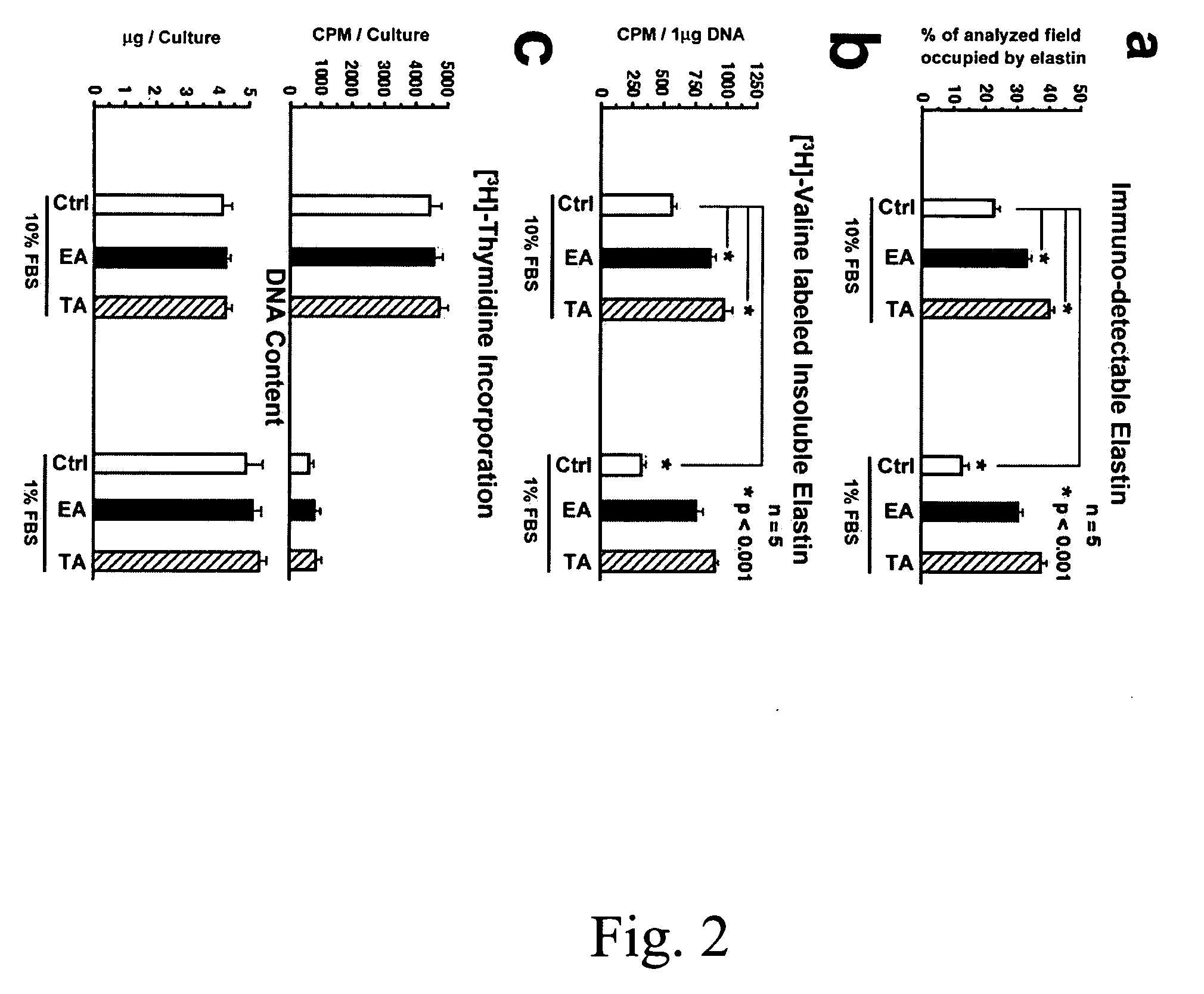
Figure 3
Abstract
Description
CROSS REFERENCE TO RELATED APPLICATIONS
[0001] This application claims priority to U.S. Provisional Patent Application No. 60 / 665,966 titled “Elastin Protective Polyphenolics” filed Mar. 29, 2005 and U.S. Provisional Patent Application No. 60 / 758,821 titled “Ellagic and Tannic Acids Protect Newly Synthesized Elastic Fibers from Premature Enzymatic Degradation in Dermal Fibroblast Cultures” filed Jan. 13, 2006, the disclosures of which are incorporated herein by reference in their entirety. This application also claims priority to U.S. patent application Ser. No. 11 / 062,377 filed Feb. 22, 2005 entitled “Compositions for Elastogenesis and Connective Tissue Treatment”, the disclosure of which is incorporated herein by reference in its entirety. This application also claims priority to U.S. Provisional Patent Application No. 60 / 671,557 filed Apr. 15, 2005 entitled “Plant-Derived Elastin Binding Protein Ligands and Methods of Using the Same”, U.S. Provisional Patent Application No. 60 / 68...
Examples
example 1
[0080] Materials. All chemical-grade reagents were obtained from Sigma (St. Louis, Mo.). αMEM medium, fetal bovine serum (FBS), 0.2% trypsine-0.02% EDTA and other cell culture products were obtained from GIBCO Life Technologies (Burlington, Canada). Polyclonal antibody to tropoelastin and BA4 monoclonal antibody to VGVAPG were purchased from Elastin Products Company, Inc. (Owensville, Mo.). Monospecific polyclonal anti-AKAAAKAAAKA antibody was a gift of Dr. Barry Starcher from the University of Texas. Secondary antibody fluorescein-conjugated goat anti-rabbit (GAR-FITC) was purchased from Sigma (St. Louis, Mo.). DNeasy Tissue system for DNA assay and RNeasy Mini Kit for isolation of total RNA were purchased from Qiagen (Mississauga, Canada). Expression probe for elastin was purchased from Applied Biosystems (Foster City, Calif.). The radiolabeled reagents, [3H]-valine, and [3H]-thymidine were purchased from Amersham Canada Ltd. (Oakville, Canada).
[0081] Cell Cultures. Biological ef...
example 2
[0104] In order to directly prove that tannic acid also binds to collagen type 1, triplicate (1 mg) aliquots of pure collagen type I were incubated with 20 μg / ml of TA for 2 h at 37° C. The initial concentration of tannic acid was confirmed by direct spectrophotometric reading at 280 nm. This method adopted from Gori et al. demonstrated a dose-dependent linear increase in absorbance. At the end of incubation period the collagen type I slurries were separated by centrifugation and the concentration of tannic acid in supernatants were spectrophotometrically determined again at 280 nm. In each experimental group means±SD were calculated and obtained values were statistically compared with beginning concentrations of both polyphenols.
[0105] Results. As shown in FIG. 5, the binding studies demonstrate that 1 mg of collagen type I (from rat tail) sequestered 75.5±0.001% (P<0.0001) of the tannic acid (originally 20 μg / mL) from solution, suggesting that tannic acid may also bind to collage...